
Belt & Road Watch is The Investigative Journal’s monthly tracker of China’s overseas infrastructure, lending and influence footprint. Figures and allegations below are attributed to public records, academic datasets and government filings; pending cases are noted as such.
China’s Belt and Road engagement is not contracting so much as relocating. Chinese firms booked record construction and investment volumes across Belt and Road partner countries in 2025, according to the Green Finance & Development Center (GFDC) at Fudan University, even as Beijing’s traditional sovereign lending kept shrinking. The center’s data shows Kazakhstan was the single largest recipient of Chinese Belt and Road money in 2025 at roughly $25.8 billion, ahead of Egypt ($10.2 billion) and Thailand ($8.5 billion). July’s developments — a multibillion-dollar deal package in Central Asia, a World Bank corruption sanction against a Chinese state enterprise, and fresh graft filings from Kathmandu to Penang — track that pivot toward corridors, ports and telecoms, and toward the accountability questions that follow the money.
1. Kazakhstan’s $15 billion Shanghai haul cements the Middle Corridor
The month’s marquee development came in Shanghai, where Kazakh President Kassym-Jomart Tokayev’s July 16 visit produced more than 70 commercial agreements. Kazakh officials and the Times of Central Asia valued the package at over $15 billion; Euronews reported a figure above $13 billion. The state holding company Samruk-Kazyna alone disclosed 19 agreements worth $4.29 billion spanning energy, transport, telecommunications and industry.
Much of it reinforces the Trans-Caspian “Middle Corridor” that routes freight between China and Europe while bypassing Russia. China’s Guoyou Materials Group will build a multifunctional terminal at the Caspian port of Kuryk with an annual capacity of 15 million tonnes; records indicate a first-phase investment near $300 million and a total potentially reaching $1.1 billion, with construction due to start in 2026 and operations in 2028, per Caspian Post. China Communications Construction Company is tied to the planned Bakhty–Ayagoz railway, described as a prospective third cross-border rail crossing with 25-million-tonne capacity, and a China-Kazakhstan container hub at the Port of Aktau, operated with China’s Lianyungang Port Holding Group, began Phase I operations the same week. On the digital side, Huawei signed a telecommunications package, Kazakhtelecom and Hengtong Group agreed to develop a data-center hub, and Transtelecom and GuoDong Group will build telecom towers.
The context matters: roughly 85 percent of China-Europe rail freight already transits Kazakhstan, and national operator Kazakhstan Temir Zholy has said it is spending some $10 billion expanding rail, ports and cargo capacity. The deals deepen Chinese equity and technology exposure across a corridor that Western planners have promoted as a diversification route away from both Russia and maritime chokepoints.
2. China–Kyrgyzstan–Uzbekistan railway inches forward — on a 35-year loan
The long-delayed China–Kyrgyzstan–Uzbekistan (CKU) railway, a $4.7 billion line linking Kashgar to Andijan via Kyrgyzstan, remains China’s most consequential Central Asian rail bet. A July analysis in The Diplomat reports officials aim to complete just 5 percent of construction by the end of 2026, with a full-completion target of 2030. Financing terms, detailed by the Jamestown Foundation and regional outlets, show China lending about $2.35 billion — roughly half the cost — as a 35-year loan to a joint project company in which China holds 51 percent and Kyrgyzstan and Uzbekistan hold 24.5 percent each. With 50 bridges and 29 tunnels accounting for some 40 percent of the route, cost and debt-servicing risk for the two smaller partners bear watching.
3. World Bank debars Chinese state enterprise for fraud
In a rare formal finding against a Chinese state-owned enterprise, the World Bank Group announced on May 27 an 18-month debarment of China National Technical Import & Export Corporation (CNTIC) over fraudulent practices affecting three Bank-financed power projects — in Pakistan, Bangladesh and the Maldives. The Bank said CNTIC failed to disclose contract commitments and litigation, failed to disclose intended commissions to third parties, and misrepresented key personnel in its Pakistan bid. The sanction came via a settlement in which the company acknowledged responsibility and agreed to build an integrity-compliance program; it qualifies for cross-debarment by other multilateral development banks. Unlike the allegations below, this is a documented finding, and it lands amid a broader pattern: CSIS has long catalogued Chinese contractors debarred by multilateral lenders for fraud and collusion.
4. Nepal’s Pokhara airport case widens to a Chinese contractor
Nepal’s Commission for the Investigation of Abuse of Authority (CIAA) filed its fourth corruption chargesheet on May 7 over the China-built Pokhara Regional International Airport, naming 13 people including former Finance Minister Gyanendra Bahadur Karki, according to reporting citing The Himalayan Times and The Kathmandu Post. Prosecutors allege a Rs 3.62 billion ($26 million) scheme in which a separate implementation agreement relieved contractor China CAMC Engineering of tax and customs liabilities without lowering the contract price — a “double benefit,” in the CIAA’s words. Two CAMC executives are named as alleged abettors. These are allegations pending before Nepal’s Special Court, not findings; China CAMC has previously rejected a parliamentary report on the project as “riddled with factual inaccuracies,” and, per Nepali press accounts, China’s outgoing ambassador raised the prosecutions directly with the interim prime minister.
The financing underscores why the case resonates. The airport was built with a concessional Export-Import Bank of China loan against a $215.96 million contract, roughly a quarter interest-free and the balance at 2 percent over 20 years. As of 2026 the facility runs at most one weekly international flight, to Lhasa; Nepal’s August 2024 request to convert the loan into a grant was declined, and repayments have now begun — a textbook illustration of the revenue-versus-debt-service gap that recurs across marginal Belt and Road projects.
5. Graft trials abroad — and a crackdown at home
In Malaysia, the long-running trial over the RM6.3 billion Penang undersea tunnel project reached its final prosecution witness in June, with a Malaysian Anti-Corruption Commission officer testifying that Consortium Zenith BUCG — a vehicle tied to China’s state-owned Beijing Urban Construction Group — gained a tender advantage from closed briefings with the state government, according to court coverage republished from The Edge. Former chief minister Lim Guan Eng, who denies wrongdoing, is on trial; the proceedings remain unresolved.
Beijing, meanwhile, is policing its own. The Maritime Executive reports the Central Commission for Discipline and Inspection has embedded monitors with state enterprises abroad and investigated roughly two dozen officials of Exim Bank and China Development Bank — the two largest Belt and Road lenders — over two years. The International Bar Association notes China launched retrospective bid-rigging enforcement campaigns in 2025 reaching back as far as 13 years. Analysts caution that this housecleaning appears aimed mainly at embezzlement of Chinese funds rather than the bribery of foreign officials — a distinction worth keeping in view.
6. Africa: lending down, engagement up, debt still heavy
The Boston University Global Development Policy Center reported in January that Chinese sovereign lending to Africa fell 46 percent in 2024 to $2.1 billion, with five countries absorbing all of it and Angola capturing nearly 70 percent. Yet GFDC data shows Africa topped 2025 Belt and Road engagement at $61.2 billion — a 283 percent jump — driven by construction contracts led by Nigeria ($24.6 billion, including a $20 billion gas-industrial park) and the Republic of Congo. The shift is the story: away from sovereign loans and toward foreign direct investment, engineering-procurement-construction contracts and trade finance.
Legacy debt, however, does not relocate. Zambia’s $6.3 billion restructuring — finalized in 2023 after years of delay — imposed an estimated 15 percent haircut on bilateral creditors and up to 34 percent on Eurobond holders, per Rhodium Group and the Center for Global Development, leaving sovereign debt near $27 billion. The U.S. State Department’s May 15 Report to Congress on outstanding Chinese debt flags Pakistan as carrying the highest absolute debt to China of any country.
Debt-to-GDP watch
Tracking the most exposed Belt and Road borrowers: Laos‘s public and publicly guaranteed debt reached roughly 94 percent of GDP at end-2024, with China holding close to half of its sovereign external debt and providing about $2.5 billion in payment deferrals plus a $900 million swap line, per the Lowy Institute and the IMF’s 2025 Article IV review. Pakistan owes China nearly $29 billion as its largest bilateral creditor, though China’s share of Pakistan’s external debt eased to about 22 percent from 25 percent, World Bank data show. Zambia‘s debt-to-GDP peaked above 110 percent during its default years. Sri Lanka, three years past sovereign default, still carried external debt near $62 billion as of 2023.
7. Confucius Institutes: closed, renamed, re-examined
U.S. scrutiny of China’s academic footprint intensified in July, when the Department of Education issued Notices of Investigation to four universities over Confucius Institutes and their foreign-gift disclosures under Section 117 of the Higher Education Act, which requires reporting of foreign funding above $250,000, according to the National Law Review and The Washington Times. Prior federal reviews found that a large share of host schools underreported such funds. Although nearly all of the more than 100 U.S. Confucius Institutes have closed — a trajectory documented by the Government Accountability Office — the Foundation for Defense of Democracies argues some programming persisted under renamed third-party nonprofits. That claim is analytical rather than adjudicated, but it points to a documented pattern of rebranding worth independent verification.
8. The bigger picture: $2.2 trillion, and less visible than ever
Underlying every line item is a portfolio whose scale keeps growing while its transparency shrinks. AidData’s “Chasing China” dataset tracks $2.2 trillion across roughly 30,000 projects in 217 countries from 2000 to 2023 — and finds that infrastructure lending in the developing world is only about a fifth of it, as Beijing’s exposure to high- and upper-middle-income economies has climbed from 12 percent to 76 percent. China lent about $140 billion in 2023 and remains the world’s largest official creditor. Crucially, AidData documents a 62 percent decline over time in publicly available information from official Chinese sources about this lending — the opacity that CSIS’s Reconnecting Asia project and others have long flagged as a feature, not a bug.
What warrants a deeper TIJ look
Several threads reward sustained investigation. First, the transparency gap itself: with disclosure from Chinese lenders down sharply, the terms — collateral, interest rates, confidentiality clauses — of this month’s Central Asian port and rail deals are largely unpublished, and mapping who actually holds equity and security over Kuryk, Aktau and the CKU joint venture would be a public service. Second, the telecom and data layer of the Kazakhstan package — Huawei systems, GuoDong towers and a Hengtong-backed data-center hub — raises standards, dependency and surveillance questions that should be examined on documented specifics, not supposition. Third, the corruption cases in Nepal and Malaysia are live and could set precedents for holding Chinese state contractors accountable in host-country courts; their outcomes, and any right-of-reply from the companies, deserve follow-through. Finally, the Confucius Institute successor entities merit a name-by-name accounting to establish what, if anything, changed beyond the letterhead.
The through-line is accountability under opacity. Where Belt and Road records are public — World Bank sanctions, court filings, academic databases — the facts can be stated plainly. Where they are not, the responsible course is to say so, and to keep asking.
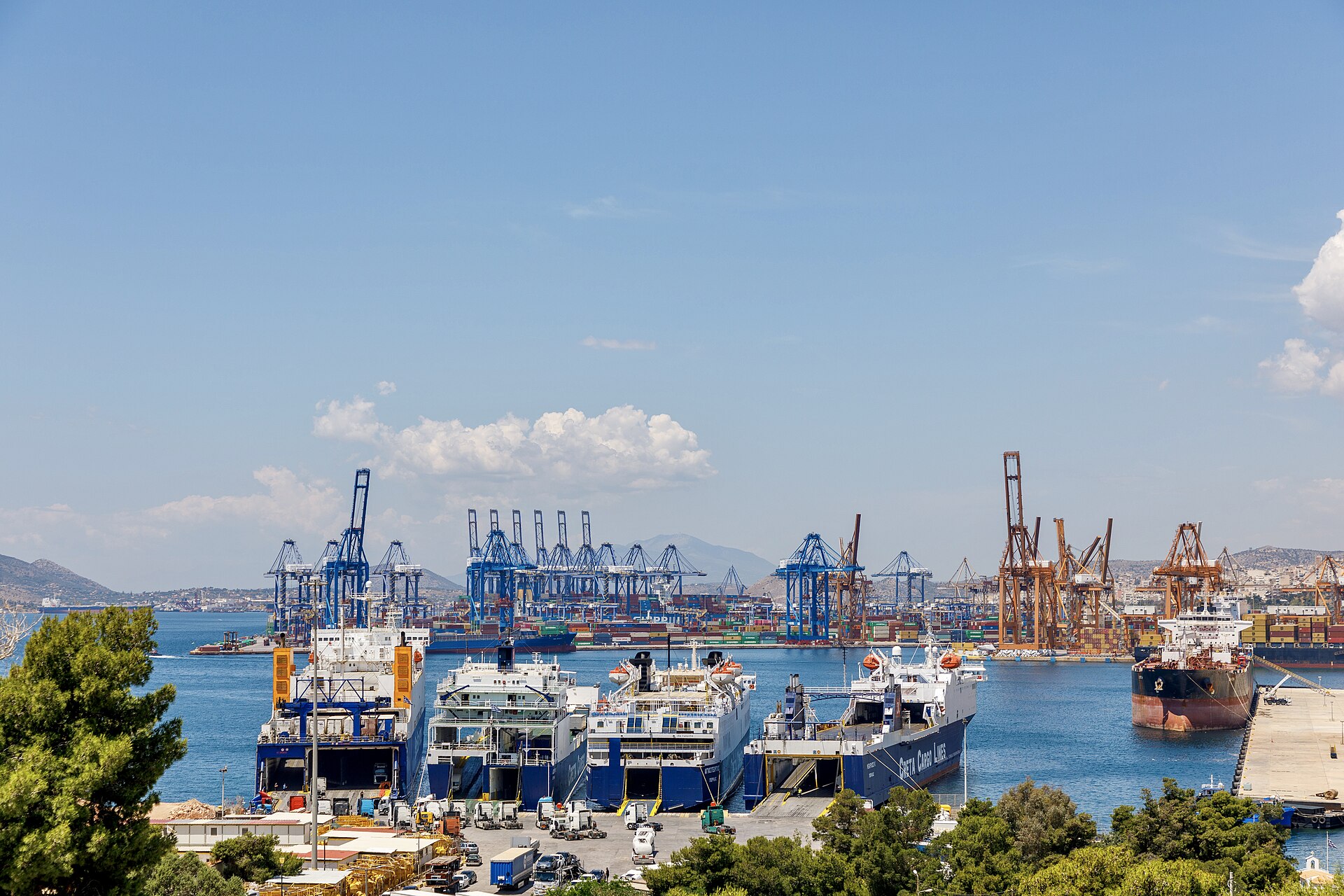
Featured image: Container port of Piraeus, Greece — a flagship COSCO-operated Belt and Road asset. Photo by Aaaatu via Wikimedia Commons, licensed under CC BY-SA 4.0. Sources are linked inline; state-media outlets were excluded as independent sources per TIJ policy.