

SEC Watch is The Investigative Journal’s daily review of notable filings and actions drawn from the U.S. Securities and Exchange Commission’s public record. All matters described as charged or alleged remain unproven; defendants are presumed innocent unless and until a court or the Commission finds otherwise.
The Securities and Exchange Commission closed the third week of June 2026 waging what its own public record shows to be a two-front effort: a steady cadence of insider-trading and offering-fraud cases from its Division of Enforcement, set against a deregulatory rulemaking agenda under Chairman Paul S. Atkins that would meaningfully reduce what public companies are required to disclose. The Investigative Journal reviewed the Commission’s litigation releases, press releases, and enforcement dockets posted through June 23, 2026. Below are the eight developments TIJ judges most consequential, each linked to the underlying SEC document.
SEC Enforcement
1. New Jersey trader charged over a partner’s work laptop
On June 23, the Commission charged Justin Jennings and Vortex Strategies LLC, a Wyoming entity Jennings allegedly owned and controlled, with insider trading (Litigation Release No. 26570). According to the SEC’s complaint, filed in the U.S. District Court for the District of New Jersey, Jennings between February 2022 and October 2024 misappropriated material nonpublic information from his then-romantic partner, an account executive at a strategic communications and investor-relations firm, by accessing her work-issued laptop without authorization.
The complaint alleges Jennings traded ahead of mergers, earnings announcements, and other corporate events involving eight public-company clients of the firm, generating roughly $2.7 million in illicit profits through his personal brokerage account and an account in Vortex’s name. The SEC charged both with violating Section 10(b) of the Securities Exchange Act and Rule 10b-5, and is seeking permanent injunctions, disgorgement with prejudgment interest, and civil penalties. The U.S. Attorney’s Office for the District of New Jersey announced parallel criminal charges.
The case, handled by the Enforcement Division’s Market Abuse Unit and the Fort Worth Regional Office, fits a pattern TIJ has tracked in 2026: relationship-based misappropriation, in which confidential deal information flows not through a corporate insider but through a person’s access to a household member or partner. The allegations are pending and untested in court. The full complaint is public.
2. Former healthcare analyst accused of trading on clinical-trial data
On June 5, the SEC charged JianQing Li, a former analyst at a New York-based investment adviser focused on the healthcare sector, with insider trading in at least twelve healthcare companies from February 2024 through October 2025 (Litigation Release No. 26561). According to the complaint filed in the Southern District of New York, Li allegedly misappropriated confidential information his employer obtained after being “wall-crossed” on client deals—including the terms of upcoming private placements and the results of clinical drug trials—and traded before that information became public.
Records filed by the Commission indicate Li allegedly realized more than $320,000 in illicit profits. Beyond standard antifraud charges, the SEC is seeking a conduct-based injunction that would bar Li from acting as or associating with an investment adviser. The U.S. Attorney’s Office for the Southern District of New York brought a parallel criminal action. The matter remains pending; the complaint details the alleged trades.
3. Alleged stock scheme targeting the parent of Napster
On June 11, the Commission filed charges against North Carolina resident Charles J. Cole, his attorney, Utah resident Torben M. Welch, and three Cole-controlled entities—Beacon Heart LLC, Heart of Humanity LLC, and Avranoc LLC—in connection with an alleged fraudulent stock scheme (Litigation Release No. 26563). According to the SEC’s complaint, the defendants defrauded Infinite Reality, Inc., now known as Napster Corp., out of 239 million shares of its stock.
The complaint alleges Cole falsely promised to invest $3.36 billion in the company and, with Welch, falsely represented that Cole or Avranoc controlled at least $55 billion in assets. On the strength of those representations, the filing states, the company issued more than 239 million shares in late 2024 and early 2025 but never received any money. The SEC further alleges Cole then pledged nearly 45 million of those shares to obtain a $1 million loan, with Welch supplying forged documents to verify Cole’s purported assets. The action, filed in the Southern District of New York alongside a parallel criminal case, names “The indigenous Nations’ Bank” and two individuals as relief defendants. The SEC says its investigation is ongoing, and the allegations have not been adjudicated.
4. Hotel-fund manager settles retail-investor misstatement claims
On June 4, the SEC filed a settled action against Phoenix American Hospitality, LLC, a Texas-based manager of real-estate investment vehicles, and its president, William Lee “Perch” Nelson of Dallas (Litigation Release No. 26560). The complaint alleges the firm raised approximately $86 million from more than 2,000 retail investors across two hotel-focused funds between March 2022 and July 2024 while making untrue statements about the funds’ holdings and profitability.
According to the Commission, one fund was represented as owning as many as eleven hotels when it in fact held only a preferred-equity interest in a single hotel until January 2024, and both funds were said to pay regular distributions of up to 12 percent annually that filings indicate were primarily funded by returns of investor capital rather than profits. Without admitting or denying the allegations, both respondents consented to permanent injunctions; the proposed judgments, subject to court approval, would impose a $591,127 penalty on the firm and a $118,225 penalty plus a five-year officer-and-director bar on Nelson. Because the matter is resolved by consent, it reflects agreed terms rather than findings after trial.
These June cases follow a busier-than-usual spring. On May 6, the Commission charged 21 individuals in an alleged decade-long insider-trading ring built on information misappropriated from multiple global law firms, and in April it published its enforcement results for fiscal year 2025. Taken together, the docket suggests that, whatever the direction of rulemaking, market-abuse and retail-fraud cases remain an active priority for the Enforcement Division.
Corporate Disclosure Watch
5. Proposed rescission of the climate-disclosure rules
On May 29, the Commission proposed to rescind, in their entirety, the climate-related disclosure rules it adopted in March 2024 (Press Release 2026-49). Those rules would have required most public companies to disclose greenhouse-gas emissions, climate-related risk management, and the financial-statement effects of severe weather in their registration statements and annual reports. Chairman Atkins said disclosure obligations should be “guided by materiality as the North Star” and imposed “only when the expected benefits justify the likely costs.”
The proposal argues the rules exceed the agency’s statutory authority and impose costs not justified by their informational benefits. The history is unusually tangled: the rules were stayed in April 2024, the Commission voted to end its defense of them in March 2025, and in September 2025 the Eighth Circuit held the consolidated petitions in abeyance pending the agency’s reconsideration. For preparers, rescission would remove a contested category from 10-K and registration-statement drafting; the proposal is open for public comment for 60 days after Federal Register publication and is likely to draw opposition from investor advocates who favor standardized climate data. The proposing release is posted.
6. Optional semiannual reporting and a new Form 10-S
On May 5, the Commission proposed amendments that would let public companies file semiannual reports on a new Form 10-S in lieu of quarterly reports on Form 10-Q (Press Release 2026-42). A company electing the option would file one semiannual report and one annual report each fiscal year rather than three 10-Qs and a 10-K, with the interim report due 40 or 45 days after the first half closes depending on filer status.
Chairman Atkins framed the change as added flexibility, saying the “rigidity” of current rules has prevented companies and investors from choosing the cadence that best fits a business. Critics of less-frequent reporting argue it reduces the information available to investors between annual filings. For TIJ’s purposes the practical question is which issuers would opt in if the rule is adopted—a choice that would itself be disclosed and worth tracking. The proposing release sets a 60-day comment window.
7. A broader deregulatory slate
The two proposals sit within a wider agenda. In May the Commission proposed reforms to registered offerings and reporting; in June it moved to rescind Regulation NMS Rules 611 and 610(e) governing order protection, and it established joint data standards required by the Financial Data Transparency Act of 2022. Each is a proposal or early-stage action, not a final rule, and each carries its own comment or implementation timeline.
What TIJ is watching next
Several threads warrant deeper reporting. The Infinite Reality/Napster Corp matter involves a 239-million-share issuance and named relief defendants, including an entity styled as a bank; the company’s own EDGAR filings on that issuance merit a close read. The semiannual-reporting proposal, if adopted, would create a public list of issuers choosing to disclose less often—a useful accountability signal. The climate-rescission comment file will show which institutional investors push back. And the back-to-back Jennings and Li cases underscore two recurring vulnerabilities: confidential information accessed through personal relationships, and clinical-trial data inside healthcare-focused advisers.
TIJ relies on primary SEC records and seeks comment from named parties where practicable; individuals and entities charged in pending matters have not been found liable, and this report notes settlements as agreed resolutions rather than adjudicated findings. Corrections and responses may be directed to the editor.
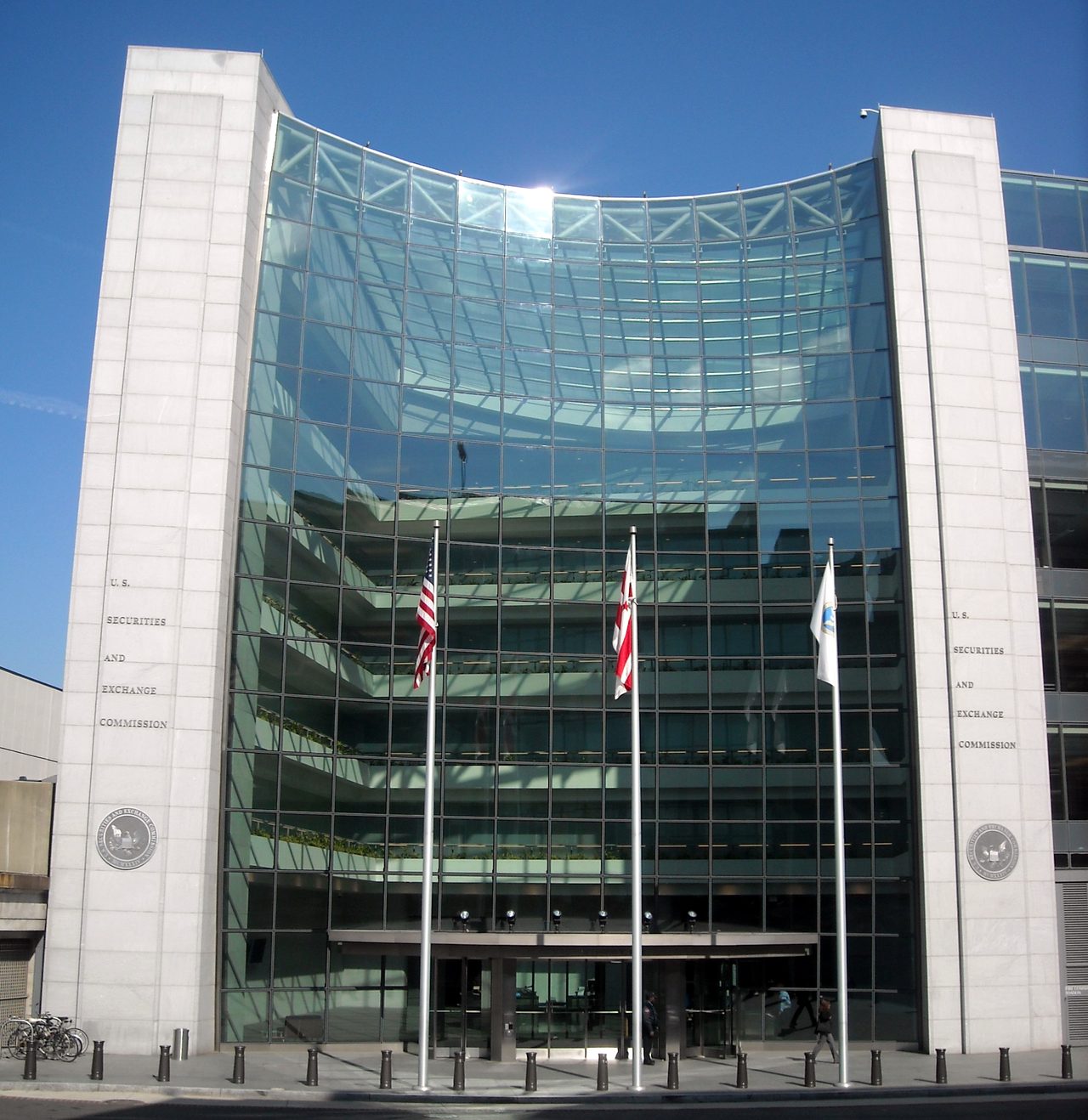
Photo: U.S. Securities and Exchange Commission headquarters, Washington, D.C. Credit: AgnosticPreachersKid, CC BY-SA 3.0, via Wikimedia Commons.