

Afternoon Wire is The Investigative Journal’s daily digest of the day’s major developments across government, the courts, and international affairs. Every item is sourced to a public record, official statement, or established wire report. Where a matter remains contested or unresolved, we say so.
Washington, July 4, 2026 — The nation marked its 250th Independence Day on Saturday under a punishing heat dome, with federal offices and courts shuttered for the holiday and the day’s news split between a coast-to-coast celebration, the closing ledger of a consequential Supreme Court term, and a dayslong state funeral in Iran that underscored how fragile the region’s new ceasefire remains.
Government
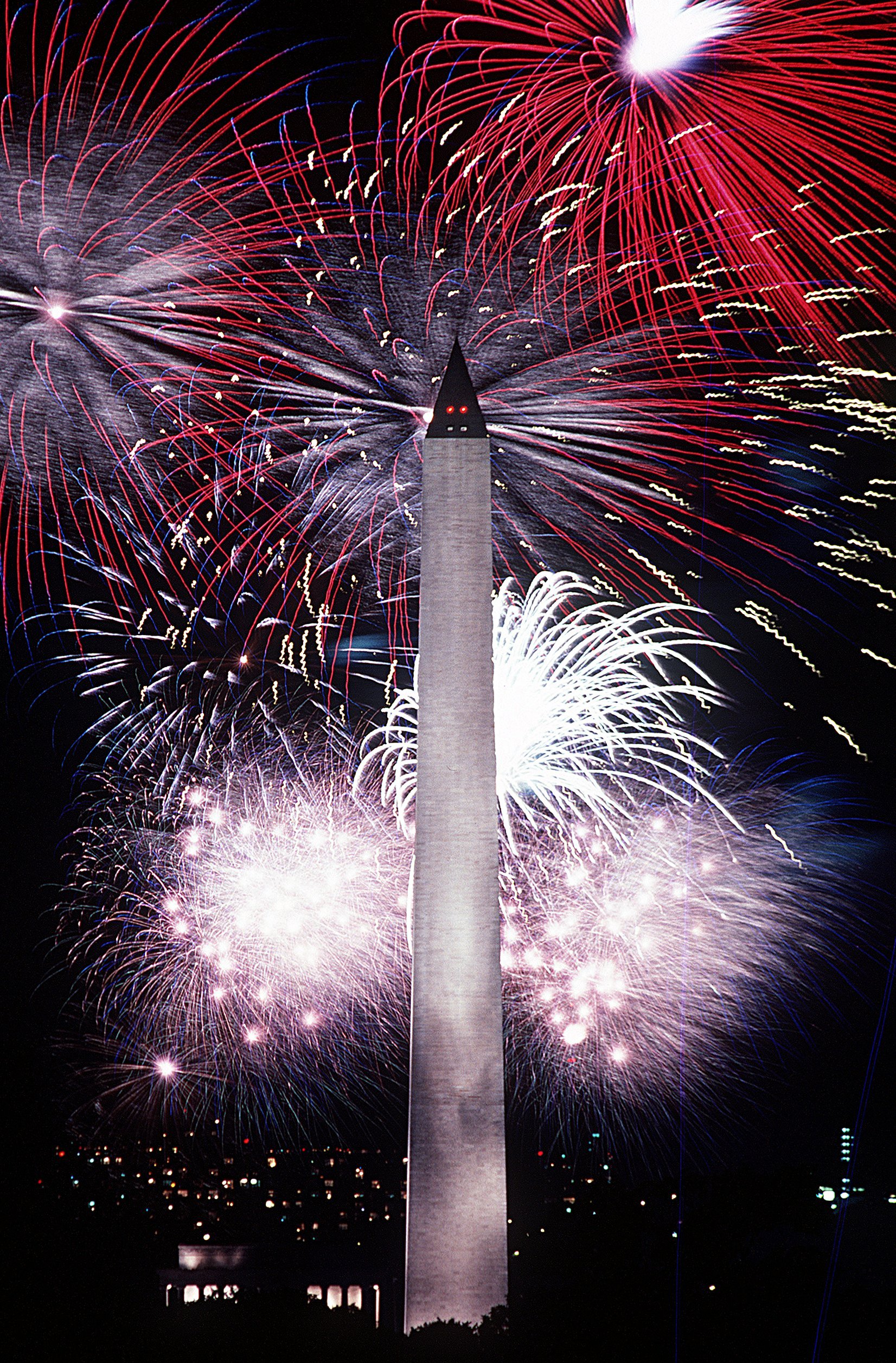
America’s 250th culminates on the National Mall under record heat
Federal and District organizers finalized the timeline for what the White House’s Freedom 250 task force has billed as the largest fireworks display in history, staged across the National Mall on Saturday evening. According to a published schedule, roughly 850,000 shells are to be launched from 10 sites spanning the Lincoln Memorial Reflecting Pool, Potomac River barges and West Potomac Park, with the display beginning about 10:30 p.m. and running some 40 minutes. Organizers say the show is intended to eclipse the current Guinness World Record of 810,904 shells.
President Donald Trump was scheduled to speak at 9:45 p.m., following daytime military flyovers and a performance by the Joint Armed Forces Orchestra. The president opened the holiday weekend a day earlier with an address at Mount Rushmore, where the White House floated — without offering any concrete plan — the idea of adding his likeness to the monument, according to live coverage of the event.
The celebration proceeded against a genuine public-safety backdrop. Because forecasts called for temperatures near 107 degrees in the capital, organizers pushed back guest entry to the Washington Monument grounds to 5 p.m. and said they were expanding cooling stations, water and medical support in coordination with the National Park Service.
A record-threatening heat wave blankets more than half the country
The holiday coincided with one of the most severe early-summer heat events in recent memory. Forecasters reported that more than 185 million people were under heat alerts, with a heat dome trapping much of the eastern and central United States and putting parts of the country in reach of the hottest Fourth of July on record. Major metropolitan areas including Boston, New York, Philadelphia and Washington were among those affected.
The conditions became a political sidebar as well. Asked about the risk, the president said he intended to deliver a lengthy holiday address regardless, and organizers weighed the heat against crowd size in adjusting the day’s timeline, according to reporting on the Freedom 250 planning. Public-health officials urged attendees to hydrate and limit sun exposure during peak afternoon hours.
June hiring slowed sharply even as the jobless rate dipped
The economic backdrop to the holiday weekend was a cooling labor market. The Bureau of Labor Statistics reported that nonfarm payrolls rose by just 57,000 in June — well short of the roughly 115,000 economists had expected and down from a downwardly revised 129,000 in May. The unemployment rate ticked down to 4.2%.
Data show that decline was driven less by strength than by Americans leaving the workforce: the labor-force participation rate fell 0.3 percentage point to 61.5%, its lowest since March 2021, and a separate household survey counted 507,000 fewer people at work, according to the June employment report. Leisure and hospitality shed 61,000 jobs despite expectations that the World Cup might lift seasonal hiring, while professional and business services, health care and social assistance added positions. Average hourly earnings rose 3.5% from a year earlier.
Congress closes the books on FY2026 spending
Before the recess, appropriators marked the completion of the fiscal 2026 funding cycle. House leaders announced that all twelve annual appropriations bills had advanced, closing out a process that independent budget analysts describe as having largely rejected the administration’s proposed deep reductions to non-defense programs. According to a running tally maintained by the Committee for a Responsible Federal Budget, final non-defense levels came in only modestly above the prior year — below the pace of inflation once adjusted.
Courts
Justices affirm birthright citizenship, rejecting the administration’s order
With the federal courthouse dark for the holiday, the most consequential legal news came from opinions handed down as the Supreme Court’s term closed. In Trump v. Barbara, decided June 30, the Court struck down the executive order that sought to end birthright citizenship for children born in the United States to parents present unlawfully or on temporary visas.
Chief Justice John Roberts wrote for the majority, which invalidated the order 6-3, with the Court dividing 5-4 on grounding the result in the Fourteenth Amendment, according to the case analysis. “Citizenship, then and now, was the right to have rights,” Roberts wrote, holding that children born to parents “unlawfully or temporarily present” satisfy the Citizenship Clause. Coverage from public radio noted the ruling settled a question that had shadowed immigration policy since the first day of the president’s second term.
Court expands presidential removal power, overturning a 91-year-old precedent
A day earlier, in Trump v. Slaughter, the Court ruled 6-3 that the president lawfully removed a Federal Trade Commissioner without cause, a decision that effectively overturned Humphrey’s Executor v. United States, the 1935 precedent that had shielded members of independent agencies from at-will dismissal. Chief Justice Roberts again wrote for the majority.
Legal observers describe the outcome as a significant expansion of executive control over agencies long treated as insulated from direct White House command. Reporting on the decision noted that the majority found the FTC’s for-cause removal protection “contrary to the separation of powers,” while the dissent warned of the consequences for regulators at bodies from the Federal Reserve to the securities and communications commissions. The practical reach of the ruling for other agencies remains to be litigated.
States may bar transgender athletes from girls’ and women’s sports
Also on June 30, in West Virginia v. B.P.J., the Court held that states may exclude transgender girls from girls’ and women’s sports teams at publicly funded schools. The justices were unanimous that the Idaho and West Virginia laws at issue did not violate Title IX, but divided 6-3 over the constitutional question.
Justice Brett Kavanaugh, writing for the majority, reasoned that “the States may maintain women’s and girls’ sports for biological females,” citing what the opinion called inherent physical differences relevant to athletic performance, according to an analysis of the decision. Advocacy groups on both sides said the ruling would reshape eligibility rules across dozens of states; the opinion left open how far its reasoning extends beyond the specific statutes reviewed.
International
Iran begins a dayslong funeral for Khamenei as the ceasefire holds — tenuously
In Tehran, Iran opened a multi-day state funeral for Supreme Leader Ayatollah Ali Khamenei, who officials say was killed in an airstrike earlier this year. Mourners filled the capital’s Grand Mosalla, and state organizers projected attendance in the millions across processions in Tehran, Qom and the Iraqi shrine cities before a planned burial in Mashhad, according to live coverage of the proceedings. Reports described crowds chanting for revenge.
Questions of succession loomed over the rites. Khamenei’s son, Mojtaba, who was named to succeed his father, has not appeared in public and is said to be recovering from injuries sustained in the strike, according to reporting on the succession. The Investigative Journal notes that internal accounts of the Iranian leadership’s condition cannot be independently verified and rests on official Iranian statements and outside reporting.
A fragile U.S.-Iran ceasefire depends on Lebanon
The funeral unfolded during a negotiated pause in hostilities. Records of the diplomacy indicate the United States and Iran signed a memorandum in mid-June establishing a 60-day extension of an earlier ceasefire to negotiate final terms, according to reporting on the preliminary agreement. Outstanding issues include the Strait of Hormuz, Iran’s nuclear and missile programs, and U.S. sanctions.
Analysts caution the arrangement is far from durable. A recent assessment reported that a broader settlement hinges on a parallel ceasefire in Lebanon, where Hezbollah has signaled resistance — a linkage that a Congressional Research Service product flags as one of several unresolved variables for lawmakers weighing sanctions relief and oversight.
Venezuela’s earthquake toll climbs as the rescue window narrows
Ten days after twin earthquakes of magnitude 7.2 and 7.5 struck northern Venezuela within a minute of each other on June 24, relief agencies described needs as “skyrocketing.” The United Nations reported that authorities had confirmed nearly 2,000 deaths and more than 6,400 rescues, with international teams still working in the hardest-hit region of La Guaira, where a three-year-old was pulled alive from rubble six days after the disaster.
The scale of the loss remains uncertain. Some official tallies put the confirmed toll higher, and U.S. Geological Survey modeling has cautioned the eventual figure could climb substantially, according to on-the-ground reporting. Tens of thousands remain unaccounted for, though aid officials note that figure likely includes people displaced or separated from families rather than confirmed dead. More than 20 countries have sent supplies and search teams.
Ukraine-Russia talks remain stalled
Elsewhere, diplomacy to end the war in Ukraine stayed frozen. According to the Council on Foreign Relations’ conflict tracker, U.S.-brokered meetings earlier this year produced prisoner exchanges and brief pauses but no durable ceasefire, with the sides still far apart on territory, NATO and monitoring. A public accounting of the negotiation record maintained by the Cambridge Initiative on Peace Settlements shows both governments have announced competing ceasefire dates without agreeing to the other’s terms.
Tomorrow’s Watch
Sunday, July 5, is likely to keep several of Saturday’s threads running. Iran’s funeral processions are scheduled to continue, moving toward Qom and, per Iranian officials, eventually to the Iraqi shrine cities before burial in Mashhad — a multi-day sequence worth watching for any first public sign of the new supreme leader. In Washington, America’s semiquincentennial programming extends through the weekend even as forecasters expect the heat dome to persist across much of the East and Midwest.
On the economic calendar, U.S. markets remain closed for the observed holiday and reopen Monday, when investors will begin pricing in a June jobs report that undershot expectations. Internationally, knockout-round matches in the 2026 World Cup — co-hosted across North America — continue to draw crowds and traffic through host cities, and relief agencies in Venezuela are expected to shift from rescue toward recovery as the survival window closes. The Investigative Journal will update these items as public records and official statements develop.
— Eduardo Bacci, The Investigative Journal