
The Investigative Journal’s daily review of federal enforcement actions, drawn from Justice Department press releases and court filings.
The Justice Department opened August with one of its most aggressive public moves yet against Mexican cartel leadership, unsealing criminal charges against five senior figures of the Cártel de Jalisco Nueva Generación (CJNG) while the State Department stacked more than $100 million in rewards on eight fugitives. The announcement headlined a busy 48-hour window that also included a $95 million Medicare fraud indictment in Nevada, a guilty plea from a Canadian hacker whose intrusions touched an estimated 100 million people, a multi-defendant Medicaid takedown in Philadelphia, and a $3.2 million civil rights settlement with OpenAI.
This edition of DOJ Watch reviews eight enforcement actions announced August 4–5, 2026. Every item below is sourced to official Justice Department releases and linked court documents; criminal charges are allegations unless a plea or verdict is noted.
More Than $100 Million in Bounties as New CJNG Indictments Are Unsealed
The Justice Department, working with the DEA, FBI, Homeland Security Investigations, IRS Criminal Investigation, and Customs and Border Protection, announced August 5 the unsealing of criminal charges against five senior CJNG leaders, alongside State Department reward offers exceeding $100 million for eight fugitives. The largest single bounty — up to $25 million — targets Juan Carlos Valencia González, known as “Pelón,” who according to court filings assumed control of the cartel after its longtime boss, Nemesio Oseguera Cervantes (“El Mencho”), was killed in a Mexican military operation in February 2026.
The newly unsealed indictments, filed in the District of Columbia, allege that the five defendants — Julio César Montero Pinzón, Carlos Andrés Rivera Varela, Hugo Gonzalo Mendoza Gaytán, Ricardo Ruiz Velasco, and Julio Alberto Castillo Rodríguez — participated in decade-long conspiracies to move cocaine, methamphetamine, heroin, and fentanyl into the United States. Filings describe Montero Pinzón and Rivera Varela as founders of the “Grupo Elite,” an enforcement arm that allegedly ran training camps teaching recruits to use rocket launchers and .50-caliber machine guns, with more than 1,000 personnel reporting to the pair. Each defendant faces up to two consecutive life terms if convicted. The indictments are public: Montero Pinzón, Rivera Varela, Mendoza Gaytán, Ruiz Velasco, and Castillo Rodríguez.
Notably, the case reaches beyond narcotics. A superseding indictment in the Eastern District of New York charges Montero Pinzón, Rivera Varela, and Griselda Margarita Arredondo Pinzón in connection with an alleged CJNG-controlled fraud scheme targeting Americans who own timeshare properties in Mexico. U.S. Attorney Joseph Nocella Jr. said thousands of U.S. victims have reported hundreds of millions of dollars in losses to Mexican timeshare fraud — a sign, prosecutors say, that transnational cartels increasingly fund operations through white-collar schemes as well as drugs. The State Department designated CJNG a foreign terrorist organization on February 20, 2025.
Canadian Hacker Pleads Guilty in Cloud Breach Affecting 165 Organizations
Connor Riley Moucka, 26, of Kitchener, Ontario, pleaded guilty August 5 in the Western District of Washington to computer fraud, wire fraud, aggravated identity theft, and conspiracy. According to court documents, between February and October 2024 Moucka and co-conspirators used stolen login credentials to compromise cloud-hosted data belonging to at least 165 customers of a U.S.-based software-as-a-service company, stealing billions of records — including call and text histories, banking data, driver’s license and Social Security numbers — and extorting victims with threats to publish the data.
The conspirators collected more than $2.5 million in ransom payments, with Moucka personally obtaining at least $495,000, according to the Justice Department. Victim companies suffered more than $9.5 million in actual losses, and the stolen data covered at least 100 million individuals. Filings indicate Moucka advertised victim data on cybercrime forums including BreachForums, Exploit.in, and XSS.is, and in at least one instance re-extorted a victim using data belonging to a government officer and a former official’s family members.
Moucka was arrested in Canada roughly six months after the breaches began and extradited in July 2025 — a comparatively rapid timeline for cross-border cybercrime cases. He faces a mandatory minimum of two years on the identity theft count and up to 30 years on the remaining counts at his October 27 sentencing. The department credited the Royal Canadian Mounted Police, Australian Federal Police, Spain’s Guardia Civil, Ukraine’s Security Service, and the Turkish National Police with assisting the investigation, which falls under the FBI’s Operation Riptide. Americans reported more than $20 billion in cybercrime losses last year, a 26 percent single-year increase, according to the department.
Nevada Physician Indicted in Alleged $95 Million Medicare Wound-Care Scheme
A federal grand jury in Nevada returned an indictment charging Stephen Dubin, M.D., 74, of Henderson, with conspiracy and five counts of health care fraud in an alleged $95 million scheme built on amniotic wound allografts — expensive skin-substitute products billed to Medicare. According to the indictment, Dubin applied allografts to elderly patients, including patients in hospice care, without medical necessity, and Medicare paid more than $54 million on the claims.
The filings allege a kickback structure worth scrutiny across the wound-care industry: two allograft distributors allegedly paid Dubin kickbacks disguised as “Rebate Agreements,” sharply reducing his real acquisition cost, while Dubin billed Medicare against sham full-price invoices and pocketed the spread. Prosecutors also allege payments flowed through a pass-through account held by a shell company, that allografts were applied to infected wounds and in quantities exceeding wound size, and that patient records were falsified to satisfy Medicare requirements. The indictment states Dubin used proceeds to fund a lavish lifestyle, including commissioning multi-million-dollar yachts.
The case is the National Fraud Enforcement Division’s first announced in Nevada since the West Coast Health Care Fraud Strike Force launched April 30. Dubin faces up to 10 years per count if convicted. An indictment is an allegation; Dubin is presumed innocent unless proven guilty.
Nineteen Charged as Medicaid Home-Care Crackdown Expands to Philadelphia
The Fraud Division announced charges against 19 defendants August 4 — company owners, purported home health aides, and Medicaid recipients — tied to more than $4 million in allegedly fraudulent claims, while formally expanding its Northeast Health Care Fraud Strike Force into the Eastern District of Pennsylvania.
The alleged fact patterns are striking for their brazenness. Filings describe aides who billed while incarcerated or hospitalized; a father-son pair who billed while the son drove for ride-share and food-delivery services; a recipient claiming debilitating illness while working as a carpenter; and defendants billing while vacationing in Miami or traveling to Saudi Arabia. In a case charged by the Pennsylvania Attorney General, one purported aide allegedly claimed more than 24 hours of work in a single day on over 1,100 occasions — roughly 64,000 impossible hours — drawing more than $1.2 million from Medicaid. One defendant was captured on a recording saying home health care was “the best kept secret,” according to the department.
The expansion continues a rapid national buildout of the strike force model, which the department credits with charging more than 6,200 defendants who collectively billed over $45 billion since 2007. For taxpayers, the open question is systemic: how electronic visit-verification and claims controls repeatedly failed to flag physically impossible billing.
Houston-Area ‘Pill Mill’ Doctor Sentenced to 12.5 Years
Maryam Qayum, M.D., 68, was sentenced to 12.5 years in prison for running her Kingwood, Texas clinic, Recare Health Clinic, as a cash-only pill mill. According to court documents, Qayum — the clinic’s sole prescriber — issued prescriptions for more than 3 million opioid pills between 2022 and 2025, often without ever seeing the patient, selling scripts to street-level dealers the clinic internally called “providers.”
Court records show prescriptions were priced to street value: up to $500 for oxycodone 30mg and roughly $300 for hydrocodone, with staff taking “tips” to fast-track dealers. Qayum pleaded guilty in March 2026 to conspiracy to unlawfully distribute controlled substances. Four co-defendants were previously sentenced, including drug dealer Melvin Sampson (210 months), nurse practitioner Tomi-Ko Bowers (96 months), clinic security guard Lester Stokes (63 months), and pharmacist Jared Williams (42 months), whose pharmacy filled the illegitimate prescriptions.
OpenAI to Pay $3.2 Million Over Claims It Disfavored U.S. Workers in Hiring
The Civil Rights Division announced a combined $3.2 million settlement August 4 with OpenAI OpCo LLC and subsidiary Statsig Inc., resolving allegations that the companies discriminated against U.S. workers in favor of temporary visa holders during Permanent Labor Certification (PERM) recruitment, in violation of the Immigration and Nationality Act.
The department’s investigation found the companies did not post PERM positions on their external job sites, required paper applications by mail for those roles while accepting electronic applications for others, and advertised the positions on late-night radio — steps investigators concluded discouraged U.S. applicants. Though fewer than ten PERM positions were at issue, the resolution includes $1.2 million in civil penalties and a $2 million back-pay fund, plus training, policy revisions, and departmental monitoring. The settlement agreement is the thirteenth under the department’s re-launched Protecting U.S. Workers Initiative — a notable enforcement footnote for an AI industry competing intensely for scarce technical talent.
Former Haitian Police Officer Admits Smuggling 140 Firearms to Haiti
Jean Robert Casimir, 53, of Lauderhill, Florida, pleaded guilty August 4 in the District of Columbia to conspiracy, smuggling, and export-control violations for illegally shipping at least 140 firearms to Haiti between 2020 and 2024 without Commerce Department licenses. Court documents describe a concealment method emblematic of the Caribbean gun pipeline: industrial air compressors cut open, packed with disassembled rifles and handguns in foam insulation, welded shut, and shipped by boat from the Miami area.
Casimir, a naturalized U.S. citizen and former Haitian National Police officer, purchased at least 108 firearms from licensed dealers and 30 to 35 more from a private seller, according to the plea. The case — investigated by FBI Miami and HSI under the Homeland Security Task Force initiative — lands amid sustained international concern over U.S.-sourced weapons arming Haitian gangs.
Fair Housing Suit Accuses Pennsylvania Landlord of Sexual Harassment
The Justice Department filed a civil lawsuit August 5 against Venkatachalam Mani, a State College, Pennsylvania landlord, alleging sexual harassment of a female tenant and retaliation after she refused his advances, in violation of the Fair Housing Act. The complaint, filed in the Middle District of Pennsylvania, alleges Mani made unwelcome sexual advances including sexual touching, then ignored the tenant’s maintenance requests — including a broken furnace in midwinter that eventually caught fire — forcing the family to move out.
The case arrived via a HUD complaint, investigation, and charge of discrimination. It joins 53 lawsuits filed under the department’s Sexual Harassment in Housing Initiative since 2017, which has recovered roughly $19 million for victims. The allegations in the complaint have not been proven; the suit seeks damages and an order barring future discrimination.
On TIJ’s Radar
Several threads from this window warrant deeper reporting. First, the CJNG timeshare-fraud nexus: the Eastern District of New York docket now formally links a designated foreign terrorist organization to a white-collar scheme that has drawn hundreds of millions of dollars from American retirees, and the money flow — from victim wire transfers to cartel coffers — deserves a full accounting. Second, the wound-care allograft economy: the Dubin indictment describes distributors who allegedly structured kickbacks as rebates, but does not name them; identifying those firms and the Medicare reimbursement mechanics that make spread-pricing profitable is a natural follow-up, particularly given the string of nine-figure allograft cases the department has brought over the past two years. Third, Medicaid’s home-care controls: the Philadelphia cases repeatedly involved billing that was physically impossible on its face, suggesting electronic visit-verification systems are failing at scale. Finally, the Moucka plea leaves open questions about co-conspirators referenced in filings and the security posture of the unnamed cloud provider whose customers bore the losses.
All criminal charges described above are allegations, and defendants are presumed innocent unless and until proven guilty in court. Civil complaints likewise contain allegations that have not been adjudicated. Settlements are not admissions of liability unless stated. The Investigative Journal welcomes responses from any party named in this digest; responses will be published as received. Corrections: editor@tij.news.
Sources
- DOJ: New Charges and Rewards Announced for Senior CJNG Leaders (Aug. 5, 2026)
- EDNY Superseding Indictment, U.S. v. Montero Pinzón et al.
- State Department Reward Posters (PDF)
- DOJ: Canadian Man Pleads Guilty to Hacking U.S. Cloud Storage Provider (Aug. 5, 2026)
- DOJ: Nevada Doctor Charged with $95M Wound Care Fraud (Aug. 5, 2026)
- DOJ: 19 Defendants Charged in Medicaid Home Health Schemes (Aug. 4, 2026)
- DOJ: Texas Physician Sentenced for Houston-Area Pill Mill (Aug. 5, 2026)
- DOJ: Civil Rights Division Settlement with OpenAI (Aug. 4, 2026)
- OpenAI/Statsig Settlement Agreement (PDF)
- DOJ: South Florida Resident Pleads Guilty to Smuggling Firearms to Haiti (Aug. 4, 2026)
- DOJ: Justice Department Sues Pennsylvania Landlord (Aug. 5, 2026)
- Complaint, U.S. v. Mani (PDF)
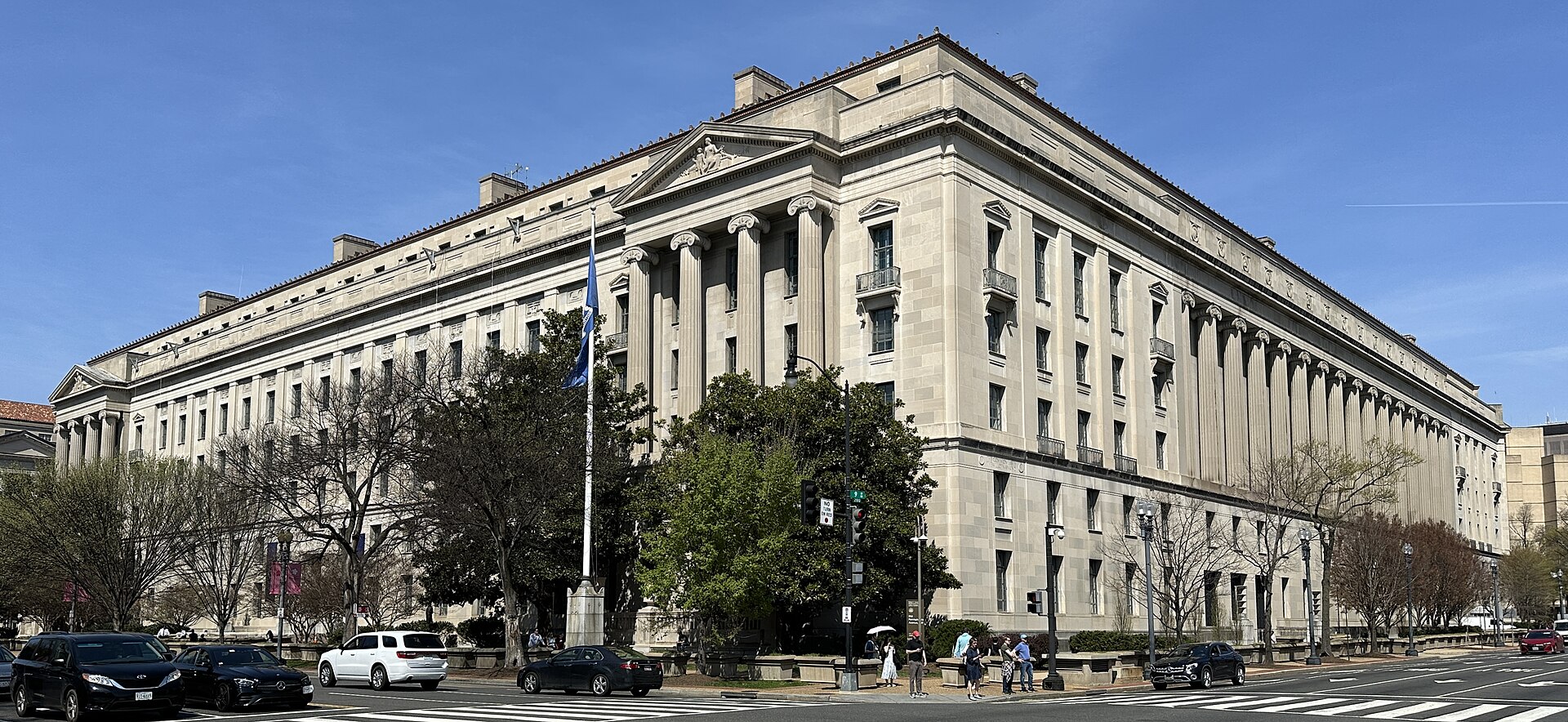
Featured image: Robert F. Kennedy Department of Justice Building, Washington, D.C. Photo by APK via Wikimedia Commons, CC BY 4.0.
