

The Investigative Journal’s daily digest of Department of Justice enforcement actions, compiled from official press releases and court filings. All charges described below are allegations unless otherwise noted; defendants are presumed innocent until proven guilty in a court of law.
The Justice Department opened the week with one of its busiest enforcement stretches of the summer. Filings and announcements between August 3 and August 4 span a Medicaid fraud takedown in Philadelphia paired with a permanent expansion of the department’s health care strike force, a $3.2 million civil rights settlement with artificial intelligence giant OpenAI, a $14.1 million False Claims Act recovery from a Medicare Advantage provider, and what the department describes as the largest coordinated denaturalization filing in its history. Below, TIJ walks through the actions that matter, what the records show, and where deeper reporting is warranted.
1. Fraud Division charges 19 in Philadelphia Medicaid home-care takedown, expands Northeast Strike Force
The department’s National Fraud Enforcement Division announced criminal charges against 19 defendants on August 4 — owners and employees of home care companies, purported aides, and Medicaid recipients — for alleged fraud schemes involving more than $4 million in claims to Medicare and Medicaid. The announcement came alongside a structural move: the permanent expansion of the Division’s Northeast Health Care Fraud Strike Force into the Eastern District of Pennsylvania, in partnership with U.S. Attorney David Metcalf’s office and the Pennsylvania Attorney General.
The allegations described in the filings are striking for their brazenness. According to the department, one purported aide billed for care she claimed to provide while incarcerated; another billed while hospitalized. In a case charged by the Pennsylvania Attorney General, filings indicate a single aide claimed more than 64,000 hours that could not have been worked — including over 1,100 occasions on which she allegedly billed for more than 24 hours of care in a single day — drawing more than $1.2 million from Medicaid. Federal prosecutors also charged a father-and-son pair who allegedly billed for home care while the son was driving for ride-share and food delivery services, and a home care agency and its two owners accused of submitting hundreds of false clock-ins totaling roughly $224,000. One defendant allegedly billed nearly $600,000 while traveling overseas; another pleaded guilty to state charges for billing while in Saudi Arabia.
The strike force model has national scale behind it: the department says it has produced prosecutions of more than 6,200 defendants who collectively billed federal programs and private insurers over $45 billion, and cites a third-party analysis projecting a return of $106.76 for every dollar spent on the Health Care Fraud Section by year ten. “This racket ends today,” U.S. Attorney Metcalf said in the release. The charges are allegations, and no defendant has been convicted in the newly filed federal cases.
2. OpenAI pays $3.2 million to settle claims it discriminated against U.S. workers
The Civil Rights Division announced a combined $3.2 million settlement with OpenAI OpCo LLC and its subsidiary Statsig Inc. on August 4, resolving allegations that the companies violated the Immigration and Nationality Act by favoring temporary visa holders over U.S. workers during Permanent Labor Certification (PERM) recruitment. The department’s investigation found that OpenAI did not advertise PERM positions on its external careers site despite doing so for other roles, required paper applications mailed in for PERM jobs while accepting electronic applications elsewhere, and advertised some positions on late-night radio — steps investigators concluded were designed to discourage American applicants.
Under the agreement, OpenAI will pay $1.2 million in civil penalties and fund a $2 million back-pay account for affected workers, alongside training, policy revisions, and departmental monitoring. Notably, the department said the resolution amount reflects the harm of shutting U.S. workers out of lucrative technology jobs even though fewer than ten PERM positions were at issue. The settlement is the thirteenth under the department’s re-launched Protecting U.S. Workers Initiative — a signal that PERM recruitment practices across Big Tech remain squarely in the department’s sights. Settlements resolve allegations and are not findings of liability.
3. Medicare Advantage provider Complete Health pays $14.1 million over “risk score” coding
Jacksonville-based Complete Health Partners Holdings agreed on August 3 to pay $14.1 million to resolve False Claims Act allegations that it caused the submission of unsupported diagnosis codes — specifically for drug and alcohol dependence and major depressive and related disorders — to inflate the “risk scores” that drive Medicare Advantage payments. The government contends that between 2020 and 2023 the management services organization disseminated incorrect coding guidance and prompted physicians to add diagnoses that were not clinically valid or supported by medical records, then took its contracted share of the inflated payments.
The case originated as a qui tam whistleblower suit filed by Karen Bowers, a former risk-adjustment director at VIVA Health, captioned United States ex rel. Bowers v. Complete Health Partners, Inc., et al., No. 3:22-cv-463 (M.D. Fla.); records indicate Bowers will receive approximately $2.47 million of the recovery. As the department notes, the claims resolved by the settlement are allegations only, and there has been no determination of liability. The settlement extends a steady drumbeat of risk-adjustment enforcement across the fast-growing Medicare Advantage sector — an area TIJ has been tracking closely.
4. DOJ files record 25 denaturalization cases
The Civil Division announced on August 3 that it filed civil denaturalization complaints against 25 naturalized citizens between July 20 and August 3 — which the department characterizes as the largest coordinated denaturalization effort in its history. The complaints allege the defendants procured citizenship illegally or by concealing material facts, including undisclosed violent crimes, sexual offenses against children, fraudulent identities, and prior deportation orders. Since January 20, 2025, filings indicate the department has brought 123 civil denaturalization complaints, the most in recorded history.
Among the cases: a Florida resident who, records suggest, admitted involvement in a business selling child sexual abuse material before naturalizing and was later convicted of money laundering conspiracy; a Texas man who allegedly obtained two separate naturalizations under two identities; and several defendants convicted of sexually abusing minors after concealing that conduct during naturalization proceedings. The department itself stresses that “the claims made in the complaints are allegations only, and there has been no determination of liability.” These are civil actions — the volume and velocity of the initiative make it one of the more consequential immigration-enforcement developments of the year, and outcomes in the district courts will bear watching.
5. Houston gang leaders convicted in drive-by murder of bystander
A federal jury convicted Shaquille Richards and Alexandra Nicks, both 32, of using a firearm to kill during a racketeering murder and murder in aid of racketeering, the department announced August 4. Prosecutors presented jail calls, social media postings, and testimony showing the two leaders of Houston’s 103 street gang ordered a retaliatory drive-by shooting in rival territory in October 2017. The intended target survived; a 53-year-old bystander standing in a front yard was shot and killed.
Four fellow gang members who carried out the shooting — armed with drum magazines holding 50 and 100 rounds — previously pleaded guilty and are set for sentencing September 2. All defendants face up to life in prison; a sentencing date for Richards and Nicks has not been set. The case, brought under the Criminal Division’s Violent Crime Initiative in Houston, closes out the prosecution of all six charged members and reflects the department’s continued use of federal racketeering statutes against neighborhood gang violence.
6. Guilty plea in firearms pipeline from Florida to Haiti
Jean Robert Casimir, 53, a naturalized U.S. citizen and former Haitian National Police officer living in Lauderhill, Florida, pleaded guilty August 4 to conspiracy, smuggling, and export-control violations for illegally shipping at least 140 firearms to Haiti between 2020 and 2024 without Commerce Department licenses. According to court documents, Casimir and co-conspirators cut open industrial air compressors, packed them with disassembled rifles and handguns insulated in foam, welded them shut, and shipped them to Haiti on boats leaving the Miami area.
The prosecution — handled by the U.S. Attorney’s Office for the District of Columbia and the National Security Division under the Homeland Security Task Force initiative — lands amid sustained concern about U.S.-sourced weapons fueling gang violence in Haiti. The guilty plea is an admission of the charged conduct; sentencing details were not included in the release.
7. Charity director charged with financing Hamas; Second Amendment suit against Montgomery County
Two additional actions round out the docket. In a national security case unsealed July 31, prosecutors in the Southern District of New York charged Mohammad Yousef Hasna, 45, of Istanbul — arrested in the United Kingdom — with conspiring to provide material support to Hamas and terrorism-financing counts. The complaint alleges Hasna, global director of a purported UK-registered charity, coordinated directly with senior Hamas official Ghazi Hamad on deliveries of cash and supplies in Gaza, concealing warehouse control and distribution lists. Filings indicate the charity’s reported gross income nearly doubled after October 7, 2023, from roughly $41.8 million to $81.56 million. Each count carries up to 20 years. Hasna is presumed innocent, and the complaint’s claims are allegations.
Separately, the Civil Rights Division sued Montgomery County, Maryland, on August 3, alleging the county’s Bill 23-26 — which bars licensed carry at thousands of locations and imposes 100-yard exclusion zones around each — violates the Second Amendment as interpreted in the Supreme Court’s Wolford v. Lopez decision. The county had not filed a response as of publication.
On TIJ’s radar
Several threads from this docket warrant deeper investigation. First, the Philadelphia home-care cases point to structural weaknesses in Medicaid’s electronic visit verification and self-directed care programs; TIJ intends to examine who owns the agencies involved and whether the billing patterns flagged by prosecutors appear in other states’ claims data. Second, the Complete Health settlement — the latest in a string of Medicare Advantage risk-adjustment recoveries — raises questions about coding practices at private-equity-backed provider groups that merit a sector-wide look at pending qui tam dockets. Third, the Hasna complaint opens a window into post-October 7 charity financing networks; the organization’s UK filings and its U.S. donor exposure are a natural next step for verification. Finally, the denaturalization surge is a policy story as much as an enforcement one: TIJ will track how district courts receive these 25 complaints and what precedents emerge.
Right of reply and sourcing note: This digest is based on Justice Department press releases and court filings linked above. Defense counsel for the individuals named were not identified in the department’s releases, and responses from the defendants and settling companies were not available at publication time; TIJ will publish responses upon receipt. Criminal charges and civil complaints are allegations, and settlements are not determinations of liability unless a court has so found.
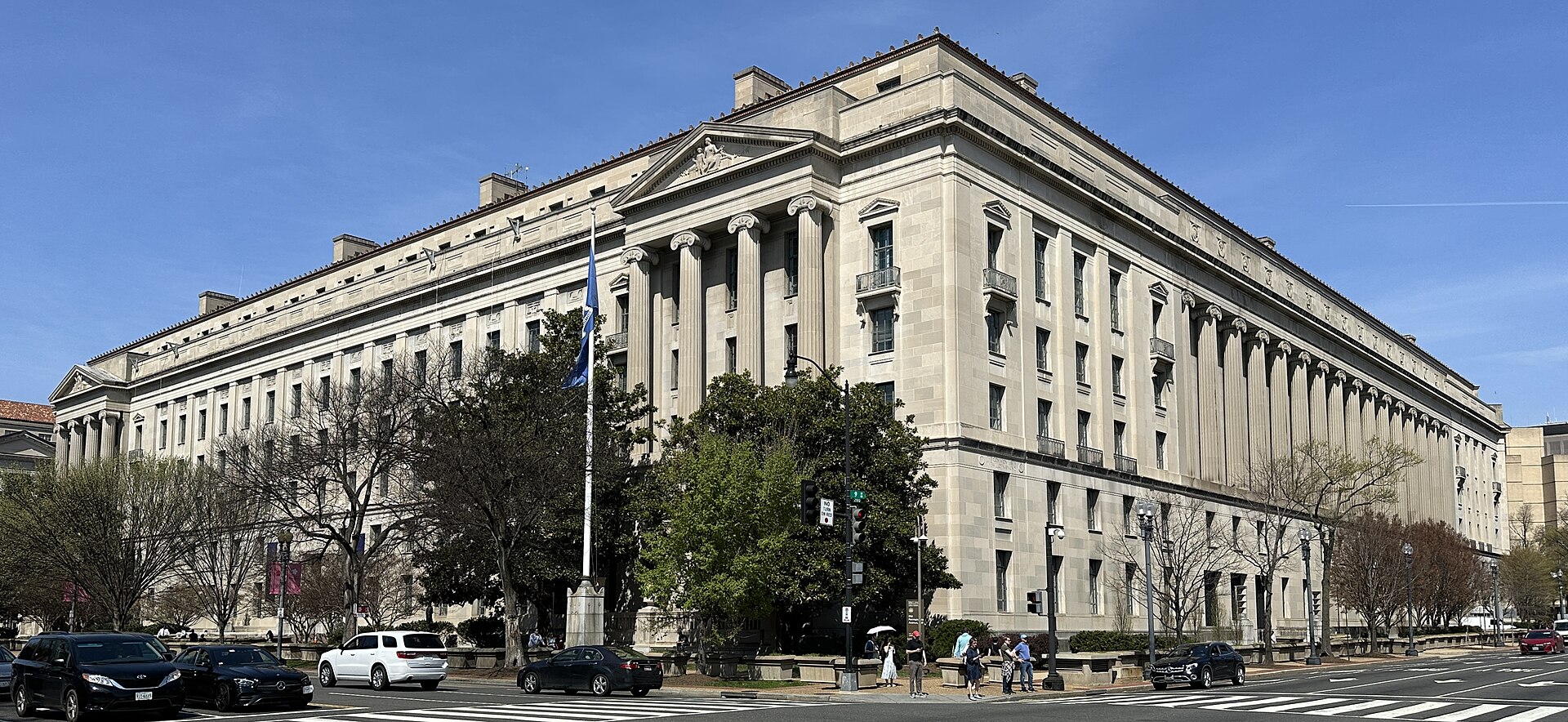
Featured image: Robert F. Kennedy Department of Justice Building, Washington, D.C. Photo by APK via Wikimedia Commons, CC BY 4.0.