
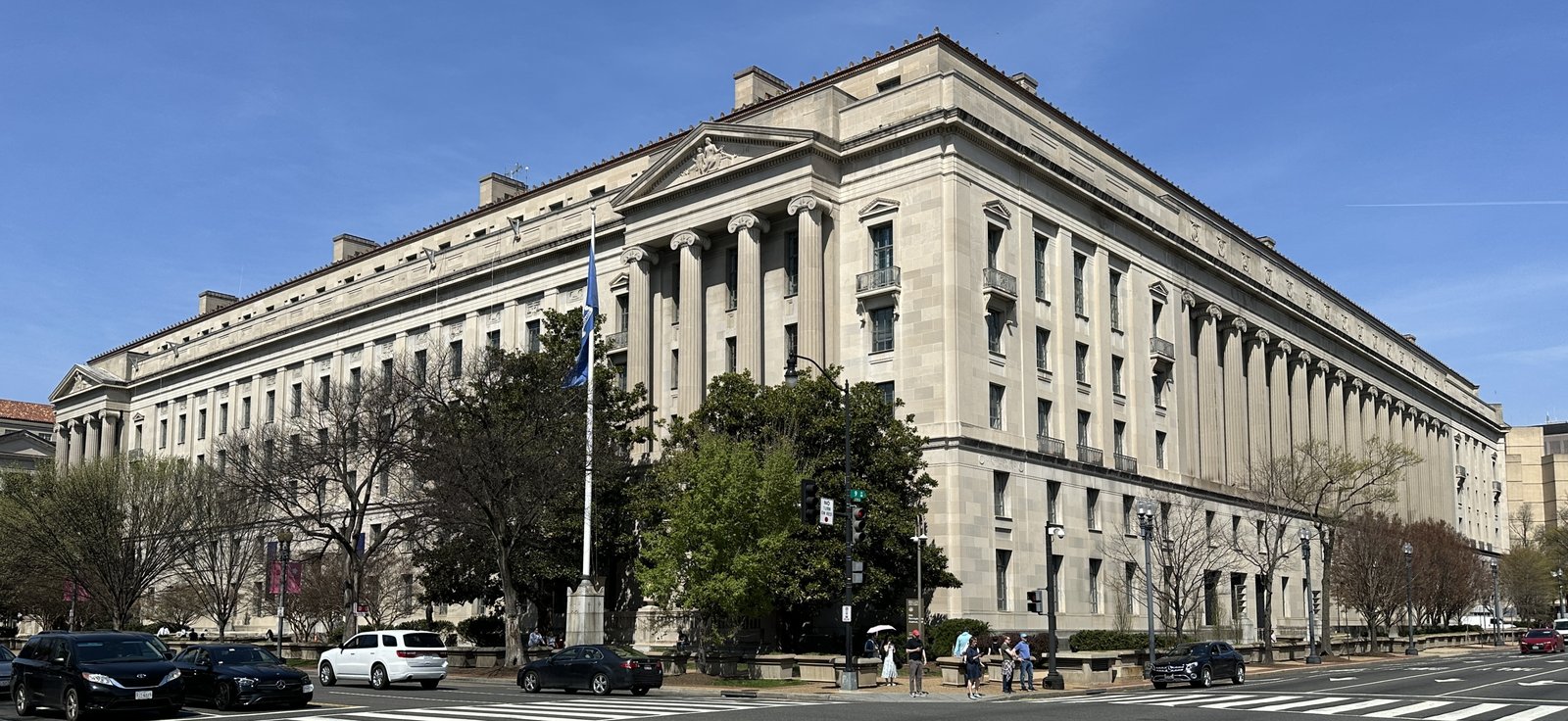
The Justice Department opened the week with a burst of enforcement activity spanning immigration, health care fraud, constitutional litigation, terrorism financing, and cartel prosecutions. Monday’s announcements from Main Justice included what the department describes as the largest coordinated denaturalization filing in its history, a $14.1 million Medicare Advantage settlement, and a new Second Amendment lawsuit against Montgomery County, Maryland. Those actions land on top of a heavy close to last week: a terrorism-financing arrest tied to Hamas, a guilty plea from the brother of the late CJNG founder “El Mencho,” and a seven-state fraud sweep the department values at more than $350 million in intended losses. Here is what filings and press releases show, with links to the primary records.
Record 25 Denaturalization Cases Filed Across U.S. District Courts
The Justice Department announced Monday that it filed civil denaturalization actions against 25 individuals between July 20 and Aug. 3 — a tranche the department calls “the largest coordinated denaturalization effort in Department history.” According to the release, the department has filed 123 civil denaturalization complaints since Jan. 20, 2025, which it says is the most in recorded history.
The complaints, filed in district courts from Arkansas to California, allege that the defendants procured citizenship illegally or by concealing material facts — including, in several cases, prior removal orders, fraudulent identities, sham marriages, and undisclosed criminal conduct. Among the examples detailed by the department: a South Florida woman whose complaint alleges she participated in a business selling child sexual abuse material before naturalizing, and an Eastern District of Texas defendant who allegedly obtained two separate naturalizations under two identities. “U.S. citizenship is one of our nation’s highest privileges, and it must be obtained lawfully and honestly,” Acting Attorney General Todd Blanche said in the release.
The significance is less any single case than the tempo. Civil denaturalization was historically rare — filings ran in the dozens per year government-wide. A record surge, executed in a two-week window and announced as “only the beginning,” signals that the Civil Division has built a standing pipeline for these cases. The claims in the complaints are allegations only, and there has been no determination of liability in any of the 25 actions.
Medicare Advantage Manager Complete Health to Pay $14.1 Million
Complete Health Partners Holdings, a Jacksonville, Florida-based management services organization operating provider groups in Florida, Alabama, and Colorado, agreed to pay $14.1 million to resolve False Claims Act allegations that it caused the submission of false diagnosis codes to inflate Medicare Advantage risk-adjustment payments. The settlement agreement covers conduct alleged between 2020 and 2023.
According to the department, Complete Health’s “risk sharing” compensation arrangement gave it a percentage of payments that Medicare Advantage organizations received from CMS — and a corresponding incentive to add diagnosis codes. The government contends the company disseminated incorrect coding guidance and prompted physicians to add diagnoses within HCC 55 (drug and alcohol dependence) and HCC 59 (major depressive, bipolar, and paranoid disorders) that were not clinically valid or supported by medical records.
The case began as a whistleblower action, United States ex rel. Karen Bowers v. Complete Health Partners, Inc., et al., No. 3:22-cv-463 (M.D. Fla.), brought by a former associate director of risk adjustment at VIVA Health; Bowers will receive approximately $2.47 million of the recovery. Risk-adjustment upcoding is now among the department’s most active health care fraud theories, and filings indicate the government’s interest is moving beyond insurers to the management companies that sit between plans and physicians. The claims resolved by the settlement are allegations only; there has been no determination of liability.
DOJ Sues Montgomery County, Maryland Over Firearm Carry Restrictions
The Civil Rights Division filed suit Monday against Montgomery County, Maryland, alleging that the county’s newly enacted Bill 23-26 violates the Second Amendment. According to the complaint as described by the department, the ordinance prohibits carrying firearms at thousands of locations and layers a 100-yard exclusion zone around each one — restrictions the department says apply even to licensed carriers with the property owner’s express consent.
The department argues the ordinance defies the Supreme Court’s recent Wolford v. Lopez decision, which held that banning carry in “places that people routinely visit in the course of their daily routines” hobbles the right to carry for self-defense. The suit was brought by the division’s Second Amendment Section, a unit created under Executive Order 14206 — and its use against a county government suggests the section intends to litigate against local carry regimes it views as Wolford workarounds. Montgomery County had not filed a response as of publication.
Charity Director Charged With Financing Hamas, Arrested in U.K.
Federal prosecutors in the Southern District of New York unsealed a three-count complaint Friday charging Mohammad Yousef Hasna, 45, of Istanbul — also known as “Orhan Korkmaz” and “Abu al-Baraa” — with conspiring to provide material support to Hamas and related terrorism-financing counts. Hasna, described as the global director of a purported humanitarian charity registered in the United Kingdom, was arrested in the U.K. the same day.
The complaint alleges Hasna coordinated directly with senior Hamas leader Ghazi Hamad on cash deliveries, procurement, trucking of supplies into Gaza, and distribution to recipients Hamad designated — while concealing which warehouses actually controlled the goods. According to the filing, the charity’s disclosed gross income nearly doubled after October 7, 2023, from approximately $41.8 million in fiscal year 2023 to roughly $81.6 million in fiscal year 2024. Each count carries a maximum of 20 years in prison.
The case is one of the most detailed public accounts to date of how prosecutors say Hamas monetizes the humanitarian-aid channel, and it was built with assistance from U.K. authorities and the Israeli Security Agency. Extradition proceedings will determine when — and whether — Hasna appears in a U.S. courtroom. The charges are allegations, and Hasna is presumed innocent unless proven guilty.
Brother of CJNG Founder “El Mencho” Pleads Guilty
Antonio Oseguera Cervantes, 67, of Michoacán, Mexico, pleaded guilty Friday to conspiring to distribute cocaine and methamphetamine destined for the United States and to a related firearms count. According to court documents cited by the department, Oseguera Cervantes trafficked for Mexico-based cartels for more than two decades — first as a Milenio Cartel member overseeing methamphetamine laboratories, then, from about 2010, working directly for his brother, the late Nemesio “El Mencho” Oseguera Cervantes, co-founder of the Cartel de Jalisco Nueva Generación.
Filings state he supplied precursor chemicals to CJNG labs, distributed cocaine and methamphetamine, and managed money laundering that moved drug proceeds from the United States to Mexico through currency exchanges. He was among 29 defendants Mexico transferred to U.S. custody in February 2025, and he faces a mandatory minimum of 15 years — and up to two consecutive life terms — at sentencing on Nov. 13. The plea is a data point in the department’s broader campaign against CJNG command-and-control, pursued under the Homeland Security Task Force initiative.
Seven-State Fraud Sweep: 17 Cases, $350 Million in Intended Losses
The National Fraud Enforcement Division — the new Main Justice division stood up in April — announced 17 cases across Alabama, Florida, Georgia, Louisiana, Mississippi, North Carolina, and South Carolina, involving more than $350 million in intended losses across SNAP benefits, SBA loans, housing programs, and tax fraud.
The headline case, United States v. Michael Shine (N.D. Ala.), charges a Birmingham-area tax preparer with filing thousands of returns falsely claiming energy tax credits, causing nearly $70 million in losses, according to the complaint. In South Florida, United States v. Rajaie Ali et al. alleges four defendants ran nearly $20 million in fraudulent EBT transactions through a single Miami convenience store. Other cases named board members of an Alabama water utility, a Tallahassee housing official, and a Louisiana charter school CEO accused of diverting nearly $1.5 million in federal education funds.
Beyond the cases, the structural news is the data: DOJ announced agreements giving the Fraud Division access to corporate registration and benefits-payment data held by six secretaries of state and three state treasurers, plus new federal-state task forces in North Carolina, Mississippi, and Florida. That data-sharing architecture — designed to pierce shell companies and layered structures — is likely to generate the next wave of cases. All charges are allegations, and defendants are presumed innocent.
Also on the Docket
Two New York ophthalmology practices, Fromer Eye Centers and Floral Park Ophthalmology, agreed to pay a combined $2.3 million to resolve allegations they billed Medicare and Medicaid for trans-cranial doppler ultrasounds through a kickback arrangement with a third-party testing company. Notably, both practices agreed to cooperate with the department’s ongoing investigation of other participants in the arrangement — records suggest more settlements or charges may follow.
What TIJ Is Watching
Three threads from this docket warrant deeper reporting. First, the denaturalization surge: 123 complaints in eighteen months is a step-change in volume, and the case-selection criteria, court-by-court outcomes, and due-process questions deserve systematic tracking rather than press-release-level coverage. Second, the Fraud Division’s state data-sharing agreements: access to corporate registration and benefits-payment data across seven states is a genuinely new investigative capability, and its yield — and privacy guardrails — will be measurable within months. Third, the Hasna complaint’s ledger of aid-to-Hamas logistics: the underlying charity’s U.K. filings, and the affiliates it worked with, are documented in public records that can be independently examined. TIJ will follow the court files on all three.
Sources: All items are drawn from Justice Department press releases and court records linked inline above: denaturalization filings (Aug. 3); Complete Health settlement (Aug. 3) and settlement agreement; Montgomery County suit (Aug. 3); Hasna complaint (July 31); Oseguera Cervantes plea (July 31); Southeast fraud actions (July 30); ophthalmology settlements (July 31).
Editorial note: Charges and civil complaints described above are allegations; all criminal defendants are presumed innocent unless and until proven guilty, and civil settlements are not determinations of liability except where noted in a plea or verdict. Defense counsel were not identified in the department’s releases; The Investigative Journal will update this digest with responses from any party named.