

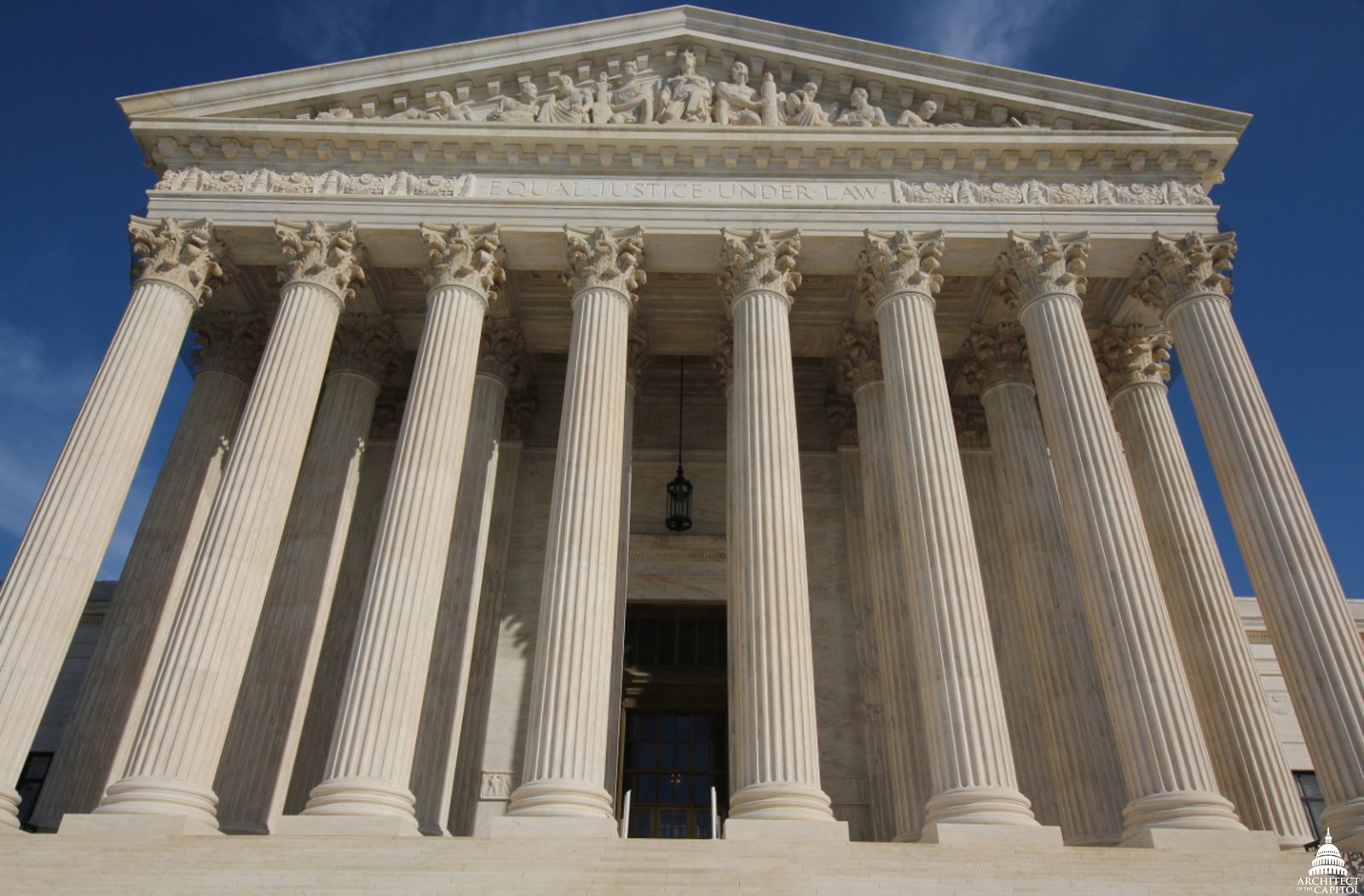
Court Watch is a weekly digest of notable federal and state court developments. This edition covers actions from the final stretch of July through the week of Aug. 3, 2026. With the U.S. Supreme Court in its summer recess following the close of the 2025–26 term on June 30, most high-court activity has shifted to the interim, or “emergency,” docket, while federal appeals and district courts continued to work through a heavy slate of election-, immigration-, and antitrust-related litigation. All items below are sourced to public records and reporting; pending matters are flagged as such.
Supreme Court
Emergency docket remains the main venue during recess. With no merits arguments scheduled over the summer, the Supreme Court’s interim docket has continued to draw attention. According to SCOTUSblog, the Court on July 7 denied requests from a youth-advocacy organization and a trade group to reinstate district-court orders that had barred Texas from enforcing a law requiring parental consent and age verification to download apps and to make in-app purchases. The order, issued without a full opinion, left the Texas statute in effect while litigation proceeds in the lower courts. Trackers maintained by the Brennan Center for Justice and Ballotpedia document the volume of emergency applications the Court has resolved over the past year, many of them arising from challenges to executive-branch actions.
The recess follows a term in which, as U.S. News & World Report reported, the Court decided more substantive matters on its emergency docket than on its traditional merits docket for the first time. In early July, the justices declined to permit the removal of a Federal Reserve governor, an emergency-docket action that several members of the Court criticized in separate writings for resolving a consequential question on an expedited basis. Reporting indicates the order divided the justices over process as much as outcome; readers should consult the Court’s published orders for the precise dispositions, which were issued without a full majority opinion.
The summer lull is expected to give way to a full argument calendar when the Court reconvenes for its next term in October. Several emergency applications tied to the disputes discussed below — particularly the election-administration and immigration cases — could reach the justices before then if the government seeks a stay.
Federal Courts of Appeals
First Circuit leaves block on federal voter-list order in place. In the most consequential appellate development of the period, the U.S. Court of Appeals for the First Circuit on July 26 declined to disturb a lower-court injunction that halted a March executive order directing the creation of a federal “state citizenship list” of eligible voters and restricting U.S. Postal Service delivery of mail ballots to people on that list. According to CBS News and The Washington Post, the ruling rejected the administration’s effort to move forward with the mail-voting restrictions in the 23 states that had sued ahead of the November midterm elections.
The appellate decision followed a preliminary injunction issued in June by U.S. District Judge Indira Talwani in Boston, who concluded that the challengers were likely to succeed on their argument that the Constitution assigns authority over election rules to the states and Congress rather than the president. Reporting by Votebeat notes that the injunction applies only in the jurisdictions that joined the suit — a consequence of the Supreme Court’s 2025 decision in Trump v. CASA, which curtailed the availability of nationwide injunctions. The administration has defended the order as a safeguard against noncitizen voting; the Justice Department said it was “reviewing all options,” leaving open the possibility of an emergency application to the Supreme Court.
D.C. Circuit keeps Haitian TPS protections in place, for now. A three-judge panel of the U.S. Court of Appeals for the D.C. Circuit in late July denied the government’s renewed motion for a stay that would have allowed it to end Temporary Protected Status for Haitian nationals, according to an analysis by law firm Greenspoon Marder and reporting from The Haitian Times. The panel’s order preserved protections and associated work authorizations while the underlying appeal proceeds. The dispute concerns the scope of executive discretion to wind down a humanitarian designation, and the litigation remains active; the procedural posture may change quickly, so readers should treat the current status as provisional.
Federal Circuit issues early-August patent decisions. The U.S. Court of Appeals for the Federal Circuit, which handles patent and certain government-claims appeals, released several opinions in early August even though it was not sitting for oral argument. Court records compiled by Justia and the court’s own calendar list precedential decisions issued Aug. 4, including Scilex Pharmaceuticals Inc. v. Aveva Drug Delivery Systems, Inc. The opinions turn on technical questions of patent validity and infringement; practitioners should consult the slip opinions for the courts’ specific holdings.
Federal District Courts
Paramount–Warner Bros. merger remains frozen amid antitrust challenge. In the Northern District of California, U.S. District Judge Araceli Martínez-Olguín on July 23 extended an order blocking the proposed Paramount–Warner Bros. Discovery merger for an additional 14 days, meaning the transaction cannot close before Aug. 18, according to Variety. The extension followed an initial 14-day temporary restraining order the judge issued July 20, reported by NPR and CNBC.
A coalition of 12 state attorneys general alleges the combination would violate the Clayton Act by reducing competition in the markets for basic-cable licensing and theatrical distribution. The Writers Guild of America has filed a separate challenge to the roughly $111 billion deal, contending it would suppress writers’ compensation. As Deadline reported, Paramount pressed for a multi-day evidentiary hearing to cross-examine the states’ witnesses, while the states urged the court to rule on the injunction motion without a lengthy hearing. A hearing on the preliminary-injunction request was set for Aug. 3, with the judge indicating the guild’s motion would be resolved on the same schedule. The outcome of that hearing had not been finalized as of this writing, and the matter is best treated as pending. Filings indicate that, beginning Oct. 1, Paramount would owe Warner shareholders roughly $650 million for every 90 days the deal is delayed, with a breakup fee reportedly reaching $7 billion if the transaction is not completed by June 4, 2027.
Underlying election-order litigation continues in Boston. The district-court proceedings that produced the voter-list injunction discussed above remain active in the District of Massachusetts. Plaintiffs’ counsel and advocacy organizations, including materials published by Elias Law Group, have characterized the rulings as barring implementation of the registration and mail-ballot provisions in the participating states for the November election. Because the case is being litigated on parallel tracks — trial-court merits proceedings and appellate review — the operative rulings may evolve, and the summaries here reflect the record as reported.
State Courts
Virginia firearms law faces statewide preliminary injunction. At the state level, reports indicate that a Washington County (Va.) Circuit Court judge expanded a preliminary injunction against Virginia’s new restrictions on certain semi-automatic firearms and magazines, commonly referenced as SB 749, so that it applies statewide effective July 21. According to a grassroots judicial report and an account from plaintiffs’ counsel, the court concluded the injunction should reach beyond the named parties. These accounts come from sources aligned with the challengers; the ruling is a preliminary one in ongoing trial-court litigation and is subject to further proceedings and likely appeal, so it should not be read as a final decision on the statute’s validity.
Ohio Supreme Court activity. Among state high courts, the Supreme Court of Ohio was active in early August. Its daily case announcements reflect routine but noteworthy docket management, including the Aug. 4 acceptance for review of Shawnee Ridge Hunting, L.L.C. v. LaRose and the publication on Aug. 3 of official versions of several previously released opinions. Decisions accepted for review this summer will be briefed and argued in the coming months; the Ohio court’s docket is available through public case databases.
Cases to Watch
Several matters could produce significant rulings in the coming week. The most closely watched is the Paramount–Warner Bros. Discovery preliminary-injunction decision: with the current freeze set to expire Aug. 18 and the parties disputing whether a multi-day evidentiary hearing is warranted, Judge Martínez-Olguín’s ruling will determine whether one of the largest media transactions in recent memory can proceed while the antitrust case is litigated. Second, the federal voter-list dispute bears watching for any emergency application to the Supreme Court, given the Justice Department’s statement that it is weighing its options and the approaching November election calendar. Third, the Haitian TPS litigation in the D.C. Circuit remains fluid, and further orders on the government’s stay requests could come at any time. Finally, state high courts — including Ohio — will continue to add cases to their fall dockets, several of which raise election-administration and regulatory questions likely to feature in future editions of Court Watch.
This digest summarizes publicly reported court actions and links to primary and secondary sources where available. Pending matters are noted as such; nothing here should be construed as legal advice. Corrections and additional documentation can be directed to the editor.