

The Investigative Journal’s weekly tracker of bills, budget scores, and rulemakings that matter. All claims are sourced to public records linked below.
Both chambers of Congress have left Washington — the House until August 31 and the Senate until September 14, according to industry legislative trackers — but the paper trail they left behind sets up a consequential September. Before adjourning, the Senate passed a stopgap funding bill on a 90-6 vote, a farm bill collapsed in committee, and the Congressional Budget Office quietly added $200 billion to its deficit projection for the fiscal year that ends September 30. Here is where the record stands.
1. Senate passes stopgap funding through December 11 on a 90-6 vote
Status: Passed Senate August 8; awaiting House action in September.
The Senate voted 90-6 on August 8 to approve a continuing resolution extending fiscal 2026 funding levels through December 11, pushing the shutdown deadline past the midterm elections, Roll Call reported. According to the CBO cost estimate posted August 5, Division A of the Continuing Appropriations and Extensions Act, 2027 would extend, through December 11, 2026, the appropriations and authorities contained in all 12 annual fiscal 2026 appropriations acts, with divisions B through D scored as authorizing legislation excluded from pay-as-you-go scorecards.
Press accounts indicate the measure maintains funding for highway, rail, and transit programs and makes targeted adjustments for the WIC nutrition program, national security shipbuilding, and the Disaster Relief Fund, CBS News reported. The lopsided vote came after what the Washington Post described as hours of tense pre-recess negotiations, a package of early morning votes that also cleared the way for confirmation of Todd Blanche as attorney general.
2. Two chambers, two deadlines: reconciliation fight ahead
Status: House passed H.R. 9770 (through December 4); Senate version runs to December 11.
The Senate bill is not the end of the story. The House passed its own continuing resolution in late July — H.R. 9770, which extends funding only through December 4 — on a 220-205 vote, according to the House Appropriations Committee and NPR. The two chambers must reconcile the one-week gap between deadlines — and more substantive policy differences — before anything reaches the president’s desk. The House is not expected to vote until the first week of September, trackers indicate, leaving roughly four weeks of floor time before the September 30 funding expiration.
The most significant substantive difference: the Senate version includes a provision delaying the Office of Management and Budget’s proposed rewrite of the Uniform Guidance governing federal grants, which records indicate would otherwise take effect October 1. The National Association of Counties, which supported the delay, notes the Uniform Guidance governs every federal grant, cooperative agreement, and pass-through award counties receive. The House bill contains no comparable language.
3. The OMB grants rule becomes a bipartisan flashpoint
Status: Proposed rule; effective date would slip to at least December 11 under Senate CR.
The grants provision is worth tracking in its own right. The delay language was a bipartisan Senate product, Inside Higher Ed reported, and outside pressure is building for more than a pause: the U.S. Conference of Mayors on August 8 called on Congress to permanently block the rule, arguing it would open grant awards to political interference. Research and health organizations including the AACR have applauded the delay.
Whether the provision survives House-Senate reconciliation will signal how much appetite exists in the House for constraining OMB’s grantmaking overhaul. For grantees — states, counties, universities, hospitals — the difference between an October 1 effective date and a December 11 delay is a compliance planning question with real budget consequences.
4. Farm bill fails in committee over SNAP error-rate dispute
Status: Failed Senate Agriculture Committee markup, 10-11, on August 6; chairman targeting September retry.
The Senate Agriculture Committee’s August 6 markup of the Agricultural Act of 2026 — Chairman John Boozman’s “Farm Bill 2.0” — failed on a 10-11 vote, Iowa Capital Dispatch reported. The sticking point, according to reporting and committee statements, was the timeline for states with high SNAP payment error rates to begin sharing benefit costs: the bill offered a one-year delay for states with error rates between 6 and 14 percent, while Democrats sought two years.
Boozman, who had released updated bill text ahead of the meeting, called his error-rate flexibility proposal “the best and final offer” in his opening remarks. Farm-state stakeholders now face another month of uncertainty on commodity programs, crop insurance, and nutrition policy; the chairman has indicated he intends to reconvene the committee in early September, per trade press accounts.
5. CBO adds $200 billion to the fiscal 2026 deficit projection
Status: Published estimate; fiscal year closes September 30.
The Congressional Budget Office now projects the fiscal 2026 deficit at $2.1 trillion, up from the $1.9 trillion it projected in February, The Hill reported. The agency attributes the revision mostly to customs collections running below expectations after the Supreme Court’s February decision striking down tariffs imposed under the International Emergency Economic Powers Act; CBO estimates 2026 tariff and customs-duty collections will come in roughly $250 billion below its earlier projections, according to the same report.
CBO’s monthly budget review data show the government ran a deficit of nearly $1.8 trillion through the first ten months of fiscal 2026 — about $169 billion more than the same period a year earlier. The figures land in the middle of the appropriations fight and will frame the December debate over full-year spending bills.
6. NDAA: House done, Senate stalled
Status: H.R. 8800 passed House July 22; S. 4784 reported but awaiting Senate floor time.
The House passed its $1.15 trillion fiscal 2027 National Defense Authorization Act (H.R. 8800) on a narrow 216-212 vote on July 22, Breaking Defense reported. The Senate Armed Services Committee completed its markup and reported S. 4784 (S. Rept. 119-127) in June, but the bill did not receive floor consideration before recess, per the Congressional Research Service status tracker.
The NDAA has become law for more than six consecutive decades, and records suggest the practical question is timing, not passage: with the Senate out until September 14 and appropriations consuming floor time, conference negotiations on the defense bill are likely to stretch deep into the fall.
7. Appropriations scoreboard: House 12-for-12 in committee, Senate at zero
Status: 2 of 12 House bills passed on the floor; no Senate bills marked up.
Behind the CR fight sits a stark asymmetry. The House Appropriations Committee has approved all 12 fiscal 2027 bills and passed two on the floor, while the Senate has yet to begin formal consideration of any, according to the Committee for a Responsible Federal Budget’s appropriations tracker. Senate appropriators have prioritized bipartisan negotiations over topline discretionary levels before moving individual bills, a standstill that advocacy groups tracking the process say has delayed release of bill text entirely. The Congress.gov appropriations status table tracks each bill’s progress.
The practical implication: whichever CR deadline survives reconciliation — December 4 or December 11 — Congress will be writing full-year fiscal 2027 spending bills in a lame-duck session with almost no Senate committee work banked.
8. Comment window closes on FRA move to rescind signal-employee certification rule
Status: Comment period closed August 13.
Today marked the comment deadline on the Federal Railroad Administration’s proposal to rescind its final rule requiring certification of railroad signal employees, according to the Federal Register notice extending the comment period. The proposal, first published in May, is part of the administration’s broader deregulatory docket; the extension notice indicates FRA will now review submissions before deciding whether to finalize the rescission.
Rail labor organizations and safety advocates have contested similar rescissions in the past, and any final rule is likely to draw litigation scrutiny — a docket worth watching for readers tracking how deregulatory actions fare in court.
9. State watch: California’s AI transparency mandate takes effect
Status: In effect as of August 2, 2026.
California’s AI Transparency Act (SB 942) became operative August 2, requiring large generative AI providers to offer watermarking, latent content disclosures, and AI-detection tools for AI-generated content, according to legal analyses tracking state AI law. Because covered providers operate nationally, the practical effect reaches well beyond California — the familiar pattern of Sacramento setting de facto national compliance standards while Congress debates preemption.
The state-federal collision is live: analysts note a federal executive order and pending congressional proposals signal efforts to constrain state AI regulation, making California’s implementation a test case for how far state mandates run before federal law intervenes.
On TIJ’s Radar
Three threads from this week’s record connect directly to our accountability beats. First, the OMB Uniform Guidance fight is at bottom a dispute over who controls federal grant dollars and under what documentation standards — the same records we rely on to trace grant flows. Second, the SNAP error-rate impasse turns on state payment-error data, a program-integrity metric worth independent scrutiny regardless of which delay timeline prevails. Third, CBO’s $250 billion downward revision in customs collections is a reminder that tariff enforcement and customs revenue — central to our ongoing reporting on cross-border logistics and de minimis shipping — now materially move the federal balance sheet. We will track all three when Congress returns.
Corrections and right of reply: The Investigative Journal contacted no individual subjects for this tracker, which is based entirely on public records and published reports linked above. Officials named are public figures acting in official capacities; we welcome responses at gravitassynergy@gmail.com.
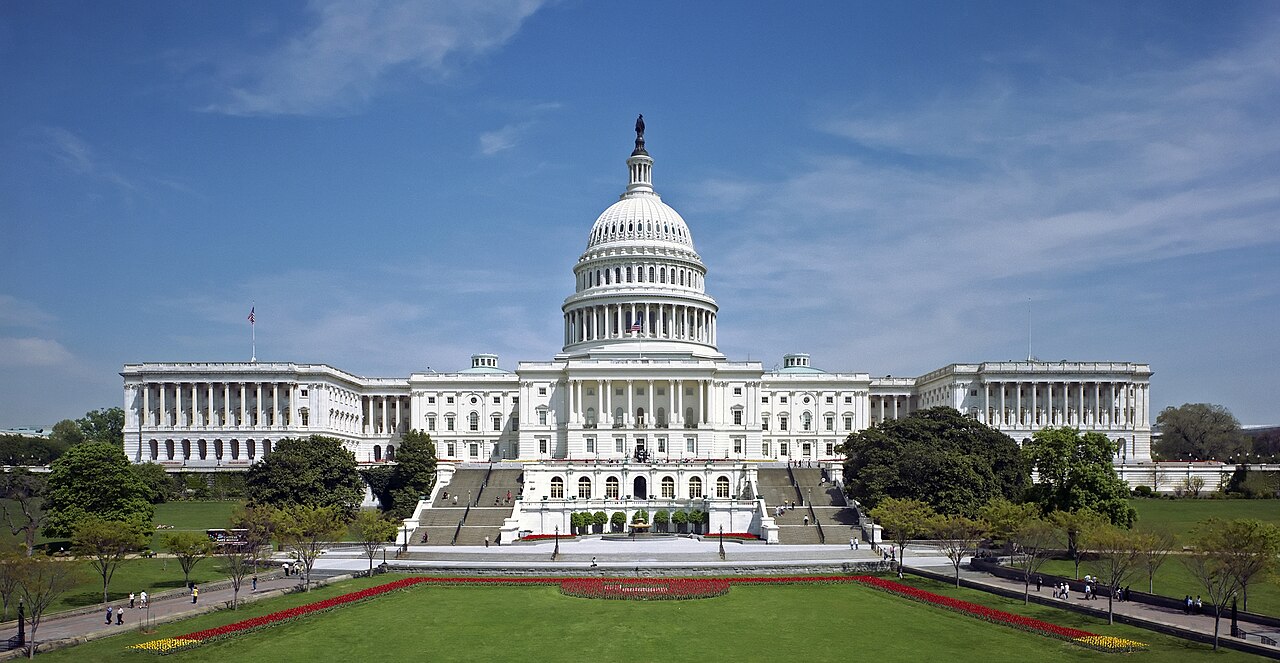
Photo: The west front of the United States Capitol. Credit: David Iliff, CC BY-SA 3.0, via Wikimedia Commons.