

The Investigative Journal’s daily review of notable filings on the Securities and Exchange Commission’s EDGAR system, together with the Commission’s enforcement docket. Every item below is drawn from public records linked in the text.
The second-quarter institutional ownership picture came into focus on Friday, August 14 — the statutory deadline for Form 13F reports covering the quarter ended June 30 — and the headline belongs to Berkshire Hathaway, whose filing shows the conglomerate become a net buyer of equities for the first time in three and a half years. The same Friday brought an unusual regulatory anticlimax: the Commission cancelled, one day before it was scheduled, an open meeting at which it was expected to propose its first tailored offering rules for crypto assets. On the enforcement side, the week produced fraud charges against a Nasdaq-listed crowdfunding-platform operator and against three New Jersey men in an alleged $47 million affinity fraud. Here is what stood out.
Berkshire Hathaway’s 13F: a $19.8 billion turn toward buying
Berkshire Hathaway’s Form 13F-HR for the quarter ended June 30, 2026, filed with the SEC after Friday’s close, reports a U.S. equity portfolio of approximately $299.3 billion spread across 29 positions — the same position count as the prior quarter, but with markedly different composition. Analysis of the filing published by Forbes indicates Berkshire bought roughly $23.5 billion of stock against $3.7 billion of sales in the quarter — net purchases of almost $19.8 billion, the company’s first net-buying quarter after fourteen consecutive quarters as a net seller.
The filing shows Alphabet as Berkshire’s third-largest holding, a stake press reports place at roughly $36.6 billion, behind Apple and American Express and ahead of Coca-Cola and Bank of America. Warren Buffett, who handed the chief executive role to Greg Abel at the start of the year while remaining chairman, told CNBC on July 15 that the Alphabet position was his: “I initiated it.” The portfolio grew still more concentrated — the top five holdings account for 76.5 percent of the reported portfolio and the top ten for 91 percent, according to the Forbes analysis. The quarter’s single new name was a small position in homebuilder D.R. Horton, while Constellation Brands was eliminated entirely and Bank of America was trimmed for an eighth consecutive quarter. Berkshire’s Delta Air Lines stake, built over the first half of the year, stands at about $5.4 billion, which records suggest makes it the airline’s second-largest shareholder.
The 13F captures only U.S.-listed equities, so it understates the breadth of Berkshire’s recent deployment of capital. The company separately closed its acquisition of homebuilder Taylor Morrison Home Corporation on July 24 for about $6.8 billion in cash. Taken together, the records depict a conglomerate that has resumed putting money to work in Abel’s first year as chief executive — a shift investors had waited on through years of cash accumulation. Berkshire’s own quarterly reports are available on the company’s investor site.
Pershing Square’s consolidated $19.5 billion book
Among the wave of Friday deadline filings, Pershing Square Inc. — the New York-listed management company of William Ackman’s investment platform — submitted a 13F holdings report disclosing 15 reportable positions with an aggregate information-table value of $19,465,692,772 as of June 30. The report, signed by Ackman as authorized signatory, consolidates six affiliated managers, including Pershing Square Capital Management, L.P.
The filing is a reminder of how concentrated the Ackman platform remains: fifteen names across nearly $19.5 billion, a portfolio construction philosophy that leaves little room for error but has defined the firm for two decades. The disclosure, accepted by EDGAR at 4:27 p.m. Friday, will be parsed closely for position changes now that the management company itself answers to public shareholders.
Skye Bioscience’s 8-K: a reverse merger that values the acquirer at $14.5 million — or $2 million
San Diego-based Skye Bioscience (Nasdaq: SKYE) disclosed in a current report filed August 14 — also filed as proxy soliciting material ahead of a special shareholder vote — that it has agreed to acquire UK-based Redx Pharma Limited through an English scheme of arrangement. The structure is, in economic substance, a reverse takeover: filings indicate pre-transaction Redx equityholders are expected to own approximately 46.17 percent of the combined company, investors in roughly $104 million of concurrent financings about 48.45 percent, and legacy Skye holders approximately 5.38 percent. Redx’s management team, led by incoming chief executive Lisa Anson, will run the combined company, and Skye’s current officers and directors are expected to tender their resignations at closing.
The filing contains a disclosure that merits attention: Skye’s $14.5 million attributed equity value is subject to something the agreement calls the “Specified Adjustment.” If that matter — which the 8-K does not describe — is not resolved by closing, Skye’s valuation in the exchange ratio automatically falls to a $2.0 million floor, an 86 percent haircut to its negotiated worth. The report also discloses separation agreements for chief executive Punit Dhillon and executive Tu Diep, contingent value rights entitling legacy holders to 90 percent of net proceeds from dispositions of Skye’s pre-merger assets, and a committed financing package that includes a $67.9 million securities purchase agreement (expandable to $72.9 million), a $36 million Redx Series A round, and a $22 million equity line with a fund affiliated with Redmile Group.
Separately, the same report states that Skye’s board approved a 1-for-8 reverse stock split, expected to take effect on or about August 24, to lift the share price back above the $1.00 minimum required by Nasdaq Listing Rule 5550(a)(2). Approximately 35.4 million outstanding shares will become roughly 4.4 million. Shareholders will be asked to approve the share issuance and change of control at a special meeting to be noticed in a forthcoming proxy statement; the company’s filings are collected at its investor relations page.
The crypto rulemaking that wasn’t: SEC pulls Friday’s open meeting
The Commission had noticed an open meeting for 10:00 a.m. Friday, August 14, with a single agenda item: whether to propose “new rules to create a tailored offering regime for certain investment contracts involving crypto assets.” It never happened. The meeting page, updated August 13, now lists the session as cancelled, alongside the Sunshine Act cancellation notice; the page offers no elaboration on the reason.
The significance lies in what the proposal was expected to be. Industry press, including CoinDesk, reported that the item would have been the Commission’s first formal crypto rulemaking proposal under Chairman Paul Atkins, converting staff guidance into a durable offering framework. A last-minute cancellation of a noticed Commission vote is uncommon, and the Commission has not publicly rescheduled the item as of this writing. Whether the delay reflects drafting refinements, a votes problem at the Commission table, or coordination with parallel legislative activity is not knowable from the public record — but issuers structuring token offerings around anticipated rules will now wait longer for certainty.
Enforcement: Netcapital and its officers charged over alleged sham revenue
The SEC announced in Litigation Release No. 26607 that on August 10 it filed a civil complaint in federal court in Boston against Netcapital Inc. — operator of a Regulation Crowdfunding platform — and five affiliated individuals, alleging a scheme to overstate revenue while the company raised more than $25 million from investors. According to the complaint, from roughly October 2021 through January 2024 Netcapital improperly recognized nearly $14 million in revenue from consulting agreements the SEC alleges were fictitious — some allegedly forged — overstating revenue by approximately 345 percent. The purported consulting clients, the complaint alleges, were startups seeking to raise money from the public under Reg CF.
The named defendants include John Fanning, who the SEC alleges functioned as an officer without holding the title; his wife Coreen Kraysler, the company’s chief financial officer; former chief executive Martin Kay; accountant Paul Riss; and Cecilia Lenk, a prior chief executive of the relevant subsidiary. The Commission seeks injunctions, disgorgement, officer-and-director bars, and civil penalties. These are allegations, and the litigation is pending; the defendants have not been adjudicated liable. One exception is already partially resolved: without admitting the allegations, Lenk consented to a proposed judgment, subject to court approval, that would impose injunctions and a $50,000 penalty.
The case lands two weeks after the Commission established a specialized Financial Reporting and Accounting Unit within the Enforcement Division — a signal, records suggest, that accounting-fraud cases against smaller public companies are again a priority. For the crowdfunding ecosystem, the allegations cut deeper: Netcapital’s platform is itself a gatekeeper through which retail investors access early-stage offerings.
Enforcement: alleged $47 million affinity fraud in Toms River
In the week’s other significant enforcement action, the SEC announced charges against three Toms River, New Jersey residents — Leor Moshe, Jacob Goldman, and Isaac Odes — in connection with an alleged $47 million fraud that targeted members of Orthodox Jewish communities. The complaint, filed in the District of New Jersey and summarized in Litigation Release No. 26610 dated August 13, alleges that from about November 2019 through June 2023, Moshe raised money through his company Capital Funding ASAP LLC on the promise that investor funds would finance short-term small-business loans at fixed returns of between 9 and 53 percent.
Instead, the SEC alleges, Moshe misappropriated more than $11 million for personal use and directed more than $850,000 in Ponzi-like payments to earlier investors. Goldman and Odes, who were not registered as brokers, allegedly solicited more than $23 million from at least 25 investors in exchange for compensation. The complaint states that investors across seven states lost more than $25 million. Moshe is charged with violating antifraud provisions; Goldman and Odes with broker-registration violations. As with all pending SEC civil actions, the complaint’s claims are allegations that the defendants are entitled to contest in court.
On TIJ’s radar
Several threads from this digest warrant deeper reporting. First, Skye Bioscience’s undescribed “Specified Adjustment” — a contingency capable of cutting the company’s merger valuation from $14.5 million to $2 million — is a conspicuously consequential unknown for a Nasdaq-listed issuer, and the forthcoming proxy statement should be read closely when it is filed. Second, the Netcapital complaint raises structural questions about Regulation Crowdfunding gatekeepers that extend beyond one company; the alleged use of the platform’s own startup clients as instruments of revenue inflation deserves examination across the sector. Third, the cancelled crypto rulemaking: the gap between a noticed Commission vote and its eleventh-hour withdrawal is exactly the kind of procedural crevice worth prying open with the meeting record and any forthcoming reproposal. And finally, 13F season’s second-order story — the deepening concentration of the largest portfolios, from Berkshire’s 76.5 percent top-five weighting to Pershing Square’s fifteen names — will shape how much single-stock risk sits inside vehicles that retail investors treat as diversified proxies.
Methodology and right of reply: This digest reports exclusively from public government records and filings linked above, supplemented by the credited press analyses. No comment was sought from the companies or individuals named prior to publication of this filings summary; entities wishing to respond may contact The Investigative Journal, and responses will be noted in future coverage. Allegations in SEC complaints are just that — allegations — unless and until a court enters judgment.
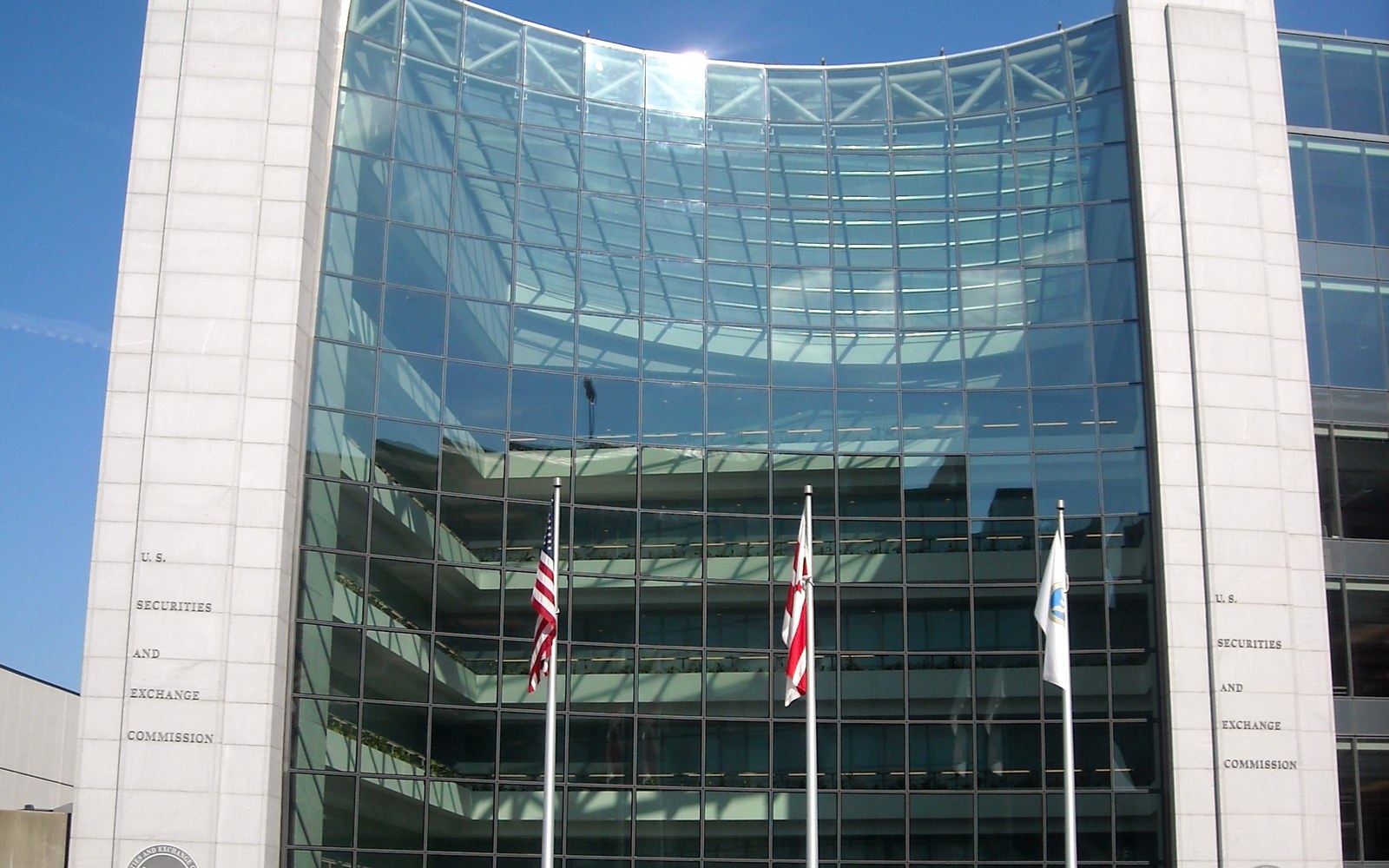
Featured image: U.S. Securities and Exchange Commission headquarters, Washington, D.C. Photo by AgnosticPreachersKid via Wikimedia Commons, CC BY-SA 3.0.
