

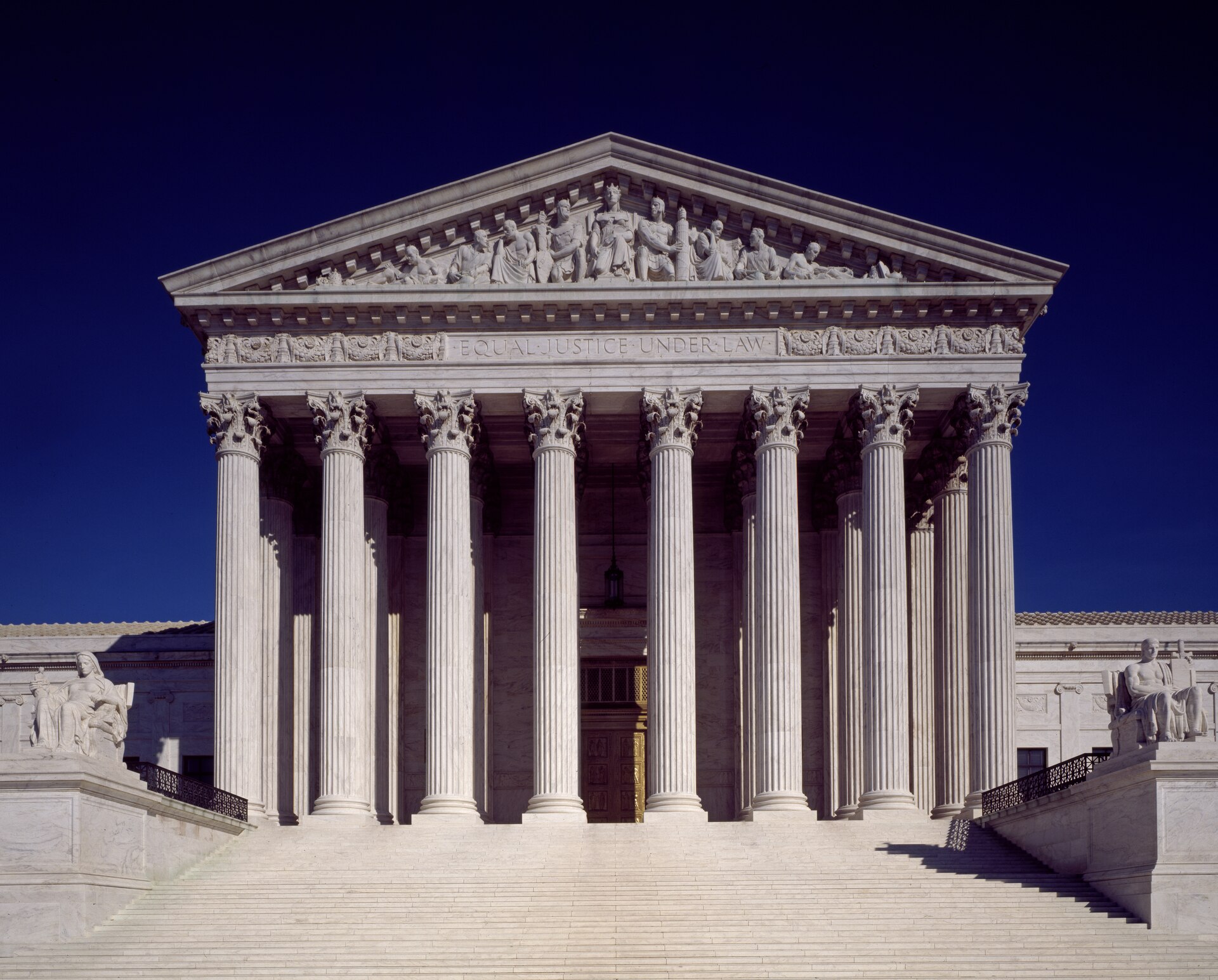
The Supreme Court’s emergency docket flared again during the justices’ summer recess, with the Trump administration filing papers in two separate disputes — over construction of the new White House ballroom and over the president’s mail-voting executive order — in the span of three days. Below the high court, federal appeals panels ruled on immigration detention and environmental permitting, district judges in Massachusetts handed down consequential decisions on election administration and campus civil-rights enforcement, and Ohio’s high court issued rulings touching workplace safety and the state’s fast-growing data-center economy. Here is The Investigative Journal’s roundup of the week’s notable court actions, compiled from public filings and court records.
Supreme Court
Administration asks justices to let White House ballroom construction resume
The Trump administration asked the Supreme Court late in the week to lift a lower-court order that halted above-ground construction of the new White House ballroom, according to SCOTUSblog. In the application, Solicitor General D. John Sauer called Senior U.S. District Judge Richard Leon’s injunction “extraordinary and unlawful,” writing that it “will halt the ongoing construction of the integrated military complex, including a totally secure ballroom space, at the East Wing of the White House, which is vitally required by national security.”
The filing came one week after a divided D.C. Circuit panel upheld Leon’s ruling, with Judges Patricia Millett and Bradley Garcia concluding that Congress, not the president, “has exclusive authority to regulate the construction and demolition of White House structures.” The panel gave the government 14 days to seek Supreme Court review. Court records indicate Leon’s order permits underground work and safety-related construction to continue while blocking the 90,000-square-foot ballroom project above ground. The National Trust for Historic Preservation, which sued after the East Wing was demolished in October 2025, said every court to review the case so far has found the ballroom construction unlawful. The docketed case is National Park Service v. National Trust for Historic Preservation (26A203).
Government presses for prompt action on mail-ballot order as second injunction lands
Solicitor General Sauer filed a supplemental brief Wednesday urging the justices to “act promptly” on the administration’s pending emergency application to unblock Section 3 of the president’s March mail-voting executive order, filings indicate. That section directs the U.S. Postal Service to begin a rulemaking on ballot-envelope design — including unique barcodes — and provides that USPS “shall not transmit mail-in or absentee ballots” from voters whose names do not appear on state-specific lists. The administration’s original application, filed July 27, seeks a stay of a June injunction won by 23 states and the District of Columbia.
Sauer argued the challenges are premature because the order “merely instructs agencies to pursue a proposed policy in a manner that is consistent with law,” and warned that without prompt relief the lower-court orders “will effectively run out the clock” on implementing Section 3 before November. Notably, the filing also asked the justices to explain the rationale for any order they issue — a request that comes amid ongoing debate over unexplained emergency-docket rulings. NewsNation reported that the twin applications have put the court “in the hot seat” in the thick of its recess.
Federal Appeals Courts
First Circuit: detained noncitizens are entitled to bond hearings
A First Circuit panel on Thursday upheld a Massachusetts district court ruling that the administration’s 2025 policy of categorically detaining noncitizens without bond hearings is unlawful. In Guerrero Orellana v. Moniz, the court held that the mandatory-detention provision of 8 U.S.C. § 1225(b)(2)(A) applies to noncitizens “seeking admission” at the border — not to people already living in the country after unlawful entry, who remain eligible for bond hearings under § 1226(a).
The policy at issue stems from July 2025 DHS guidance, later adopted by the Board of Immigration Appeals, that reversed a 29-year-old reading of the 1996 immigration statute. According to the ACLU of Massachusetts, the First Circuit is now the seventh federal appellate court to reject the government’s interpretation. The ruling applies to a certified class of people arrested by immigration officers and held in New England detention facilities; the lead plaintiff, a Salvadoran national arrested in September 2025, was released on a $3,500 bond after the district court ordered a hearing. Docket records are available via the Civil Rights Litigation Clearinghouse (D. Mass. No. 1:25-cv-12664).
Eleventh Circuit clears EPA approval of phosphogypsum test road
A unanimous Eleventh Circuit panel on Aug. 12 rejected the Center for Biological Diversity’s challenge to the EPA’s approval of Mosaic Fertilizer’s experimental use of phosphogypsum — a mildly radioactive byproduct of phosphate fertilizer production — in road construction on the company’s private land at its New Wales facility in Polk County, Florida. The EPA approved the request in December 2024, and the test roads were laid in November 2025 as part of an 18-month study, records show.
The environmental group had argued the agency relied on outdated risk data and departed from its own 1992 conclusion that using phosphogypsum in roads “presents an unacceptable level of risk to public health.” The panel sided with the EPA’s reading of its authority under the Clean Air Act program governing the material. The decision is a win for the fertilizer industry, which has long sought beneficial-reuse options for the more than one billion tons of phosphogypsum stacked in Florida.
Federal District Courts
Judge blocks USPS mail-ballot restrictions nationwide
U.S. District Judge Indira Talwani of Massachusetts on Tuesday issued a preliminary injunction barring the Postal Service from implementing Section 3 of Executive Order 14399 anywhere in the country, in a case brought by the League of Women Voters and other nonpartisan voting groups, according to Votebeat. It is the second injunction against the order — Talwani’s June ruling covered the 24 jurisdictions that sued — and this one extends relief nationwide, Fox News reported.
In her 27-page ruling, Talwani rejected the government’s argument that the dispute was not ripe because USPS has not finalized its rules, writing that “the millions of citizens who rely on mail voting require clarity as to how or whether they will vote in November,” and that the order “is thus causing irreparable harm” through voter confusion, the opinion states. The Justice Department has told the Supreme Court the injunctions are premature and that delay itself causes irreparable harm to the government; that question now sits with the justices, as noted above.
Judge dismisses Justice Department’s Title VI suit against Harvard
U.S. District Judge Richard Stearns on Thursday dismissed the Justice Department’s civil rights lawsuit alleging Harvard University remained in violation of Title VI over its handling of campus antisemitism, the Harvard Crimson reported. In a brief four-page decision, Stearns found the incidents cited in the government’s amended complaint — concentrated in the 2023–24 school year, with three from March 2025 — “too isolated and episodic to support a plausible inference that any institutionalized noncompliance with Title VI persists at Harvard to this day.”
The suit, filed in March and amended in June, had sought to cut off future federal funding and claw back roughly $1 billion in grants. Stearns wrote that the government “misconstrues” the purpose of an enforcement action by treating it as punishment for past conduct rather than a means of securing future compliance, according to Fox News. The ruling did not decide whether Harvard violated civil rights law in the months after the Oct. 7, 2023 attacks. Assistant Attorney General Harmeet Dhillon said the department disagrees with the ruling and is assessing next steps, The Hill reported — a signal that an amended filing or appeal may follow.
State Supreme Courts
Ohio high court revives $1.9 million award in farm-equipment safety case
The Supreme Court of Ohio ruled Aug. 12 that a dairy worker severely injured by an unguarded rotating shaft did not have to prove his employer never intended to repair the equipment in order to pursue an intentional-tort claim, according to Court News Ohio. Writing for the majority in Camara v. Gill Dairy, L.L.C., Justice Jennifer Brunner held that under R.C. 2745.01(C), a worker need only offer evidence of the employer’s “deliberate removal” of a safety guard — “no more and no less” — to trigger a presumption of intent.
The decision found that the Twelfth District Court of Appeals wrongly overturned a $1.9 million jury award to Jose Camara, who was thrown over a sand spreader’s power take-off shaft in 2019 when his clothing caught on the unguarded part. The ruling clarifies the evidentiary burden in one of the few remaining paths Ohio workers have to sue employers outside the workers’ compensation system.
Ashville data-center referendum heads toward the ballot after Ohio ruling
Fallout continued this week from the Ohio Supreme Court’s near-unanimous Aug. 7 decision in State ex rel. McNamara-Smith v. Grube, which held that the village of Ashville could not use an “emergency” resolution to fast-track its agreement with developer EdgeConneX for two data centers and an 800-megawatt natural gas plant, the Ohio Capital Journal reported. The court found the village’s stated justifications “merely parrot” state law and failed to explain why a 30-day waiting period would delay the project.
The ruling sends residents’ referendum petition to the Pickaway County Board of Elections, which records indicate is now consulting the county prosecutor on whether the resolution was an administrative action exempt from referendum. The decision carries statewide implications as Ohio communities weigh a wave of data-center development: a separate petition fight over a large-scale data-center ban in Trenton is also headed to the high court.
Cases to Watch This Week
Summer order list. The Supreme Court is expected to issue a summer order list Monday, Aug. 17, with another scheduled for Sept. 4, per SCOTUSblog’s calendar — watch for action on pending emergency matters.
The mail-ballot application. The justices could rule at any moment on the administration’s request in the Executive Order 14399 litigation. With the midterms less than 12 weeks away, timing is now as consequential as the merits.
The ballroom stay request. A response from the National Trust and any administrative stay in No. 26A203 could come within days.
Immigration detention at the court. With seven circuits now aligned against the administration’s bond-hearing policy, filings suggest a petition for Supreme Court review is a realistic next step in Guerrero Orellana or a companion case.
Wassily v. Blanche. Briefing continues in what SCOTUSblog describes as the court’s next major asylum case, set for the fall term.
Editor’s note: Court Watch is compiled from public court records, opinions, and on-the-record statements; characterizations of parties’ positions are drawn from their own filings and public comments, including the Justice Department’s responses noted above. Rulings described here may be appealed, and allegations in pending cases are not findings of liability.