

The Investigative Journal’s weekly survey of international corruption enforcement, money laundering cases, and kleptocracy developments, drawn from public records, court filings, and the reporting of independent investigative outlets.
The week’s most consequential development came out of Kyiv, where Ukraine’s anti-corruption agencies say a laundering operation ran through a state-owned bank and reached into the Presidential Office itself — a case that will test whether Ukraine’s wartime anti-corruption architecture can hold senior officials to account. Elsewhere, the U.S. Treasury’s Financial Crimes Enforcement Network imposed a record penalty on UBS’s American brokerage arm, Lebanon indicted its former central bank governor for a third time, and the Justice Department secured a first-of-its-kind sentence against a banker who allegedly serviced a Russian-based Medicare fraud syndicate. Here is what the public record shows.
Ukraine: “Operation Forest Gump” Reaches Zelenskyy’s Inner Circle
Ukrainian President Volodymyr Zelenskyy dismissed senior aide Iryna Mudra on August 20 — the same day she said anti-corruption investigators had notified her of suspicion in a case involving the alleged laundering of 150 million hryvnias, roughly $3.3 million, according to reporting by the Organized Crime and Corruption Reporting Project (OCCRP). Ukraine’s National Anti-Corruption Bureau (NABU) and the Specialized Anti-Corruption Prosecutor’s Office said their operation, codenamed “Forest Gump,” uncovered a group that allegedly moved criminal proceeds through the formal financial system using state-owned Sense Bank and accounts belonging to shell companies under its control.
According to investigators, the cash was allegedly passed through a conversion center described in released recordings as a “laundry,” deposited into company accounts, and then used to post bail for an alleged member of a criminal organization investigated in the separate “Midas” corruption case. Investigators said the group included a deputy head of the Presidential Office, a former member of parliament, and the chairs of the state bank’s management and supervisory boards, though authorities did not name them in their public video. Sense Bank confirmed that law enforcement conducted investigative activities at its headquarters and said it is cooperating.
Mudra denies wrongdoing. In a statement published through her lawyers, she said she was not detained, is preparing for court, and described the investigators’ recordings as fragmented and out of context. “Accountability applies to everyone, myself included,” she said. The case matters beyond one official: it lands as Kyiv seeks continued Western reconstruction financing, and it follows NABU’s July action sending a former Ukrainian nuclear official to trial for allegedly demanding a “15 percent cut” on contracts. The suspicion notices are allegations, not findings; no court has ruled on the matter.
FinCEN Hits UBS With Record $125 Million Broker-Dealer Penalty
The Treasury Department’s Financial Crimes Enforcement Network assessed a $125 million civil penalty against UBS Financial Services Inc. for what the agency called “willful” violations of the Bank Secrecy Act — the largest penalty FinCEN has ever imposed on a U.S. broker-dealer. According to the agency’s announcement, reported August 3 by OCCRP, the firm failed to monitor more than $10 billion in foreign currency wire transfers and missed red flags on high-risk customers tied to Russia and Latin America, in some instances even after an internal affiliate raised concerns.
UBS admitted to the violations and agreed to retain an independent reviewer to evaluate its compliance program, with a specific focus on illicit-finance risks involving drug cartels, Russia, Iran, and Venezuela. The resolution is FinCEN’s second enforcement action against the firm for monitoring weaknesses, following a 2018 assessment that documented similar deficiencies.
The significance is structural. Broker-dealers have historically drawn lighter anti-money laundering scrutiny than banks, and repeat findings at a firm of UBS’s scale suggest the wealth-management channel remains a viable route for moving suspect funds into U.S. markets. The mandated review’s focus on cartel and sanctioned-jurisdiction exposure indicates where Treasury believes the residual risk sits.
Lebanon Indicts Ex-Central Bank Chief Salameh for a Third Time
A Lebanese judge filed new charges against former central bank governor Riad Salameh, 76, and Samir Hanna, 88, the former head of Bank Audi, over alleged embezzlement, money laundering, bribery, and illicit enrichment, according to Lebanon’s National News Agency and OCCRP reporting published August 11. Filings described by OCCRP allege the creation of shell companies, misappropriation of central bank funds, and the fraudulent use of those funds to purchase shares and bonds in commercial banks. Prosecutors requested an arrest warrant for Salameh; Hanna has reportedly posted $1 million bail. Both men deny wrongdoing, and Salameh has repeatedly denied all charges against him across multiple proceedings.
This is the second indictment of Salameh in Lebanon this year and the third overall, following a January 2026 indictment over an alleged $44 million embezzlement and a 2024 arrest tied to central bank commissions. European authorities separately allege he siphoned more than $300 million from Banque du Liban through a front company owned by his brother, with probes documented in Switzerland, France, Germany, and Luxembourg. He has denied those accusations as well.
The wider story is asset recovery. Under new leadership, Banque du Liban is pursuing civil claims against banks and executives to claw back funds lost in the 2019 collapse the World Bank ranked among the worst economic crises since the mid-19th century. The bank’s lead counsel told OCCRP’s partner Daraj that out-of-court settlements are off the table: “Money has to be returned; we are talking billions of dollars.”
“Concierge Banker” Sentenced in $10.6 Billion Medicare Laundering Case
A former Brooklyn bank branch manager, Renat Abramov, 37, was sentenced to 18 months in prison for helping a transnational criminal organization launder proceeds of what the Justice Department describes as the largest health care fraud scheme it has ever charged, according to DOJ and OCCRP. Prosecutors said Abramov acted as a “concierge banker” for straw owners of medical equipment companies, opening accounts through which more than $8 million in fraud proceeds passed and facilitating offshore transfers. He pleaded guilty in February to conspiracy to commit money laundering.
The underlying scheme, charged through the nationwide Operation Gold Rush takedown, allegedly involved a criminal organization based in Russia and elsewhere that used stolen personal and medical data from more than one million Americans to submit $10.6 billion in fraudulent Medicare claims. Federal authorities say they blocked all but roughly $41 million of the $4.45 billion scheduled for disbursement, though supplemental insurers still paid out about $900 million.
The conviction is the first time DOJ’s Health Care Fraud Unit has convicted a former bank employee of conspiring to launder health care fraud proceeds — a signal that enforcement is moving beyond fraudsters to the financial professionals who allegedly enable them. That enabler-focused theory of prosecution mirrors the approach anti-corruption bodies have urged for kleptocracy cases.
France: Prosecutors Seek Trial for BNP Paribas in Gabon “Ill-Gotten Gains” Case
French prosecutors are seeking to send BNP Paribas to trial in connection with the long-running “biens mal acquis” (ill-gotten gains) proceedings against the family of Gabon’s late president, according to OCCRP’s OpenLux project, which reported the development July 30. The ill-gotten gains docket — which has previously produced convictions and asset seizures against ruling families from Equatorial Guinea and elsewhere — has increasingly turned its attention to the financial institutions that allegedly held or moved the money, not only the politically exposed persons who acquired it.
If a trial proceeds, records suggest it would be one of the most significant tests to date of bank exposure in French kleptocracy litigation. BNP Paribas is entitled to contest the prosecutors’ request, and a trial referral is not a finding of guilt.
Sanctions Watch: IRGC-Linked Crypto Network and London Property
Two recent Treasury actions continue to ripple. In late July, the U.S. sanctioned relatives and associates of Iranian tycoon Babak Zanjani as part of a crackdown on an alleged Islamic Revolutionary Guard Corps-linked cryptocurrency network, per OCCRP reporting on the designations. Separately, an OCCRP news exclusive found that Hossein Ghorbani Zahed, newly designated by Treasury as an alleged “financier” of an Iranian oil network, holds roughly £25 million in Knightsbridge real estate through a sanctioned company — a fresh data point in the persistent pattern of London property serving as a store of value for sanctioned wealth. OFAC’s current designations are searchable in the SDN List, and its recent actions page logs an additional SDN designation earlier this month.
The through-line matches what Transparency International and the Financial Action Task Force have long flagged: beneficial-ownership opacity in real estate and corporate registries remains the load-bearing wall of sanctions evasion.
Leads Worth Deeper TIJ Investigation
Several threads from this week warrant follow-up. First, the Sense Bank angle in Kyiv: investigators allege the group obtained de facto control of a state-owned bank in June — how a nationalized institution’s governance was allegedly captured merits documentary reconstruction. Second, the UBS reviewer mandate: the compliance review’s cartel and Venezuela focus suggests specific typologies Treasury has seen; FinCEN’s assessment document deserves a close read. Third, the Gold Rush syndicate’s offshore leg: DOJ says funds moved offshore, but the destination jurisdictions remain publicly unmapped. Fourth, the intersection of the Zanjani-network designations with UK property records — Companies House and Land Registry filings may show additional holdings. Finally, Lebanon’s civil recovery campaign against commercial banks could become a template for post-collapse asset recovery elsewhere and merits sustained tracking.
Editor’s note: All charges described above are allegations unless a court has entered a conviction; defendants are presumed innocent. Where individuals have publicly responded, their denials are noted. The Investigative Journal welcomes responses from any person or entity named in this digest and will publish them as received. Claims are sourced to the linked public records and reporting; readers can consult the primary documents directly.
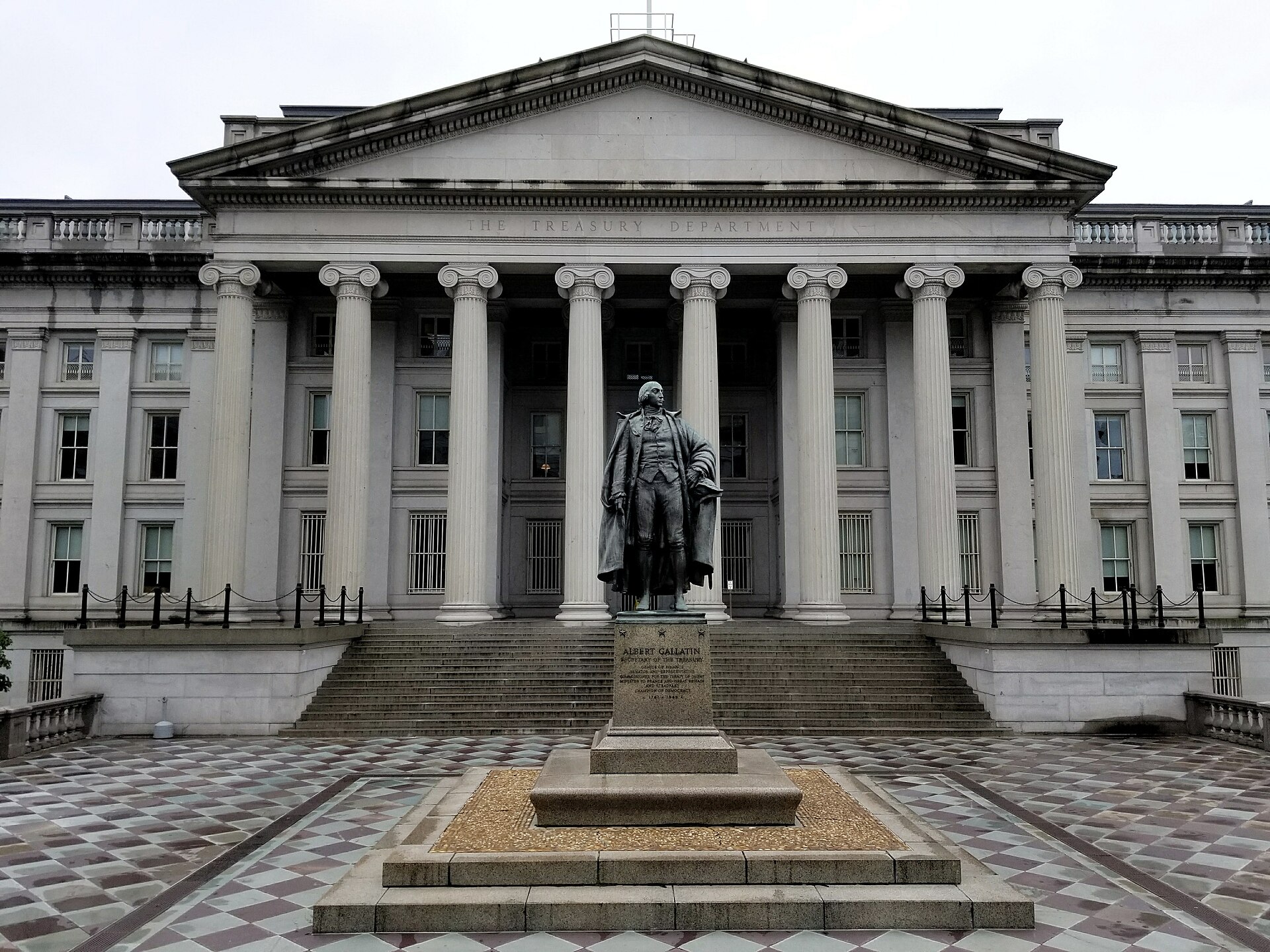
Featured image: U.S. Treasury Building, Washington, D.C. Photo: Sealy j via Wikimedia Commons, CC BY-SA 4.0.
