

DOJ Watch is The Investigative Journal’s daily review of federal enforcement activity, compiled from Justice Department press releases, court filings, and other public records. Every claim below is sourced to a linked public document.
The Justice Department’s first two days of September produced a run of enforcement actions that spans nearly the full breadth of the federal docket: a counterterrorism financing operation against Hamas, the sentencing of an American who admitted working for Chinese intelligence, a defense-contractor cybersecurity settlement, a nine-defendant racketeering murder indictment, two multimillion-dollar tax fraud prosecutions, and a guilty plea in a violent sex trafficking case. Below, TIJ reviews the seven most notable actions announced September 1–2, 2026, what the public records show, and which threads warrant deeper reporting.
1. FBI seizes $560,000 in Hamas-bound cryptocurrency, takes control of Al Qassam Brigades’ web infrastructure
The department announced September 1 that court-authorized seizures allowed the FBI to take approximately $560,000 in cryptocurrency donations destined for Hamas and to seize domains and servers — including the group’s main website, AlQassam.ps — that the designated Foreign Terrorist Organization used to raise money and recruit supporters on behalf of its military wing, the Al Qassam Brigades. According to the department, the seizures were executed under warrants dated March 25, 2025, June 25, 2025, and Oct. 10, 2025, with additional actions on July 29 and Aug. 18, 2026; the unsealed seizure affidavits are posted with the release.
Court documents allege that a group chat claiming association with Hamas on an encrypted platform directed supporters to a fundraising website that supplied a rotating set of cryptocurrency donation addresses. Investigators used multiple human sources to identify, trace, and seize the funds. “These seizures deprive Hamas of resources it relies on to recruit and radicalize individuals online and finance barbaric attacks like the one on October 7, 2023,” said Assistant Attorney General for National Security John A. Eisenberg. U.S. Attorney Jeanine Ferris Pirro for the District of Columbia added: “Your networks are not secure, your crypto is vulnerable, and we will not stop until your ability to wage war is defeated.”
The most consequential detail may be buried in the release: by capturing the group’s domains and servers, the FBI says it intercepted incoming donations and “obtained information regarding thousands of individuals who contacted Hamas online in an effort to donate or attempt to donate” — information the bureau says it will use in future counterterrorism efforts. The FBI’s Albuquerque Field Office is leading the investigation, with prosecution handled by the U.S. Attorney’s Office for the District of Columbia and the National Security Division’s National Security Cyber Section.
2. American who acted as an agent of Chinese intelligence sentenced to two years
Thomas Weir Pauken II, 51, an American citizen who lived and worked in the People’s Republic of China, was sentenced September 1 to two years in prison and 36 months of supervised release — with no overseas travel — for acting as an agent of a foreign government inside the United States. According to court documents, from at least 2019 until February 2026 Pauken took direction from people he knew worked for the PRC, including a handler he met in 2017 identified as “Cathy,” who prosecutors say worked with China’s Ministry of State Security.
Filings indicate Pauken received at least $100,000 for taskings that included meeting potential intelligence assets in the United States, supplying them with dedicated laptops and cellphones to communicate with his handler, relaying collection requirements, and passing the assets’ reports back to Beijing. Records also state that Pauken sold reports to a group of Chinese clients from Wuhan who sought information about U.S. technology and the Department of Justice itself — and who wanted Pauken to find an expert to help them engage in cyber espionage.
“Pauken betrayed his country for money,” said Assistant Attorney General Eisenberg. FBI Assistant Director Roman Rozhavsky said Pauken “admitted to working at the direction of China’s Ministry of State Security to attempt to infiltrate U.S. political circles while also providing new recruitment targets for his Chinese handlers.” The case was prosecuted in the Eastern District of Virginia — a two-year sentence for what prosecutors describe as a seven-year course of conduct.
3. Honeywell Aerospace pays $2.04 million over defense-contract cybersecurity allegations
Honeywell Aerospace Inc. agreed to pay $2,042,518 to resolve allegations that it violated the False Claims Act by failing to comply with cybersecurity requirements in a U.S. Department of Defense contract, the department announced September 1. The settlement resolves allegations that from April 2020 through December 2023, a business unit of Honeywell International Inc. submitted claims for payment while failing to meet the NIST Special Publication 800-171 security controls required by contract and regulation on one of its networks. It is important to note, as the department itself does, that the claims resolved by the settlement are allegations only and there has been no determination of liability.
The case began as a whistleblower lawsuit — United States ex rel. Rachel Tenney v. Honeywell International Inc., No. 3:22-cv-129 (W.D.N.C.) — filed by a former Honeywell employee, who will receive $375,823 as her share of the recovery under the False Claims Act’s qui tam provisions. “Government contractors that obtain defense information in administering their contracts must follow required cybersecurity standards,” said Assistant Attorney General Brett A. Shumate of the Civil Division.
The settlement extends a now-established enforcement pattern: DOJ treating contractor cybersecurity shortfalls as fraud on the government, with employee whistleblowers as the primary detection mechanism. For the defense industrial base, filings in this line of cases suggest that NIST 800-171 attestations carry real False Claims Act exposure.
4. Nine alleged gang members charged with RICO conspiracy and murder in Eastern Virginia
A second superseding indictment unsealed September 1 charges nine alleged members of the “Cautious District” subset of the United Bloods Nation — commonly called the Makk Ballers — with RICO conspiracy, racketeering murder and attempted murder, and firearms offenses. The indictment describes a violent street gang operating across Eastern Virginia, Maryland, and Delaware that allegedly engaged in murder, robberies, narcotics trafficking, and shootings.
According to the indictment, on Feb. 13, 2024, three defendants traveled from Virginia Beach to Accomack County, hid in the woods near a residence, and ambushed a man they believed had assaulted one of them days earlier, shooting him multiple times; the victim died. In a separate February 2024 incident, gang members allegedly fired dozens of rounds into a home where a rival was sleeping, leaving a second victim partially paralyzed. Three defendants face a mandatory minimum of life in prison if convicted of the murder. Homeland Security Investigations and the Accomack County Sheriff’s Office are leading the investigation.
These charges are allegations only. All nine defendants are presumed innocent unless and until proven guilty beyond a reasonable doubt in a court of law.
5. Detroit “ghost preparer” admits $7 million false-refund scheme
Rodney Underwood of Detroit pleaded guilty to filing a false claim in connection with what prosecutors describe as a $7 million scheme to defraud the IRS, the department announced September 2. According to court documents and statements made in court, Underwood prepared and filed more than 200 nearly identical false returns for Detroit-area clients, “ghost preparing” them — leaving the paid-preparer field blank so the returns appeared self-prepared — while fabricating dividend income and withholding amounts to generate refunds the clients were not entitled to receive.
The false returns claimed more than $7 million in refunds and caused an actual loss to the government of approximately $6.2 million, records show. Underwood, who did not report his scheme fees on his own returns, faces a maximum of five years in prison at sentencing, scheduled for Jan. 6, 2027. The case was investigated by IRS Criminal Investigation and prosecuted by the Tax Section of DOJ’s National Fraud Enforcement Division — the fraud-focused division the department stood up earlier this year.
6. Las Vegas tax preparer gets five years for “Special Tax Shelter Strategy”
Michael J. Moore, a Las Vegas tax preparer and former CPA, was sentenced September 2 to 60 months in prison for operating two false-return schemes that caused a tax loss of more than $3.5 million. According to court documents, from 2015 through 2025 Moore ran a practice that advertised to clients in the adult entertainment industry and promoted a fraudulent product he called the “Special Tax Shelter Strategy” — promising, for fees that often ran to tens of thousands of dollars, returns that eliminated tax owed and generated large refunds, with his fees paid out of the refund money itself.
Records indicate Moore fabricated business expenses frequently amounting to hundreds of thousands of dollars in losses, and in some instances filed returns using a former employee’s name and personal identifying information without permission. Notably, filings show that after he had already been charged, Moore launched a second scheme reporting false losses from defunct or dormant corporate entities. He pleaded guilty to tax evasion, aiding the filing of a false return, wire fraud, and aggravated identity theft. “Return preparers like Mr. Moore who abuse their clients’ trust and undermine the integrity of the internal revenue laws will continue to be brought to justice,” said Assistant Attorney General Colin M. McDonald of the National Fraud Enforcement Division.
7. Guilty plea in New York sex trafficking case; defendant admits kidnapping six additional women
Chad Barclay, 33, a Trinidadian national and lawful permanent resident, pleaded guilty September 2 to sex trafficking in the Eastern District of New York. During the plea hearing, Barclay admitted that in September 2022 he enticed a victim to his residence to engage in commercial sex, then robbed and sexually assaulted her. As part of the plea agreement, he stipulated to kidnapping six additional women between 2022 and 2023.
Court records show Barclay was originally charged in a 20-count superseding indictment in August 2023 — spanning interstate prostitution, Hobbs Act robbery, kidnapping, access device fraud, aggravated identity theft, and witness tampering — with additional counts added in a second superseding indictment in May 2026. He faces a mandatory minimum of 15 years in prison; sentencing will be set by the court. The FBI’s New York Field Office and the NYPD investigated the case through the Child Exploitation and Human Trafficking Task Force.
On TIJ’s radar: what warrants deeper investigation
Three threads from this cycle merit sustained attention. First, the Hamas operation’s donor intelligence: the FBI states it obtained information on thousands of individuals worldwide who contacted Hamas seeking to donate. Whether that data produces material-support prosecutions — and in which districts — is a story TIJ will track through coming court filings. Second, the uncharged actors in the Pauken case: court records describe Wuhan-based clients who sought information about the Justice Department itself and tried to recruit cyber-espionage expertise through Pauken. The public record does not indicate whether those individuals face charges. Third, the cybersecurity False Claims Act docket: the Honeywell settlement — driven by a whistleblower who will collect $375,823 — signals continued DOJ appetite for treating NIST 800-171 noncompliance as fraud, and TIJ is examining which other defense contractors face similar qui tam exposure. We are also watching the caseload cadence of the department’s new National Fraud Enforcement Division, which announced two multimillion-dollar tax convictions in as many days.
Editor’s notes: This digest is compiled exclusively from Justice Department public records linked above; TIJ has not independently reviewed the underlying evidence. Charges in the Eastern Virginia racketeering case are allegations, and those defendants are presumed innocent. The Honeywell settlement resolves allegations only, with no determination of liability. TIJ did not obtain comment from counsel for the individuals and companies named; responses submitted to our newsroom will be appended to this article.
Sources
- DOJ: Hamas terrorist financing disruption (Sept. 1, 2026) — with linked seizure affidavits
- DOJ: Pauken sentencing, agent of the PRC (Sept. 1, 2026)
- DOJ: Honeywell Aerospace False Claims Act settlement (Sept. 1, 2026)
- DOJ: Nine charged with RICO conspiracy and murder (Sept. 1, 2026)
- DOJ: Michigan man pleads guilty in $7M tax fraud (Sept. 2, 2026)
- DOJ: Nevada preparer sentenced for false return schemes (Sept. 2, 2026)
- DOJ: Guilty plea in New York sex trafficking case (Sept. 2, 2026)
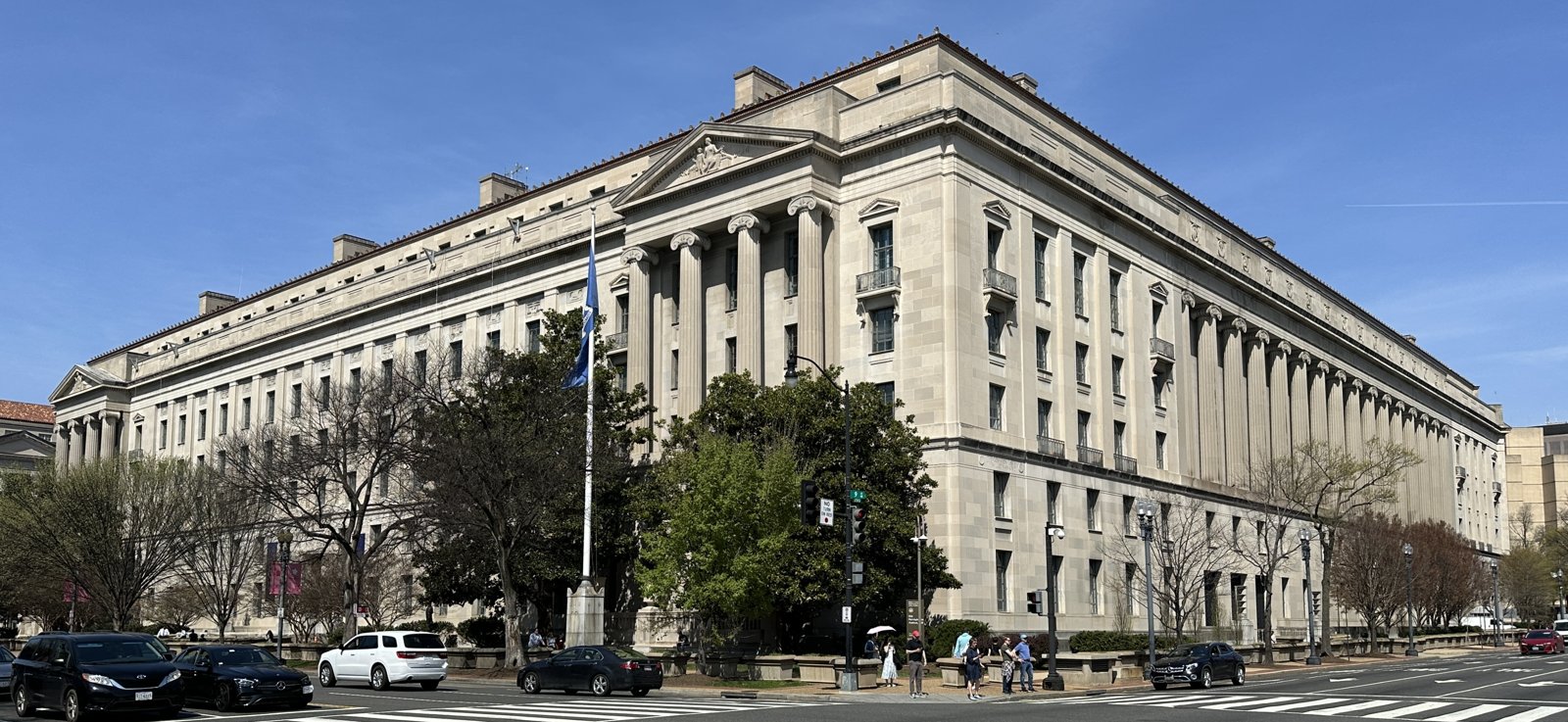
Featured image: Robert F. Kennedy Department of Justice Building, Washington, D.C. Photo by APK via Wikimedia Commons, CC BY 4.0.
