

WASHINGTON — A newly unobstructed election executive order, a national emergency declaration covering the power grid, and a mounting flood catastrophe on the Nepal-China border headline Thursday’s briefing. With Congress still out until September 2, the day’s most consequential action ran through the courts and the executive branch — and through Jackson Hole, Wyoming, where the Federal Reserve’s annual symposium opened Thursday ahead of a closely watched Friday keynote. Here is where things stand as of Thursday afternoon, August 27, 2026.
Government
White House declares national emergency over foreign equipment in the power grid
President Trump on Wednesday signed Executive Order 14420, declaring a national emergency over what the order calls an “unusual and extraordinary threat” posed by foreign-supplied bulk-power system equipment. Invoking the International Emergency Economic Powers Act and the National Emergencies Act, the order prohibits new acquisitions or installations of grid equipment tied to a “Covered Foreign Entity” when the Energy Secretary determines the transaction poses an undue risk of sabotage, unauthorized remote access, or supply disruption.
The order’s text goes further than a transaction ban: it authorizes the Energy Secretary to impose conditions on equipment already installed — including requirements to “identify, isolate, monitor, secure, disconnect, replace, or remove” risky hardware — and directs implementing rules within 120 days. A companion White House fact sheet frames the action as a response to foreign cyber and supply-chain threats to transmission infrastructure rated at 69 kilovolts and above. The order also sets a 180-day deadline for recommended Federal Acquisition Regulation revisions to prioritize U.S.-manufactured energy infrastructure in federal procurement.
The economic backdrop matters here: the order itself cites the growth of data centers, artificial intelligence, and defense production as reasons grid dependence — and the consequences of a successful attack — have increased since a similar first-term order. Utilities and equipment vendors now face a 120-day window of regulatory uncertainty until the Energy Department publishes its implementing rules and any pre-qualified vendor lists contemplated by the order.
Classified Saudi civil nuclear agreement reaches Congress
The administration this week submitted a civil nuclear cooperation agreement with Saudi Arabia to Congress for review, according to Associated Press sources cited by the Washington Post. Under the Atomic Energy Act’s Section 123 process, Congress has 90 days in session to review the pact; unless both chambers pass a joint resolution of disapproval, it takes effect without a vote.
Two features distinguish this agreement from prior 123 agreements, according to reporting. First, the pact is classified in its entirety — unusual for civil nuclear accords, which have historically been public even when annexes were not. Second, CNN reports the deal includes a pathway for uranium enrichment on Saudi soil, though officials describe that step as years away. Some Democratic lawmakers and nonproliferation specialists have criticized the absence of a permanent enrichment prohibition, per that reporting. The administration has said the agreement remains contingent on Saudi Arabia normalizing relations with Israel under the Abraham Accords framework, ABC News reported — a linkage that ties the nuclear file directly to the region’s diplomacy (more below in International).
Shutdown clock: stopgap through December 11 awaits the House
Before leaving town, Senate appropriators struck a deal on a continuing resolution to fund the government through December 11, brokered by Appropriations Committee leaders Susan Collins and Patty Murray, NBC News reported. Congressional tracking accounts indicate the measure cleared the Senate 90-6, with the House vote still ahead when members return September 2.
None of the twelve full-year appropriations bills for the fiscal year beginning October 1 has been enacted, and current funding lapses at the end of September 30, according to a Conference Board policy backgrounder. The House’s own version had reportedly proposed a December 4 end date; reconciling that difference is the remaining procedural step before the measure can reach the President’s desk. The December date reflects a bipartisan preference, evident in both chambers, to avoid any funding lapse in the weeks surrounding the November midterms.
Spokane-area fires near full containment after historic losses
The three fires that make up Washington state’s Spokane Complex — Old Trails, Autumn Lane, and Fairview — are now at or near full containment, with Fairview fully contained and the other two at 97-98 percent, according to fire officials cited by MyNorthwest. All evacuation orders have been lifted and crews have shifted to mop-up operations.
The toll is severe: roughly 9,900 acres burned, 921 structures damaged or destroyed, and some 65,000 residents displaced at the peak of the emergency, NBC News reported. Investigators have attributed the Old Trails Fire, which began August 1, to arson, according to local reporting — a finding that, if charges follow, would move the disaster into the courts.
Courts
Mail-ballot order clears its last nationwide injunction; states file a new challenge
U.S. District Judge Indira Talwani in Boston on Wednesday lifted her injunction that had blocked the U.S. Postal Service from implementing portions of the President’s March election-integrity executive order, removing the final nationwide legal obstacle to the order ahead of the midterms, WBUR reported. Talwani wrote that “the court finds it likely that the Supreme Court would apply the same reasoning here” — a reference to the high court’s August 24 per curiam order in Trump v. California, which stayed a parallel Massachusetts injunction on standing and ripeness grounds.
The Supreme Court’s unsigned opinion held that the states challenging Executive Order 14399 had not shown concrete, imminent injury from what it characterized as “an internal directive from the President to his subordinates,” noting the order’s provisions must be implemented “consistent with applicable law.” Justice Sotomayor dissented, joined by Justice Kagan, writing that the ruling “does not address whether” the order’s directives are lawful and merely postpones adjudication; Justice Jackson dissented separately. The merits questions — including the order’s directives to DHS on citizenship lists and to USPS on ballot-envelope rules — remain live in the lower courts.
The litigation is not over. Democratic state officials filed a fresh challenge this week arguing the federal government is improperly interfering in state election preparations, according to AP reporting — a suit that, unlike the earlier premature challenge, will be filed against implementation now under way. The timing is compressed: the first mailed ballots are set to go out next week.
Filings describe sweeping DHS surveillance during Minnesota enforcement surge
Court filings in a Minnesota criminal case allege that federal agents, during this year’s immigration enforcement surge in the Twin Cities, secretly recorded meetings at churches, libraries, restaurants, and schools, infiltrated private group chats, and compiled dossiers — including names, addresses, and family and employment details — on attendees of a church gathering, NPR reported Tuesday. Defense motions state that agents also captured license plates at community events and that DHS obtained financial records of nonprofits and national labor unions, including the Service Employees International Union and the Communications Workers of America.
These are allegations in pending litigation, drawn from defense filings, and a court has not ruled on them. The government has responded: prosecutors wrote that requesting the financial records was “within the authority” of the agency, per NPR’s account of the filings. How the presiding judge treats the surveillance evidence — and whether any of it is suppressed — will shape both the underlying prosecutions and the broader debate over the domestic-intelligence tools used in interior enforcement operations.
Alleged CJNG regional commanders indicted in Washington
A federal grand jury in the District of Columbia returned an indictment against two Mexican nationals, Ramon Alvarez Ayala, 44, and Rafael Alvarez Ayala, 42, charging conspiracy to distribute cocaine and methamphetamine for importation into the United States and a firearms count involving a machinegun, the Justice Department announced. Prosecutors allege the brothers served as regional commanders for the Cártel de Jalisco Nueva Generación in Michoacán.
The case lands amid the administration’s broader designation-and-prosecution campaign against Mexican cartels, with the D.C. grand jury increasingly the venue of choice for extraterritorial trafficking charges. An indictment is an allegation; the defendants are presumed innocent unless and until convicted.
International
Nepal flood toll mounts after glacial collapse; hundreds missing
Search teams continued Thursday to work through villages along the upper Trishuli River, where flash floods triggered by a glacial collapse on Wednesday morning devastated settlements in Nepal’s Rasuwa and Nuwakot districts and struck the Gyirong Port area across the Chinese border. NPR reported at least 98 confirmed dead in the initial accounting, with hundreds missing; tallies cited in subsequent reporting have risen substantially, with CNN reporting fears of hundreds killed and rescue officials citing more than a thousand unaccounted for, including several hundred foreign nationals. Figures remain fluid and unverified as recovery operations continue.
Nepal has mobilized its army, armed police, and national police, supported by helicopters and medical teams, according to Rappler’s account of official briefings. The immediate risk is a secondary disaster: forecasters expect roughly three more days of monsoon rain over slopes destabilized by the flooding, and officials have warned of further landslides and mudslides in the search zone.
Russia strikes nine Ukrainian cities in overnight barrage
Russia bombarded cities across Ukraine with missiles and drones in an assault that ran from overnight into Thursday morning, with explosions echoing across Kyiv after daybreak, according to AP reporting that noted Moscow itself described the strike on nine cities as “massive.” In the capital, four districts were hit, damaging residential buildings, a school, and a medical facility, with no fatalities reported by city police as of midday; the Kyiv Independent reported at least seven people injured nationwide, with explosions also reported in Odesa and Zaporizhzhia.
The barrage continues a late-August pattern of long-range exchanges — Ukrainian drones have repeatedly reached Russian refining infrastructure this month — even as diplomatic signaling continues in the background. Records of the past week suggest both sides are positioning around possible new proposals to end the war, though no framework has publicly advanced.
Israel reinforces West Bank as military cites multi-front volatility
IDF Chief of Staff Lt. Gen. Eyal Zamir on Thursday ordered a significant reinforcement of troops in the West Bank and said the military is “advancing battle procedures on all fronts,” citing readiness requirements from Iran and Lebanon to Gaza, according to the Times of Israel’s live coverage. The posture shift comes as the U.S.-backed Gaza framework faces stress: an envoy to the Board of Peace said Israel must honor its commitments for the ceasefire process to advance, Haaretz reported.
The regional file is now tightly linked to Washington’s Saudi diplomacy: with the civil nuclear agreement’s entry into force conditioned on Riyadh’s recognition of Israel, the durability of the Gaza arrangements bears directly on whether the normalization track — and with it the nuclear pact — moves forward this fall.
Tomorrow’s Watch
Friday, August 28, brings a concentrated calendar:
- Jackson Hole keynote, 10:00 a.m. ET. Federal Reserve Chair Kevin Warsh delivers his first symposium keynote as chair at the Kansas City Fed’s annual economic policy symposium, running through Saturday under the theme “Financial Innovation: Implications for Payments and Policy.” Markets will parse the speech against a backdrop of elevated long-term yields — the 30-year Treasury touched its highest level since 2007 earlier this month, according to market analyses — and recent Treasury operations aimed at long-end borrowing costs.
- Payrolls benchmark revision. The BLS releases its preliminary annual payroll benchmark revision Friday, per Newsquawk’s weekly calendar — a data point capable of rewriting the year’s employment narrative ahead of the September FOMC meeting.
- Ballots and briefs. With the last nationwide injunction lifted, the first mailed ballots are set to go out next week, per WBUR’s reporting, while the states’ new lawsuit begins moving — expect early motion practice and possible emergency applications as implementation meets litigation in real time.
- Nepal search window. Rescue teams face roughly three more days of forecast rain over unstable terrain; casualty figures should firm up, and the foreign-national count will draw consular attention from multiple capitals.
- Congress countdown. Lawmakers return Wednesday, September 2, with the House facing the December 11 stopgap and a September 30 funding deadline — 28 days of session time to act.
The Afternoon Wire is compiled from public records, court filings, official statements, and credited wire and broadcast reporting. Allegations described in pending litigation are unproven unless a court has ruled; parties referenced in enforcement actions are presumed innocent unless convicted. Entities discussed may submit responses or corrections to the editor.
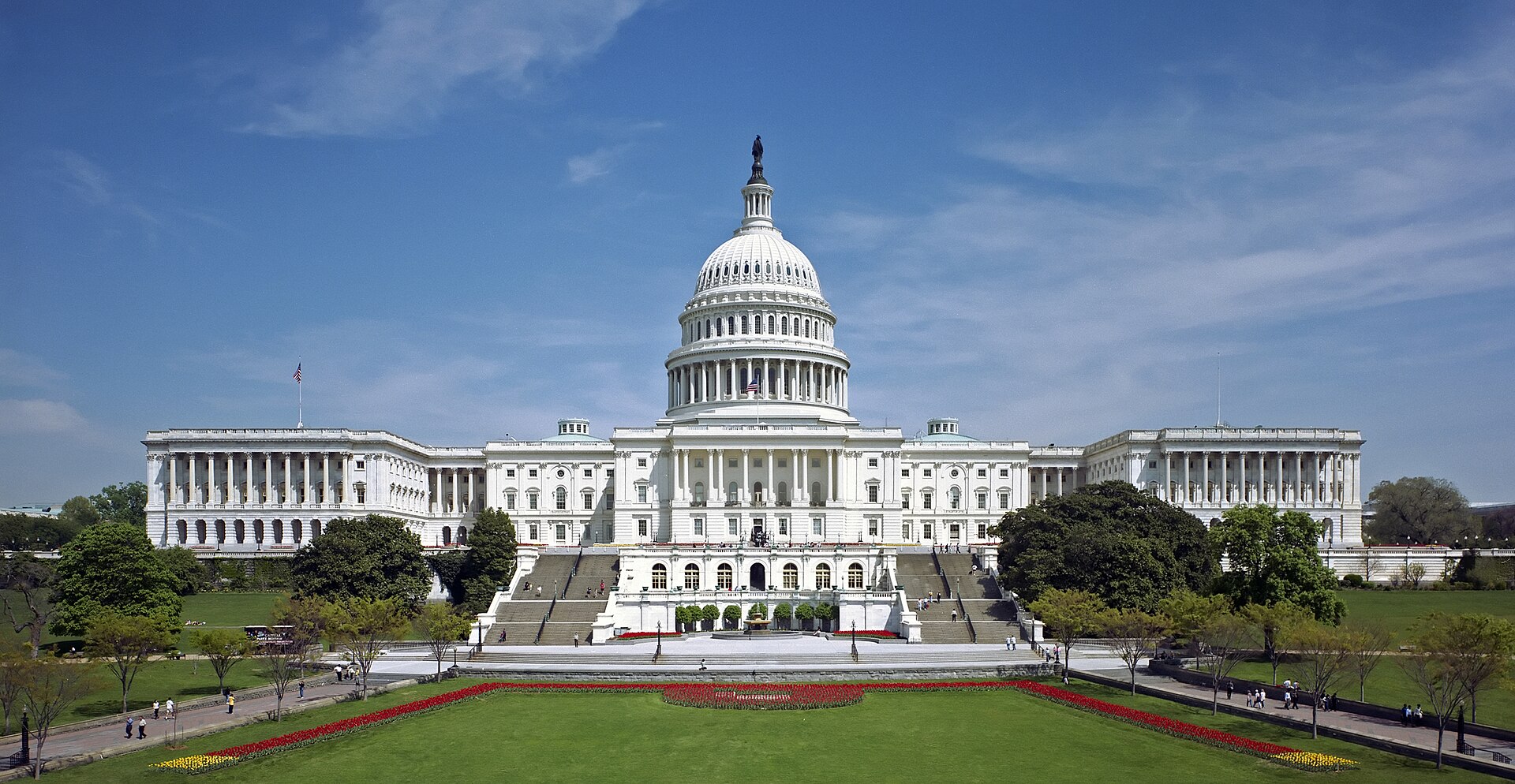
Featured image: The west front of the United States Capitol. Public domain, via Wikimedia Commons.
