

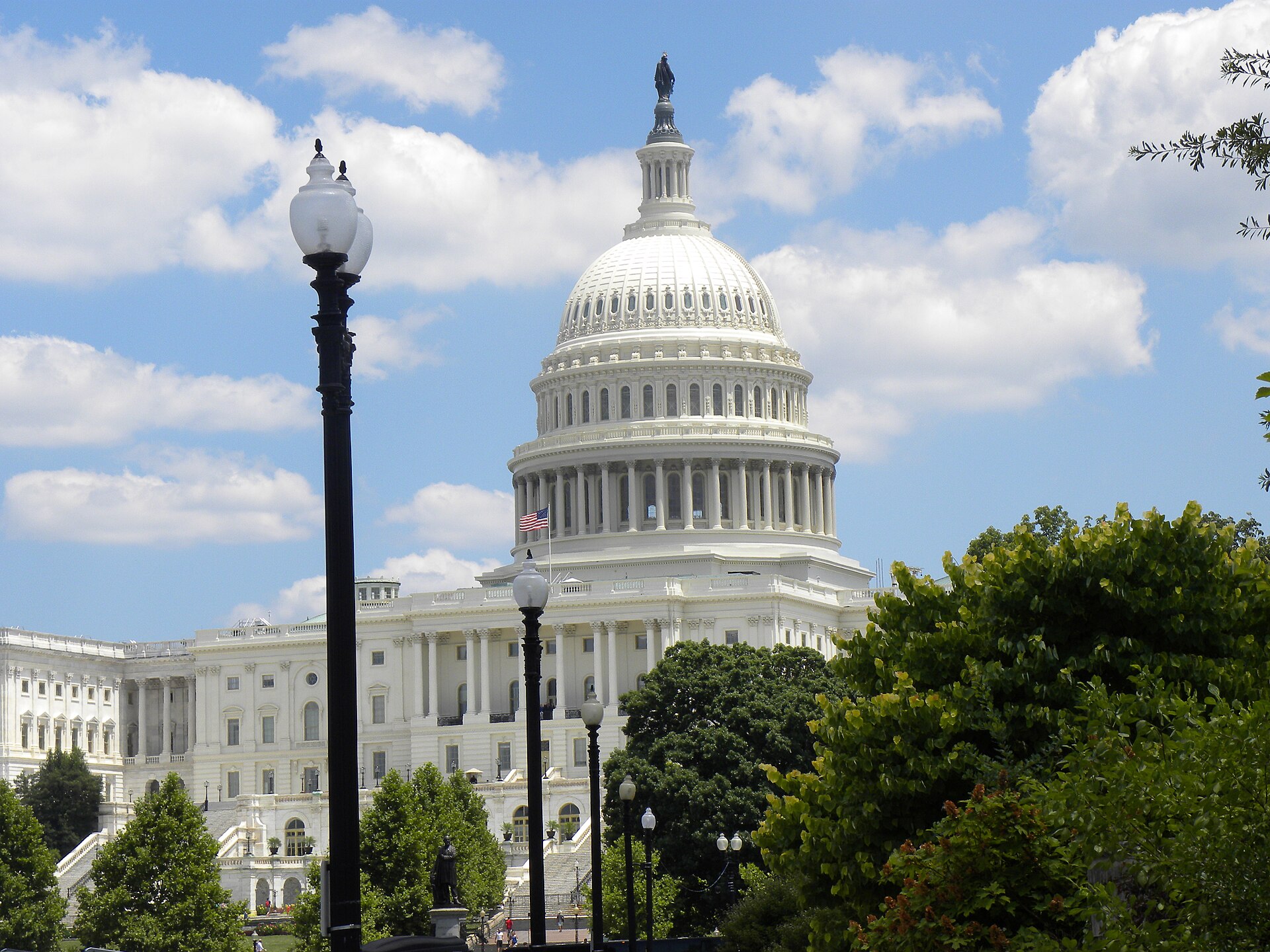
Capitol Watch is The Investigative Journal’s daily review of congressional activity, compiled from roll-call records, committee notices and official floor summaries.
House and Senate leaders spent the week of July 13 contending with their own majorities as much as with the opposition. A sweeping veterans package was pulled from the House floor after a one-vote scare, Senate Democrats blocked the annual defense policy bill from advancing, and a new Federal Reserve chairman delivered his first semiannual testimony to a divided Congress. Below are eight of the week’s most consequential actions on Capitol Hill, each drawn from the public record.
1. House GOP pulls sweeping veterans package after one-vote cliffhanger
The marquee floor drama of the week ended without a final vote. On Thursday, the House rejected a motion to send the Take Care of America’s Veterans Act (H.R. 9237) back to committee, but Republican leadership then pulled the bill before members could vote on final passage. The motion to recommit, offered by Rep. Chris DeLuzio, D-Pa., failed 210–211 (Roll No. 249), with Rep. Victoria Spartz, R-Ind., switching her vote at the last minute to hand leadership a one-vote reprieve.
Rather than proceed, Speaker Mike Johnson delayed the measure. According to reporting by Military Times, Johnson told reporters the bill would not return “for weeks,” likely not until September, citing what he described as lingering “misinformation” about the package. The bill bundles more than 60 measures, including the widely backed Major Richard Star Act and the Love Lives On Act.
The dispute centers on how to pay for the package. The offset relies on a Department of Veterans Affairs rule revising disability ratings for tinnitus and sleep apnea — a change VA officials indicated they intend to pursue and which filings estimate could save roughly $57 billion over a decade. Veterans Affairs Committee Chairman Mike Bost, R-Ill., argued the bill “is paid for and capable of actually moving” to the Senate, while ranking member Mark Takano, D-Calif., pressed to split the package apart. The American Legion has endorsed the measure; the Veterans of Foreign Wars and Disabled American Veterans oppose the offset.
2. Senate Democrats block $1.15 trillion defense authorization
The Senate on Tuesday rejected cloture, 50–46, on the motion to proceed to the National Defense Authorization Act for fiscal 2027 (S. 4784), falling well short of the 60 votes required to open debate. The vote fell almost entirely along party lines. Majority Leader John Thune voted no — a procedural move that preserves his ability to call the measure back up through a motion to reconsider.
According to reporting by Breaking Defense and other outlets, Democrats tied their opposition to the administration’s handling of the renewed conflict with Iran, including the absence of a congressional war authorization, as well as to the measure’s topline and to provisions deepening U.S.–Israel defense cooperation. Reporting places the package at roughly $1.15 trillion, encompassing about $1.1 trillion for the Defense Department, $41 billion for Energy Department nuclear-weapons activities and $11 billion in other defense-related spending.
Republicans countered that blocking the annual policy bill stalls pay, procurement and readiness priorities for the armed forces. The NDAA has been enacted every year for more than six decades, and both parties have historically found a path to passage; Thune’s preserved motion signals the chamber is likely to revisit the measure. Records show the bill remains on the Senate’s calendar.
3. New Fed chair Warsh delivers first testimony amid inflation fight
Federal Reserve Chairman Kevin Warsh, who took the helm of the central bank in May, appeared Tuesday before the House Financial Services Committee for the semiannual Monetary Policy Report, then before Senate Banking on Wednesday. In prepared testimony, Warsh said the Fed has “no tolerance for persistently elevated inflation” and pledged a “resolute commitment to restoring price stability.”
The Federal Open Market Committee held its target range for the federal funds rate at 3.5 to 3.75 percent at its June meeting, and Warsh did not signal a near-term move. He outlined a plan to stand up five internal task forces to review the factors shaping monetary policy and pointed to the ongoing buildout of artificial-intelligence infrastructure as a force reshaping the economy, while cautioning that its ultimate effects remain uncertain. The appearance drew scrutiny from lawmakers in both parties, given the Fed’s independence and the political stakes of the inflation debate heading into the midterm year.
4. State–foreign operations spending bill passes on party lines
The House passed the National Security, Department of State, and Related Programs Appropriations Act, 2027 (H.R. 8595) on Wednesday by a near-party-line vote of 217–209 (Roll No. 247). According to the bill’s summary, the measure provides roughly $47.3 billion — about $11.9 billion above the administration’s request and $2.7 billion below the current-year enacted level.
The floor fight was largely an intramural one. A series of Republican-offered amendments failed, including a Roy amendment (136–291), two Massie amendments (6–421 and 104–314 with 10 present), a Fine amendment (178–247) and a Boebert amendment (79–348). A Democratic motion to recommit failed 209–216. The pattern — conservative spending amendments falling well short while the underlying bill advanced on a thin majority — underscored the narrow margins Republican leaders are managing as the fiscal 2027 appropriations season accelerates.
5. Sunshine Protection Act clears House; privacy bill divides the parties
In a rare bipartisan tally, the House passed the Sunshine Protection Act (H.R. 139), which would make daylight saving time permanent, by a vote of 308–117 (Roll No. 238). The measure split both caucuses rather than the chamber: Republicans backed it 193–22 and Democrats divided 114–95, a reminder that the clock debate does not track partisan lines.
By contrast, the Protecting Privacy in Purchases Act (H.R. 1181) passed on Tuesday almost entirely along party lines, 221–201 (Roll No. 240), with Republicans voting 215–1 and Democrats 5–200. A motion to recommit failed 208–217. The contrast between the two votes illustrates how sharply process and policy can diverge within a single week on the House floor.
6. Senate confirms Schwartz to the Second Circuit
The Senate on Tuesday confirmed Matthew A. Schwartz, 50–45, to the U.S. Court of Appeals for the Second Circuit (PN938-2). The vote was party-line, with the chamber’s two independents joining Democrats in opposition. Schwartz, a former law clerk to Justice Samuel Alito, has represented President Trump in personal legal matters, a background that Democratic members cited in opposing the nomination.
The confirmation continues a steady cadence of judicial installations this session; Majority Leader Thune has also filed cloture on a separate district-court nominee, Jeffrey T. Kuntz, for the Southern District of Florida. Lifetime appeals-court appointments carry outsized influence over federal law, and the Second Circuit’s jurisdiction covers New York, Connecticut and Vermont.
7. Oversight and investigations: China, fraud, DEI and counterintelligence
Committee activity reflected the fund’s core accountability themes. The Select Committee on the Chinese Communist Party held a hearing on “Protecting American Innovation: The Federal Research Security Enterprise,” while the Foreign Affairs Committee examined “U.S. Economic Security and Investment Abroad” and the Bureau of Industry and Security’s export-control budget in a session on the “AI arms race.”
The Oversight and Government Reform Committee held a hearing on “Emerging Fraud Threats and the Evolving Fraud Landscape” and a separate session on diversity, equity and inclusion programs, while the House Permanent Select Committee on Intelligence convened on “States on the Frontlines of Counterintelligence.” Additional markups and hearings, catalogued in the majority leader’s weekly committee preview, spanned FDA drug-development policy, small-business AI adoption, FEMA reform, a Water Resources Development Act markup and a package of nuclear-licensing bills.
8. Bipartisan measures: travel, grid resilience and a VA clinic
Away from the party-line fights, several measures drew lopsided bipartisan support under suspension of the rules. On Monday the House passed the Improving Travel for American Families Act (H.R. 8897), 398–12, and the Weatherizing Infrastructure in the North and Terrorism Emergency Readiness Act (H.R. 3106), 400–7, a grid-resilience measure.
On Thursday, the chamber voted 418–0 (Roll No. 248) to name a Department of Veterans Affairs multispecialty clinic in Marietta, Georgia, for Col. Michael H. Boyce. Such near-unanimous tallies are a recurring feature of the suspension calendar and a reminder that a substantial share of House business still moves with cross-party consensus, even in a week defined by narrow, contested votes.
Looking ahead
The House Financial Services Subcommittee on Digital Assets is scheduled to hold a field hearing on the CLARITY Act and digital-asset markets on Friday, July 17. In the Senate, Thune’s preserved motion to reconsider leaves the door open to another NDAA cloture attempt, and the chamber has additional judicial nominations queued. Speaker Johnson has signaled the veterans package is unlikely to resurface until September, and appropriations work on the remaining fiscal 2027 bills is expected to continue.
On the TIJ beat
Several of the week’s hearings intersect directly with The Investigative Journal’s reporting priorities. The Select Committee on the CCP’s focus on research-security — the safeguards meant to keep federally funded American research from being siphoned abroad — along with Foreign Affairs’ examination of economic-security zones and the Bureau of Industry and Security’s export-control posture, all bear on questions of foreign influence, supply-chain dependency and technology transfer that TIJ continues to investigate. We will track how these oversight threads translate into legislation and enforcement in the weeks ahead.
Sources for this report include U.S. Senate roll-call records, the Office of the Clerk of the House, the House Republican Cloakroom’s daily floor summaries, the House majority leader’s weekly committee preview, the Federal Reserve Board and contemporaneous reporting. Vote figures reflect official tallies as recorded. Legislation described here remains pending unless otherwise noted.