

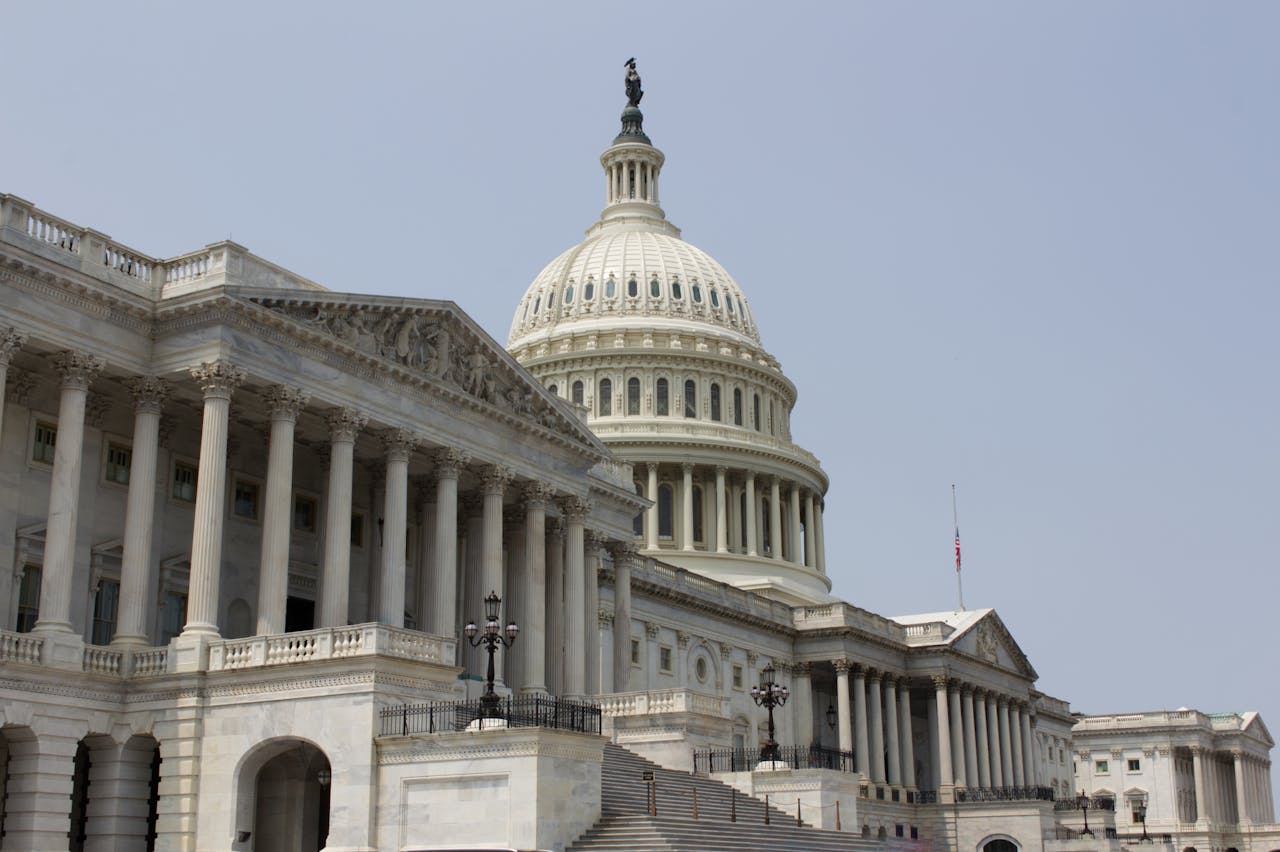
Capitol Hill closed the month with a procedurally dense day — a defeated war powers resolution on Iran, a Farm Bill that finally cleared the House, a unanimous Senate self-restriction on prediction-market trading, a stopgap surveillance extension, and the formal end of the 75-day Department of Homeland Security shutdown. The Investigative Journal’s Capitol Watch tracks the day’s roll calls, hearings, and oversight skirmishes, and flags what is queued for next week.
Senate rejects Iran war powers resolution for sixth time
The headline floor action of April 30, 2026 was the Senate’s defeat of S.J.Res. 184, the latest war powers resolution seeking to compel removal of U.S. armed forces from hostilities in or against the Islamic Republic of Iran absent a fresh congressional authorization. The motion to discharge the resolution from the Senate Foreign Relations Committee failed 47–50, according to the Senate roll call record. Floor remarks from Senators Murphy, Van Hollen, Kim, and Booker preceded the vote, per the Senate Daily Press log.
The resolution, the sixth war powers measure on Iran considered this Congress, was sponsored by Senator Adam Schiff (D-Calif.) and invokes the 1973 War Powers Resolution’s 60-day clock. Records suggest the prior five iterations — including S.J.Res. 116, S.J.Res. 118, S.J.Res. 123, and S.J.Res. 104 — were all rejected on or near party lines earlier in 2026. Republican leadership has consistently held the line that operational decisions remain with the executive branch during the statutory 60-day window, while a small bipartisan bloc has urged that any extension of operations beyond that window must be put to Congress.
For TIJ’s accountability beat, the meaningful detail is the persistence rather than the outcome: Iran war powers votes have become a near-monthly procedural fixture, and each one produces a fresh, recorded position from every senator. Filings indicate the next attempt is already in drafting.
House clears the 2026 Farm Bill, 224–200
After a multi-year impasse, the House passed H.R. 7567, the Farm, Food, and National Security Act of 2026, by a 224–200 vote — the farthest a comprehensive farm bill has advanced since the 2018 reauthorization. The roll call is logged as Roll Call 154. The measure was managed on the floor by House Agriculture Committee Chairman Glenn Thompson (R-Pa.).
The package reauthorizes USDA programs through fiscal 2031, with updates to crop insurance, conservation, nutrition assistance, trade promotion, and rural development. According to the National Association of Counties summary, late-stage floor amendments stripped pesticide liability protections, removed the year-round E15 sales provision (deferred to a separate vote in two weeks), and added a fertilizer supply-chain title. An amendment permitting rotisserie chicken purchases under SNAP was adopted on the floor.
The bill now moves to the Senate, where its prospects depend on whether negotiators can reconcile House nutrition-title changes with the Senate Agriculture Committee’s draft. Committee staff data shows the package’s ten-year cost projection has not yet been re-scored after the floor amendments; CBO is expected to issue a revised estimate in the coming weeks.
Senate, by unanimous consent, bans itself from prediction markets
In one of the day’s more procedurally novel moments, Senator Bernie Moreno (R-Ohio) achieved unanimous consent for passage of S.Res. 708, amending Rule 37 of the Standing Rules of the Senate to prohibit members from trading on event prediction markets. An amendment by Senator Alex Padilla (D-Calif.) extended the prohibition to officers and employees of the Senate. The resolution is effective immediately, as reported by NBC News.
Records suggest the rule change targets venues such as Kalshi and Polymarket, where contracts trade on legislative outcomes, executive actions, judicial decisions, and other events that members and staff can plausibly influence or learn of through official duties. Drafters described the measure as a logical extension of existing STOCK Act-style restrictions on trading individual equities on the basis of nonpublic information.
The resolution covers only the Senate. House members, House staff, and executive-branch employees remain outside its scope; comparable restrictions there would require separate House action, an executive order, or new federal legislation. TIJ’s ethics beat is tracking whether House Administration takes up a parallel resolution.
Congress sends 45-day FISA 702 extension to the President
With consensus on broader reforms still elusive, lawmakers passed a 45-day extension of Section 702 of the Foreign Intelligence Surveillance Act, the warrantless surveillance authority used to collect communications of non-U.S. persons abroad. The House cleared the extension 261–111, sending the measure to the President’s desk hours before the prior short-term extension expired, per The Washington Times. NPR’s earlier summary documents the parallel Senate action.
On the Senate floor, Senator Ron Wyden (D-Ore.) called up S. 4444 — a competing three-week extension paired with a requirement to declassify a recent FISA Court ruling Wyden has described as documenting “serious violations” of Section 702 minimization rules. Senator Tom Cotton (R-Ark.) objected, blocking unanimous consent. Records indicate Wyden subsequently obtained a written commitment from Cotton and Senate Intelligence Committee Vice Chairman Mark Warner (D-Va.) to send a joint letter to the Director of National Intelligence and the Acting Attorney General requesting declassification of the FISA Court opinion in question.
For TIJ’s surveillance beat, the operative item is the FISA Court ruling itself: declassification, in whole or in part, would mark the first time in this Congress that a sitting court order on Section 702 compliance has been made public. We will track the joint letter and any DNI response.
DHS funding restored — 75-day partial shutdown ends
The House passed, by voice vote, a Department of Homeland Security funding package that ends a 75-day partial shutdown of the agency, according to CNN. The bill, which the President signed the same day, restores funding to most DHS components but, in a notable concession from Republican leadership, contains no appropriations for U.S. Immigration and Customs Enforcement; ICE funding is to be addressed in a separate vehicle.
Filings indicate this was the longest partial DHS shutdown on record. The voice-vote mechanism — used in lieu of a recorded roll call — limits the public accountability trail; TIJ has filed a request for the manager’s amendment text and the underlying section-by-section.
Appropriations: Air Force, Space Force, and Indian Health Service
The House Appropriations Defense Subcommittee held a 9:30 a.m. budget hearing in 2358-C Rayburn on the FY2027 Department of the Air Force request. Witnesses were Secretary Troy Meink, Chief of Staff Gen. Kenneth Wilsbach, and Chief of Space Operations Gen. Chance Saltzman. According to the Air Force Times, the services jointly requested over $24 billion for the Weapons System Sustainment program, with the Air Force share at roughly $22 billion. Subcommittee Chairman Ken Calvert (R-Calif.) used his opening to press on flying-hour readiness and depot capacity, two metrics that have featured in prior appropriations cycles.
A parallel 10:30 a.m. budget hearing in 2008 Rayburn covered the Indian Health Service request, with subcommittee staff focused on facility maintenance backlogs and contract health services obligations. TIJ’s accountability beat is tracking IHS uncompensated care figures requested but not yet provided in writing.
Oversight: Bondi contempt resolution and Epstein records subpoenas
The House Oversight and Government Reform Committee remains the principal venue for high-temperature investigations. Ranking Member Robert Garcia (D-Calif.) and committee Democrats filed a civil contempt resolution against former Attorney General Pam Bondi after she failed to appear for a deposition pursuant to a bipartisan committee subpoena originally adopted 24–19 in March. Chairman James Comer’s (R-Ky.) office has separately confirmed subpoenas for records and testimony from former officials in connection with the committee’s Epstein-related document review. TIJ has noted these are pending matters; no findings of contempt have been entered, and right-of-reply requests have been logged with both former officials’ counsel.
Cross-party developments: Cornyn–Murphy on Kayla Hamilton Act
Senator John Cornyn (R-Texas) sought unanimous consent on H.R. 4371, the Kayla Hamilton Act, which would expand vetting requirements for unaccompanied alien children released to sponsors. Senator Chris Murphy (D-Conn.) objected, blocking immediate passage. The exchange — recorded in the Senate Daily Press log at 12:27 p.m. — preserves a clean record of each side’s stated reasoning and indicates the bill is unlikely to advance without a managers’ negotiation.
Looking ahead: scheduled votes and hearings
The Senate has filed cloture on the renominations of Kevin Warsh of Florida to be a Member and Chairman of the Federal Reserve Board of Governors; cloture votes are expected next week. Adoption of S.Res. 690, the en bloc executive nominations vehicle on which cloture was invoked 51–46 earlier in the day, is scheduled no earlier than Friday, May 1. The House floor schedule shows a separate vote on year-round E15 sales in approximately two weeks, broken out from the Farm Bill at members’ request.
Items for TIJ investigative beats
Three threads from today’s session warrant continued tracking. First, the FISA Court ruling at the center of the Wyden–Cotton–Warner exchange: any declassified portion will be the most consequential primary-source release on Section 702 compliance this Congress. Second, the prediction-markets prohibition’s enforcement mechanism: filings indicate compliance will be administered through the Senate Ethics Committee, but the disclosure regime — what trades, by whom, over what period — has not yet been spelled out. Third, the DHS funding package’s exclusion of ICE: the next vehicle for ICE appropriations, and any policy riders attached, will be a near-term test of how the appropriations process handles politically contested line items. TIJ’s accountability and legislative watch desks will continue tracking each through next week.
Reporting drawn from Congress.gov, the Senate Daily Press, the House Clerk’s office, House and Senate committee websites, and contemporaneous reporting cited above. Every factual claim is sourced to a public record. Pending matters are identified as such; no findings are reported where none exist.