

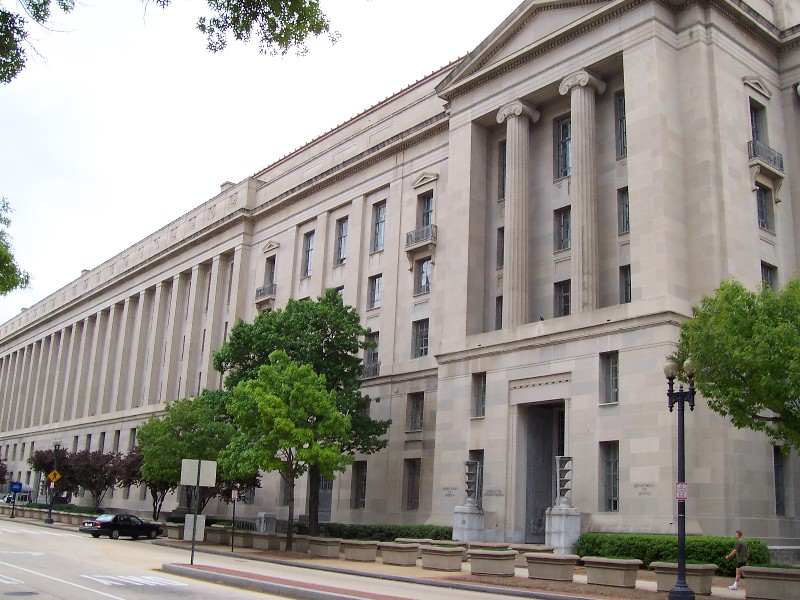
DOJ Watch is The Investigative Journal’s daily digest of federal enforcement activity, tracking the indictments, settlements and prosecutions that define the Justice Department’s accountability docket. Today’s edition covers the most consequential actions from the closing stretch of July 2026 — a period dominated by clinical-laboratory fraud recoveries, a nine-figure entertainment-finance indictment, and a string of national-security cases spanning domestic terrorism, cartels and Russian cybercrime infrastructure.
Top case: Texas lab, former CEO and Florida businessman pay $36.4M over genetic-testing kickbacks
The Justice Department announced on July 30 that Access DX Laboratory of Houston, its former chief executive Michael Stewart, and Florida businessman Harold Shatz will pay a combined $36.4 million to resolve allegations that they violated the False Claims Act by paying kickbacks and billing Medicare and Medicaid for medically unnecessary genetic testing. According to the department’s filings, the parties, between January 2018 and January 2020, paid kickbacks to marketers in exchange for patient referrals, used unbundled billing codes, and paid telemedicine providers for what the government characterized as false and fraudulent doctors’ orders.
Unlike a purely civil resolution, this matter carries admitted criminal conduct. Records show Stewart agreed on June 24 to plead guilty to conspiracy to defraud the United States and to pay and receive health care kickbacks under 18 U.S.C. § 371, while Shatz entered a parallel plea agreement on October 15, 2025. Access DX also entered a five-year Corporate Integrity Agreement with the Department of Health and Human Services Office of Inspector General requiring compliance auditing and review of referral arrangements. The civil recovery originated with a whistleblower, Douglas Green, who filed a qui tam action and is set to receive a $7.2 million share.
“Healthcare referrals must reflect the best decision for patients, not the influence of kickbacks,” said Assistant Attorney General Brett A. Shumate of the Civil Division. The department noted that, except to the extent admitted in the plea agreements, the claims remain allegations only. Read the DOJ release.
Beverly Hills film producer indicted in alleged $100M investment fraud
A federal grand jury in Chicago has indicted film producer Jason Cloth, 60, of Beverly Hills, California, on seven counts of wire fraud in a case unsealed July 28, according to the U.S. Attorney’s Office for the Northern District of Illinois. Prosecutors allege that Cloth, operating the Canada-based Creative Wealth Media Finance Corp., solicited clients — including an Illinois investment advisor and that advisor’s clients — to invest in purported film and entertainment projects and a gaming platform between 2019 and 2026, fraudulently obtaining more than $100 million based on false representations about the performance and value of their investments.
The indictment alleges a Ponzi-style structure in which Cloth used some investor money to repay earlier investors, while diverting funds to other purposes, including a Canadian real-estate project. The government is seeking forfeiture of at least $12.25 million tied to the projects identified in the charging document. Cloth was arrested in Los Angeles and made an initial appearance there; each wire-fraud count carries a maximum of 20 years in prison.
The U.S. Securities and Exchange Commission provided assistance, a signal that parallel civil securities exposure may follow. As the office emphasized, an indictment is not evidence of guilt, and Cloth is presumed innocent. Read the DOJ release.
Dallas COVID-testing lab and investors pay $24M
On July 23, the department announced that Magnolia Diagnostics of Dallas and its owners, John and Kelly Bains, agreed to pay $19.2 million to resolve False Claims Act allegations, with company investors paying an additional $4.8 million — a $24 million total. The government alleges that, beginning in April 2020, Magnolia required senior-living communities seeking COVID-19 testing to also receive expensive respiratory pathogen panels, using prepopulated requisition forms and treating provider signatures as blanket “standing orders.”
The allegations are notably granular: filings indicate Magnolia continued performing the panels after communities questioned their medical necessity, that John Bains at times allegedly threatened to withhold COVID-19 testing from facilities that declined the add-on panels, and that specimens were frozen and stored for weeks or months — generating results after they could no longer inform treatment or infection control. The inclusion of investors in the recovery is significant, reflecting what the Civil Division framed as a willingness to pursue those who “receive and retain” the financial benefits of misconduct. The settlement resolves allegations only, with no determination of liability. Read the DOJ release.
Two charged in $43M Chinese money-laundering network tied to investment scams
Zhuoying Chen, 27, of Brooklyn, and Haojie Zhang, 38, of Queens, made initial appearances in Brooklyn federal court on charges of conspiracy to launder proceeds of cyber investment-fraud scams, the Justice Department said on July 16. According to the unsealed indictment, between 2020 and 2022 the pair managed a network of more than a dozen individuals who opened roughly 140 bank accounts in the names of about 45 shell companies to launder at least $43 million, then allegedly coordinated with China-based co-conspirators to move the money abroad.
The underlying frauds follow a now-familiar pattern that investigators describe: perpetrators cultivate trust with victims over messaging apps and social media, display fabricated investment “profits,” and encourage escalating deposits before draining the funds. The case, prosecuted by the U.S. Attorney’s Office for the Eastern District of New York and the Criminal Division’s Money Laundering, Narcotics and Forfeiture Section, is part of the Homeland Security Task Force established under Executive Order 14159. The money-laundering conspiracy count carries a maximum of 20 years. The charges are allegations, and both defendants are presumed innocent. Read the DOJ release.
Three Russian nationals and two “bulletproof hosting” firms indicted over $62M in losses
An indictment unsealed July 14 in the Northern District of Ohio charges three St. Petersburg-based Russian nationals — Alexander Volosovik, 43; Kirill Zatolokin, 34; and Yulia Pankova, 29 — along with two related companies, Medialand LLC and ML.Cloud LLC, with running “bulletproof hosting” services that prosecutors say enabled cybercrimes causing more than $62 million in U.S. victim losses. The charges include conspiracy to commit computer fraud, conspiracy to commit wire fraud, wire fraud and conspiracy to commit money laundering; the indictment was originally returned in December 2024.
According to court documents, the companies knowingly leased infrastructure to cybercriminals to deploy malware and ransomware, support criminal marketplaces, and launch phishing and brute-force attacks, with 42 victims across 21 states — including banks, schools, hospitals, government entities and media companies. The action is coordinated with sanctions: the Treasury Department’s Office of Foreign Assets Control designated the defendants and entities in November 2025, joined by the United Kingdom and, in part, Australia, and the State Department’s Rewards for Justice program is offering up to $10 million for information. The department framed the case within Operation Riptide, its cybercrime campaign, noting Americans reported more than $20 billion in cybercrime losses last year, a 26 percent single-year increase. The defendants, who remain outside U.S. custody, are presumed innocent. Read the DOJ release.
Eight indicted in alleged plot to attack White House UFC event
In one of the month’s most serious national-security matters, a federal grand jury in Columbus returned a two-count indictment charging eight men in connection with an alleged plot to attack the Ultimate Fighting Championship “Freedom 250” event held at the White House on June 14, the Justice Department announced July 9. The indictment charges conspiracy to provide material support to terrorists and conspiracy to commit murder on federal government territory and to murder a federal official.
According to the charging document, the defendants — including Tycen J. Proper, 19, of Danville, Ohio, and Chandler Scaggs, 21, of West Virginia, who was allegedly assigned as a sniper — began coordinating in May 2026 through encrypted and mainstream platforms including Signal, SimpleX, Discord, TikTok and Instagram. Prosecutors allege the group amassed weapons and tactical gear, conducted marksmanship and combat training, and planned to target senior officials. The National Security Division and FBI Counterterrorism Division led the case; the material-support count carries up to 15 years and the murder-conspiracy count up to life. The department stressed that an indictment contains only allegations and that all defendants are presumed innocent until proven guilty. Read the DOJ release.
Two United Cartels leaders charged with narco-terrorism and material support
A federal grand jury in the District of Columbia indicted Juan Jose “Juanjo” Farias Mendoza, 31, and Israel “Papo” Vega Farias, 37, both of Michoacán, Mexico, and described by the department as high-ranking members of the United Cartels, the Justice Department announced July 2. The two are charged with conspiracy to manufacture and distribute methamphetamine for importation into the United States, providing material support to a designated foreign terrorist organization, and firearms offenses involving machine guns and destructive devices.
The case reflects the government’s evolving use of terrorism authorities against Mexican trafficking organizations. The State Department designated the United Cartels — also known as Cárteles Unidos — as both a Foreign Terrorist Organization and a Specially Designated Global Terrorist in February 2025, and the department notes the two defendants are the son and nephew, respectively, of the cartel’s top leader, Juan Jose Farias Alvarez. Both defendants, who are not in U.S. custody, face maximum penalties of life imprisonment. The charges are allegations, and the defendants are presumed innocent. Read the DOJ release.
Cases that warrant deeper TIJ investigation
The clearest pattern in this reporting period is the concentration of clinical-laboratory and genetic-testing fraud recoveries. Beyond the Access DX and Magnolia settlements, July alone produced the NeoGenomics resolution of roughly $9.8 million (July 20), the $14.5 million Labcorp settlement (July 15), and the $4.6 million EyePoint Pharmaceuticals resolution (July 17). The recurrence of the same fact patterns — kickbacks to marketers, medically unnecessary panels, and whistleblower-initiated qui tam suits — suggests a structural vulnerability in how Medicare reimburses laboratory testing that merits sustained coverage rather than case-by-case treatment.
Two institutional developments also warrant tracking. The department repeatedly cited the newly created Task Force to Eliminate Fraud and National Fraud Enforcement Division as the organizing framework for its civil-fraud work; measuring whether that architecture changes recovery volumes or targeting will be a meaningful accountability question. Separately, the Media Land indictment’s focus on “bulletproof hosting” infrastructure — rather than individual hackers — reflects a shift toward disrupting the services layer of cybercrime, an approach whose effectiveness TIJ will continue to assess as Operation Riptide develops. Where these cases remain pending, TIJ notes that the accused are entitled to a presumption of innocence and to a right of reply, which this publication extends to all named parties.
Sourcing note: Every case above is drawn directly from U.S. Department of Justice press releases and associated court filings, each linked in the text. Figures, dates and charges reflect the department’s public records as published; settlements resolve allegations without admissions of liability except where criminal pleas are noted, and all indictments are allegations subject to the presumption of innocence.