

Compiled from public records, including U.S. Department of Justice press releases, court filings and contemporaneous reporting. Except where a conviction or sentence is expressly noted, the matters below reflect allegations only; defendants are presumed innocent unless and until proven guilty in a court of law.
Federal prosecutors closed the third week of June 2026 with a dense run of enforcement activity spanning domestic terrorism, organized crime, hate-crime violence, healthcare fraud and cryptocurrency schemes. The following digest summarizes seven notable matters announced by the Justice Department, its component U.S. Attorney’s Offices and federal investigative agencies, with direct links to the underlying public records and the significance of each for accountability watchers.
1. Five Charged in Alleged Plot to Attack White House UFC Event
The Justice Department announced on June 16 that five men were arrested and charged in connection with an alleged plot to attack and kill government officials and other attendees of the Ultimate Fighting Championship “Freedom 250” event held at the White House on June 14, according to the department’s press release. The FBI said it made arrests over the preceding weekend across Ohio, Missouri, Nebraska and California.
According to court documents described by the department, the conspirators allegedly planned to fly explosive-laden drones over the crowd and then shoot fleeing attendees. FBI Director Kash Patel said investigators became aware of the threat several days before the event and launched a multi-state operation. Reporting by The Washington Post and PBS NewsHour indicated that one defendant is a 19-year-old from Ohio and that members of the group allegedly espoused anti-government views and made antisemitic statements.
If the allegations are substantiated, the case would rank among the more significant thwarted domestic attack plots of 2026, and it underscores the growing role of small unmanned aircraft in attack planning. The charges remain allegations; no defendant has been convicted.
2. Twenty-Six Charged in Rhode Island Racketeering Indictment
A federal grand jury in the District of Rhode Island returned a 49-count, 67-page indictment charging 26 alleged members and associates of what prosecutors describe as the “East Side and Allied Gangs Criminal Enterprise,” the U.S. Attorney’s Office announced June 18 in a press release. Twenty-three defendants are charged with racketeering conspiracy and three with related offenses.
The indictment alleges a pattern of criminal activity dating to at least 2013 across Providence, Pawtucket and Central Falls, including murder, attempted murder, robbery, firearms offenses and narcotics trafficking. Records also describe alleged fraud schemes targeting unemployment-insurance and COVID-19 relief programs and tax filings, as detailed in local coverage. The investigation drew on the ATF, the Providence Police Department, the U.S. Department of Labor Office of Inspector General, IRS Criminal Investigation and Homeland Security Investigations.
RICO cases of this scale are resource-intensive and typically signal a multi-year investigation. The inclusion of pandemic-relief fraud counts within a violent-crime racketeering case reflects a continuing federal focus on COVID-era benefit fraud. The matter is pending, and the defendants are presumed innocent.
3. Florida Man Indicted Over Alleged Mass-Shooting Plot Targeting Jewish Victims
A federal grand jury in the Southern District of Florida indicted Forrest Kendall Pemberton, 27, of Gainesville, on federal hate-crime and firearm charges, the Justice Department said June 18 in a press release. Prosecutors allege Pemberton armed himself with an AR-15 rifle equipped with a silencer and surveilled an American Israel Public Affairs Committee (AIPAC) office in Plantation, Florida.
According to the indictment, Pemberton allegedly attempted to carry out a mass shooting on December 23, 2024, targeting the office’s employees because they were Jewish, as NBC 6 South Florida reported. He is charged with attempted hate crime, using and carrying a firearm during a crime of violence, and possession of a short-barreled rifle. If convicted of the hate-crime count, he faces a maximum penalty of life in prison, with the firearm counts carrying up to an additional 35 years.
The case adds to a growing docket of federal hate-crime prosecutions tied to threats against religious institutions and advocacy organizations. The charges are allegations, and Pemberton is presumed innocent pending trial.
4. Three Arrested in Kansas and California on ISIS Support Charges
Earlier in the month, the FBI arrested three men — Bisaam Ghafoor, 21, of Leawood, Kansas; Elias Shamsaldeen, 21, of Porterville, California; and Bereen Dzayee, 25, of Lakeside, California — on a criminal complaint filed in the District of Kansas charging conspiracy to provide material support to ISIS, a designated foreign terrorist organization, according to the Justice Department’s press release.
According to the complaint, the men collectively provided more than $2,000 to an individual they believed to be an ISIS member and allegedly discussed plots that included drone attacks targeting U.S. service members, as reported by NBC News. The complaint describes communications said to have occurred between early 2025 and June 2026.
The case is the second matter in this digest in which prosecutors allege weaponized-drone planning, reinforcing a pattern federal authorities have flagged as an emerging threat vector. The defendants face a complaint, not yet an indictment, and are presumed innocent.
5. Healthcare Fraud Unit Secures Six Trial Convictions Topping $1.1 Billion
In a notable burst of trial activity, the Justice Department’s National Fraud Enforcement Division said its Health Care Fraud Unit secured six federal jury-trial convictions between May 13 and June 1, spanning five federal districts and six distinct categories of healthcare fraud, with combined intended losses exceeding $1.1 billion, according to the department’s announcement.
Unlike the charging documents elsewhere in this digest, these are findings rather than allegations: juries returned guilty verdicts after trial. The department said the prosecutions leaned on data analytics and financial forensics, tools it has increasingly emphasized in healthcare-fraud enforcement.
The cluster of trial wins signals an aggressive posture toward taking healthcare-fraud cases to verdict rather than resolving them through pleas, and confirms that healthcare fraud remains among the department’s highest enforcement priorities.
6. Tennessee Man Indicted in Alleged Cryptocurrency Ponzi Scheme
A federal grand jury in the Western District of Tennessee returned an 11-count indictment on June 12 charging Misam M. Abidi of Nolensville with operating an alleged cryptocurrency Ponzi scheme through his firm, Star Credit Holdings, according to IRS Criminal Investigation.
The indictment alleges that between 2020 and 2024 Abidi defrauded investors across the country of millions of dollars. It charges three counts of wire fraud, two counts of operating an unlicensed money-transmitting business, three counts of aiding and assisting in the preparation of false tax returns, and three counts of money laundering.
The case reflects continued federal attention to investment-fraud schemes marketed through cryptocurrency, an area where charging documents increasingly pair securities-style fraud counts with tax and money-laundering charges. The allegations are unproven, and Abidi is presumed innocent.
7. Oklahoma Grand Jury Returns Narcotics and Firearms Indictments
The U.S. Attorney’s Office for the Northern District of Oklahoma announced the results of its June 2026-A federal grand jury session, which returned indictments across a series of narcotics and firearms cases, in a press release. Among them, prosecutors charged two Mexican nationals identified as Magallanes Medrano, 58, and Flores Sanchez, 39, with distributing and possessing cocaine with intent to distribute and using a communication facility to further drug trafficking.
Other indictments in the same session included charges against an individual identified as Pineda Cubias, 25, for alleged firearm possession while unlawfully present in the United States, alongside cocaine-distribution and drug-premises counts; and against a defendant identified as Martinez, 31, for allegedly making a false statement to acquire a firearm. Investigating agencies included the Drug Enforcement Administration’s Tulsa Resident Office, the ATF, Homeland Security Investigations and state and local partners.
The session offers a regional snapshot of routine federal narcotics and firearms enforcement, including the recurring nexus between drug trafficking and immigration-status firearm offenses. All charges are allegations, and each defendant is presumed innocent.
Cases Warranting Deeper Investigation
Drone-enabled threats. Two of this period’s national-security matters — the alleged White House UFC plot and the Kansas–California ISIS support case — reportedly involved planning around weaponized drones. The recurrence of small-UAS attack planning in unrelated cases is a thread The Investigative Journal intends to track closely.
The Fraud Division build-out. The Justice Department’s reorganized National Fraud Enforcement Division has posted a rapid cadence of charges and convictions in 2026 and, per an April department release, secured $300 million in funding for prosecutorial support. How that structural expansion reshapes white-collar enforcement merits sustained coverage.
Civil Rights Fraud Initiative. In April, the department announced its first False Claims Act settlement under the initiative, with IBM agreeing to pay $17,077,043 to resolve allegations tied to its diversity practices in federal contracting, as documented by Holland & Knight. The novel application of the False Claims Act to civil-rights certifications is an emerging civil-enforcement theory with significant implications for recipients of federal funds.
Right of reply: Individuals named in pending matters who wish to respond may contact the editor at The Investigative Journal. This digest quotes public records sparingly and summarizes them in the publication’s own words for purposes of news reporting.
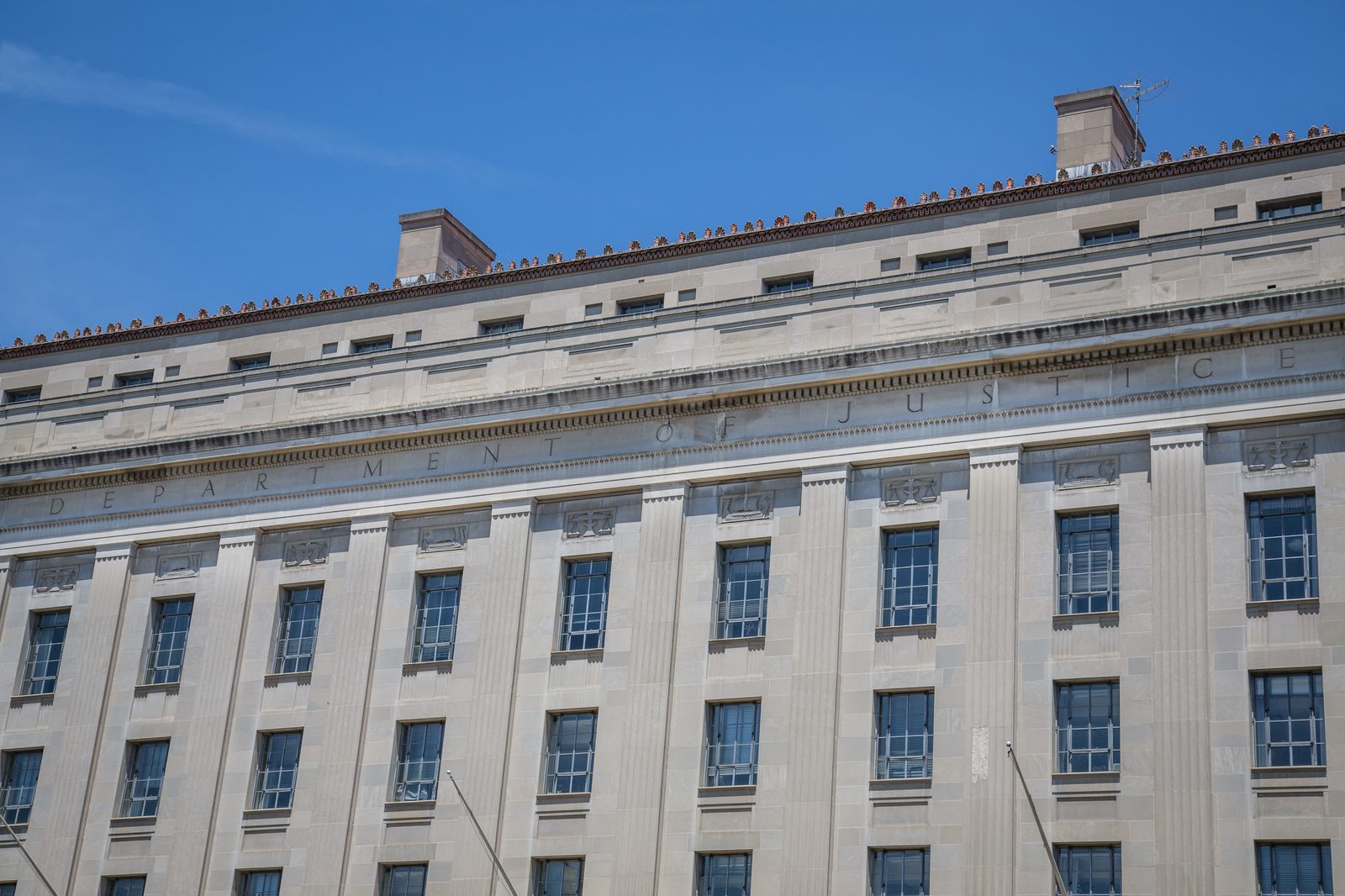
Image: U.S. Department of Justice headquarters, Washington, D.C. Photo by Tony Webster via Wikimedia Commons, licensed under CC BY 2.0.