

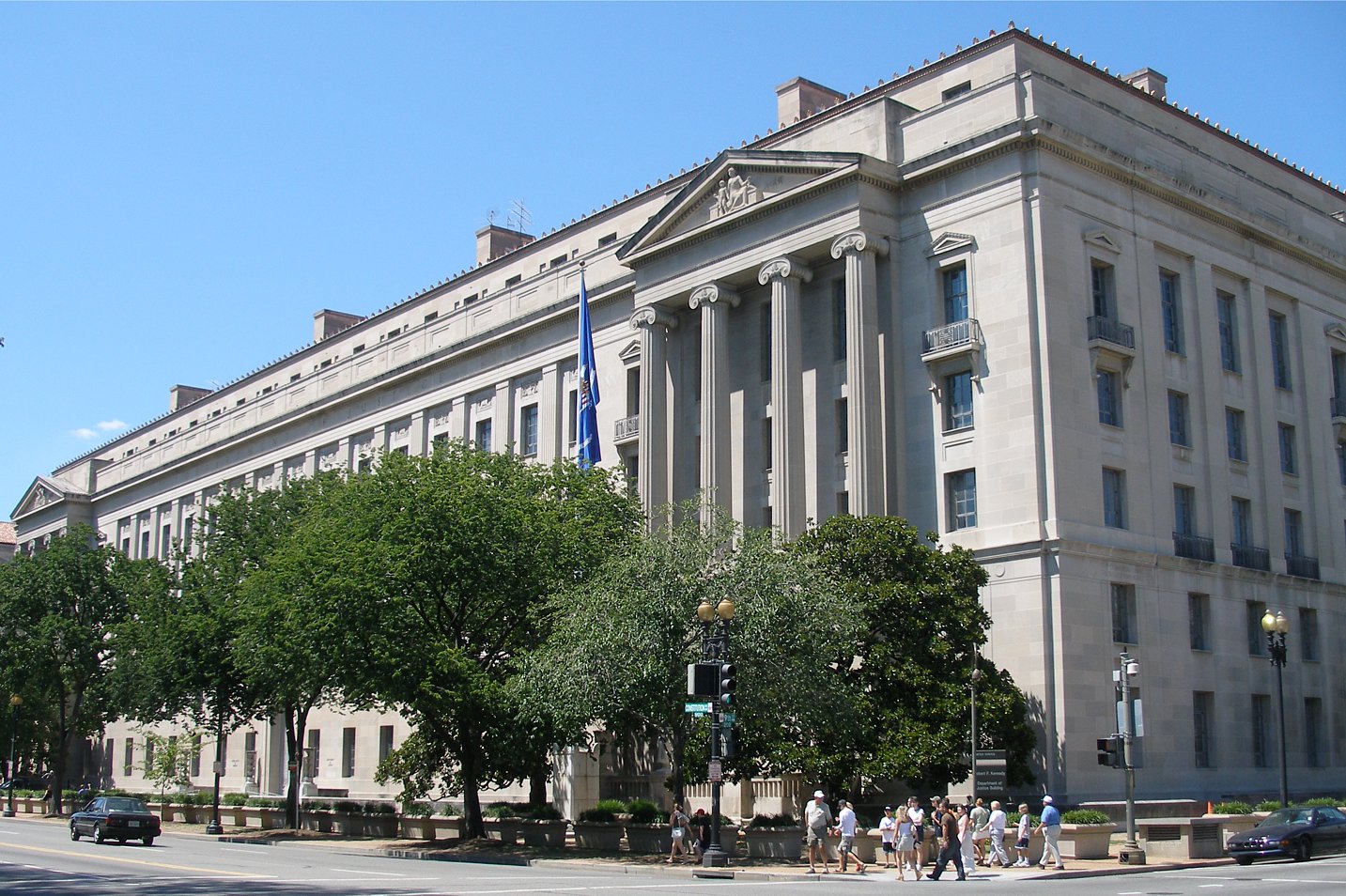
DOJ Watch is The Investigative Journal’s daily digest of federal enforcement activity, compiled from public Justice Department, FBI, and U.S. Attorney records. Charges described below are allegations unless a conviction, guilty plea, or final settlement is noted. Defendants in pending matters are presumed innocent until proven guilty.
WASHINGTON — The Justice Department closed the week with the largest coordinated health care fraud enforcement action on record, charging 455 defendants in a takedown that authorities valued at more than $6.5 billion in alleged false claims. The sweep anchored a stretch of June enforcement that also included a fast-moving domestic terrorism investigation tied to a planned attack on a White House event, the National Security Division’s first corporate declination under a new self-disclosure policy, and a terrorism-financing case in California. The following digest summarizes eight notable actions and flags several that merit closer scrutiny.
1. Record $6.5 billion national health care fraud takedown
On June 23, the department announced the 2026 National Health Care Fraud Takedown, which it described as the largest such operation in its history. According to the department, 455 defendants — including 90 doctors and other licensed medical professionals — were charged across 56 federal districts and 45 states and territories, with 50 state Medicaid Fraud Control Units participating. Records indicate the government seized more than $182 million in cash, luxury vehicles, jewelry, and other assets in connection with the cases.
A significant share of the alleged loss stems from fraudulent wound-care billing. The department alleges that 11 defendants across six districts submitted billions of dollars in claims for amniotic wound allografts, with one company relabeling tissue-bank grafts at a roughly 2,000 percent markup and paying kickbacks to drive demand. Filings indicate that providers billed Medicare more than $4 billion for one company’s allografts over a two-and-a-half-year span. In a separate matter in the Southern District of Texas, prosecutors allege a nurse practitioner ran a $906 million scheme and used proceeds to buy high-end vehicles and jewelry, including a Ferrari and an $865,000 necklace that the government has since seized.
The department also emphasized patient-harm cases, including charges against a Florida medical director accused of an $89 million scheme to bill for unnecessary cardiovascular tests on student athletes; the department alleges one student later died from complications of an enlarged heart after results were rubber-stamped as normal. International cooperation produced several apprehensions, and the FBI added genetic-testing fraud fugitives Khalid Satary and Emylee Thai to a new “Most Wanted Fraudsters” list. All counts are allegations, and the department noted that an indictment is not evidence of guilt.
2. FBI arrests two more in alleged White House UFC attack plot
On June 22, the FBI announced two additional arrests in its investigation of an alleged plot to attack the June 14 Ultimate Fighting Championship “Freedom 250” event at the White House. William Lee Spartacus Falkner was charged by criminal complaint in the Western District of Washington with conspiracy to commit murder, and Jordan W. Rincker, 28, of St. Joseph, Missouri, faces the same charge in the Western District of Missouri.
According to the complaints, the conspirators discussed using explosive-laden drones to drive attendees toward waiting gunmen, and one arrestee told investigators the goal was to sow enough chaos to attempt an overthrow of the U.S. government. Investigators say a search of Rincker’s residence and storage unit recovered firearms, 3D-printed gun parts, ballistic plates, and an off-grid mesh-network communication device. The charges remain accusations; conspiracy to commit murder carries a maximum penalty of life in prison.
The case is significant for what it signals about the use of commercially available drones and 3D-printed weapons in domestic plots, and for the speed of the multi-state response. Earlier arrests in the same investigation were announced the prior week, indicating the matter is active and may yield further charges.
3. National Security Division issues first corporate declination for Bosch
In a notable shift in corporate enforcement, the National Security Division on June 17 declined to prosecute Robert Bosch GmbH, resolving an investigation into the alleged export of sensor products and software to Huawei, a company on the Commerce Department’s Entity List, in violation of export controls. The department said this was the first declination it has granted a company under the department-wide Corporate Enforcement and Voluntary Self-Disclosure Policy.
According to the department, two non-U.S. Bosch subsidiaries exported more than $70 million in foreign-produced items to Huawei affiliates between September 2020 and September 2024 without required licenses. Bosch voluntarily disclosed the conduct, cooperated, and remediated, and agreed to disgorge roughly $11.4 million in profits, a portion of which will be credited toward a $36.2 million civil penalty paid in a parallel Commerce Department action. The resolution illustrates the tangible benefits the department is offering companies that self-report sanctions and export-control violations — a policy development that compliance officers and corporate counsel will be watching closely.
4. San Diego man charged with funneling charity funds to Hamas
On June 17, prosecutors unsealed a five-count complaint charging Reda Mazen Rida Sabassi, 38, of San Diego, with conspiring to provide material support to Hamas, sanctions evasion, wire fraud, money laundering, and false statements. The department alleges that Sabassi used a purported charity, Ikram — The Arab Charity Foundation Inc., to solicit donations ostensibly for humanitarian aid in Gaza while diverting funds to the designated terrorist organization and to himself.
Filings indicate that between December 2023 and February 2024, Sabassi raised roughly $600,000 through online campaigns, sent about $116,000 to a Hamas member, and attempted to convert approximately $382,000 into cryptocurrency for transfer through a Hamas-linked fundraising network previously designated by the Treasury Department. The case is being prosecuted in the Southern District of New York. The charges are accusations only; the four most serious counts each carry a maximum penalty of 20 years in prison.
5. Massachusetts benefit-fraud sweep nets 15 defendants
The department on June 18 announced charges against 15 people — 11 of whom it identified as being in the country illegally, alongside four U.S. citizens — in connection with more than $1.4 million in alleged fraud against SNAP, MassHealth, and Social Security disability and unemployment programs. The largest single case involves a Framingham man the department says is responsible for more than $546,000 in combined benefit fraud and who faces passport-fraud and aggravated-identity-theft counts.
U.S. Attorney Leah B. Foley said the arrests are the opening phase of a sustained effort by a newly created Benefit and Voter Fraud Team, and that charges will be announced on a rolling basis. The matters remain allegations pending adjudication. The case reflects a broader federal emphasis on safety-net program integrity, and the department’s stated intent to continue filings suggests Massachusetts will remain an active enforcement front.
6. Alabama defense contractor settles cybersecurity False Claims Act case
On the civil side, Huntsville-based defense contractor LOGZONE Inc. agreed on June 18 to pay $507,144 to resolve allegations that it knowingly failed to meet cybersecurity requirements on two Navy contracts. According to the department, from May 2021 to March 2025 the company did not implement certain controls under NIST Special Publication 800-171, receiving an assessment score of -170 on a scale that runs from -203 to 110.
The department stressed that the claims are allegations only and that there has been no determination of liability. Still, the settlement is part of a growing line of “cyber-fraud” enforcement under the False Claims Act, in which the government pursues contractors for misrepresenting their compliance with security standards. For the defense industrial base, the case is a reminder that attestations about cybersecurity posture can carry FCA exposure.
7. Dual U.S.-Israeli citizen arraigned over threats to Jewish institutions
Michael Ron David Kadar, 27, a dual U.S.-Israeli citizen extradited from Norway, was arraigned on June 22 in Orlando on an indictment from the Middle District of Florida charging hate crimes and obstruction of the free exercise of religion in connection with alleged threats against Jewish schools and community centers. The matter is significant both for the extradition — reflecting cross-border cooperation in threat cases — and for its place in a series of June filings concerning antisemitic threats and violence. The indictment is an allegation, and Kadar is presumed innocent.
8. The civil enforcement backdrop
Beyond the headline criminal cases, the department’s civil docket remained busy in June, including a separately announced lawsuit targeting alleged Medicaid fraud in New York’s roughly $10 billion home-care program. Taken together with the False Claims Act settlements, the pattern indicates the Civil Division and U.S. Attorneys are continuing to pursue large public-program recoveries in parallel with the criminal takedowns — an approach that maximizes financial recovery even where criminal charges are not brought.
Cases that warrant deeper TIJ investigation
Several threads from this week deserve sustained reporting. First, the wound-allograft billing surge — in which Medicare paid out billions before regulators realigned reimbursement rates — raises questions about how a single product category could expand so rapidly before detection, and whether the reimbursement structure itself invited abuse. Second, the flight of charged fraudsters abroad, including fugitives the FBI says are now in the United Arab Emirates and Vietnam, exposes gaps in extradition and bond practices that TIJ intends to examine. Third, the New York home-care Medicaid litigation warrants tracking given the program’s scale. Finally, the “ghost fleet” tanker prosecution announced earlier in the month points to a widening front in sanctions enforcement against vessels moving Iranian and Venezuelan oil.
Sources: U.S. Department of Justice Office of Public Affairs press releases (June 17–23, 2026), linked inline. All figures and characterizations are drawn from public DOJ statements and charging documents. The Investigative Journal will update individual entries as cases proceed and will note convictions, acquittals, or dismissals as they are entered.