

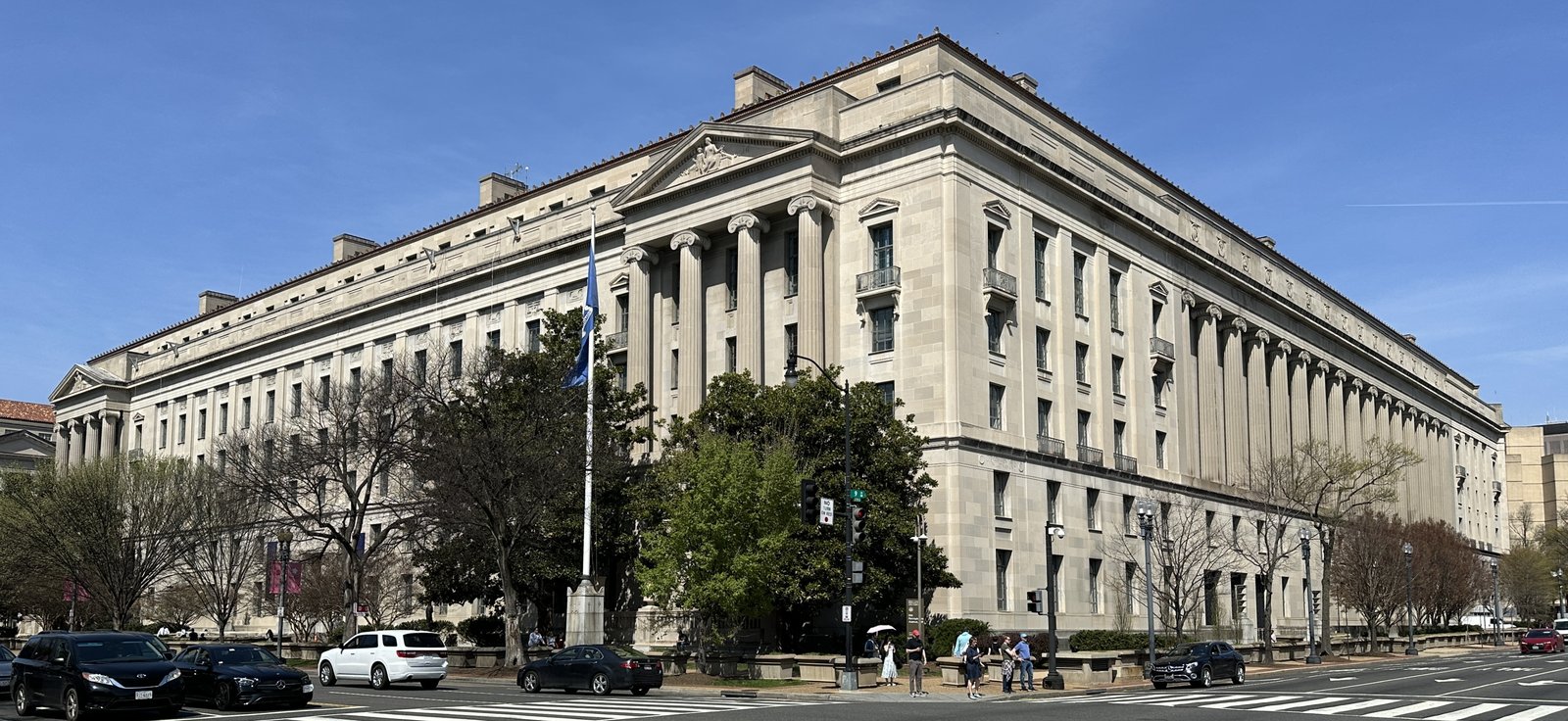
DOJ Watch is The Investigative Journal’s running digest of federal enforcement activity. Every matter below is drawn from the Justice Department’s own press releases and charging documents, with direct links provided. Except where a guilty plea, conviction, or settlement is explicitly noted, the actions described are allegations only, and each defendant is presumed innocent unless and until proven guilty beyond a reasonable doubt.
The Justice Department capped a busy June with the largest health care fraud takedown in its history, a first-of-its-kind corporate declination in an export-control matter, and a cluster of national-security, benefit-fraud, and government-contracting cases. The through-line connecting much of the month’s activity is the Department’s newly created National Fraud Enforcement Division, stood up on April 7, 2026, and an expanded reliance on data analytics to detect schemes before money leaves federal accounts. Below are eight enforcement actions announced between June 12 and June 23 that merit attention.
1. Record $6.5 billion national health care fraud takedown
On June 23, the Department announced the 2026 National Health Care Fraud Takedown, charging 455 defendants — including 90 doctors and other licensed medical professionals — in connection with more than $6.5 billion in alleged false claims. According to the Department, the coordinated action spanned 56 federal districts and 45 states and territories, with 50 state Medicaid Fraud Control Units participating, which the Department describes as the most in its history. Authorities reported seizing more than $182 million in cash, vehicles, jewelry, and other assets.
Among the most striking allegations, filings indicate that 11 defendants across six districts were charged in schemes tied to amniotic wound allografts. In one Arizona matter, a sales executive is alleged to have driven a kickback scheme in which a company relabeled and resold allografts at a roughly 2,000% markup; in the Southern District of Texas, a nurse practitioner was charged in a $906 million scheme. Records also describe a Southern District of Florida case in which the medical director of a cardiovascular testing practice allegedly billed $89 million for unnecessary tests on student athletes — a case the Department says involved patient harm, including the death of a student athlete whose abnormal results were allegedly rubber-stamped as normal.
The Department emphasized international cooperation, citing the apprehension of fugitives in Cyprus, Estonia, and the Philippines, and announced new additions to an FBI “Most Wanted Fraudsters” list. The Department stressed that an indictment is merely an allegation and that all defendants are presumed innocent. The scale of the action, and its heavy reliance on the Health Care Fraud Unit’s Data Fusion Center, signals that algorithmic detection is now central to the Department’s white-collar strategy.
2. Arkansas pathology lab pays $30 million to resolve kickback allegations
In a civil resolution announced June 17, Advanced Pathology Solutions of North Little Rock, Arkansas, together with its management organization and three current and former owners, agreed to pay $30 million to resolve False Claims Act allegations. The government alleged that, from 2015 through July 2022, the laboratory furnished unlawful kickbacks to gastroenterology practices to induce referrals and ordered medically unnecessary “special stain” tests that were ineligible for Medicare reimbursement.
The settlement, which followed three whistleblower suits filed under the qui tam provisions of the False Claims Act, includes a five-year Corporate Integrity Agreement with the Department of Health and Human Services Office of Inspector General. As is standard in such resolutions, the claims are allegations only and there has been no determination of liability. The case illustrates the continued use of the False Claims Act — and private whistleblowers — as a civil complement to the criminal health care prosecutions described above.
3. National Security Division issues its first corporate declination
On June 17, the Justice Department’s National Security Division declined to prosecute Robert Bosch GmbH over an alleged scheme in which two non-U.S. subsidiaries exported more than $70 million in sensor products and software to Huawei and its affiliates — entities on the Commerce Department’s Entity List — without required licenses, in alleged violation of export-control regulations. It is the first declination the division has granted under the Department-wide Corporate Enforcement Policy.
According to the Department, Bosch voluntarily self-disclosed the conduct, cooperated, and remediated, and in the absence of aggravating circumstances qualified for a declination. The company agreed to disgorge roughly $11.4 million in profits, a portion of which is credited against a $36.2 million civil fine paid in a parallel Commerce Department action. The decision is significant as a policy precedent: it offers a concrete data point for how multinational companies may be treated when they self-report export-control violations, and it underscores the administration’s stated emphasis on incentivizing voluntary disclosure.
4. San Diego man charged with funneling donations to Hamas
The Department unsealed a five-count complaint on June 17 charging Reda Mazen Rida Sabassi, 38, of San Diego, with conspiring to provide material support to Hamas, sanctions evasion, wire fraud, money laundering, and false statements. Prosecutors allege that Sabassi used a purported charity and online crowdfunding campaigns to solicit donations ostensibly for humanitarian aid in Gaza, while in fact diverting funds to the designated foreign terrorist organization and to himself.
According to the complaint, between December 2023 and February 2024 Sabassi raised approximately $600,000, sent roughly $116,000 to a Hamas member, and attempted to convert about $382,000 into cryptocurrency for transfer through a Hamas-linked fundraising network. The charges are accusations only, and Sabassi is presumed innocent. The case reflects the National Security Division’s continued focus on terrorism financing routed through ostensibly charitable channels — a recurring vulnerability that TIJ has tracked across multiple jurisdictions.
5. Ghost-fleet tanker master pleads guilty after Coast Guard pursuit
In one of the month’s few resolved criminal matters, Avtandil Kalandadze, 47, a citizen of Georgia and former master of the tanker Bella 1, pleaded guilty on June 12 in federal court in Washington, D.C., to failing to obey a Coast Guard order to heave to. Court records describe a multi-week pursuit across the Atlantic after the vessel — which the Department says historically transported Iran- and Venezuela-origin oil — fled an interdiction by the Coast Guard cutter Munro in December 2025.
According to the plea agreement, the Bella 1 moved roughly 1.8 million barrels of Iran-origin oil to Asia using obfuscation tactics such as disabling its tracking transponder and concealing the ship’s name during a ship-to-ship transfer. Kalandadze, who faces a maximum of five years and is set to be sentenced August 7, will be deported after serving any prison term. The guilty plea is a notable conviction in the Department’s broader campaign against the sanctioned “ghost fleet,” and signals that crew members — not only owners — face individual criminal exposure.
6. Alabama defense contractor settles cybersecurity false-claims case
On June 18, Huntsville, Alabama-based defense contractor LOGZONE Inc. agreed to pay $507,144 to resolve False Claims Act allegations that it knowingly failed to meet cybersecurity requirements on two Navy contracts. The government alleged that, from May 2021 to March 2025, the company did not implement controls required under NIST Special Publication 800-171, receiving an assessed score of -170 on a scale running from -203 to 110.
The settlement, which resolves allegations without any determination of liability, is part of the Civil Division’s Civil Cyber-Fraud Initiative holding contractors accountable for cybersecurity representations. For the defense industrial base, the action is a reminder that attestations about safeguarding controlled defense information carry False Claims Act exposure — a compliance risk that TIJ expects to see tested more frequently as the Department leans into cyber-related enforcement.
7. Fifteen charged in Massachusetts benefit-fraud sweep
The Department announced on June 18 that 15 individuals had been charged in connection with more than $1.4 million in alleged benefit fraud in Massachusetts, spanning the Supplemental Nutrition Assistance Program, the state’s MassHealth program, and Social Security, disability, and unemployment benefits. The charges include passport fraud, aggravated identity theft, and false statements relating to health care programs. The U.S. Attorney’s office said the arrests are the first of what it described as a rolling series of benefit-fraud cases coordinated through a new district Benefit and Voter Fraud Team.
The charging documents contain allegations only, and the defendants are presumed innocent. Several individuals were charged using “John Doe” designations because, according to the Department, they had been living under stolen identities. The case is one of several this month tying benefit-program integrity to the administration’s broader anti-fraud task force, and it bears watching as additional charges are announced.
8. Seven indicted in Nevada over pandemic relief loans
Rounding out the month’s fraud docket, the Department announced on June 12 that seven Las Vegas men had been arrested and indicted on wire-fraud charges in connection with roughly $205,639 in fraudulent COVID-19 relief loan applications submitted to the Small Business Administration’s Paycheck Protection Program and Economic Injury Disaster Loan program. The arrests, coordinated across FBI field offices in Las Vegas, Phoenix, and Houston, reflect the Department’s continued pursuit of pandemic-era relief fraud years after the programs closed.
Each indictment is an allegation, and the defendants are presumed innocent; if convicted, each faces a statutory maximum of 20 years. Though modest in dollar value next to the month’s headline cases, the action illustrates the Department’s stated intent to pursue pandemic fraud regardless of size — and the durability of the multi-year statute of limitations that continues to make these cases viable.
Cases that warrant deeper TIJ investigation
Several threads from this month’s enforcement activity merit sustained reporting. First, the wound-allograft schemes at the center of the health care takedown — involving alleged markups of up to 2,000% and billions in Medicare payments before the Centers for Medicare and Medicaid Services realigned reimbursement in January 2026 — raise questions about how such pricing went undetected for years, and how the relabeling supply chain operated. Second, the fugitives newly added to the FBI’s “Most Wanted Fraudsters” list, including individuals the Department says fled to the United Arab Emirates and Vietnam after being released on bond, warrant scrutiny of pretrial-release decisions in large fraud cases. Third, the Bosch declination establishes a precedent worth tracking: TIJ will watch whether comparable self-disclosures by other multinationals yield similar outcomes, and whether the disgorgement-plus-civil-fine model becomes the template for export-control resolutions.
Finally, the Massachusetts U.S. Attorney’s promise of benefit-fraud charges “on a rolling basis,” and a separate civil suit the Department filed June 16 over New York’s $10 billion Medicaid home-care program, suggest that public-benefit integrity will be a defining enforcement theme of 2026. The Investigative Journal will continue to follow these dockets as they develop.
Sources: All facts in this digest are drawn from U.S. Department of Justice press releases and charging documents, linked inline above. Readers can review the full announcements at justice.gov. Parties named in pending matters are entitled to a right of reply; TIJ will update this report with any response received.