

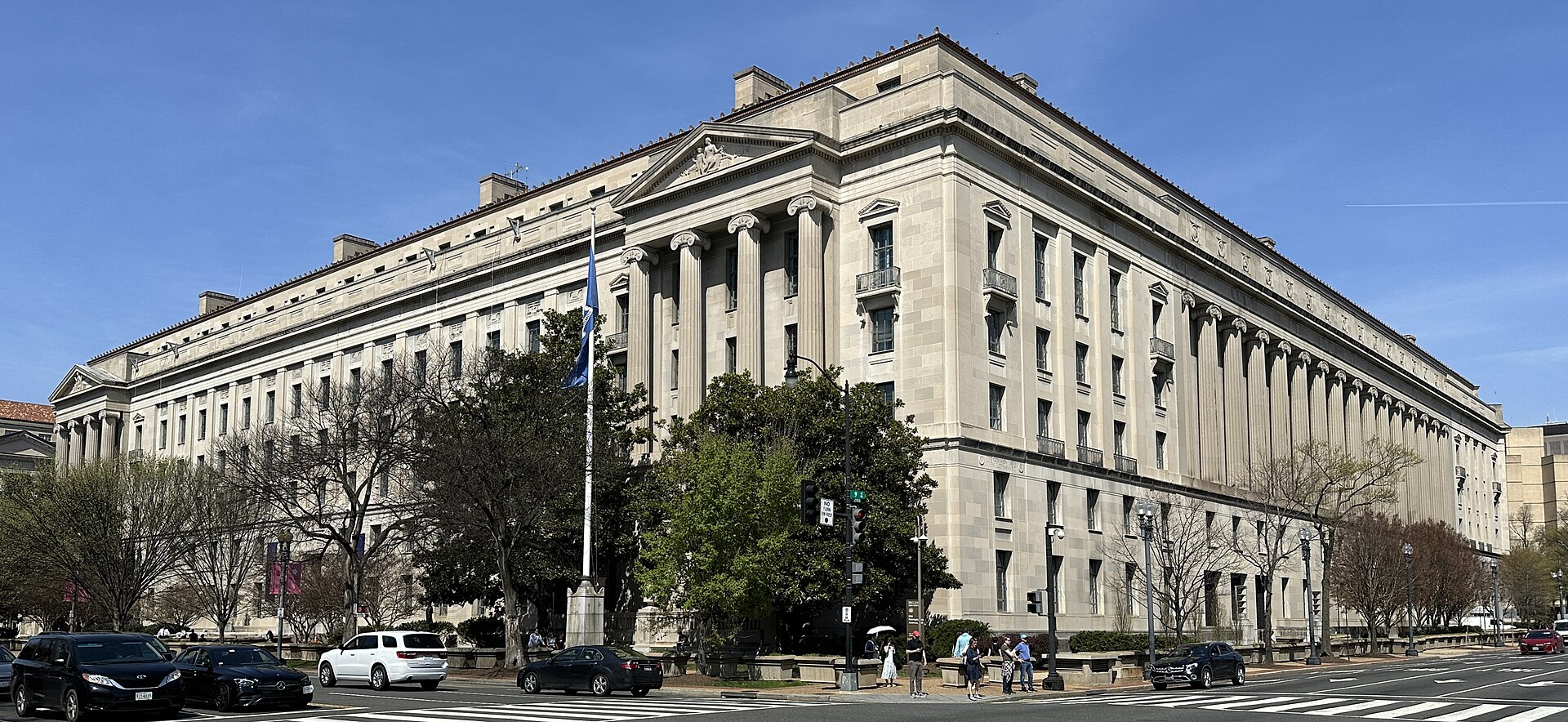
The Investigative Journal’s daily accounting of federal enforcement. Every item below is drawn from Justice Department press releases and court records, with links to the primary documents. Criminal charges are allegations, and all defendants are presumed innocent unless and until proven guilty in a court of law. Civil settlements resolve allegations and are not findings of liability.
Main Justice opened the week at full throttle. Monday, September 14, brought seven notable enforcement announcements from the department’s Office of Public Affairs — anchored by a $385 million False Claims Act resolution with Abbott Laboratories over contaminated infant formula allegations, and a nationwide COVID-era loan fraud surge that swept in more than 160 defendants across 44 U.S. Attorney’s offices. National security prosecutors also logged guilty pleas in a Russia export-control case and in the 2024 bombing of a California courthouse. Here is what moved, what the records show, and what The Investigative Journal will be watching next.
Abbott to Pay $384.9 Million Over Contaminated Infant Formula Allegations
Abbott Laboratories has agreed to pay $384,999,040 to resolve allegations that it caused false claims to be submitted to federal and state programs between January 1, 2018, and December 31, 2022, arising from powder infant formula and nutritional therapy products manufactured at its Sturgis, Michigan, and Casa Grande, Arizona, facilities, according to the Justice Department’s announcement. The government’s complaint in intervention, filed November 13, 2025, alleged that taxpayer-funded programs purchased formula made in an environment that put products at unacceptable risk of microorganism contamination.
The complaint’s details are striking: filings allege that roof leaks were a common occurrence at the Sturgis plant, that Abbott deployed “roof leak umbrellas” over processing areas rather than fixing root causes, and that the company continued running spray dryers after documenting cracks and pits in the equipment. The government further alleged that Abbott lengthened production runs between cleaning cycles and, in certain instances, did not test for bacterial growth or disclose adverse results. Those allegations were resolved by settlement and have not been tested at trial; a negotiated FCA resolution is not a court finding of liability.
“Today’s settlement is a victory for American families and makes clear the safety of our children is not negotiable,” said Acting Deputy Attorney General Trent McCotter. The case was announced alongside the U.S. Attorney’s Office for the Western District of Michigan and USDA’s Office of Inspector General. The significance is hard to overstate: the resolution signals that food-safety compliance failures tied to federal purchasing — here, programs that feed infants — will be treated as fraud on the taxpayer, not merely as regulatory matters.
‘Operation No Doze’: COVID Loan Fraud Surge Reaches $245 Million, 160-Plus Defendants
The department’s National Fraud Enforcement Division, with the Small Business Administration and SBA’s Office of Inspector General, announced the results of Operation No Doze, a summer surge targeting fraud in COVID-era small business loan programs. Between June 12 and September 1, prosecutors obtained felony charges against nearly 80 defendants accused of roughly $100 million in intended losses; approximately 43 defendants pleaded guilty to SBA-related COVID fraud totaling about $44 million, and roughly 40 more were sentenced in cases involving nearly $100 million. In all, the surge spanned more than 160 defendants and approximately $245 million in intended loss, according to the department.
The newly charged defendants allegedly fabricated businesses, submitted false payroll and revenue figures, stole identities, and concealed foreign ties on loan applications — allegations that remain to be proven in court. The scale of the remaining exposure is the larger story: SBA Administrator Kelly Loeffler said the agency has suspended 870,000 borrowers tied to $39 billion in suspected fraudulent Paycheck Protection Program and COVID EIDL activity, with demand letters going out and Treasury collections to follow for those who do not repay.
Forty-four U.S. Attorney’s offices and 20 federal and state investigative agencies participated, with parallel announcements from offices including the Northern District of Illinois and the Eastern District of Michigan. Four years after the pandemic programs closed, the charging pace suggests pandemic-fraud accountability is accelerating rather than winding down.
Russian National Pleads Guilty to Smuggling U.S. Aerospace Parts to Russia
Andrei Samuilovski, 32, a holder of Russian, Estonian, and Swiss citizenship, pleaded guilty in the District of Columbia to conspiracy to violate the Export Control Reform Act in a scheme to move U.S.-origin aviation and aerospace components to Russia without Commerce Department licenses. Court documents indicate the conspiracy ran from early 2022 through September 2024.
According to the filings, Samuilovski co-founded ITC Middle East FZ-LLC, a United Arab Emirates entity established in March 2022 — approximately four weeks after Russia’s full-scale invasion of Ukraine triggered sweeping new export restrictions. Dozens of shipments of export-controlled aerospace commodities, cumulatively valued at nearly $2 million, flowed from U.S. companies to ITC and were ultimately reexported to Russia, records indicate. Sentencing before Judge Carl J. Nichols is set for January 13, 2027; the count carries a maximum of 20 years. The case is another data point in the government’s sustained campaign against third-country transshipment networks that keep sanctioned Russian end users supplied with American parts.
Guilty Plea in 2024 Bombing of Santa Barbara County Courthouse
Nathaniel James McGuire, 22, of Santa Maria, California, pleaded guilty to use of a weapon of mass destruction and malicious destruction of a building using an explosive for the September 24, 2024, bombing of the Santa Maria courthouse. According to his plea agreement, McGuire threw a backpack containing an explosive device past security screening toward sheriff’s deputies; the bomb detonated outside a courtroom, injuring three people, and the courthouse sustained roughly $35,000 in damage.
The plea agreement describes an attack that could have been far deadlier: after the detonation, McGuire went to his vehicle to retrieve two long guns and ten Molotov cocktails, intending to re-enter the courthouse to kill deputies and a judge, before a security guard and officers stopped him. He admitted acting in retaliation for deputies seizing his firearms earlier that year. McGuire has been in federal custody since September 2024 and faces up to life in prison at his March 1, 2027, sentencing. Prosecutions of violence directed at courts and law enforcement have become a visible priority for the National Security Division’s Counterterrorism Section, which assisted in the case.
Six Charged in Three States in Election Fraud Cases
The department announced charges against six individuals in California, Kansas, and Louisiana involving illegal voting, fraudulent voter registration, and identity fraud. In the Central District of California, a federal grand jury indictment charges James Brass, 47, of Victorville, along with petition circulators Courtney Price, 49, and Jateisha Herron, 33, with conspiracy to commit identity fraud in furtherance of a state felony. Prosecutors allege the defendants paid people on Skid Row in downtown Los Angeles to sign ballot-initiative petitions using stolen identities of registered voters.
Separately, two noncitizens residing in Kansas and Louisiana were charged with illegally voting, and a Louisiana individual was charged with fraudulently registering an ineligible voter. All six defendants are presumed innocent; the charges are allegations that the government must prove beyond a reasonable doubt. With federal midterm elections less than two months away, the cases signal that the department’s election-integrity docket — a stated priority of Attorney General Todd Blanche and FBI Director Kash Patel — is likely to remain active through the fall. The petition-fraud theory in the California indictment is particularly notable, extending federal identity-fraud statutes to the ballot-qualification process rather than voting itself.
Accenture Entities to Pay $25 Million Over Contract Certification Allegations
Accenture Federal Services, Accenture plc, and Accenture LLP agreed to pay $25 million to resolve alleged False Claims Act violations tied to anti-discrimination requirements in federal contracts. The government alleged that from 2017 onward, AFS certified compliance with equal-opportunity contract provisions while making hiring and promotion decisions influenced by race and sex — including monthly color-coded demographic scorecards for business units, separate promotion “pipelines,” and training programs with eligibility limited by race.
As with Abbott, the settlement resolves allegations only; there has been no trial or admission recounted in the announcement. The resolution is among the first major FCA recoveries under the administration’s initiative directing enforcement against federal contractors whose diversity programs allegedly cross into unlawful discrimination — a legal theory corporate compliance departments across the contracting sector are now confronting. Records suggest more such cases are in the pipeline.
Colombian Smuggler Admits Role in Voyage That Left 42 Missing at Sea
Luis Enrique Linero Pinto, 41, known as “El Calvo,” pleaded guilty in El Paso to conspiracy to commit alien smuggling and placing lives in jeopardy, following his extradition from Colombia. According to court documents, Linero Pinto received migrants on San Andres Island, Colombia, arranged their lodging, and loaded them onto boats bound for Nicaragua en route to the United States — and bribed members of the Colombian Navy for real-time intelligence on patrol vessel positions so smuggling boats could avoid detection.
On October 21, 2023, a boat carrying approximately 40 migrants and two captains disappeared after leaving San Andres Island; those aboard have never been found. Linero Pinto admitted his role in that voyage. He faces up to 20 years at a sentencing date not yet set. The case, built by Homeland Security Investigations and the department’s Joint Task Force Alpha with Colombian cooperation, shows the extradition pipeline for smuggling networks is functioning — and that prosecutors are attaching mass-casualty consequences to the smuggling economy’s business model.
Also on the Docket
Three additional items from late last week merit attention. In a legal first, the department removed Afghan national Nazira Haji Zada through the United States Alien Terrorist Removal Court — a tribunal Congress created decades ago that no prior administration had ever used. Zada, whose son and son-in-law were convicted over an ISIS-inspired Election Day 2024 shooting plot, conceded alien-terrorist status and waived appeal; the government used classified evidence under the ATRC statute. In Brooklyn, an adult daycare owner was sentenced to 76 months for leading a $64 million Medicaid fraud and kickback scheme, with over $56 million in restitution ordered. And a Ukrainian national received four years in a wire fraud conspiracy connected to the Conti ransomware operation.
On TIJ’s Radar
Several of Monday’s actions warrant deeper investigation, and The Investigative Journal will be pulling the underlying filings. First, the Abbott settlement: the government’s complaint in intervention contains detailed factual allegations about testing practices and disclosure decisions at Sturgis — the same facility at the center of the 2022 national formula crisis — and the settlement agreement deserves a close read on state program shares, whistleblower provisions, and what conduct falls outside the release. Second, Operation No Doze: the SBA’s stated universe of 870,000 suspended borrowers and $39 billion in suspected fraud dwarfs the $245 million addressed this summer; the recovery rate, and who ultimately gets prosecuted versus a demand letter, is a story we intend to follow with data. Third, ITC Middle East: court records identifying the U.S. suppliers whose parts flowed through the UAE entity to Russia could illuminate how transshipment networks still exploit American distributors. Finally, the first-ever ATRC removal raises procedural questions — classified evidence, concession-and-waiver outcomes — that deserve scrutiny regardless of the removal’s national security merits.
Right of reply: The companies and individuals named above are entitled to respond. TIJ will publish substantive responses from named parties or their counsel of record; contact the editor at tij.news. Reporting above is based solely on public Justice Department releases and court records linked in each item.
Sources
- DOJ: Abbott Agrees to Pay Over $384M (Sept. 14, 2026) | Settlement agreement (PDF)
- DOJ: Operation No Doze COVID Loan Fraud Surge (Sept. 14, 2026)
- DOJ: Russian National Pleads Guilty to Smuggling Aerospace Goods (Sept. 14, 2026)
- DOJ: Guilty Plea in Santa Barbara County Courthouse Bombing (Sept. 14, 2026)
- DOJ: Six Charged for Illegal Voting and Identity Fraud (Sept. 14, 2026)
- DOJ: Accenture Agrees to Pay $25M (Sept. 14, 2026)
- DOJ: Colombian National Pleads Guilty in Human Smuggling Case (Sept. 14, 2026)
- DOJ: First Use of Alien Terrorist Removal Court (Sept. 11, 2026)
- DOJ: Brooklyn Daycare Owner Sentenced in $64M Medicaid Fraud (Sept. 11, 2026)
- DOJ: Ukrainian National Sentenced in Conti Ransomware Case (Sept. 10, 2026)
Featured image: Robert F. Kennedy Department of Justice Building, Washington, D.C. Photo via Wikimedia Commons, CC BY 4.0.