

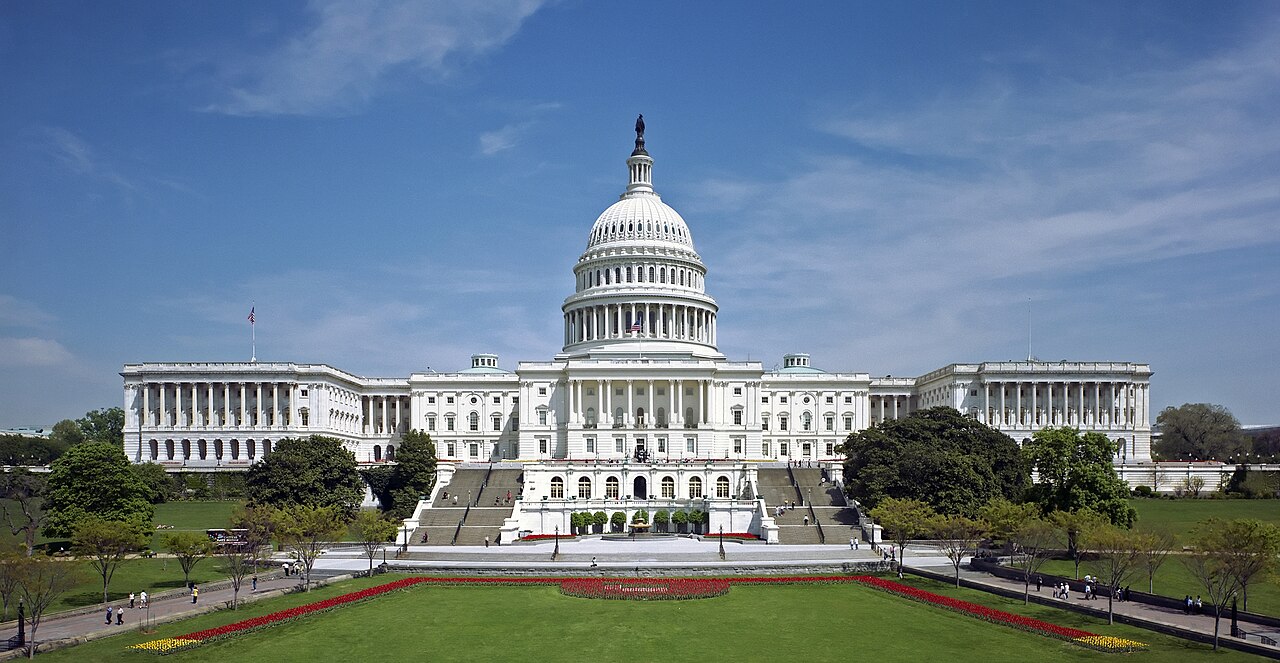
WASHINGTON — The Capitol is largely dark this week, with the House scattered to its districts and the Senate gone until mid-September. But the quiet is deceptive. Congress left town without completing a single fiscal year 2027 appropriations bill, government funding runs out September 30, and the two chambers departed with dueling stopgap measures that expire a week apart. Layered on top: a Congressional Budget Office tally showing the deficit running $1.8 trillion through ten months of the fiscal year, a defense authorization bill stalled on the Senate floor, and a sweeping Russia sanctions package awaiting House action. Here is where the major legislative files stand as of the week of August 17.
1. Rival stopgaps set up a September funding showdown
Status: House CR passed July 21; Senate alternative passed August 8; differences unresolved.
Before adjourning, the House passed H.R. 9770, a continuing resolution funding the government at current levels through December 4, on a largely party-line 220–205 vote. The Senate answered on August 8 with its own stopgap running through December 11, approved 90–6 after what Roll Call described as days of negotiation over floor timing, according to the Committee for a Responsible Federal Budget’s appropriations tracker.
The one-week gap between the two end dates is small; the procedural distance is not. The House must either take up the Senate’s version or negotiate a compromise vehicle within weeks of returning in early September — the Senate is not due back until September 14 — leaving a narrow runway before the October 1 shutdown trigger. The stakes are elevated by recent history: CRFB records show fiscal 2026 saw three separate funding lapses, including a Department of Homeland Security shutdown that ran from February 14 to April 30 and was resolved only with H.R. 7147 in late April.
2. The FY2027 appropriations scoreboard
Status: All 12 bills through House committee; 3 passed the House floor; Senate committee has produced none.
The House Appropriations Committee has approved all twelve FY2027 bills, and three have cleared the floor: Military Construction–VA (400–15 on May 15), Agriculture–FDA (213–210 on June 4), and National Security–State (217–209 on July 15), according to the Congress.gov appropriations status table and committee records posted by the House Appropriations Committee.
The Senate Appropriations Committee, by contrast, has not agreed on topline spending levels and has yet to release a single bill, a standstill the National Low Income Housing Coalition attributes to the breakdown of the bipartisan process that normally anchors Senate markups. Analysts at the American Action Forum note the House bills cut nondefense spending, boost defense, and carry policy riders unlikely to survive the Senate — a recipe for a December collision no matter which CR date prevails. With the Fiscal Responsibility Act’s caps expired after FY2025, there are no enforceable statutory limits shaping the endgame, CRFB notes.
3. CBO corner: a $1.8 trillion ten-month deficit — and battleship sticker shock
Status: Monthly Budget Review published August 10; Navy battleship cost report published August 5.
CBO’s Monthly Budget Review for August estimates the federal deficit reached $1.8 trillion over the first ten months of fiscal 2026 — $169 billion more than the same period a year earlier. Revenues rose $139 billion (3 percent) while outlays climbed $308 billion (5 percent), per the full report. Those figures will frame both the appropriations endgame and any fall tax or health-care negotiations.
Separately, CBO published a closely read analysis of the Navy’s new battleship program, estimating the planned 15-ship class of nuclear-powered guided-missile battleships would cost roughly $275 billion in 2026 dollars through 2056, with the lead ship at about $23.4 billion, according to USNI News. CBO also flagged strain on the shipbuilding industrial base — analysis that lands squarely in the middle of the defense authorization and appropriations debates below.
4. NDAA: passed the House, parked in the Senate
Status: Passed House July 22; approved by Senate Armed Services in June; awaiting Senate floor time.
The House passed H.R. 8800, the FY2027 National Defense Authorization Act, on July 22 by a 216–212 vote, authorizing a topline reported at $1.15 trillion. The Senate Armed Services Committee completed its own markup in June on an 18–9 vote, but floor consideration has stalled amid disputes over spending growth and foreign policy, Breaking Defense reports.
Committee materials indicate the bills carry a 5-to-7 percent pay raise for service members alongside major shipbuilding and aircraft authorizations. The practical question for September is sequencing: with floor time consumed by the funding fight, conferencing the two NDAA versions before year’s end becomes harder each week the Senate bill sits on the calendar.
5. Russia sanctions package heads to the House
Status: Passed Senate 86–11 on August 7; awaiting House action.
In its final major act before recess, the Senate passed the Lindsey O. Graham Sanctioning Russia and Iran Act of 2026 by an 86–11 vote, using a bipartisan education measure sponsored by Sen. Michael Bennet (D-Colo.) as the legislative vehicle, according to Bennet’s office. The bill imposes primary and secondary sanctions targeting Russia’s financial network and so-called shadow fleet, and authorizes tariffs of up to 100 percent on imports from the largest purchasers of Russian oil and gas, per Sen. Kevin Cramer’s summary.
The measure — named for the South Carolina senator who championed it, CNBC reports — now awaits the House. Sen. Roger Wicker (R-Miss.) published an outline of the legislation August 17, a sign supporters intend to keep momentum through the recess. House scheduling in September will indicate whether leadership moves it standalone or folds it into a broader package.
6. The other September cliff: ACA premium credits
Status: H.R. 1834 passed the House January 8; pending in the Senate.
The Affordable Care Act’s enhanced premium tax credits expired December 31, 2025, and the question of restoring them hangs over the fall agenda. The House passed H.R. 1834 — a three-year extension — on January 8 by a 230–196 vote, with 17 Republicans joining Democrats after a discharge petition forced the measure to the floor, UPI reported. The Senate has not taken it up.
The stakes are documented in a Congressional Research Service analysis of the expiration’s effect on 2026 exchange premiums; KFF-based estimates cited by Thomson Reuters suggest average marketplace premium payments rise sharply without the enhancements. The politics are equally documented: the first fiscal 2026 shutdown, which CRFB records as running October 1 to November 12, 2025, turned in large part on this issue — and open enrollment begins November 1, two days before the midterm elections.
7. Crypto market structure: CLARITY’s closing window
Status: Passed House July 2025; approved by Senate Banking May 14; no Senate floor vote scheduled.
The Digital Asset Market Clarity Act passed the House 294–134 in July 2025 and cleared the Senate Banking Committee 15–9 on May 14, per the committee’s own summary and the Latham & Watkins policy tracker. On July 22, Senate Republicans released updated text merging the Banking and Agriculture committee frameworks and adding a government-ethics title, Paul Hastings reports.
What the bill lacks is floor time. Majority Leader John Thune indicated before the recess that it would not come up before the break, and industry analysts warn that without Senate action this fall, comprehensive market-structure legislation likely resets in the next Congress. September’s calendar crunch makes that scenario increasingly plausible.
8. Regulatory watch: Medicare physician pay comments close September 14
Status: Proposed rule published July 16; comment period open through September 14.
The Centers for Medicare & Medicaid Services’ CY2027 Physician Fee Schedule proposed rule (CMS-1848-P), published in the Federal Register on July 16, is one of the most consequential open dockets in Washington. Comments are due September 14, per the CMS fact sheet.
Provider groups are focused on proposed conversion-factor updates and quality-program changes; analyses by Holland & Knight indicate many physicians face net payment reductions in 2027 as a temporary 2.5 percent update from CY2026 lapses. Expect the comment file — and congressional letters echoing it — to feed directly into fall discussions of a legislative “doc fix.”
9. State watch: California’s AI endgame, with national reach
Status: Legislature faces August 31 adjournment; roughly 30 AI bills in final-passage window.
California’s Legislature returns from its summer recess to an August 31 deadline to pass bills, with roughly 30 artificial-intelligence measures — covering chatbot safety for minors, AI copyright transparency, and algorithmic-management worker protections — surviving into the final window after this month’s appropriations-committee votes, according to Tech Times and the Transparency Coalition.
The national implications are hard to overstate: Latham & Watkins describes California as assuming the role of lead U.S. AI regulator, and the Transparency Coalition counts 85 AI-related laws enacted across 27 states so far in 2026 — a record pace. Whatever reaches the governor’s desk by month’s end will effectively set compliance baselines for companies operating nationwide, and will sharpen the federal preemption debate when Congress returns.
10. On our beat: the de minimis wind-down tightens
Status: Statutory repeal effective July 1, 2027; CBP pilots expanding now.
For readers following this publication’s reporting on Chinese e-commerce and cross-border logistics: the dismantling of the de minimis duty exemption is proceeding on two tracks. Congress repealed Section 321 treatment for commercial shipments effective July 1, 2027, in the 2025 reconciliation law (P.L. 119-21), which also created civil penalties of up to $10,000 for splitting orders to dodge duties, according to a Congressional Research Service brief. Executive action got there first — de minimis treatment was suspended for China and Hong Kong in May 2025 and globally that August — and CRS reports Customs and Border Protection collected over $1 billion in duties on more than 246 million low-value shipments between May and December 2025.
The operational squeeze continues: CBP launched a new entry process for postal shipments valued at $800 or less in July, and plans a September pilot of a voluntary electronic process for postal shipments up to $2,500, per White & Case. Records suggest the compliance burden is shifting onto the direct-from-China parcel channels — and the last-mile carriers that serve them — that this publication has examined. Ways and Means and Senate Finance retain jurisdiction as implementation questions mount ahead of the 2027 statutory deadline.
The week ahead
August 31: California Legislature adjourns. Early September: House returns; FY2027 funding negotiations resume. September 14: Senate returns; CMS-1848-P comments close. September 30: government funding expires. This tracker is compiled from public legislative records, official committee documents, and agency filings linked throughout; bill statuses reflect Congress.gov and chamber records as of publication.