

Status key: Enacted = signed into law; Passed House/Senate = cleared one chamber; Reported = approved by committee; Introduced = text released, no committee action recorded. Information is drawn from the public sources linked below and was current as of Thursday, October 15, 2026.
With the midterm elections on November 3 and the government funded only through December 11, Congress enters the final stretch of 2026 with a crowded list of expiring authorities and unfinished bills. This week’s Legislative Watch tracks ten items: the stopgap spending law and the stalled FY 2027 appropriations bills, a new Congressional Budget Office (CBO) analysis of higher interest rates, a bipartisan Senate permitting bill, the defense policy bill, two infrastructure measures, the farm bill, and two newly scored bills with oversight implications.
1. Continuing Appropriations and Extensions Act, 2027 — Status: Enacted
The stopgap funding law is the controlling fact for everything else on the calendar. According to the Committee for a Responsible Federal Budget (CRFB), the Senate passed the continuing resolution 90-6 on August 8, the House passed it 370-48 on September 1, and the President signed it on September 2. The measure funds the government through December 11, 2026. The Congressional Research Service has published an overview of the continuing appropriations, and the CRFB’s appropriations tracker lays out the vote history.
Breaking Defense reported that the House vehicle funded Defense Department programs at FY 2026 levels, left out the Iran-related war funding the White House had requested in a supplemental, and omitted most of the Pentagon “anomalies” the administration sought, including $1 billion for the Trump-class battleship. Those requests now become part of the December negotiation. See the Breaking Defense report.
The significance is timing. A bill that clears by wide bipartisan margins removes shutdown risk before the election, but it also pushes every hard choice into a lame-duck session. According to law firm Holland & Knight, the same law carried a surface transportation extension, and several other authorities expire on the same December 11 date, including National Flood Insurance Program authorization and borrowing authority and EPA’s authority to collect TSCA fees.
2. FY 2027 Appropriations Bills — Status: House 3 of 12 passed; Senate none
All twelve regular appropriations bills have been approved in the House Appropriations Committee, and three have passed the House floor: Military Construction-VA (400-15 on May 15), Agriculture (213-210 on June 4), and National Security-State (217-209 on July 15), per the CRFB tracker. Holland & Knight reports the Senate has taken no comparable floor action. Those closer vote counts on two of the three bills suggest how difficult it will be to reconcile House and Senate positions.
The CRFB lists the President’s FY 2027 request at $1.814 trillion in base funding, compared with $1.622 trillion enacted for FY 2026, with a separate $350 billion defense request routed through reconciliation. It also notes there are no enforceable discretionary caps for FY 2027. Holland & Knight identifies three plausible outcomes by December: an omnibus or a set of minibus packages, a second continuing resolution into early 2027, or a partial lapse in funding, and it considers a second stopgap realistic. The House Appropriations Committee’s bill texts and markups are available at appropriations.house.gov.
3. CBO Report on Higher Interest Rates — Status: Published October 8
CBO’s report, Projections of Deficits and Debt Under Two Scenarios With Higher Interest Rates, is not a bill, but it bears on every fiscal debate this fall. CBO’s baseline has the 10-year Treasury rate averaging 4.3 percent over 2026-2036, with debt held by the public rising from 100.6 percent of GDP in 2026 to 120.2 percent in 2036.
In the first alternative scenario, rates run 150 basis points higher; the 10-year rate averages 5.8 percent, deficits are $6.0 trillion larger than the baseline over the period (including $4.9 trillion in additional net interest), and debt reaches 133.1 percent of GDP in 2036. In the second, rates run 50 basis points higher; deficits grow by $1.9 trillion and debt reaches 124.4 percent of GDP. CBO attributes about five-sixths of the added deficit in both cases to higher rates on existing debt. The CRFB, which has published its own analysis of the report, says the 10-year yield has closed more than 100 basis points above CBO’s earlier projections. For lawmakers weighing year-end tax and spending packages, the report is a reminder that financing costs, not only program decisions, move the deficit.
4. Bipartisan American Affordability and Jobs Act of 2026 (S. 5653) — Status: Introduced
Senators Shelley Moore Capito (R-W.Va.), Sheldon Whitehouse (D-R.I.), Mike Lee (R-Utah), and Martin Heinrich (D-N.M.), the top Republicans and Democrats on the Environment and Public Works and Energy and Natural Resources committees, released S. 5653 on September 30. According to an Akin Gump summary, the bill would set one-year and two-year deadlines for NEPA environmental assessments and impact statements, shorten the judicial review window, limit Clean Water Act Section 401 reviews to water quality, expand FERC authority over interstate transmission, and require computational loads of 20 megawatts or more to cover their associated infrastructure costs.
Akin Gump reports Senate leaders plan to seek floor consideration in November, with a House path that remains uncertain. Holland & Knight notes that the Senate is not expected to vote before Election Day and that negotiations over wind and solar projects continue. No CBO estimate was found for the bill as of this writing. Committee materials: Senate EPW and Senate Energy and Natural Resources.
5. FY 2027 National Defense Authorization Act — Status: Passed House; Senate floor stalled
Holland & Knight reports the House passed its version in July. The Senate Armed Services Committee reported its bill, but a motion to proceed failed cloture and the full Senate has not moved further. Inside Defense lists a CBO cost estimate of the Senate bill; the page could not be retrieved for this report, so figures are not included here. Holland & Knight still expects enactment, but only after significant changes to House provisions. The practical question is whether a conference product can be finished in the lame-duck session that overlaps with the December 11 funding deadline.
6. Water Resources Development Act of 2026 (H.R. 9497 / S. 4949) — Status: Passed House; Senate committee reported
The House passed H.R. 9497 415-9 on September 16 (Roll Call 313), after the Transportation and Infrastructure Committee reported it 66-0 on July 14. The National Association of Counties says the bill authorizes 131 new feasibility studies and ten construction projects, lets the Army Corps accept non-federal funds for projects that exceed authorized costs, and requires an electronic permitting system. See NACo’s summary.
The Senate Environment and Public Works Committee approved its own bill, S. 4949, unanimously in July, according to Holland & Knight. NACo notes the Senate text would also reauthorize the Clean Water and Drinking Water State Revolving Fund programs. With bipartisan margins in both chambers, Holland & Knight describes year-end enactment as well positioned; the remaining work is reconciling the two texts.
7. Farm Bill (House-passed bill; Senate S. 5526) — Status: Passed House; Senate reported
The House passed the Farm, Food, and National Security Act of 2026 224-200 on April 30. The Senate Agricultural Act of 2026, S. 5526, was reported on September 24. Holland & Knight identifies state cost-sharing for the Supplemental Nutrition Assistance Program as the main sticking point, with Senate Democrats seeking a two-year delay against a one-year proposal. Because the 2025 reconciliation law already extended many commodity and conservation programs through 2031, the pressure to finish is lower than in past cycles, and a short extension is a fallback if talks stall.
8. BUILD America 250 Act (H.R. 8870) — Status: Reported by House committee
The House Transportation and Infrastructure Committee approved H.R. 8870, a roughly $580 billion, five-year surface transportation reauthorization covering FY 2027-2031, by a 62-2 vote on May 22. Holland & Knight reports it has not reached the House floor, the Ways and Means Committee has not acted on Highway Trust Fund financing, and the Senate has no text or markup. Its expectation is another extension into 2027. Funding the trust fund is the central open question, and it is a revenue matter outside the transportation committee’s jurisdiction. Committee page: House Transportation and Infrastructure.
9. SECURE Grid Act (H.R. 7257) — Status: Reported by Senate committee; CBO estimate released October 13
CBO’s estimate covers H.R. 7257 as ordered reported by the Senate Energy and Natural Resources Committee on September 30. The bill would update state energy security plans through 2031 to address physical security, cybersecurity, and resilience of local distribution systems. CBO estimates spending subject to appropriation of about $13 million in outlays over 2027-2031 (authorizations of $4 million a year) and no effect on the deficit. It is a small bill, but it reflects growing attention to grid vulnerability.
10. Foreign Funding Transparency Act (H.R. 9772) — Status: Reported by House committee; CBO estimate released October 13
CBO’s estimate of H.R. 9772, as reported by the Ways and Means Committee on August 27, says the bill would require tax-exempt organizations above certain thresholds to report foreign-source contributions to the IRS, with separate reporting for entities based in China, Iran, North Korea, and Russia. CBO puts IRS administrative costs under $500,000 over 2027-2031, and the Joint Committee on Taxation projects a negligible revenue effect. The estimate states that the bill contains no intergovernmental or private-sector mandates. Committee page: House Ways and Means.
Relevant to TIJ Beats
For readers following foreign influence and accountability, H.R. 9772 is the most direct item: it would give the IRS data on foreign money flowing to tax-exempt groups. On energy and infrastructure, the permitting bill’s large-load provisions and the SECURE Grid Act both address how electricity demand and grid security are handled. On fiscal oversight, CBO’s rate scenarios and the December 11 deadline set the frame. Several other expirations are queued behind the funding date: health extenders and TANF on December 31, per Holland & Knight. TIJ will continue to track these items through the lame-duck session. Lawmakers and agencies named in this report are invited to provide comment; no right-of-reply requests have been received as of publication.
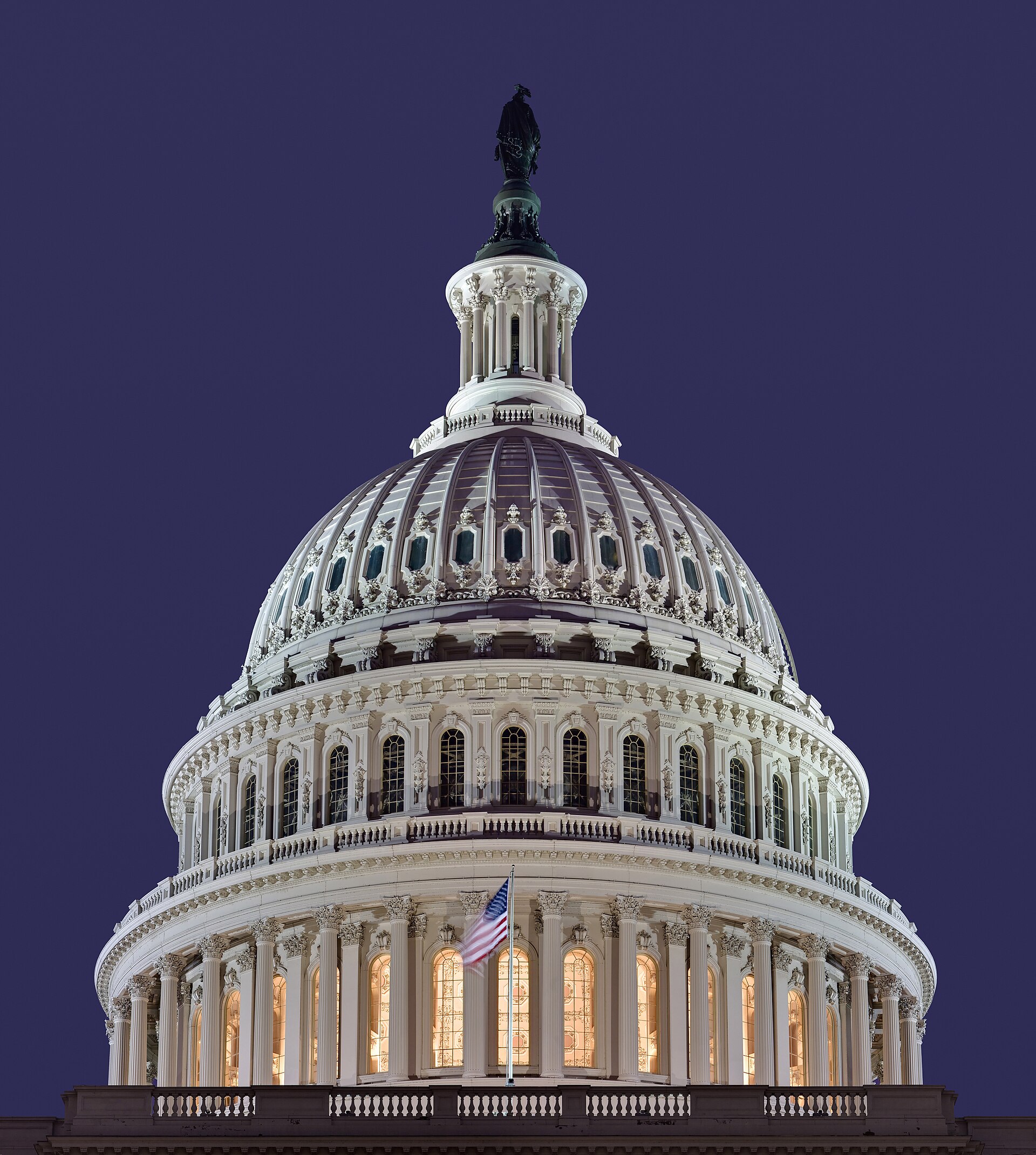
Featured image: U.S. Capitol dome, photograph by Diliff via Wikimedia Commons, licensed CC BY 2.5. Bill statuses reflect the sources cited and may have changed; readers should consult Congress.gov for the official record.
