

The Investigative Journal’s daily digest of overnight developments in government, the courts and international affairs. All items are sourced to public records, official statements or wire reporting. Filings and indictments described below reflect allegations, not findings, unless otherwise noted.
Washington and New York dominated the overnight cycle as President Donald J. Trump used his address to the 81st session of the United Nations General Assembly to set out an explicit choice on Iran, then signed a tripartite Arctic security agreement with Denmark and Greenland on the sidelines of the same gathering. In the courts, the Justice Department announced a civil rights finding against a major medical school, unsealed an election-mail indictment in Utah, and prevailed in a Texas land-exchange dispute. Here is what moved, and what to watch today.
Government
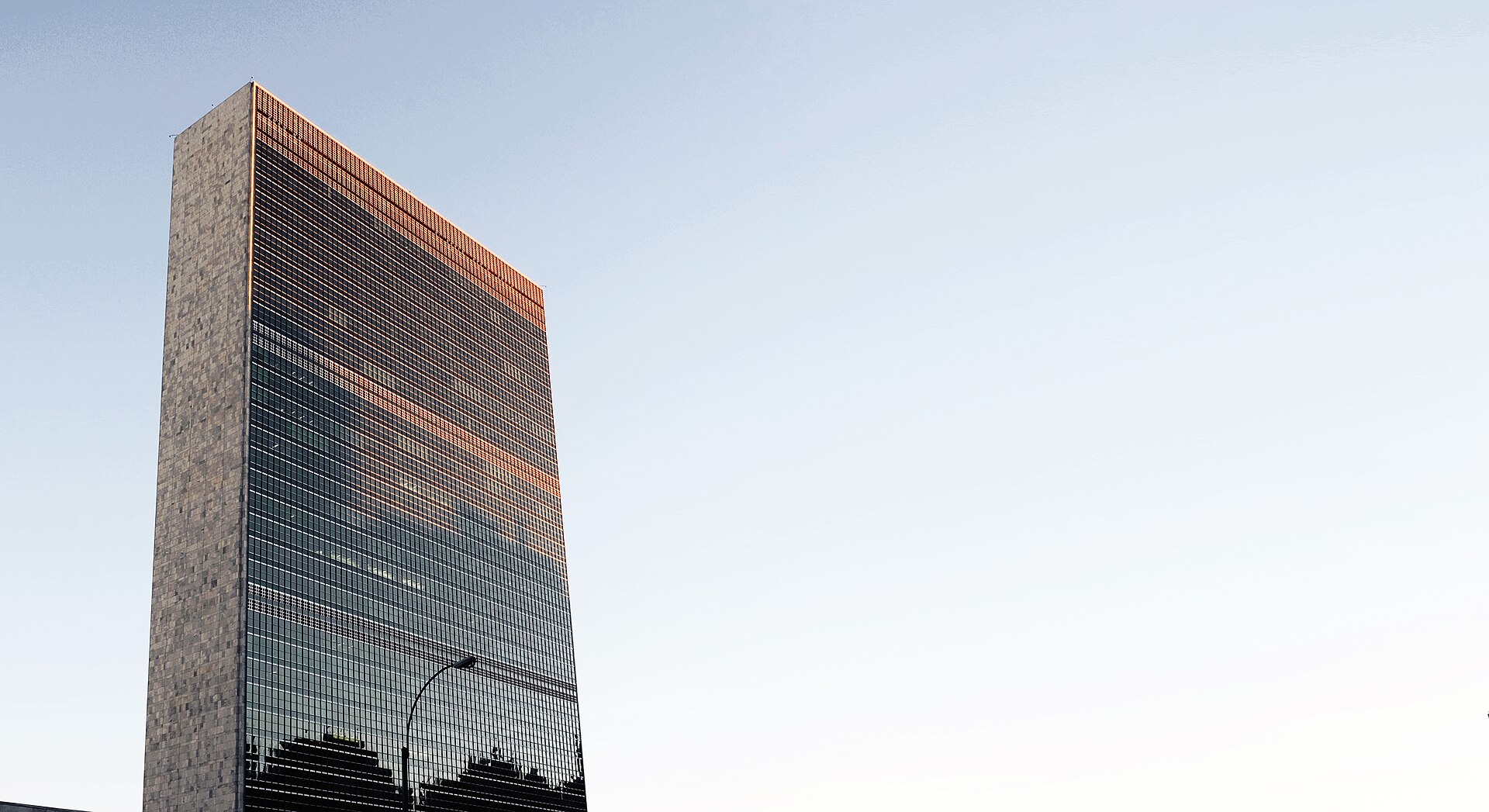
Trump frames an Iran ultimatum from the General Assembly podium. In remarks delivered Tuesday at U.N. Headquarters, the President told delegates he faces what he described as a “big decision” — to reach an agreement ending the war with Iran or to move against the Islamic Republic decisively. According to the White House transcript summary of the address, the President argued that “while others have talked, I have acted,” and reiterated a longstanding position that Iran will not be permitted to obtain a nuclear weapon. CBS News reported that the President defended the use of American military force in Iran and Venezuela and said the international system had proved incapable of managing those threats on its own.
The speech also staked out a position on emerging technology governance. The President said the United States “totally rejects any attempt to construct a globalist scheme of control” over artificial intelligence — a direct signal ahead of multilateral efforts to build an international AI oversight framework. Several figures cited in the address, including casualty counts attributed to the Iranian government and interdiction percentages attributed to counter-narcotics strikes, are administration characterizations that independent bodies have not separately confirmed; readers should treat them as claims rather than verified findings.
Arctic security agreement signed with Denmark and Greenland. Hours after the address, the President joined Danish Prime Minister Mette Frederiksen and Greenlandic Prime Minister Jens-Frederik Nielsen to sign an Arctic security agreement. The White House release describes permanent basing rights, no direct cost to U.S. taxpayers, and a provision barring adversary states from establishing a base, military presence or sensitive investment on the island without American approval. Frederiksen called the deal “an even bigger and better agreement” than the 1951 defense arrangement it supersedes, and Danish Foreign Minister Lars Løkke Rasmussen framed it as consistent “with full respect for the sovereignty and territorial integrity of the Kingdom of Denmark.”
Reporting on the released text indicates the agreement permits modernization and expansion of the Pituffik Space Base in northwest Greenland and the establishment of additional defense areas, including sites at Narsarsuaq in the south and Mestersvig in the east. The Washington Post reported that the President pledged new Arctic military installations at the signing. NATO Secretary General Mark Rutte and European Commission President Ursula von der Leyen both issued statements welcoming the arrangement, according to the White House compilation.
CBO projects Social Security retirement fund insolvent by mid-2032. New Congressional Budget Office projections released this week find the Old-Age and Survivors Insurance trust fund will exhaust reserves by mid-2032, with retirees facing an estimated 26 percent benefit reduction at that point, rising toward 40 percent by century’s end. An analysis by the Committee for a Responsible Federal Budget notes that CBO’s numbers run slightly worse than the Social Security Trustees’ own estimates, which put combined-fund insolvency at 2034 against CBO’s 2033. CBO data show program costs have climbed from 10.7 percent of taxable payroll in 1990 to 15.0 percent today, while revenues have moved from 12.7 to 12.9 percent over the same period — a structural gap, not a cyclical one.
Fiscal calendar: December 11, not September 30. Contrary to the usual end-of-fiscal-year framing, the operative government funding cliff this cycle falls on December 11, 2026, along with expirations for certain Veterans’ Affairs health extenders, farm bill provisions and surface transportation authorization. House appropriators have said publicly they are moving a Continuing Appropriations Act for fiscal 2027 early rather than waiting for the final weeks — a procedural posture shaped by two shutdowns earlier this year.
Fed holds the line on inflation. The Federal Open Market Committee raised the federal funds target range to 3.75–4 percent on September 16, its first increase since 2023, per the Board’s implementation note. The statement cited elevated inflation. Market participants read the accompanying projections as leaving a further increase on the table before year-end.
Courts
Supreme Court leaves mail-ballot restrictions frozen for November. In a brief, unsigned order, the Court declined to disturb a district court freeze on new Postal Service mail-ballot rules, writing that the government “is unlikely to succeed on the merits.” Justice Brett Kavanaugh concurred, noting there is “at least a fair prospect” the rule falls within USPS statutory authority but that election officials lack time to implement it. Justices Samuel Alito and Clarence Thomas dissented. Votebeat’s account traces the underlying dispute to a March executive order and the 95-page final rule published in the Federal Register in August. The order leaves the rule’s ultimate legality unresolved for future cycles.
Former postal worker indicted over discarded Utah ballots. The Justice Department announced Tuesday that an indictment was unsealed charging a former USPS letter carrier with unlawful secretion, destruction and delay of mail, alleging he discarded mail entrusted to him including roughly 300 mail-in ballots addressed to registered Utah voters. The charges are allegations; the defendant is presumed innocent, and the case is pending. Separately, Votebeat reported that federal prosecutors have charged 16 people across several states, including Michigan, Wisconsin and Texas, in connection with alleged noncitizen voting. Those matters are also pending.
Civil Rights Division finds Title VI violation at UCSF medical school. The Department’s Civil Rights Division announced a finding that the University of California, San Francisco School of Medicine discriminated on the basis of race in admissions for its 2023–2025 incoming classes, in violation of Title VI of the Civil Rights Act and the Supreme Court’s 2023 decision in Students for Fair Admissions v. Harvard. The announcement is an agency finding rather than a judicial ruling; UCSF’s response was not included in the Department’s release, and the school retains a right of reply.
Texas court clears SpaceX land exchange. The U.S. District Court for the Southern District of Texas denied a preliminary injunction sought against a land exchange between the Fish and Wildlife Service and SpaceX, finding plaintiffs failed to establish injury in fact for standing or irreparable harm, according to the Department’s summary. The ruling is interlocutory and does not resolve the merits.
Maduro immunity motion pending in SDNY. Counsel for former Venezuelan leader Nicolás Maduro filed motions in early September asking the Southern District of New York to dismiss the narcotics indictment on head-of-state and conduct-based immunity grounds, Bloomberg Law reported. Docket reporting indicates prosecutors face an October 2 response deadline before Judge Alvin Hellerstein, with a hearing set for November 17 and trial currently calendared for June 2027. The charges remain allegations.
International
High-Level Week under way, with a thinner leaders’ bench. The General Debate opened Tuesday under the theme “Restoring trust, managing transformation: A United Nations that delivers for all,” per the U.N.’s official program. Roughly 120 to 130 leaders and senior representatives are attending through September 28. As UN News noted, this is Secretary-General António Guterres’s final high-level week; his term ends December 31.
Trump meets Venezuela’s interim leader. The President met interim Venezuelan President Delcy Rodríguez on the sidelines Tuesday evening, the first such encounter since U.S. forces captured Maduro in January. The meeting follows an August agreement giving the United States a position in Venezuelan oil production. Secretary of State Marco Rubio told reporters the arrangement represents a unique opportunity expected to generate royalties and revenue for a future democratically elected Venezuelan government.
Succession race unresolved. The Security Council has held three straw polls on candidates to succeed Guterres without consensus, NPR reported. Costa Rica’s Rebeca Grynspan and Guyana’s Carolyn Rodrigues Birkett are described as front-runners; former Chilean President Michelle Bachelet withdrew over the weekend, leaving seven candidates. As a permanent member, the United States holds veto power over the selection. The State Department’s public position is that the next Secretary-General must return the organization “to basics.”
Palestinian Authority address by video; Netanyahu on Thursday. For a second consecutive year, the administration declined visas for the Palestinian Authority delegation, and the General Assembly voted to permit President Mahmoud Abbas to address the body by prerecorded video Thursday morning, per NPR’s account. Israeli Prime Minister Benjamin Netanyahu is scheduled to speak later Thursday. Russian Foreign Minister Sergey Lavrov is expected to address the Assembly September 26.
Worth Watching
- Zelenskyy and Pezeshkian at the podium (Wednesday). Ukrainian President Volodymyr Zelenskyy and Iranian President Masoud Pezeshkian are both listed to address the General Debate today — the first substantive Iranian response at the podium to Tuesday’s ultimatum. The official General Debate portal carries the running speakers list.
- Climate Action and Just Transition event (Wednesday). Guterres convenes leaders on renewable transition and climate finance, alongside a separate session marking the 40th anniversary of the Declaration on the Right to Development.
- Xi Jinping at the White House (Thursday). The Chinese leader is expected in Washington while the General Assembly continues in New York — a split-screen that analysts cited by NPR read as a statement about where decisions are being made.
- October 2: Government response due on the Maduro immunity motion in SDNY.
- October 5: The Supreme Court opens October Term 2026. The October argument calendar includes disputes over climate-change liability and veterans’ benefits jurisdiction.
- October 28: Sentencing is scheduled for former National Security Adviser John Bolton, who pleaded guilty in June to one count of unlawful retention of national defense information, NPR reported at the time.
- December 11: Government funding expires. Watch whether the House’s early continuing resolution holds through the midterms.
The Investigative Journal extends a right of reply to any party named in this briefing. Corrections and responses may be directed to the editorial desk. Pending matters will be updated as dockets move.