

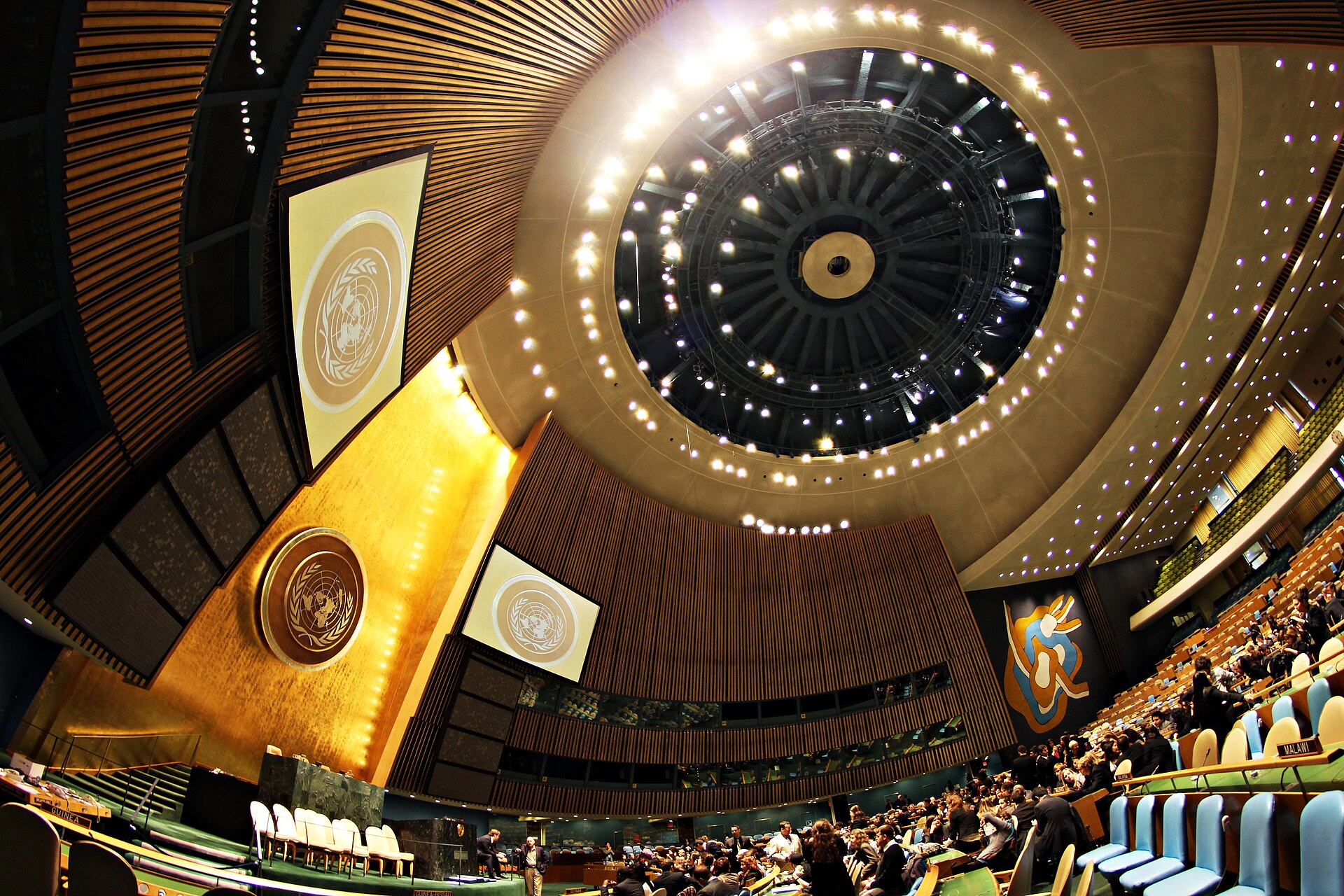
The Investigative Journal’s daily digest of government, courts, and international developments. Reporting is drawn from official statements, court records, and wire coverage as of 3 p.m. Eastern, Tuesday, September 22, 2026. Items are sourced to primary records where available; allegations are identified as allegations and pending matters are flagged as pending.
Tuesday’s news cycle ran through two zip codes: the United Nations complex on Manhattan’s East Side, where the President signed an Arctic security agreement and addressed the General Assembly, and the federal courthouses where election-year litigation over ballots and congressional maps continued to move at emergency speed. Behind both, a monetary tightening cycle that resumed last week continues to reshape the economic backdrop heading into the November midterms.
Government
Greenland security agreement formalized in New York. President Donald Trump was scheduled to sign a trilateral security agreement with the prime ministers of Denmark and Greenland in a New York ceremony Tuesday, on the margins of the U.N. General Assembly, according to ABC News. The President announced the framework on September 18, describing it as giving the United States “permanent control over security, and all other needs, in Greenland,” and said planning would begin immediately on a substantially expanded U.S. military presence on the island.
Reporting on the text indicates the accord bars non-NATO military basing in Greenland, restricts investment by designated adversary states, and forecloses any Chinese or Russian installation on the territory — provisions that align closely with longstanding U.S. Arctic posture objectives and with the 1951 U.S.-Danish defense treaty framework that already governs Pituffik Space Base. NPR reported that the arrangement builds a larger American footprint rather than altering title to the territory.
One caveat belongs in the record. Danish Prime Minister Mette Frederiksen and Greenlandic Prime Minister Jens-Frederik Nielsen have each characterized the document as a security agreement among three parties rather than a transfer of sovereignty, and the agreement requires ratification by the Danish and Greenlandic parliaments before entering into force. Until those votes occur, the operative legal effect of Tuesday’s signature is a signed instrument awaiting domestic approval on two other ends. Readers should treat characterizations of “permanent control” as the American framing of a document that two other governments describe in narrower terms.
The Fed resumes tightening. The Federal Open Market Committee voted unanimously on September 16 to raise the federal funds target range by 25 basis points to 3.75%–4%, CNBC reported — the first increase in more than three years. The committee’s statement said inflation “remains elevated,” and Chairman Kevin Warsh said price growth has been too high for too long. Updated projections showed 16 of 18 participants anticipating at least one further increase this year.
The driver is energy. The conflict with Iran has disrupted Gulf transit and refining logistics, and an outage on a Saudi east-west pipeline compounded the squeeze. The policy problem is a familiar one: a supply-side price shock that monetary policy cannot fix directly, met with tightening intended to prevent it from migrating into wage and services inflation. The July FOMC minutes show the committee debating precisely that trade-off before holding rates steady at that meeting.
Funding secured through December 11. The government is operating under a continuing resolution signed September 2 that extends current funding levels to December 11, removing the October 1 lapse risk. The House cleared the measure 370–48 on September 1 after Senate passage 90–6 in August, per the House Appropriations Committee. The practical effect is to push the full-year fiscal 2027 appropriations fight past the midterms — a scheduling decision both conferences supported. The Committee for a Responsible Federal Budget’s deadline tracker lists December 11 as the next binding fiscal date.
Context matters here: federal employees have absorbed three funding lapses in the past twelve months totaling roughly 123 days, including a 76-day Department of Homeland Security shutdown that ended April 30. A clean extension is, by the standard of the last year, an unusually orderly outcome.
Election-crimes charges across seven states. The Justice Department announced charges on September 18 against 16 individuals in connection with alleged illegal voting, fraudulent voter registration, and related offenses. Per the department’s release, the cases span Texas, Idaho, Georgia, Massachusetts, Wisconsin, New Jersey, and Michigan, with eight defendants in Texas. Charged conduct includes alleged unlawful voting by non-citizens, false claims of citizenship to register or vote, and derivative counts including wire fraud, naturalization fraud, and passport fraud.
These are charges, not findings. Every defendant is presumed innocent, and none of the cases has reached trial. The department has not published aggregate data placing these prosecutions against total ballots cast in the affected jurisdictions, and readers should not extrapolate from 16 individual prosecutions to any claim about systemic prevalence. Counsel-of-record information was not available in the initial release; TIJ has no indication that any defendant has offered public comment.
Courts
Supreme Court leaves mail-ballot rule blocked. On September 14 the Supreme Court declined the administration’s application to implement portions of a U.S. Postal Service rule implementing a March executive order restricting delivery of absentee and mail-in ballots. The vote was 7–2, with Justices Alito and Thomas dissenting. The orders of the Court are posted on the Court’s public orders docket.
The reasoning is narrower than the headline count suggests. Justice Kavanaugh wrote that there is “at least a fair prospect” the final rule falls within the Postal Service’s statutory authority, but that state and local election officials lack sufficient time to implement it before November. That is a timing holding, not a merits holding — the underlying statutory question remains live for a future term. Votebeat reported that the practical consequence is that mail voting in 2026 will function substantially as it has in prior cycles.
Eighth Circuit: Missouri must use the 2025 map. A panel of the Eighth Circuit on Monday upheld a district court ruling requiring Missouri to conduct November’s congressional elections under the map enacted in a 2025 special session, rejecting a challenge that sought to restore the 2022 lines. The panel wrote that use of the 2022 map in November “violates the Constitution” and that only the 2025 map complies with the Constitution and federal law.
The procedural history is tangled. A veto petition against the 2025 map gathered more than 300,000 signatures; Secretary of State Denny Hoskins rejected that petition on the day of the August primary, which was itself conducted under the 2025 lines. Challengers argued to the panel that county clerks have already begun printing ballots; the state and Republican candidates argued that switching maps between a primary and a general election is what disenfranchises voters. The challenging group, People Not Politicians, has said it intends to seek emergency review at the Supreme Court — which would make this the third trip to the high court in this dispute. State officials have said a final answer is needed by Tuesday to meet ballot-distribution deadlines, which puts the timeline on the Court rather than on the litigants.
Appeals panel weighs Comey and James dismissals. The Justice Department’s appeal of the dismissal of criminal cases against former FBI Director James Comey and New York Attorney General Letitia James remains pending. A district judge dismissed both indictments after finding that interim U.S. Attorney Lindsey Halligan, who secured them, had been unlawfully appointed; the department noticed an appeal. Reporting on the panel argument indicates the judges expressed skepticism toward the government’s position, though a ruling has not issued and no inference should be drawn from questioning at argument. Both matters are pending; neither defendant has been convicted of anything, and the dismissals rested on the appointment question rather than on the merits of the underlying allegations.
International
The General Assembly address. The President addressed the General Assembly on Tuesday, his first appearance at the rostrum since the onset of the conflict with Iran. U.N. Ambassador Mike Waltz told reporters in advance that the remarks would cover negotiated peace agreements, U.S. activity in the Western Hemisphere, progress on the 20-point Gaza framework, and the position that Iran must not obtain a nuclear weapon, NBC News reported. CBS News reported a parallel schedule of bilateral meetings on Iran, Gaza, and Ukraine.
Iran: attrition, and the Strait. The Congressional Research Service’s standing product on the conflict, CRS Report R48887, describes a war that has settled into attrition, with Iran facing constrained strike capacity and severe economic pressure. The strategic center of gravity remains the Strait of Hormuz, where disruption in the opening days of the conflict halted commercial transit and propagated into global energy markets. An April ceasefire and a June memorandum of understanding both collapsed; the memorandum formally expired in August.
The market signal has improved somewhat. Brent settled near $100 on Monday after four consecutive declining sessions, off the $107 level recorded around the Fed meeting and above the roughly $70 mark in July. U.S. Central Command has reported that crude and LNG flows through Hormuz reached a six-month high with main transit lanes clear of mines, and that regional oil flows averaged about 17.1 million barrels per day over a recent ten-day window despite the continuing Saudi pipeline disruption. CNBC’s coverage of the September price spike documents the volatility band. The President said on September 16 that the United States is “hopefully toward the end” of the conflict.
Gaza framework: partial implementation. The 20-point plan endorsed by the Security Council in Resolution 2803 has delivered on its early provisions — the living hostages were released within three days of the October 2025 ceasefire, the last deceased hostage was recovered in January, and humanitarian access expanded — while reconstruction and disarmament provisions have not advanced. Independent assessments indicate Israel holds roughly 54 percent of the territory and Hamas the remainder. U.N. briefings to the Security Council, including the Deputy Special Coordinator’s open-debate remarks, have urged consolidation of the ceasefire amid continued violations by both sides.
Ukraine: talks reconstituted, territory unresolved. U.S. envoys Steve Witkoff and Jared Kushner met President Vladimir Putin in Moscow before traveling overland to Kyiv, arriving September 6. President Volodymyr Zelenskyy welcomed the restart but said the territorial question “remains a relevant one” and can only be settled at leader level. Trilateral talks in the United Arab Emirates have been accepted in principle for October without an agreed date, per the UK House of Commons Library briefing.
Tomorrow’s Watch
Xi Jinping arrives in Washington. The state visit runs September 23–25, confirmed by Beijing on Monday — Xi’s first White House visit in eleven years. NPR’s preview identifies the live files: an expiring one-year trade truce, tariff schedules, rare-earth export controls, advanced semiconductors and AI, and Chinese positioning on the Iran conflict. Watch whether any deliverable is announced Wednesday or whether the truce is simply extended.
U.N. high-level week continues. Wednesday’s calendar includes a high-level meeting marking the fortieth anniversary of the Declaration on the Right to Development and a Climate Summit convened by the Secretary-General in the Trusteeship Council Chamber from 3 to 6 p.m. The full schedule is posted at the U.N.’s high-level week page.
Missouri at the Supreme Court. If People Not Politicians files the emergency application it has signaled, the Court could act on a compressed schedule given the ballot-printing deadline. Watch the orders docket.
Greenland ratification. Tuesday’s signature starts a parliamentary clock in Copenhagen and Nuuk. Vote scheduling in either body is the next real test of whether the agreement takes effect as written.
Fiscal calendar. Seventy-nine days to the December 11 funding deadline, with full-year fiscal 2027 appropriations unresolved and the midterms intervening.
Right of reply: The Investigative Journal extends an opportunity to respond to any individual or institution named in this briefing. Corrections and responses may be directed to the editor. Charged individuals referenced in the Justice Department matter are presumed innocent; the cases are pending. Featured image: United Nations General Assembly Hall, by Basil D Soufi, via Wikimedia Commons, CC BY-SA 3.0.