

By Eduardo Bacci — The Investigative Journal
The securities regulator opened the second half of the year with a settled fraud case against an electric-truck maker, while a cluster of Current Reports filed on the U.S. Securities and Exchange Commission’s EDGAR system this month documented a law-enforcement seizure at a Nasdaq-listed proxy-network operator, a billion-dollar-plus broadband consolidation, and a wave of executive turnover. Today’s edition of SEC Watch reviews the most consequential disclosures in the public record and flags the filings that may warrant closer scrutiny. Every claim below is drawn from primary filings or official Commission releases, which are linked directly.
SEC settles fraud charges with EV maker Battle Motors and its CEO
The Commission on July 10 filed a settled enforcement action against Battle Motors, Inc., an Ohio-based manufacturer of electric and gas-powered commercial vehicles, and its chief executive and chairman, Michael W. Patterson, according to Litigation Release No. 26585, dated July 13. The Commission alleges the company and Patterson made misleading statements that portrayed Battle as more commercially successful than it was in connection with a convertible-debt offering that raised $112.5 million from two outside investors.
According to the SEC’s complaint, filed in the U.S. District Court for the Northern District of Ohio, Battle and Patterson told investors the company had received 115 electric-vehicle purchase orders totaling $30 million over three months. In reality, the complaint states, the company held firm orders for only eight vehicles — roughly $2 million — with the remainder resting on expressions of customer interest. The filing further alleges that the company represented a dealer network of 180 dealers across 320 locations when it in fact had 47 dealers at 156 locations.
Without admitting or denying the allegations, both defendants consented to final judgments, subject to court approval, permanently enjoining them from violating Sections 17(a)(2) and (3) of the Securities Act of 1933. The proposed judgments would require Battle to pay a $591,127 civil penalty and Patterson to pay $118,225, and would impose a two-year officer-and-director bar on Patterson. The matter, handled by the Commission’s Atlanta Regional Office, illustrates the agency’s stated emphasis on individual accountability: a corporate penalty paired with a personal penalty and a bar. The order remains subject to court approval, and the civil settlement does not resolve any other proceeding.
Alarum Technologies discloses law-enforcement action and pauses proxy network
Alarum Technologies Ltd. (Nasdaq: ALAR), a Tel Aviv-based internet-access company, furnished a Form 6-K on July 6 attaching three press releases that, read together, describe a fast-moving disruption to one of its core business lines. On July 2, the company said it was responding to what it characterized as a reported seizure of certain domains associated with the residential proxy network operated by its subsidiary, NetNut Ltd. On July 3, it provided an update “regarding recent law enforcement action affecting certain domains” tied to NetNut.
By July 4, the filing indicates, the company announced a “temporary operational pause of certain network services” while it investigated the incident. Alarum, which reports as a foreign private issuer, did not in the furnished document identify the authority involved or the legal basis for the action, and the disclosures reflect the company’s own characterization of events rather than findings by any court or agency. For a company whose revenue depends on the continuity of its network infrastructure, an operational pause of unspecified duration is a material development; the filing does not quantify the financial impact. TIJ will monitor subsequent filings for further detail.
Cable One moves to full ownership of Mega Broadband in a debt-heavy deal
Cable One, Inc. (NYSE: CABO), the Phoenix-based broadband provider that operates under the Sparklight brand, has been documenting one of the year’s more leveraged rural-broadband consolidations. In a Form 8-K the company disclosed a definitive agreement to acquire all of the equity in Mega Broadband Investments Holdings LLC (“MBI”), which operates as Vyve Broadband, that it did not already own. Cable One holds a 45 percent stake; affiliates of private-equity firm GTCR and MBI management own the balance, and the GTCR investors exercised a put option to trigger the sale.
The filing indicates a purchase price for the remaining 55 percent of roughly $475 million to $495 million, and states that MBI’s total net indebtedness when it becomes a wholly owned subsidiary is expected to be approximately $845 million to $895 million, in the form of term loans maturing in November 2027. MBI reported roughly $310 million in revenue for the 12 months ended September 30, 2025, serving about 210,000 residential and business data customers. Cable One said it anticipates completing the transaction on October 1, 2026, subject to customary conditions and financing.
The disclosure warrants attention less for the price than for the balance sheet it implies. Absorbing close to $900 million of MBI net debt on top of Cable One’s existing obligations, at a time when the company’s own filings flag elevated broadband-subscriber losses, concentrates financing and integration risk into the fourth quarter. Records show the company intends to fund the purchase with cash and borrowings that may include its $1.25 billion revolving credit facility. Investors will look to the company’s next periodic report for confirmation of the financing structure and updated subscriber trends.
Bread Financial and Tarsus Pharmaceuticals disclose C-suite departures
Two Item 5.02 filings this week underscore continued churn in senior commercial roles. Bread Financial Holdings, Inc. (NYSE: BFH) said in a July 14 release attached to a Current Report that Valerie Greer, executive vice president and chief commercial officer, will retire after nearly four decades in financial services; she will remain through February 2027 to assist the transition. The company said Dennis McCarthy, who joined in 2021 and previously spent nearly a decade at Citi, will be promoted to executive vice president and chief revenue officer in early September, reporting to president and chief executive Ralph Andretta.
Separately, Tarsus Pharmaceuticals, Inc. (Nasdaq: TARS) disclosed in a Form 8-K dated July 13 that chief commercial officer Aziz Mottiwala would leave the company on July 15 to become chief executive of a public medical-device company. The filing, signed by general counsel Bryan Wahl, records the departure under Item 5.02 without describing a permanent successor; company statements indicate an interim commercial leader will serve during a search. For an eye-care company in the commercial phase of its lead product, continuity in the commercial organization is a metric worth tracking through subsequent filings.
The enforcement backdrop: a fraud-first posture
The Battle Motors settlement lands against an enforcement program the Commission has publicly recalibrated. In its fiscal-year 2025 enforcement results, released April 7, the agency reported 456 total actions and $17.9 billion in ordered monetary relief, while explicitly repositioning what it counts as success toward fraud cases and individual accountability. Chairman Paul S. Atkins said the Commission had “put a stop to regulation by enforcement” and redirected resources toward “fraud, market manipulation, and abuses of trust.” The agency noted that nearly nine in ten standalone actions filed under the current leadership involved charges against individuals.
That framing is visible in the July docket. Beyond Battle Motors, the Commission’s litigation-release log records a settled action against YouPlus, Inc. and its founder Shaukat Shamim (LR-26584, July 13); a complaint against Weiguo Zhai (LR-26581, July 9); and a resolved matter involving Quest Education L.L.C. and several individuals (LR-26580, July 6). Each is a civil action; allegations that have not been adjudicated remain allegations, and settlements were entered without admissions. Taken together, the month’s releases are consistent with the Commission’s stated preference for fraud and individual-misconduct cases over disclosure-technicality sweeps.
Filings that may warrant deeper TIJ investigation
Three threads stand out for follow-up. First, the Alarum/NetNut matter: a Nasdaq-listed issuer disclosing a law-enforcement action against the infrastructure of a residential proxy network — a category of service that has drawn scrutiny over its potential misuse — is worth tracking for any formal Commission inquiry, restatement, or expanded operational impact in later filings. Second, Cable One’s pending MBI purchase and its roughly $845 million to $895 million of assumed net debt merit continued attention as the October target date approaches, particularly the interplay between the acquisition financing and the company’s broadband-subscriber trajectory. Third, in the governance column, Global Net Lease, Inc. (NYSE: GNL) has disclosed an all-stock acquisition of Modiv Industrial alongside the announced retirements of two directors following its 2026 annual meeting — a combination of strategic and board change that, per the company’s own materials, reshapes its portfolio and oversight at once.
As always, this digest summarizes public filings and official Commission releases; it does not allege wrongdoing beyond what those records state, and pending matters are noted as such. Companies and individuals named here are entitled to respond, and TIJ will incorporate any substantive reply. Corrections and tips may be sent to the editor.
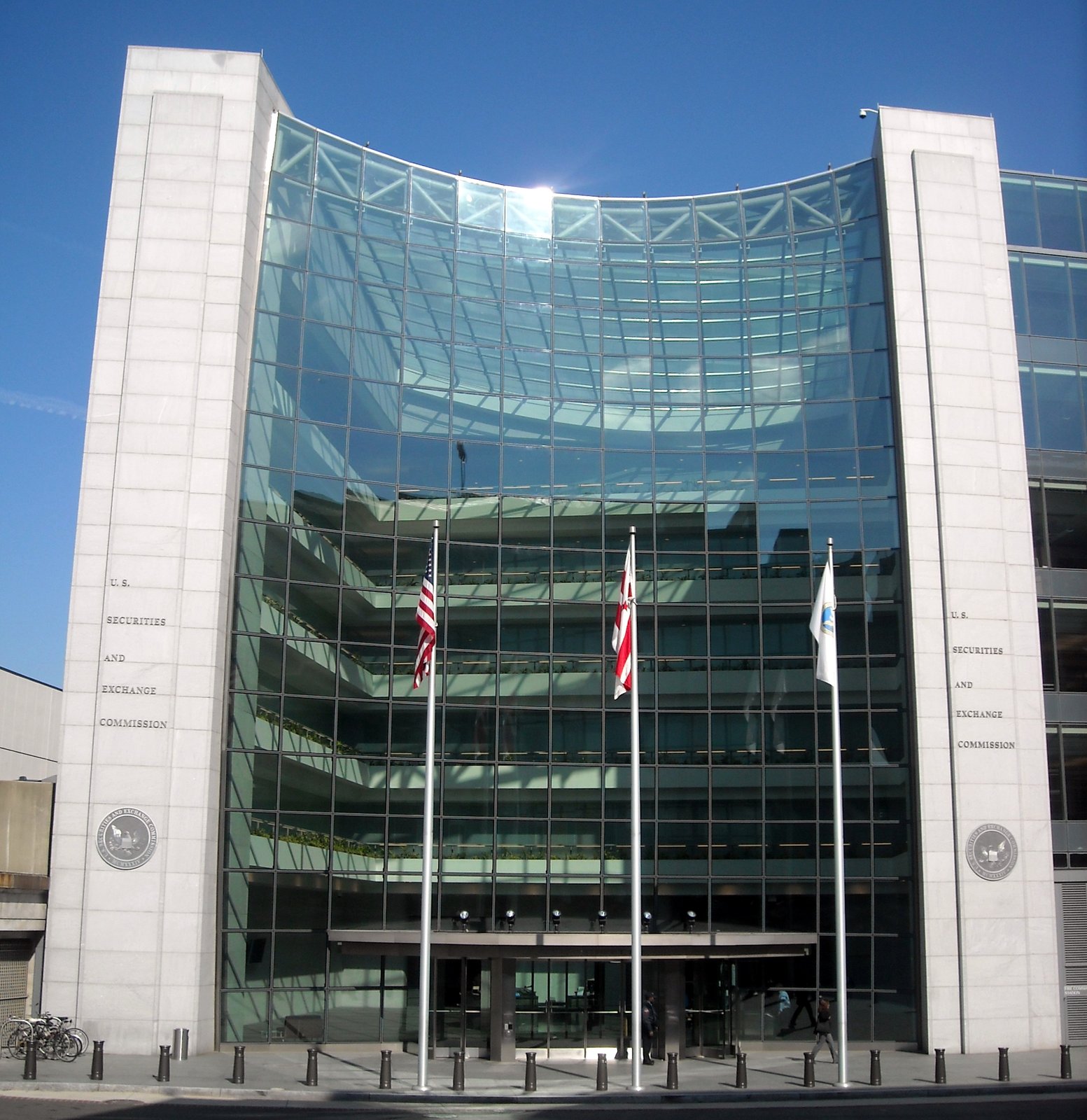
Featured image: U.S. Securities and Exchange Commission headquarters, Washington, D.C. Photo by AgnosticPreachersKid, licensed under CC BY-SA 3.0, via Wikimedia Commons. Sources: SEC EDGAR filings and SEC.gov press and litigation releases, linked inline.