

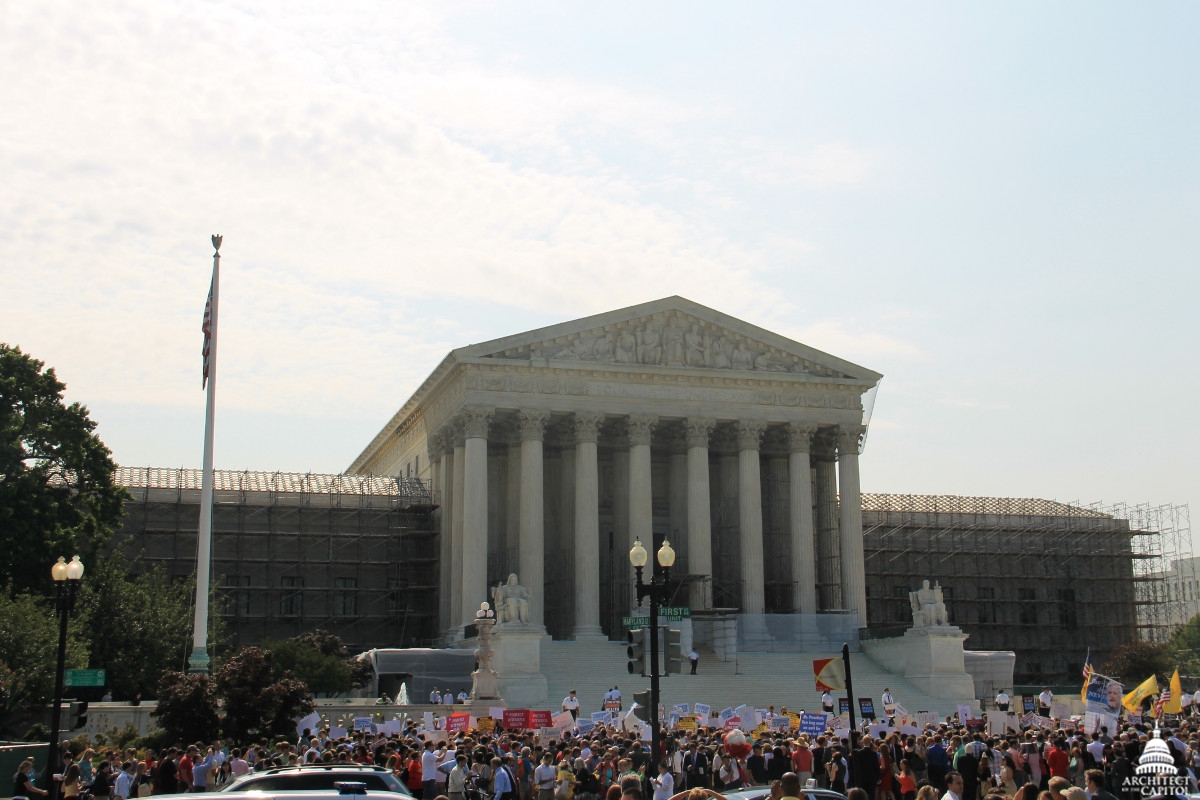
Court Watch is The Investigative Journal’s weekly digest of the most consequential rulings, orders and filings across the American judiciary. This edition covers the week of June 15–19, 2026.
The Supreme Court entered the home stretch of October Term 2025 this week, and the pace of decisions accelerated accordingly. According to SCOTUSblog’s docket tracker, the justices have now issued 49 decisions of the 73 cases granted for the term, leaving roughly 17 argued cases still awaiting resolution as the calendar pushes toward the traditional end-of-June finish. Thursday, June 18 was the marquee day, with three signed opinions handed down, including a closely watched Second Amendment ruling. The Court also added cases for next term, fielded a defamation emergency application from a former Alabama chief justice, and was asked to walk away from a major immigration dispute it heard in April. Below is the week in the courts, grouped by court level, with links to the underlying records.
Supreme Court — Opinions
Justices narrow the federal gun ban for drug users in United States v. Hemani
The week’s headline decision came Thursday in United States v. Hemani (No. 24-1234), where the Court held that the federal government could not prosecute a Texas man under the statute barring “unlawful user[s]” of controlled substances from possessing firearms. Writing for the Court in a 19-page opinion, Justice Neil Gorsuch concluded that, at least as applied to Ali Danial Hemani, the prosecution could not be squared with the Second Amendment. The case arose from a 2022 FBI search of Hemani’s home that turned up a pistol, roughly 60 grams of marijuana and a smaller quantity of cocaine; Hemani acknowledged using marijuana about every other day.
Applying the framework set out in 2022’s New York State Rifle & Pistol Association v. Bruen and refined in 2023’s United States v. Rahimi, Gorsuch reasoned that the government’s historical analogues—chiefly early American laws targeting “habitual drunkards”—did not justify automatically stripping a regular drug user of the right to bear arms without any individualized showing of dangerousness. The opinion notes that those founding-era laws “usually provided some form of process” before a person lost his liberties, in contrast to a statute that “automatically divests an individual of his constitutional right” the moment he becomes an unlawful user. Gorsuch pointedly observed that the government’s own recent move to reclassify marijuana as having “a lower potential for dependence and abuse” sat uneasily with its argument that all such users are categorically dangerous.
Records of the decision indicate the judgment was unanimous, though the reasoning fractured the Court. Justice Clarence Thomas concurred separately on Commerce Clause grounds; Justice Ketanji Brown Jackson, joined by Justice Sonia Sotomayor, wrote that the Bruen framework itself is “unworkable”; and Justice Samuel Alito, joined by Justice Elena Kagan, agreed with the result but not the majority’s reasoning. Gorsuch stressed that the holding is “a narrow one” that does not disturb the ban on gun possession by convicted felons or resolve whether the government could prosecute a user whose drug use is shown to make him dangerous. A separate carry-related case, Wolford v. Lopez, remains pending. SCOTUSblog’s opinion analysis provides additional detail.
A divided Court clarifies Rooker-Feldman in T.M. v. University of Maryland Medical System
Also on Thursday, the Court split 5-4 in T.M. v. University of Maryland Medical System Corp. (No. 25-197), a procedural dispute over the reach of the Rooker-Feldman doctrine, which bars lower federal courts from sitting in review of state-court judgments. Justice Sotomayor’s majority opinion held that the doctrine can apply even when the challenged state-court judgment is not yet final—that is, even when it remains subject to further review in state appellate proceedings. The Court affirmed the U.S. Court of Appeals for the 4th Circuit, which had blocked a Maryland woman’s federal challenge to a settlement-based consent order entered in her state case.
Justice Thomas filed a concurrence defending the doctrine as “correct as an original matter,” while Justice Amy Coney Barrett, joined by Chief Justice John Roberts and Justices Kagan and Gorsuch, dissented. Barrett argued that the majority relaxed boundaries the Court had carefully drawn in 2005’s Exxon Mobil Corp. v. Saudi Basic Industries Corp. and warned that the doctrine “has been given an inch—it should not be allowed to take a mile.” As SCOTUSblog’s analysis notes, the decision sharpens a long-confusing jurisdictional rule that governs how often litigants can move from state court into federal court seeking a second look.
Court recognizes a narrow exception to appellate waivers in Hunter v. United States
The third signed opinion of the day, Hunter v. United States, addressed the enforceability of appellate waivers—provisions in plea agreements in which defendants give up the right to appeal. According to SCOTUSblog’s reporting, the Court ruled that defendants may, in certain circumstances, appeal a sentencing condition notwithstanding such a waiver. The decision reflects the principle that an agreement not to appeal will not be enforced where doing so would work a miscarriage of justice by leaving in place an egregious error.
For practitioners, the ruling is a reminder that boilerplate waiver language does not foreclose every challenge to a sentence, particularly where the condition imposed is alleged to be unlawful on its face. The full opinion and any separate writings will be posted to the Court’s slip-opinion page; readers should consult the opinion itself for the precise contours of the exception the Court recognized.
Supreme Court — Orders, Cert Grants and Denials
Three cases added for next term
From its June 11 conference, the Court issued a list of orders on Monday, June 15 granting review in three cases, per SCOTUSblog’s summary. In Genalo v. Black (No. 25-886), the justices will consider whether and when a noncitizen whose immigration detention has become “unreasonably prolonged” is constitutionally entitled to a bond hearing, and what evidentiary standard applies—an appeal brought by the federal government from a 2nd Circuit ruling. The Court directed the parties to also brief whether the case is moot. In Kian v. Florida (No. 25-6623), the Court will revisit the constitutionality of six-person juries, with the petitioner urging it to overrule the 1970 decision in Williams v. Florida. And in Guerrero v. Johnson (No. 25-1003), the justices took up a technical but high-stakes habeas question about when a death-row inmate may file a second federal petition raising an intellectual-disability claim.
The order list also produced two written dissents from Justice Alito. In Alabama v. Powell (No. 25-848), joined by Justice Thomas, Alito would have summarily reversed a state ruling that threw out a capital conviction over a prosecutor’s comment. In E.D. v. Noblesville School District (No. 25-906), Alito wrote alone to urge the Court to clarify the line between the student-speech standard of Tinker v. Des Moines and the school-sponsored-speech standard of Hazelwood v. Kuhlmeier.
Notable denials
Among the petitions the Court declined to hear, three stand out. The justices turned away Page v. Comey (No. 25-705), former Trump adviser Carter Page’s suit against former FBI Director James Comey and others over Foreign Intelligence Surveillance Act warrants, on statute-of-limitations grounds; Justice Jackson did not participate, as the matter had been assigned to her during her earlier service as a federal district judge. The Court also declined National Shooting Sports Foundation v. James (No. 25-1026), a firearms-industry challenge to a New York public-nuisance statute, and HMTX Industries v. United States, a challenge to the U.S. Trade Representative’s authority to expand Section 301 tariffs on Chinese imports—a denial that leaves a Federal Circuit ruling in place as the administration weighs its trade-policy options.
Supreme Court — Emergency Docket and Pending Motions
Roy Moore asks the justices to protect an $8.2 million defamation award
On Tuesday, June 16, Roy Moore, the former chief justice of the Alabama Supreme Court, filed an emergency application in Moore v. Senate Majority PAC (No. 25A1396). Moore won an $8.2 million jury verdict against the Democratic-aligned Senate Majority PAC over a 2017 campaign advertisement he says falsely portrayed him as having solicited sex from a 14-year-old girl during his U.S. Senate special-election campaign, which he lost to Democrat Doug Jones. The jury found the PAC had acted with “actual malice,” the standard set by New York Times v. Sullivan.
The U.S. Court of Appeals for the 11th Circuit threw out that verdict, prompting Moore’s request that the Supreme Court block the appellate court’s mandate—scheduled to issue on or about June 15—from taking effect while he seeks review. Moore argues that if the mandate issues and the bond securing the award is released, the judgment “will be lost as a practical matter” before the Court can decide whether to grant certiorari. Justice Thomas, who handles emergency matters from the 11th Circuit, had not, as of filing, directed the PAC to respond. The application remains pending.
Haitian nationals ask the Court to abandon a TPS case it already heard
In a notable end-of-term maneuver, a group of Haitian nationals on Tuesday asked the justices to dismiss Trump v. Miot (No. 25-1084) as “improvidently granted”—to walk away without a ruling—even though the Court heard argument on April 29. The case concerns whether the administration lawfully ended Temporary Protected Status for Haiti, a designation first extended after the 2010 earthquake. The challengers contend that newly obtained documents show the termination notice rested on a flawed process; those assertions are allegations in a pending matter, and the government has defended the termination as lawful. The motion would not necessarily affect a companion case involving Syrian nationals, Mullin v. Doe (No. 25-1083), which remains before the Court.
Federal Appeals Courts
11th Circuit’s reversal of the Moore verdict drives the week’s emergency docket
The most consequential federal-appellate development of the week is the one underlying Moore’s Supreme Court filing: the 11th Circuit’s decision setting aside the $8.2 million defamation judgment in his favor. Defamation suits brought by public figures must clear the demanding “actual malice” bar, and appellate courts review such verdicts independently. The practical effect of the appellate ruling—and the timing of its mandate—is precisely what Moore is now asking the Supreme Court to pause. The appellate posture illustrates how quickly a trial victory can be unwound on appeal, and how the issuance of a mandate can force a losing party onto the emergency docket. Readers can follow the docket through the case page.
State Supreme Courts
Routine but instructive criminal rulings out of Ohio and West Virginia
State high courts continued their ordinary work this week. The Supreme Court of Ohio decided State ex rel. Wade v. Shoop, Slip Opinion No. 2026-Ohio-2198, on June 16, a habeas-corpus matter in which the court held that an inmate’s transfer from juvenile to adult court had satisfied the statutory bindover requirements, so the adult court did not lack subject-matter jurisdiction; the court affirmed the dismissal of his petition. The opinion is available through the court’s online docket.
In West Virginia, the Supreme Court of Appeals released a decision in State v. Randy C. Cain (No. 23-535) on June 15, a felony criminal appeal that drew a separate opinion concurring in part and dissenting in part. The slip opinion is posted to the court’s opinions page. Neither ruling breaks new constitutional ground, but together they are a reminder that the bulk of American adjudication—criminal procedure, jurisdiction, post-conviction review—happens in state courthouses, not in Washington.
Cases to Watch in the Coming Week
With the term winding down, the next several days will be busy. The justices were scheduled to release additional orders on Monday, June 22, and the Court has signaled that opinions are expected on Tuesday, June 23 and Thursday, June 25, when it will also hold a conference. Among the marquee cases still outstanding is Wolford v. Lopez, a challenge to a Hawaii law that bars firearms on private property without the owner’s express permission—a decision that could arrive at any time and that would build on this week’s ruling in Hemani.
Also worth watching: the fate of the Syrian TPS case, Mullin v. Doe, in light of the Haitian nationals’ motion to dismiss their companion dispute; whether the Court acts on Moore’s emergency application before the 11th Circuit’s mandate alters the status quo; and the remaining argued cases of October Term 2025. SCOTUSblog’s running list of the most important cases yet to be decided is a useful guide as the Court clears its docket. The Investigative Journal will return next Monday with a full accounting of the term’s final decisions.
A note on sourcing: This digest relies on primary court records—published opinions, order lists and docket entries on supremecourt.gov and state-court websites—together with independent, non-partisan analysis from SCOTUSblog. Characterizations of pending matters reflect the parties’ filings and are identified as allegations, not findings. Where a case remains undecided or an application is pending, that status is noted in the text.