

SEC Watch is The Investigative Journal’s daily read of what companies and regulators put on the public record. Every claim below is drawn from a filing or an official release from the U.S. Securities and Exchange Commission; allegations are identified as such, and settlements and dismissals are noted where they apply.
The first full trading week of the third quarter closed with an unusually dense cluster of executive-suite disclosures. Within roughly seventy-two hours, three large, index-weight companies—payments processor Fiserv, satellite and connectivity group EchoStar, and clear-aligner maker Align Technology—each filed a Form 8-K reporting the departure of a senior officer. On the enforcement side, the SEC logged a small settled insider-trading case tied to a pharmaceutical acquisition and a routine unregistered-broker judgment, even as a federal judge in Ohio handed the agency a notable defeat by dismissing its securities case against the former chief executive of FirstEnergy. Below are seven filings from the week that merit a closer look.
Corporate Disclosure Watch
1. Fiserv’s president resigns for “good reason”
Payments and financial-technology company Fiserv, Inc. (Nasdaq: FISV) disclosed in an 8-K filed July 7, 2026 that its president, Dhivya Suryadevara, resigned for “good reason” under her August 28, 2025 offer letter and the company’s Executive Severance and Change of Control Policy. The filing states her resignation as president is effective July 7, 2026, and that she will remain a non-executive officer employee—eligible for her base salary and benefits—through July 31, 2026 to support what the company called “an orderly transition of her duties.”
Fiserv named two long-tenured insiders, Andrew Gelb (executive vice president and chief operating officer, Financial Solutions) and Srini Krish (head of technology and operations, Financial Solutions), as interim leaders of that business, effective immediately. Both joined the company in 2014. The filing does not elaborate on the circumstances behind the departure beyond the contractual provisions it cites, and records indicate the exit follows a broader leadership transition the company flagged in mid-June 2026. Under securities practice, a resignation for “good reason” is a defined contractual trigger rather than a statement of cause, and readers should not infer wrongdoing from the language.
For a company with a market capitalization near $28 billion that sits at the plumbing of U.S. card and core-banking transactions, turnover in the president’s office is a governance event worth tracking, particularly as investors watch for a permanent leadership structure in the Financial Solutions unit.
2. EchoStar’s Akhavan exits as Ergen consolidates control
EchoStar Corporation (Nasdaq: ECHO, formerly SATS) reported a more abrupt change. In an 8-K covering events of July 6, 2026, the company disclosed that Hamid Akhavan resigned—effective immediately—from all of his positions, including chief executive officer of EchoStar Capital, president and chief executive officer of Hughes, and seats on the boards of both EchoStar and Hughes Satellite Systems Corporation. The filing states the resignation came “after discussions with the Board of Directors regarding a change of strategic direction,” and that Akhavan will remain available to consult through December 31, 2026.
Company co-founder and chairman Charles W. Ergen will assume Akhavan’s responsibilities as principal executive officer of Hughes, according to the filing, further concentrating operational authority in Ergen’s hands. The 8-K also discloses that Akhavan’s letter agreement will be modified to accelerate the vesting of options previously scheduled to vest on December 31, 2026 to the July 6, 2026 resignation date, and that the EchoStar Capital unit will be folded into a Corporate Development function led by executive vice president Thomas A. Cullen. The company did not quantify the compensation impact of the accelerated vesting.
Coming shortly after EchoStar signaled it would retire the SATS ticker in favor of ECHO, the immediate departure of the operating chief and the reassignment of duties to the founder is a material governance development for a roughly $30 billion enterprise navigating heavy spectrum obligations and a contested strategic path.
3. Align Technology loses its top lawyer to Illumina
Align Technology, Inc. (Nasdaq: ALGN), maker of the Invisalign system, filed an 8-K on July 8, 2026 disclosing that Julie Coletti, executive vice president and chief legal and regulatory officer, resigned on July 6 to become chief legal officer of genomics company Illumina, Inc. Her departure from Align is effective August 1, 2026, and the filing was signed by chief financial officer John Morici.
The one-item disclosure is brief and names no successor or interim replacement, which the company’s own filing leaves open. A chief legal and regulatory officer at a medical-device company oversees an unusually broad remit—litigation, intellectual property, and interaction with health regulators—so the vacancy, however routine the underlying move, is one investors and counterparties will watch until Align names a permanent replacement. The filing frames the exit as a voluntary move to a larger legal role rather than a matter of disagreement with the company.
4. Cable One moves to full ownership of Mega Broadband Investments
Rural and small-market broadband operator Cable One, Inc. (NYSE: CABO) continued to document one of the year’s larger mid-cap consolidations. Across a series of current reports on Form 8-K, the company disclosed that it will acquire the roughly 55% of Mega Broadband Investments Holdings LLC (MBI) it does not already own, after private-equity investor GTCR exercised a put option on January 2, 2026. Filings indicate the option price is set by a formula tied to MBI’s adjusted EBITDA for the twelve months ended June 30, 2025 and its net debt, and is currently estimated at about $475 million to $495 million.
The filings further indicate that when MBI becomes a wholly owned subsidiary—targeted for October 1, 2026, subject to antitrust and communications-regulatory approvals—its total net indebtedness is expected to be roughly $845 million to $895 million in term loans maturing in November 2027, to be financed through cash and additional borrowings. To manage that load, Cable One launched an MBI term-loan exchange offer and outlined a new $1.0 billion revolving credit facility. In a July update, the company also reported preliminary second-quarter 2026 revenue of $346 million to $352 million and capital expenditures of $72 million to $76 million; those figures are preliminary and unaudited by the company’s own description. Separately, the disclosures describe folding Cable One’s Clearwave Fiber joint venture into Point Broadband, with Cable One rolling its equity into the combined entity as a minority holder.
The transaction is a case study in how a smaller operator is financing consolidation with leverage in a higher-rate environment. The added debt, the SOFR-linked pricing on the new facilities, and the October closing target are the variables most likely to move Cable One’s credit profile, and they warrant continued monitoring as definitive figures replace estimates.
SEC Enforcement
5. A settled insider-trading case tied to the AstraZeneca–Icosavax deal
On July 8, 2026, the SEC filed settled insider-trading charges against Maryland resident Weiguo Zhai, according to Litigation Release No. 26581 (July 9, 2026). As alleged in the complaint, filed in the U.S. District Court for the District of Maryland (No. 8:26-cv-02694), Zhai worked at AstraZeneca Pharmaceuticals LP and served on the due-diligence team evaluating AstraZeneca PLC’s acquisition of Icosavax, Inc. through a tender offer that was publicly announced on December 12, 2023.
The SEC alleges Zhai misappropriated AstraZeneca’s confidential information by buying 1,000 shares of Icosavax in his own brokerage account and 1,000 shares in his wife’s account before the announcement. According to the complaint, Icosavax’s stock rose approximately 49.48% on the news, yielding Zhai aggregate illicit profits of $10,006. Zhai consented to a proposed final judgment—subject to court approval—that would permanently enjoin him from violating Sections 10(b) and 14(e) of the Securities Exchange Act and Rules 10b-5 and 14e-3, and would order him to pay $10,006 in disgorgement, $1,535 in prejudgment interest, and a $10,006 civil penalty. The release does not describe the resolution as involving an admission of the allegations.
The dollar figures are small, but the fact pattern is instructive: the SEC continues to pursue deal-team members who trade around pending mergers, and the surveillance that flagged a roughly $10,000 gain underscores how granular the agency’s market-abuse detection has become. The matter was handled by the SEC’s Philadelphia Regional Office.
6. A final judgment against a Las Vegas “financial education” firm
In Litigation Release No. 26580 (July 6, 2026), the SEC reported that on June 29, 2026 a federal court in Nevada entered a final consent judgment against Las Vegas–based Quest Education L.L.C., its principal Daniel Blue, and former employees David Christopher White and Keitoh Jordan Spears for allegedly acting as unregistered securities brokers and selling unregistered securities (No. 2:25-cv-00105).
The SEC’s complaint alleged that Quest marketed itself as an investor-education company that helped customers set up self-directed retirement accounts, while its largest revenue driver was commissions from third parties for steering customers into unregistered offerings. According to the complaint, Quest solicited customers to invest in offerings from at least eight issuers between October 2019 and April 2023 and received approximately $2.5 million in commissions; White and Spears each allegedly received more than $200,000. The release states that the defendants consented to the judgment without admitting the allegations. Each was permanently enjoined from violating Section 5 of the Securities Act and Section 15(a)(1) of the Exchange Act; Blue was additionally barred from participating in the issuance, purchase, offer, or sale of any security, and Blue and Spears were each ordered to pay an $11,823 civil penalty.
7. Court dismisses the SEC’s case against FirstEnergy’s former CEO
Not every enforcement docket moved the agency’s way. In Litigation Release No. 26578 (June 30, 2026), the SEC disclosed that on June 27, 2026, U.S. District Judge J. Philip Calabrese of the Northern District of Ohio granted a motion to dismiss filed by Charles E. Jones, the former chief executive of FirstEnergy Corp. (No. 5:24-cv-01560-JPC). The court found that the Commission’s complaint, as alleged, did not state a claim against Jones for violations of the federal securities laws.
The SEC had sued Jones in September 2024, and FirstEnergy’s conduct in Ohio has been the subject of extensive public litigation and regulatory scrutiny. The dismissal is a meaningful setback for the agency’s effort to hold the executive personally liable under the securities laws, and—because it turned on the sufficiency of the pleadings—it does not resolve the underlying factual disputes so much as find the complaint legally insufficient as written. The allegations against Jones were not proven, and the ruling leaves open questions about whether the agency will seek to amend or appeal. For accountability watchers, the decision is a reminder that pleading standards, not just facts, shape which corporate-governance cases survive.
Threads worth pulling
Several of this week’s filings deserve a second look from TIJ. The dismissal of the FirstEnergy case raises a broader question the record does not yet answer: how effectively can the SEC translate high-profile corporate scandals into personal liability for the executives at the top, and what does the Jones ruling signal for similar pleadings still in the pipeline? EchoStar’s immediate leadership change and the reassignment of operating authority to its founder—paired with accelerated option vesting—is the kind of governance event that rewards a close reading of the next proxy statement. And Cable One’s debt-financed march to full ownership of MBI is a leverage story whose real terms will only be visible once the estimates in these 8-Ks harden into audited figures after the targeted October 1 close.
Two categories also bear watching as summer progresses: definitive proxy statements (DEF 14A) tied to the tail end of annual-meeting season, where executive-compensation votes and shareholder proposals are disclosed, and second-quarter 13-F filings due in mid-August, which will show how large institutions repositioned during the quarter. TIJ will continue to track the EDGAR docket daily.
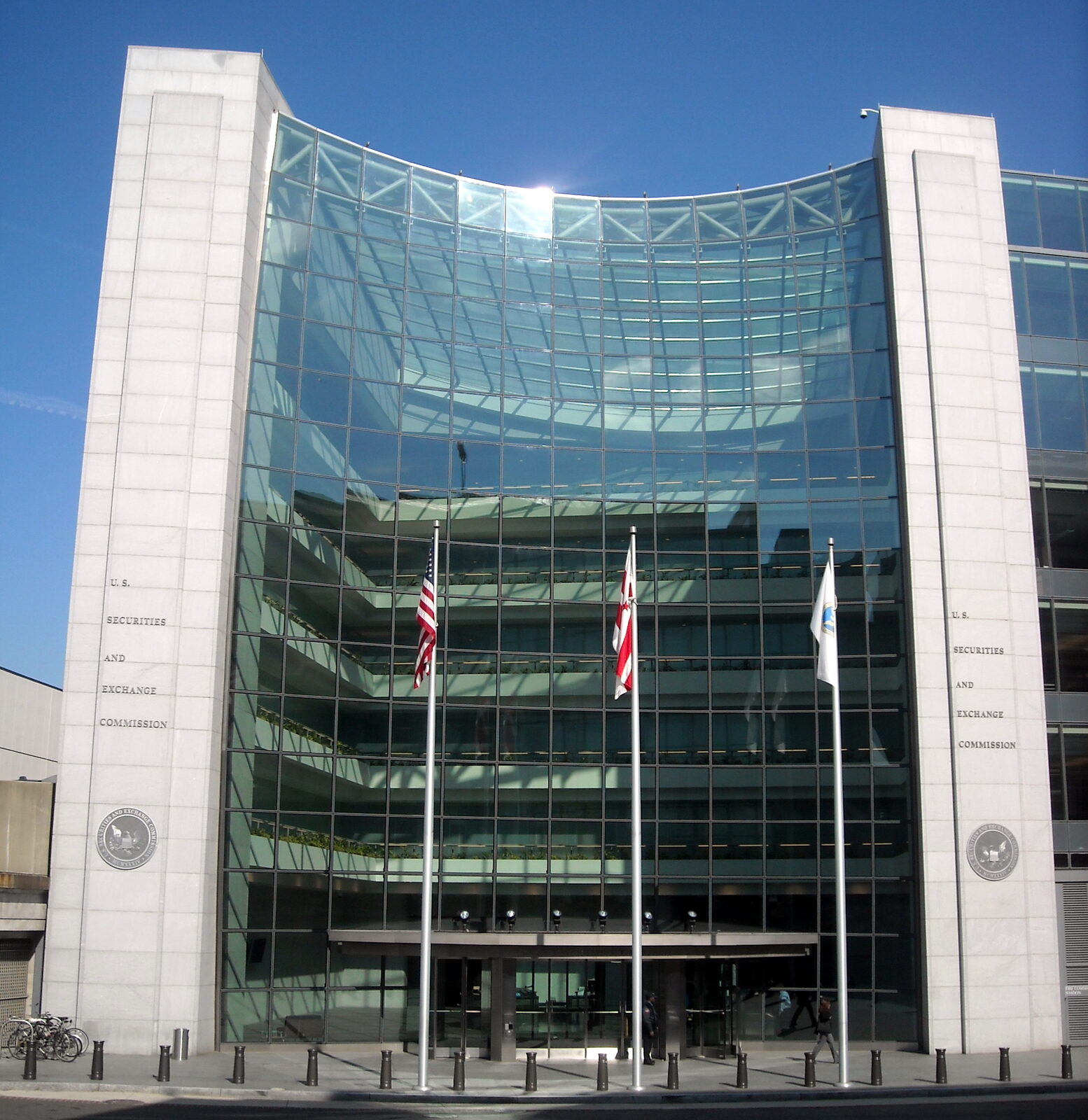
Sources: U.S. Securities and Exchange Commission EDGAR filings and litigation releases, linked inline. Featured image: U.S. Securities and Exchange Commission headquarters, Washington, D.C., photograph by Wikimedia Commons user AgnosticPreachersKid, licensed under CC BY-SA 3.0. This report summarizes public records; companies and individuals named are entitled to a right of reply, which TIJ will append upon request.