

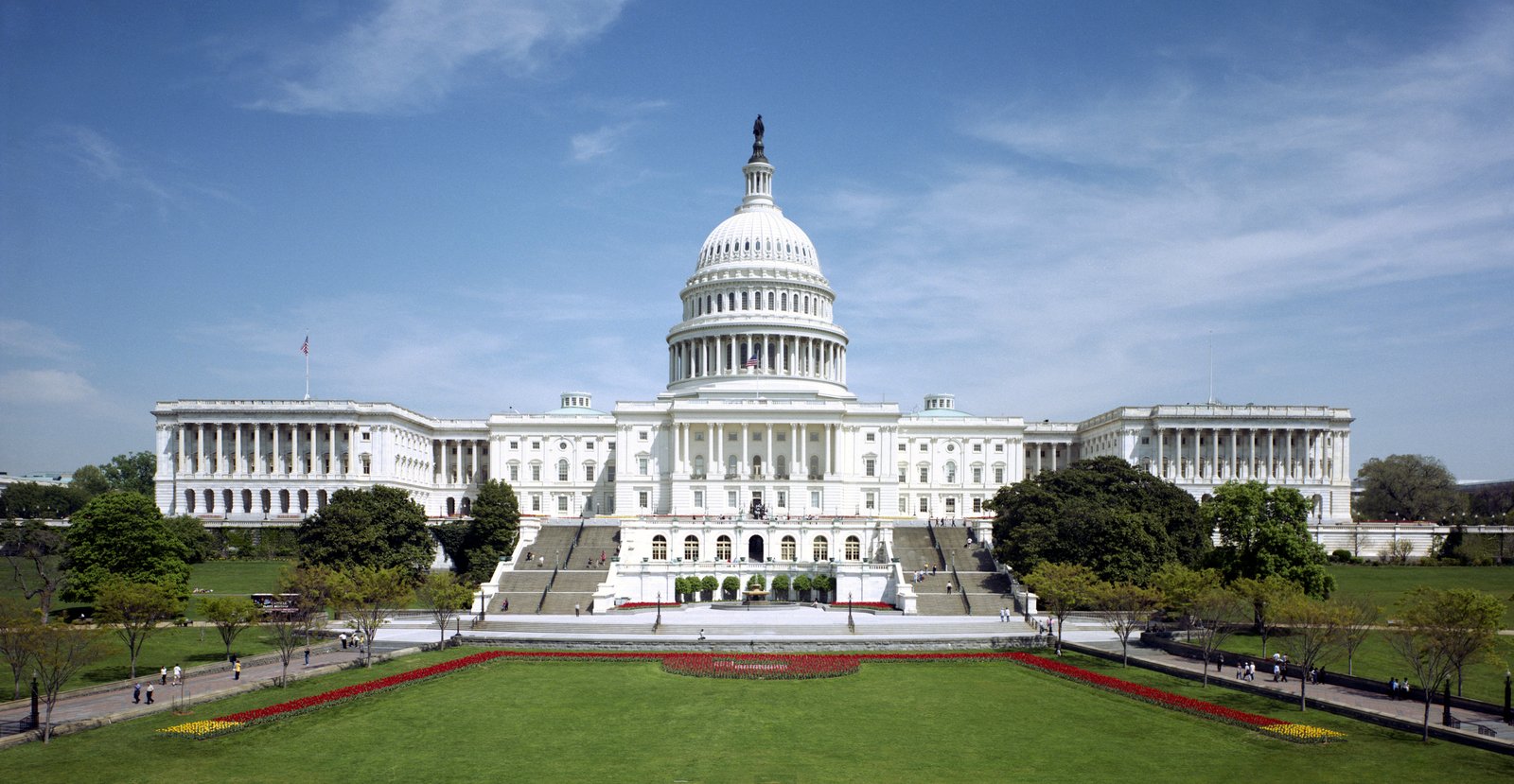
Capitol Watch is The Investigative Journal’s daily digest of congressional activity, compiled from public records including Congress.gov, the Office of the Clerk of the House, the Senate roll-call archives, official committee schedules, and Congressional Budget Office publications. Every figure below is drawn from a primary source and linked accordingly.
Congress closed out its pre-recess stretch this week with a familiar fault line on full display: a divided Senate rejected a fresh attempt to rein in U.S. military involvement in Iran, even as a handful of Republicans again broke ranks to support the effort. On the House side, records show members had already cleared a $1.15 trillion defense authorization, a fiscal 2027 budget blueprint, and a stopgap spending measure before decamping for a five-week August recess. Below are the notable actions of the past several days, drawn strictly from the public record.
1. Senate rejects effort to curb Iran war powers, 49–50
The Senate on Thursday, July 30, rejected a motion to discharge S.J.Res. 181, a joint resolution “to direct the removal of United States Armed Forces from hostilities within or against the Islamic Republic of Iran that have not been authorized by Congress.” According to the official Senate roll-call record (Vote No. 216), the motion failed 49 to 50, with one senator not voting. The vote was recorded at 12:28 p.m.
The tally cut across party lines in both directions. Republicans Susan Collins of Maine, Lisa Murkowski of Alaska, and Rand Paul of Kentucky joined 45 Democrats and the two independents who caucus with them in voting to advance the measure, according to the roll call. Senator John Fetterman, Democrat of Pennsylvania, crossed the other way to vote no, and Republican leader Mitch McConnell of Kentucky was recorded as not voting. Because the discharge motion required a simple majority and fell one vote short, the resolution remained bottled up rather than proceeding to the floor for final passage.
The vote was the latest in a series of war-powers challenges this summer, and reporting from The Washington Post and Roll Call characterized it as a largely symbolic effort by resolution supporters to assert Congress’s constitutional role over the use of force. Supporters framed the measure as a reassertion of legislative authority under the War Powers Resolution; opponents, who held the majority, argued against constraining ongoing operations. The Investigative Journal notes that the resolution’s failure leaves the underlying policy question — the scope of congressional authorization for the campaign — formally unresolved.
2. House-passed $1.15 trillion defense bill awaits Senate action
Records from the Office of the Clerk show the House passed the National Defense Authorization Act for Fiscal Year 2027 (H.R. 8800) on July 22 by a vote of 216 to 212 (Roll Call 278). According to the clerk’s breakdown and the independent tracker GovTrack, the measure drew 209 Republican and 6 Democratic yes votes, while 7 Republicans and 205 Democrats opposed it; one independent voted in favor.
The roughly $1.15 trillion measure raises servicemember pay and expands production capacity, according to Military Times. Coverage of the debate indicated Democratic opposition was tied in part to objections over the administration’s Iran policy, while Republican supporters emphasized readiness and modernization. As Breaking Defense reported, the bill’s path forward runs through the Senate, where the annual authorization had not yet advanced as of the House vote.
The NDAA is one of the few pieces of legislation Congress passes annually, and its provisions set policy across the Defense Department. Because the House and Senate versions must ultimately be reconciled, the final shape of pay raises, procurement authorities, and oversight provisions remains subject to change. The Investigative Journal will track the conference process when the Senate takes up its companion measure.
3. House adopts fiscal 2027 budget blueprint, 216–214
On the same day, the House adopted a fiscal 2027 congressional budget resolution, H.Con.Res. 113, by a vote of 216 to 214 (Roll Call 281), according to the clerk’s records. A budget resolution is not signed into law; instead, it sets top-line spending and revenue targets and can unlock the reconciliation process, a fast-track procedure that allows certain fiscal legislation to pass the Senate with a simple majority.
Reporting by NPR described the blueprint as a vehicle that could be used to unlock additional funding tied to the Iran conflict. Because the resolution passed by a razor-thin two-vote margin, its adoption underscores how narrow the House majority’s room for maneuver remains on fiscal questions. Any reconciliation bill that follows would face its own votes in both chambers, and the specific spending instructions would be written later.
4. Stopgap spending bill would fund government through Dec. 4
Earlier in the sequence, the House voted 220 to 205 to extend federal funding at existing levels through December 4, according to NPR, which reported that six Democrats joined Republicans to advance the continuing resolution. A continuing resolution keeps agencies operating at current spending levels and is typically used to buy time when full-year appropriations bills have not been enacted before the fiscal year ends on September 30.
The measure, if it clears the Senate and is signed, would push the next funding deadline into early December, setting up another potential confrontation over appropriations later in the year. U.S. News & World Report reported that the House sent a flurry of bills to the Senate before the summer break, of which the stopgap was among the most consequential. The Investigative Journal notes that the December timeline places the next shutdown-avoidance vote squarely in the pre-holiday legislative crunch.
5. Senate clears nominations package as pre-recess business winds down
Alongside the war-powers vote, the Senate on July 30 agreed to S.Res. 817 by a vote of 50 to 47 (Vote No. 217). The resolution authorizes the en bloc consideration in executive session of certain nominations on the Executive Calendar — a procedural tool that lets the Senate confirm a batch of nominees together rather than voting on each individually.
Such packaging resolutions have become a routine feature of the confirmation process as both parties look to clear backlogs of executive and judicial nominees before extended recesses. The near party-line margin on the procedural vote reflects continuing disagreement over the terms under which nominations are processed. The specific nominees covered by the resolution are listed on the Senate’s Executive Calendar.
6. Committee dockets: Fauci testimony, AI in the workplace, tribal water rights
The official committee schedule for the week of July 27 lists several notable sessions. The Senate Homeland Security and Governmental Affairs Committee scheduled an open hearing to examine testimony from Dr. Anthony Fauci, the former director of the National Institute of Allergy and Infectious Diseases. As of publication, The Investigative Journal had not independently reviewed a transcript of the session, and this digest does not characterize testimony that has not been verified against the record.
The schedule also lists a Senate Health, Education, Labor, and Pensions subcommittee hearing on the impact of artificial intelligence on the workplace, a Senate Energy and Natural Resources business meeting to consider S.365 and H.R.1729 — measures amending the John D. Dingell, Jr. Conservation, Management, and Recreation Act — and a Senate Indian Affairs Committee hearing examining multiple bills related to water-rights settlements for Native American tribes. Business meetings of this kind are where committees formally advance or amend legislation, making them a leading indicator of what may reach the floor after the recess.
7. Budget office logs new cost estimates as deficit tops $1.9 trillion
The Congressional Budget Office continued issuing cost estimates as lawmakers prepared to leave town. According to the CBO’s most-recent publications, estimates released on July 30 covered H.R. 2985, the Modernizing Government Technology Reform Act; H.R. 5517, the Northern Border Security Enhancement and Review Act; S. 3676, the American Decade of Sports Act; and S. 4009, the Falun Gong and Victims of Forced Organ Harvesting Protection Act. Cost estimates accompany legislation ordered reported by committees and inform members before floor consideration.
The estimates land against a stark fiscal backdrop. In its Budget and Economic Outlook: 2026 to 2036, the CBO projected federal outlays of $7.4 trillion in 2026 — equal to 23.3 percent of gross domestic product — and a fiscal-year 2026 deficit of $1.9 trillion. Those figures frame every spending debate now before Congress, from the defense authorization to the stopgap funding measure, and they will shape the reconciliation discussions the budget blueprint is designed to enable.
What’s next on the calendar
Both chambers are now heading into the August district work period. According to Roll Call and NPR, House members are scheduled to return for votes on Monday, August 31, following the five-week break. When lawmakers reconvene, the calendar will be dominated by unfinished appropriations work ahead of the September 30 end of the fiscal year, the still-pending Senate defense authorization, and any reconciliation instructions that follow from the fiscal 2027 budget resolution. The December 4 funding deadline set by the House-passed stopgap looms as the next hard deadline after that.
On the TIJ accountability beat
Several of this week’s actions intersect directly with The Investigative Journal’s ongoing coverage areas. The repeated war-powers votes bear on executive-authority and congressional-oversight questions that TIJ tracks closely; the fiscal 2027 budget blueprint and the $1.15 trillion defense bill feed the publication’s reporting on defense spending and procurement accountability; and the CBO’s estimate for the Falun Gong and Victims of Forced Organ Harvesting Protection Act (S. 4009) connects to TIJ’s human-rights and China-accountability reporting. The scheduled Homeland Security hearing on Dr. Fauci’s testimony falls squarely within the government-accountability beat, and TIJ will follow the official record when a transcript becomes available. Readers seeking to verify any item above can follow the linked Congress.gov, House Clerk, Senate, and CBO records directly.
All vote tallies and bill descriptions in this digest are sourced to official congressional records and nonpartisan trackers. Where reporting from news organizations is cited, it is attributed by name. Items describing scheduled hearings reflect the published committee calendar and do not assert the content of testimony that has not been verified against the record.