

The Office of the Federal Register has scheduled 100 documents for publication in today’s edition — 79 notices, 12 final rules and 9 proposed rules from 30 federal agencies, according to the public-inspection filings posted ahead of this morning’s issue. The docket is heavy on telecommunications policy, with the Federal Communications Commission advancing two major rulemakings, and includes the formal public-comment window for the Justice Department’s egg price-fixing settlement and a 200-page proposed rewrite of the federal Head Start standards.
Below are the entries most likely to matter for consumers, industry and the accountability beats The Investigative Journal tracks, with comment deadlines for readers who want a say. Because these documents were reviewed on public inspection, final publication details — including exact comment deadlines — should be confirmed against the published versions at the links provided.
FCC floats sweeping new security rules for foreign telecom equipment
The FCC is seeking comment on what its filing describes as “a broad set of additional measures to strengthen the security and integrity of its equipment authorization program” — the gateway through which virtually every radiofrequency device sold in the United States must pass. The Third Further Notice of Proposed Rulemaking in ET Docket No. 21-232 proposes bifurcating the agency’s “Covered List” of prohibited equipment into producer-based and production-location-based categories, addressing the “white labeling” of covered gear under other brand names, and requiring hardware and software bill-of-materials disclosures so regulators can see what components sit inside authorized devices.
The filing also floats prohibitions on authorizing equipment that merely contains Covered List components or software, codified definitions for drones and routers, term limits on equipment authorizations, and — notably for enforcement — a requirement that every FCC-certified device have a U.S.-based party legally liable for compliance. The proposals build on a companion order adopted at the commission’s July open meeting; according to analyses by the law firms Cooley and Wiley, the commission has this year extended Covered List restrictions to component-level hardware and added foreign-made routers to its security reviews. Comments are due 30 days after publication — effectively September 8, 2026, given the intervening weekend and Labor Day holiday — with reply comments due around September 21.
DOJ opens 60-day comment window on egg price-fixing settlement
The Justice Department’s Antitrust Division published the proposed final judgment and competitive impact statement in United States et al. v. Cal-Maine Foods, Inc. et al., the civil case filed June 29 in the Northern District of Iowa (No. 5:26-cv-04060) alongside 17 states. The complaint alleges that Cal-Maine Foods, Hickman’s Egg Ranch and the Versova companies violated Section 1 of the Sherman Act by coordinating bids “designed to artificially inflate the daily price quotations” of Urner Barry, the market-reporting firm whose benchmark underpins egg contracts nationwide.
The proposed judgments would bar the producers from communicating with competitors about bids and benchmark submissions, prohibit agreements on the price or terms of bids, and impose compliance obligations for five years. According to the department’s announcement and contemporaneous reporting by CNBC, the settlement package also includes $3.3 million in payments to the states and a donation of roughly 53 million eggs. The filings contain allegations, not adjudicated findings; under the Tunney Act, the court must determine that the settlement serves the public interest before entering it. Public comments are due within 60 days of the notice — on or about October 6, 2026 — by email to the division’s Chicago office.
HHS proposes wholesale rewrite of Head Start standards
The Administration for Children and Families released a 200-page proposed rule — the largest single filing in today’s issue — that would rescind and replace the Head Start Program Performance Standards last revised in 2024. The agency says the new standards would “significantly reduce Federal bureaucratic burden,” defer to state policies “wherever possible,” return control to local Head Start agencies and parents, cut duplication with statute, and emphasize health, nutrition and physical exercise for young children.
The scale of the rescission means the proposal is likely to draw heavy comment from both program operators, who have long cited compliance costs, and child-development advocates, who will scrutinize which of the 2024 requirements disappear. Comments on docket ACF-2026-0595 are due 60 days after publication — on or about October 6, 2026 — via regulations.gov.
FCC’s “Build America” plan would put a 120-day clock on local broadband permitting
In a second major telecom item, the commission proposes rules (WC Docket No. 25-253) targeting state and local practices it says slow wireline broadband construction in violation of Section 253 of the Communications Act. The centerpiece is a rebuttable presumption that a state or locality has “effectively prohibited” service if it fails to process right-of-way authorizations within 120 days, paired with limits capping permit fees at a “reasonable approximation” of a government’s actual, direct costs — with safe-harbor fee levels presumed compliant.
The proposal follows a 2025 Notice of Inquiry that, according to the filing, documented “excessive delays and fees” facing providers. It also sets up a federalism fight: municipalities have historically resisted FCC preemption of local permitting authority, while builders argue delay is the binding constraint on deployment. Comments are due 45 days after publication (on or about September 21, 2026), with replies due around November 5.
PHMSA streamlines approvals for professional fireworks
The Pipeline and Hazardous Materials Safety Administration issued a final rule expanding the authority of private Fireworks Certification Agencies, which could previously approve only consumer fireworks built to the APA 87-1A standard, to also approve display and professional fireworks built to APA 87-1B and 87-1C. The agency says the change will “streamline PHMSA’s fireworks approval process and provide the industry with improved regulatory flexibility” — a deregulatory step consistent with the administration’s broader push to move routine certifications out of federal queues. The rule takes effect 30 days after publication, in early September.
FAA proposes inspections for Boeing 787 engine-cowl debris risk
The FAA proposed an airworthiness directive covering certain Boeing 787-8, 787-9 and 787-10 aircraft after a report that the protection system on the left fan cowl of the right engine “does not sufficiently cover the components and systems from possible cross engine debris” — the scenario in which fragments from a failing engine strike the opposite side of the aircraft. The directive would require a maintenance-records check or inspection to identify the fan cowl part number, with follow-on corrective actions where needed. Comments on Docket No. FAA-2026-7233 are due 45 days after publication, on or about September 21, 2026.
Treasury removes Iraqi carrier Fly Baghdad from sanctions list
The Office of Foreign Assets Control published a notice that, effective August 5, it unblocked and removed Fly Baghdad Airlines (a.k.a. Iraq Express) from the Specially Designated Nationals list, along with two aircraft. Treasury designated the carrier in January 2024, alleging it provided support to Iran’s Islamic Revolutionary Guard Corps-Qods Force and aligned militias; the delisting notice, as is typical, does not state the reasons for reversal. The notice also updates identifying information for other current designees.
Also on TIJ’s radar
Several smaller entries touch beats this publication follows closely. Commerce’s International Trade Administration ruled that Crown Polyethylene Products is not eligible for a separate rate and will be treated as part of the “China-wide entity” in the antidumping review of polyethylene retail carrier bags — one of at least six trade-enforcement notices in today’s issue, alongside reviews covering carbazole violet pigment from India and China and tin mill products from Taiwan and Türkiye. The Nuclear Regulatory Commission confirmed a renewed license for enCore Energy’s Dewey-Burdock uranium in-situ recovery project in South Dakota, a data point in the domestic nuclear-fuel revival. The Coast Guard completed its Port Access Route Study for the approaches to Galveston Bay, Sabine Pass and Calcasieu Pass — the corridors serving America’s largest LNG export terminals. And the FCC scheduled Auction 114 for FM broadcast construction permits, with applications due September 30 and bidding to follow.
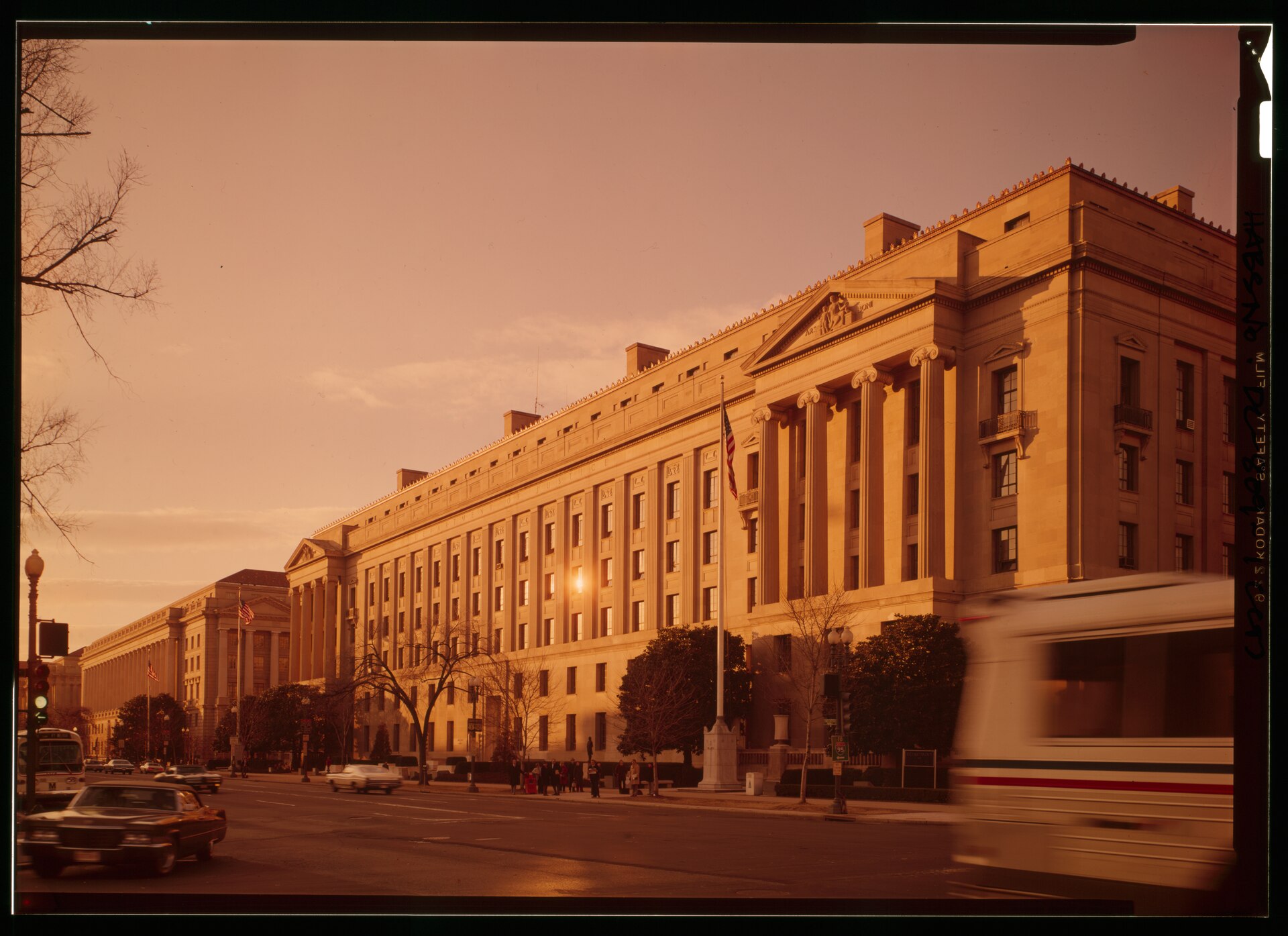
This digest is compiled from public federal filings scheduled for publication in the August 7, 2026 Federal Register. Entities are referenced solely as they appear in public records; documents reviewed on public inspection may differ in minor respects from the published versions. Featured image: the National Archives Building, Washington, D.C., home of the Office of the Federal Register (Historic American Buildings Survey, public domain, via Wikimedia Commons).
Sources
- Federal Register, documents on public inspection for August 7, 2026
- FCC, Third FNPRM, equipment authorization security (ET Docket No. 21-232)
- FCC, Build America wireline NPRM (WC Docket No. 25-253)
- DOJ Antitrust Division, U.S. et al. v. Cal-Maine Foods, Inc. et al., proposed final judgment
- DOJ press release on the egg-producer settlement
- HHS/ACF, Reducing Federal Burden for Head Start Programs (ACF-2026-0595)
- PHMSA, fireworks certification final rule
- FAA, proposed AD, Boeing 787 (FAA-2026-7233)
- Treasury/OFAC, sanctions actions
- Cooley LLP analysis of FCC Covered List expansion and Wiley Rein alert
- CNBC, egg-producer settlement report