

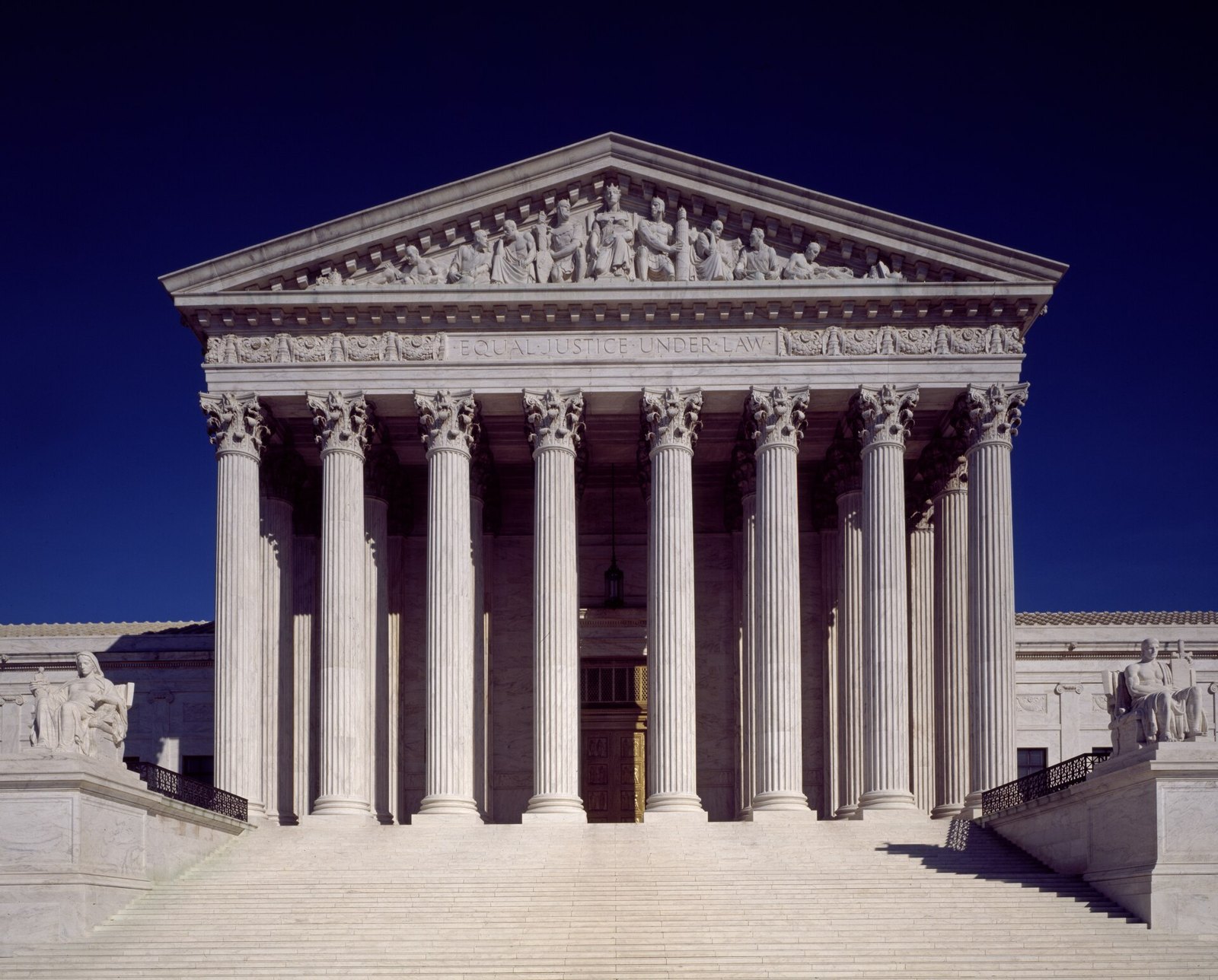
The first full week of August delivered an unusually dense set of court actions for a period when the federal judiciary is normally at its quietest. A divided District of Columbia Circuit panel blocked construction of a new White House ballroom, a federal judge in Texas struck down the National Firearms Act’s registration regime for suppressors and short-barreled rifles, the Supreme Court released an October argument calendar loaded with climate and immigration disputes, and 23 states filed their opposition to an emergency application that could determine how mail ballots are handled in the November midterms.
What follows is a survey of the week’s most consequential court actions, grouped by court level, with links to the underlying opinions and filings. Every matter described below remains subject to further review unless otherwise noted, and allegations described in pending cases have not been adjudicated.
The Supreme Court
Mail-in voting order: states file opposition on the emergency docket
Lawyers for 23 states and the District of Columbia filed a consolidated opposition on Aug. 3 urging the justices to leave in place a district court order limiting implementation of a March 31 executive order on mail-in voting, according to SCOTUSblog. The applications are docketed as Trump v. California (26A124) and Alabama v. California (26A139).
The provisions at issue direct the Department of Homeland Security to compile lists of adult citizens in each state and transmit them at least 60 days before a federal election, instruct the attorney general to prioritize investigation of state and local officials who issue federal ballots to ineligible voters, and require states using mail ballots to furnish the U.S. Postal Service with lists of eligible recipients. U.S. District Judge Indira Talwani, sitting in Boston, found the challengers’ claims unripe as to elections after Nov. 3, 2026, but concluded the order created a “direct and immediate dilemma” for the midterms and barred implementation in the challenging jurisdictions through that date. The First Circuit declined to stay that ruling, observing that neither the federal government nor the 12 intervening states had defended the order’s legality on the merits.
Solicitor General D. John Sauer argued that the dispute is not ripe because implementing agencies have not settled on their approach, and that absent a stay there is “not enough time to obtain ordinary appellate relief” before November. The challengers characterized Talwani’s order as a “narrow injunction” limited to the plaintiff states. The Court had not acted on the requested administrative stay as of the week’s close. Given the compressed election calendar, the timing of any ruling may matter as much as its content.
October calendar signals a consequential term opening
The Court released its October argument calendar on Aug. 4, scheduling seven cases across five days. Suncor Energy (U.S.A.) v. Commissioners of Boulder County leads off on Oct. 5, presenting whether federal law preempts state-law claims seeking damages for injuries attributed to interstate and international greenhouse-gas emissions. The outcome carries direct consequences for the dozens of similar municipal suits filed against energy producers over the past decade, and a preemption holding would resolve a question that has divided state and federal courts for years.
Also on the calendar: Genalo v. Black (Oct. 13), asking whether noncitizen detention can become so prolonged that it triggers a constitutional right to a bond hearing and what evidentiary standard would govern; Anderson v. Intel Corp. Investment Policy Committee (Oct. 6), addressing pleading standards for ERISA duty-of-prudence claims premised on fund underperformance; and Salazar v. Paramount Global (Oct. 14), a digital privacy dispute over the reach of the Video Privacy Protection Act. Both Anderson and Salazar present questions capable of reshaping exposure across large categories of benefits and consumer litigation. The remaining three cases are Johnson v. United States Congress (Oct. 5), Department of the Air Force v. Prutehi Guahan (Oct. 7) and Beaird v. United States (Oct. 13).
Federal Reserve removal dispute reopens
White House Deputy Chief of Staff Dan Scavino notified Federal Reserve Governor Lisa Cook in a letter dated Aug. 5 that the president is “considering” her removal, giving her until Aug. 26 to respond. The letter cites the Supreme Court’s June 29 opinion in Trump v. Cook, in which Chief Justice John Roberts wrote that Cook was entitled to “notice and some opportunity to respond” before termination, though not necessarily “an audience with the President or a full-blown judicial trial.”
The underlying allegations concern 2021 mortgage applications predating Cook’s Fed service. Those allegations remain unproven; Cook disputes them, and reporting on the underlying financial records has raised questions about them. Her counsel, Abbe Lowell and Norm Eisen, said in a statement to SCOTUSblog that they “will challenge this latest pretext.” The procedural posture is the notable development: the administration appears to be building the record the June opinion contemplated, which suggests any renewed litigation would turn on what constitutes “cause” rather than on process.
Federal Courts of Appeals
D.C. Circuit blocks ballroom construction
The week’s most prominent appellate ruling came Aug. 7, when a D.C. Circuit panel upheld a district court order temporarily halting construction of a White House ballroom, while permitting underground work to continue on security grounds. Judges Patricia Millett and Bradley Garcia concluded that Congress holds “full constitutional control over federal property and the funding of its maintenance and development,” and that the administration very likely lacks statutory authority for the project. Because the ruling reviewed a preliminary injunction, that assessment is a likelihood-of-success finding rather than a final merits holding. The panel also found that the National Trust for Historic Preservation had shown completion would inflict “irreversible harms” on its members’ historic and aesthetic interests in President’s Park and the surrounding area.
Judge Neomi Rao dissented, contending that the National Trust lacked standing and that the president’s authority to make improvements to his residence likely encompasses the project. The panel stayed its order for 14 days to permit an application to the Supreme Court, which the president has said he intends to file. The ballroom itself is privately funded, so the dispute does not turn on appropriations alone; it rests on Congress’s Property Clause authority, the absence of statutory authorization for the construction, and a statutory bar on building in federal parkland in the District absent express authority. The broader question — the scope of executive authority to alter federal property without congressional sign-off — reaches well beyond this project.
Third Circuit stays its own Second Amendment ruling
The Third Circuit granted New Jersey’s request on Aug. 4 for a stay pending certiorari in ANJRPC v. Attorney General of New Jersey, pausing the en banc court’s July 17 decision invalidating the state’s semiautomatic rifle and magazine capacity restrictions. New Jersey’s existing statutes therefore remain enforceable while the petition is pending. The account above comes from the National Rifle Association, which is a party to the litigation.
The stay sits against a crowded Second Amendment docket. The Court granted certiorari on June 30 in Viramontes v. Cook County and Grant v. Higgins, consolidated challenges to semiautomatic firearm bans in Illinois and Connecticut. Petitioners in Duncan v. Bonta filed an Aug. 3 supplemental brief pressing the circuit split the Third Circuit ruling created. The most probable path is that New Jersey’s petition is held pending disposition of Viramontes and Grant.
Fourth Circuit decertification tightens Rule 23
An Aug. 4 practitioner analysis highlighted the Fourth Circuit’s July 20 decision in State of Rhode Island Office of the General Treasurer v. The Boeing Company, which reversed certification of a securities class action. Applying Comcast Corp. v. Behrend, the panel held that a district court must rigorously examine damages methodology even where that inquiry overlaps the merits, and found that the plaintiffs’ expert offered only “a series of ‘maybes,’ ‘perhapses’ and ‘what ifs'” rather than a settled class-wide damages model.
The decision reflects a discernible appellate trend toward treating certification as a substantive gate rather than a procedural formality. The practical consequence is that defendants now have stronger incentives to litigate certification through appeal, and plaintiffs’ firms may respond by pleading shorter class periods with correspondingly smaller damages claims.
Federal District Courts
Northern District of Texas strikes NFA registration provisions
Judge James Wesley Hendrix held on Aug. 5 in Jensen v. ATF, consolidated with Silencer Shop Foundation v. ATF, that the National Firearms Act’s registration and approval requirements for suppressors, short-barreled rifles and short-barreled shotguns exceed Congress’s enumerated powers. The summary judgment opinion and final judgment are posted publicly by the National Rifle Association, which brought the case alongside the American Suppressor Association, the Second Amendment Foundation and the Firearms Policy Coalition. The docket is Silencer Shop Foundation v. ATF, No. 6:25-cv-056-H.
The reasoning is structural rather than Second Amendment-based. The court concluded that Congress enacted the NFA under its taxing power, and that registration, fingerprinting, ATF approval and the associated criminal penalties were constitutionally sustainable only as aids to collecting the statute’s taxes. When the One Big Beautiful Bill Act reduced the making and transfer taxes on those items to zero effective Jan. 1, 2026, the court reasoned, the constitutional foundation for the surviving regulatory apparatus fell away. The court rejected the government’s alternative Commerce Clause and Necessary and Proper Clause justifications on the ground that Congress had legislated solely under the taxing power, and expressly declined to reach the plaintiffs’ Second Amendment claims.
Practically, nothing has changed yet. The court stayed its judgment for seven days to permit the government to seek relief from the Fifth Circuit. The decision is a useful illustration of a broader dynamic: when Congress amends one component of a statutory scheme, it can unsettle the constitutional premises of provisions it left untouched.
State Supreme Courts
New Jersey sets an expert-testimony threshold for mental-state defenses
The New Jersey Supreme Court ruled unanimously on Aug. 3 in State v. Arrington and State v. Mustafa that criminal defendants must present expert testimony before asserting insanity or diminished capacity and receiving the corresponding jury instruction, according to the New Jersey Monitor. The opinion is posted on the state judiciary’s website.
The court held that whether a mental disease or defect existed, and how it bore on the defendant’s mental state at the time of the offense, lies beyond the common experience of lay jurors and requires particularized expertise. Testimony from the defendant, relatives or other lay witnesses may complement an expert opinion but cannot substitute for one. Defendants remain free to introduce otherwise admissible evidence of unusual statements or behavior. Because the holding conditions access to two defenses on retaining a qualified expert, its practical operation in cases involving indigent defendants is a question courts applying the rule will have to work through.
Delaware rejects a Jarkesy-style jury challenge
In Swan Energy Inc. v. Investor Protection Unit, decided July 16, the Delaware Supreme Court upheld the state attorney general’s administrative hearing authority against an argument extending SEC v. Jarkesy to state proceedings. The court reasoned that the Delaware Constitution guarantees jury trials only as the right existed at common law, and that an Investor Protection Unit action requiring neither scienter nor reliance is not analogous to a common-law claim. Because Delaware’s corporate law carries outsized persuasive weight, the ruling is likely to be cited in parallel challenges to state regulators’ administrative authority, including EFG America v. Arizona Corporation Commission, pending before the Arizona Supreme Court.
Class Action Landscape
Cornerstone Research’s midyear assessment records 39 securities class action settlements totaling $2.2 billion in the first half of 2026, with a median settlement of $20 million — above the $7.7 million to $17.6 million range that prevailed over the prior nine years. Four settlements of $100 million or more accounted for roughly 10 percent of resolved cases. Median plaintiff-style damages in Section 10(b) settlements reached $660 million. Health care defendants featured prominently.
The data point in a direction worth noting: settlement values are rising even as certification standards tighten. That combination suggests filtering at the certification stage is concentrating value in the cases that survive rather than suppressing aggregate recovery.
Executive Action Headed for Court
Two executive orders signed Aug. 6, “Continuing to Protect the Meaning and Value of American Citizenship” and “Ending Birth Tourism,” are expected to draw prompt legal challenge. They follow the Supreme Court’s June 30 decision in Trump v. Barbara, in which Chief Justice Roberts read the Fourteenth Amendment’s citizenship clause as carrying a “broad reach and narrow exceptions” limited to the children of foreign ministers and certain 19th-century tribal members.
The new order reaches beyond ambassadors to other foreign embassy employees, foreign government employees present in an official capacity, employees of international organizations, children of parents designated “alien enemies” under federal statutes, children of parents who engaged in a commercial surrogacy transaction to ensure the mother’s presence in the United States to give birth, cases involving fraud in obtaining citizenship, and children born in U.S. territories or territorial waters where citizenship is not conferred by federal statute. The litigation question is whether those categories fit within the exceptions the June opinion identified or extend past them.
Cases to Watch
The Supreme Court’s disposition of the mail-in voting applications in Trump v. California and Alabama v. California is the near-term matter with the widest practical reach, given that election administration timelines are already compressed. The ballroom stay expires around Aug. 21, making an emergency application in that dispute probable within days. The seven-day stay in Jensen lapses on or about Aug. 12, so any Fifth Circuit action is likely imminent. Governor Cook’s response to the White House is due Aug. 26. And the Court’s Oct. 5 term opening now has a defined shape, with Suncor first at the lectern.
Also pending are two certiorari petitions filed July 28 arising from an $83.3 million defamation judgment against the president: his own petition, and a separate government petition raising a Westfall Act recertification question. Together they would put the Court in the position of reviewing a civil judgment against a sitting president.
All matters described above are drawn from public court filings, published opinions and official records linked in the text. Pending cases are noted as such; allegations described have not been adjudicated. Parties named have not been contacted for comment on this digest, which summarizes the public record only.