

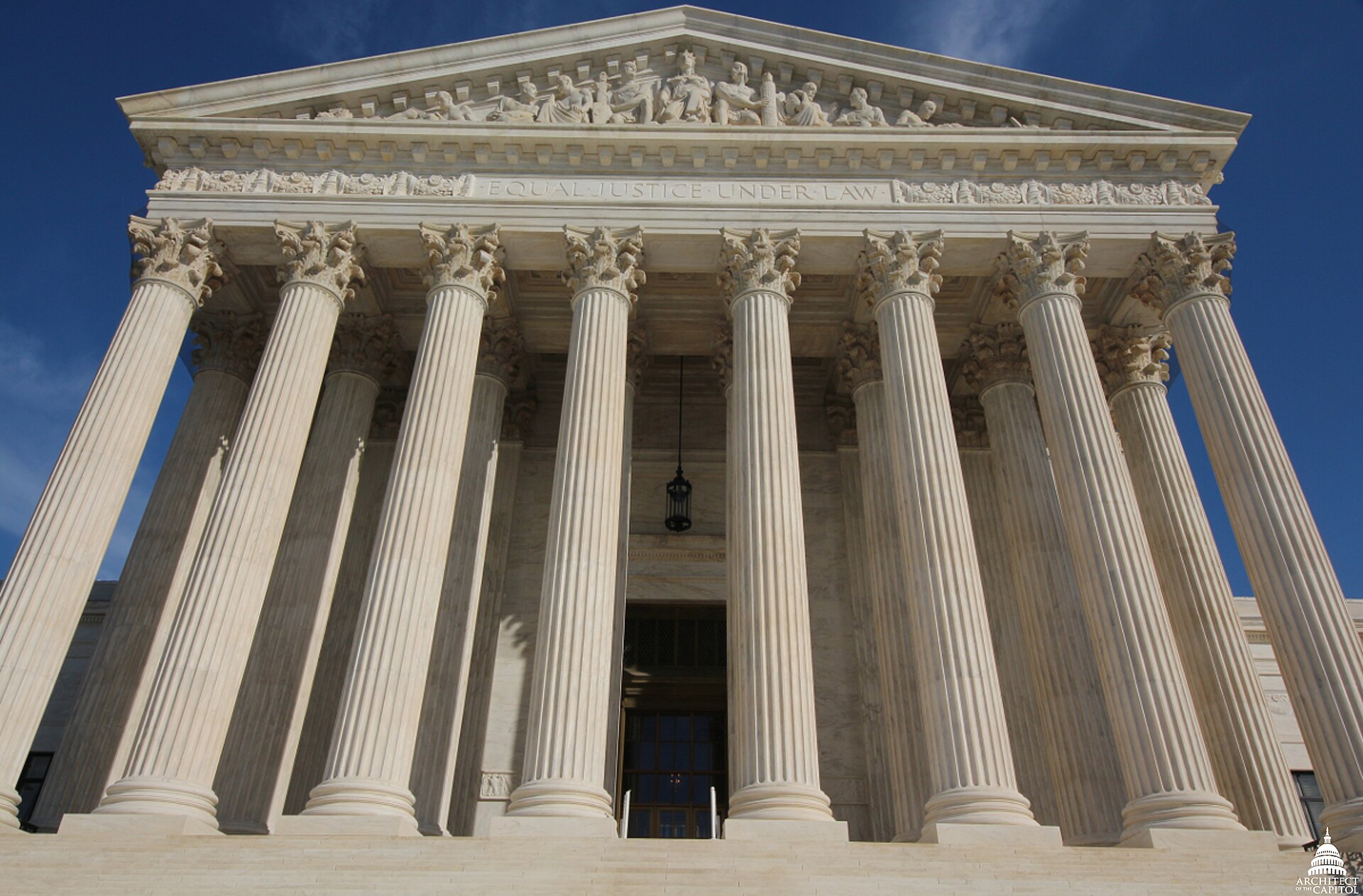
The last week of July brought no summer lull to the courts. The Trump administration took its mail-in voting executive order to the Supreme Court’s emergency docket, two petitions asked the justices to review the $83.3 million defamation verdict involving journalist E. Jean Carroll, a Minnesota federal judge certified classes in a sprawling beef price-fixing case, and state high courts in Texas and Washington issued consequential rulings of their own. Here is The Investigative Journal’s digest of the week’s notable court actions, July 27 through August 2, with links to filings and public records throughout.
Supreme Court
Administration asks justices to unfreeze mail-in voting order; responses due today
On Monday, July 27, the Trump administration filed an emergency application at the Supreme Court seeking to clear the way for full implementation of the president’s March 2026 executive order on citizenship verification and mail-in voting, according to SCOTUSblog, which tracks the application as Trump v. California. On Tuesday, twelve states led by Alabama filed their own application echoing the administration’s request. Responses from the challenging states are due Monday, August 3, by 4 p.m. EDT.
The applications followed a ruling reported on July 25, in which a First Circuit panel upheld a Boston federal judge’s June injunction blocking the order in the 23 states that sued, according to CBS News and Fortune. The order, records indicate, directed federal agencies to compile a list of eligible voters and would limit delivery of mail ballots to people on that list. With midterm elections approaching in November, the emergency docket’s handling of these applications is likely to be the most closely watched interim matter of the summer. A ruling could come within days of today’s filing deadline.
Two petitions seek review of the $83.3 million Carroll defamation verdict
Lawyers for President Trump and, separately, the federal government on Tuesday asked the Supreme Court to take up the defamation case brought by E. Jean Carroll, SCOTUSblog reported. A jury in January 2024 awarded Carroll $83.3 million over statements Trump made in 2019 denying her sexual-assault allegation, and the Second Circuit affirmed the award last year. Trump’s petition contends the ruling “wrongly eviscerates Presidential immunity”; the government’s companion petition argues the Second Circuit should have permitted the attorney general to recertify, under the Westfall Act, that Trump spoke in his official capacity — which would substitute the United States as defendant.
Filings indicate Carroll’s responses are due 30 days after the petitions are docketed. The dispute is distinct from the separate $5 million verdict, which the justices declined to review in June; Trump’s petition for rehearing of that denial remains pending, and the court could act on it as soon as August 17, according to SCOTUSblog. Both sides’ arguments are set out in the linked filings; the allegations underlying the verdicts were contested by Trump throughout, and his petitions continue to dispute liability.
Trump signals Supreme Court appeal in Clinton lawsuit; seeks September deadline
In a filing made public Tuesday, President Trump asked for an extension, to September 9, to seek review of an Eleventh Circuit decision that upheld dismissal of his lawsuit against Hillary Clinton, the Democratic National Committee and others over the origins of the 2016 Russia-collusion allegations, according to SCOTUSblog’s summary of Bloomberg’s reporting. The appeals court’s 3-0 ruling, issued in November, also affirmed nearly $1 million in sanctions against Trump and one of his lawyers for what the panel called a “frivolous” suit; two of the three judges were Republican appointees, including one Trump appointee.
Records suggest the planned petition would focus on the appeals court’s conclusion that the suit was filed too late. Whether the justices take the case or not, the extension application signals the president intends to keep litigating a dispute that has run since 2022 — and puts a marquee political case on the court’s fall intake calendar.
No rehearing sought in birthright citizenship case
The administration appears not to have asked the Supreme Court to rehear its June decision rejecting the executive order limiting birthright citizenship, SCOTUSblog reported on July 28, as the window to do so closed. The choice leaves the term’s highest-profile constitutional ruling undisturbed and shifts the policy debate to Congress, where House leaders have said they are weighing legislative options.
Federal Appeals Courts
Clock runs out on New Jersey’s rehearing window in Second Amendment case
Two weeks after a divided en banc Third Circuit struck down New Jersey’s bans on so-called assault firearms and large-capacity magazines in Association of New Jersey Rifle & Pistol Clubs v. Platkin, the state’s window to seek rehearing ran through July 31, according to published reports citing guidance from the attorney general’s office. Those reports indicate the ruling is expected to take effect in August, when the court’s mandate issues; until then, the state’s statutes remain on the books.
The July 17 decision, covered by The Hill, sets up a likely stay application and certiorari petition from the state — and a potential circuit split for the justices, who have repeatedly declined to take up hardware-ban cases. Watch for New Jersey’s next move in the coming days; the timing of the mandate will determine when, and whether, the ruling changes what dealers may lawfully sell.
District Courts
Medicaid work requirements survive first test in Boston
U.S. District Judge Richard Stearns of Massachusetts on July 30 declined a multistate request for a preliminary injunction pausing implementation of federal Medicaid work requirements, STAT reported. The decision, described in the report as an initial ruling, allows federal officials to continue rollout preparations while the states’ underlying challenge proceeds.
The stakes are large: the requirements, enacted in the 2025 budget law, tie Medicaid eligibility for certain able-bodied adults to work, training or volunteering hours, and state agencies face significant administrative builds ahead of the statutory deadlines. The denial is not a final merits ruling — litigation continues, and an appeal of the interim decision is possible — but it is an early signal of how at least one federal court weighs the states’ claimed harms.
Minnesota judge certifies classes in beef price-fixing litigation
A federal judge in Minnesota certified multiple classes in the long-running antitrust litigation accusing the four largest U.S. beef packers — Cargill, JBS, National Beef and Tyson Foods — of conspiring to depress prices paid to cattle producers while raising beef prices, according to Competition Policy International and DTN/Progressive Farmer. The certified groups include ranchers who sold fed cattle directly to the companies between June 2015 and February 2020, plus three damages classes of beef purchasers; four other proposed classes were declined.
Court filings cited in the reports say the four companies account for more than 80 percent of U.S. fed-cattle processing, and plaintiffs’ economic expert estimated prices paid to producers were suppressed by roughly 6.7 percent during the class period. The claims arise under the Sherman Act, the Packers and Stockyards Act and the Commodity Exchange Act. The companies deny the allegations, and certification does not determine liability — but it moves one of the food industry’s most significant antitrust cases materially closer to trial.
xAI’s emergency bid to halt Minnesota “nudification” law falls short
U.S. District Judge Donovan Frank on July 31 denied an emergency motion by Elon Musk’s xAI to block Minnesota’s first-in-the-nation law targeting AI “nudification” tools, which took effect August 1, FOX 9 reported. The company filed its motion on July 29 — nearly three months after the law was signed and days before it took effect — and the court found the timing undercut the claim of urgency: “Such a delay in bringing the action and the motion suggests that harm is not immediate,” Judge Frank wrote, per the report.
The ruling is preliminary; a hearing on xAI’s motion for a preliminary injunction is set for August 19, per Bring Me The News. The case is an early test of how far states may go in regulating generative-AI outputs before First Amendment objections gain traction, and other statehouses are watching. Separately in California, a federal judge in San Jose denied a preliminary injunction sought by four teachers and others against the state’s new antisemitism-education law, EdSource reported, leaving that statute in effect while the challenge proceeds.
State Supreme Courts
Texas: state may enforce delta-8 THC scheduling rule
The Texas Supreme Court on July 30 cleared the way for the state to enforce a 2021 Department of State Health Services rule classifying delta-8 THC and other synthetic hemp-derived cannabinoids as Schedule I controlled substances, according to the Texas Tribune. The decision reshapes a consumable-hemp market that has operated in legal limbo since retailers first won a block on the rule.
The practical effect, per the Tribune’s analysis, is a significant narrowing of what THC products can lawfully be sold in Texas, with implications for thousands of retailers and for neighboring states’ cross-border markets. Enforcement details and any follow-on litigation over specific products remain to be seen; readers in the industry should consult the ruling and counsel rather than assume prior practices remain lawful.
Washington: 5-4 court lets hazing-death suit against WSU proceed
The Washington Supreme Court on July 30 issued a 5-4 decision allowing the lawsuit stemming from the 2019 death of Washington State University student Sam Martinez to move forward toward a possible trial, according to the university’s public statement. Martinez died following a fraternity event during his freshman year, a case that helped drive Washington’s anti-hazing legislation.
The closely divided ruling is significant beyond this case: it bears on when public universities owe a legal duty of care to students harmed in Greek-life settings, a question courts nationwide have answered inconsistently. WSU’s statement — its side of the story — is linked above; the family’s claims have not yet been proven at trial, and the decision addresses only whether the suit may proceed.
Cases to Watch This Week
Today at 4 p.m. EDT, responses are due in the mail-in voting emergency applications; an order from the justices could follow quickly given the election calendar. On or after August 17, the court could act on Trump’s rehearing petition in the $5 million Carroll matter. August 19 brings the preliminary-injunction hearing in xAI’s challenge to Minnesota’s nudification law. The Third Circuit’s mandate in the New Jersey firearms case is expected around mid-August, with a state stay application likely before it issues. Further out: Trump’s petition in the Clinton case would be due September 9 if his extension is granted, and the justices’ September 28 “long conference” will take up the summer’s accumulated petitions — including Reel v. North Carolina, a Fourth Amendment “knock and talk” case, with a Texas Ten Commandments petition also expected to arrive, per Courthouse News.
Editorial note: This digest summarizes public court records, filings and reports linked above. Allegations described are contested unless a court has entered findings; class certification and interim orders do not resolve the merits. Parties named in this digest who wish to respond may contact The Investigative Journal, and responses will be noted in future coverage.