

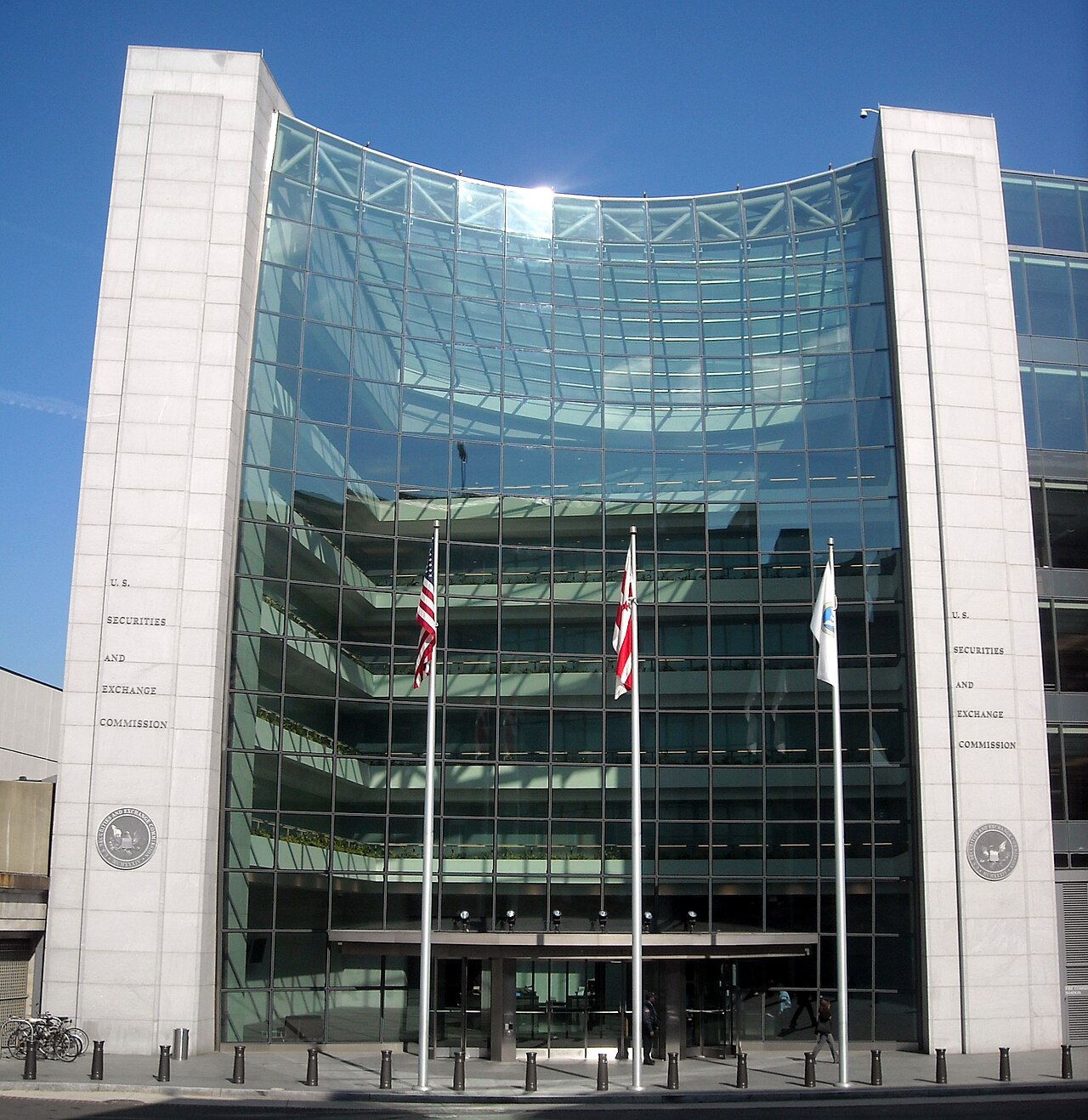
SEC Watch is The Investigative Journal’s daily review of disclosures, enforcement actions, and rulemaking at the U.S. Securities and Exchange Commission. Every claim below is drawn from public records, with direct links to the underlying documents on SEC EDGAR and SEC.gov.
The past two days brought one of the most consequential enforcement filings of the year — fraud charges against the former leadership of collapsed subprime auto lender Tricolor Holdings — alongside a landmark crypto rulemaking proposal and a cluster of corporate disclosures worth a close read: a nine-figure incentive package at Unity Software, a $600 million debt raise at Korn Ferry, Estée Lauder’s annual report, and proxy season maneuvering at Howard Hughes Holdings. Here is what the filings show.
1. SEC charges former Tricolor executives over alleged $1.9 billion “double-pledging” scheme
The Commission announced charges on August 18 against Daniel Chu, Jerome Kollar, and Ameryn Seibold — identified as the former CEO, CFO, and Senior Director of Finance of Texas-based Tricolor Holdings, LLC — for what the agency describes as a multi-year scheme to defraud investors in asset-backed securities collateralized by subprime auto loans.
According to the SEC’s complaint, filed in the U.S. District Court for the Southern District of New York, Tricolor raised more than $1.9 billion through ABS offerings from at least 2020 until its September 2025 bankruptcy, while allegedly representing that loans in the collateral pools were free and clear of other liens when many had been — or soon would be — pledged to multiple securitizations and lenders at once. The complaint further alleges the defendants manipulated loan metrics to make non-paying or defaulted loans appear current and therefore eligible for securitization pools, and that more than $945 million of ABS principal remained outstanding at the time of the bankruptcy. “We allege that these defendants defrauded investors based on bogus collateral and violated the integrity of our private credit markets,” Enforcement Division Director David Woodcock said in the release.
These are allegations, not findings; the civil case is pending, and the release notes a parallel criminal action announced by the U.S. Attorney’s Office for the Southern District of New York in December 2025. The SEC seeks injunctions, disgorgement, civil penalties, and officer-and-director bars against Chu and Kollar. For credit investors, the case is a stark data point on collateral verification in private credit — a theme TIJ will return to below.
2. “Regulation Crypto Assets”: SEC proposes a tailored offering regime
On the rulemaking side, the Commission proposed new rules on August 18 titled Regulation Crypto Assets, which would create a purpose-built securities offering framework for certain investment contracts involving crypto assets. The proposal builds on the Commission’s March 2026 interpretation of how federal securities laws apply to crypto transactions.
The proposing release and accompanying fact sheet describe two registration exemptions: a one-time exemption permitting offerings of up to $5 million over a four-year period, and a second exemption permitting up to $75 million in each 12-month period, the latter carrying financial statement and ongoing reporting obligations. The proposal also includes a conditional safe harbor under which a crypto asset would be deemed not subject to an investment contract for purposes of the definition of “security,” plus federal preemption of state registration requirements for exempt offerings and certain secondary transactions. Chairman Paul S. Atkins said the framework is intended to give crypto entrepreneurs “clear pathways to raise capital under the federal securities laws.” The comment period runs 60 days from publication in the Federal Register — a window worth watching for how established exchanges and state regulators respond.
3. Unity Software grants CEO an 880,000-unit price-vesting equity award
Unity Software Inc. (NYSE: U) disclosed in an 8-K filed August 19 that its compensation committee approved a special award of 880,000 performance-based, price-vesting restricted stock units to President and CEO Matthew Bromberg on August 17. The filing indicates the award vests in three roughly equal tranches, each requiring both continued service as CEO (through August 2027, 2028, and 2029, respectively) and a stock price hurdle: a 30-consecutive-day volume-weighted average price of $50, $60, and $75 per tranche, measurable through August 2031.
Price-vesting mega-grants of this kind reward shareholders only if the stock clears defined hurdles, but they also concentrate enormous potential payouts in a single executive. The filing details forfeiture and change-in-control mechanics, including partial vesting where hurdles were already met at termination. Shareholders will likely scrutinize the grant when Unity’s next proxy statement quantifies its grant-date fair value.
4. Korn Ferry borrows $600 million ahead of AMS acquisition
Executive search and consulting firm Korn Ferry (NYSE: KFY) disclosed in an 8-K filed August 19 that it entered an amended and restated credit agreement on August 18 with Wells Fargo as administrative agent, adding a $600 million senior secured term loan facility alongside its continuing $850 million revolver, both maturing five years from the effective date. Pricing floats at Term SOFR plus 1.125% to 2.00% depending on the company’s consolidated net leverage ratio.
The filing indicates Korn Ferry drew the full term loan at closing, using part of the proceeds to fund a redemption described in the filing and intending the balance to finance a portion of its previously announced pending acquisition of AMS. The obligations are secured by substantially all assets of the company and guarantor subsidiaries — a meaningful shift in balance-sheet posture for a professional services firm, and one that makes the AMS deal’s integration economics worth tracking in subsequent quarterly reports.
5. Estée Lauder files fiscal 2026 annual report
The Estée Lauder Companies Inc. (NYSE: EL) filed its Form 10-K for the fiscal year ended June 30, 2026 on August 19. The cover page shows approximately $26 billion in voting common equity held by non-affiliates as of December 31, 2025, with 247,291,223 Class A shares and 114,507,344 Class B shares outstanding as of August 12, 2026 — the dual-class structure that keeps effective control with the Lauder family. The filing incorporates by reference the proxy statement for an annual meeting scheduled for November 17, 2026.
For a company navigating a multi-year turnaround, the disclosures to mine are in Management’s Discussion and Analysis and the risk factors — including how the company characterizes travel retail exposure and restructuring progress. TIJ will review the full document, which spans 280 exhibits and statements, in the coming days.
6. Howard Hughes Holdings sets September 30 annual meeting; Ackman to hold “open microphone” session
Howard Hughes Holdings Inc. (NYSE: HHH) filed its definitive proxy statement on August 19 for a 2026 annual meeting to be held September 30 at 9:00 a.m. Eastern at 787 7th Avenue in New York. Stockholders of record as of August 17 will vote on eleven director nominees, an advisory say-on-pay resolution, and ratification of KPMG LLP as auditor.
Notably, Executive Chairman William A. Ackman’s letter states that he, CEO David O’Reilly, CIO Ryan Israel, and Vantage Executive Chairman Marc Grandisson will take an open-microphone session addressing “the company, our strategic direction, and our plans” — an unusually direct format for a public-company annual meeting, and consistent with the company’s evolution into a diversified holding company under Pershing Square’s leadership. Preregistration details are posted to the company’s investor relations site.
7. Encore Capital adds former Regional Management CEO to its board
Encore Capital Group (NASDAQ: ECPG), a debt purchaser and recovery firm, disclosed in an 8-K exhibit filed August 19 the appointment of Robert W. Beck to its board of directors, effective immediately, with service on the Audit and Risk Committees. The company’s release describes Beck as the former President and CEO of Regional Management Corporation and a longtime Citigroup executive across finance, operations, strategy, and corporate development roles.
Board refreshment at consumer-debt purchasers merits attention given the sector’s regulatory exposure; the appointment of a consumer-finance operator to the audit and risk functions suggests the board is deepening its bench on exactly those fronts, according to the filing.
8. Datavault AI closes NYIAX merger, issues 74.8 million shares — and keeps diluting
Small-cap Datavault AI Inc. (NASDAQ: DVLT) disclosed in an 8-K filed August 19 that it completed its merger with NYIAX, Inc. on August 18, issuing 74,800,629 new common shares at an exchange ratio of roughly 1.41 Datavault shares per NYIAX share, plus approximately $494,859 in cash to unaccredited holders. The company committed to file a resale registration statement within 30 days and to seat two NYIAX designees on its board.
Two details stand out in the filing. First, the parties waived certain closing conditions and converted them into post-closing deliverables due by noon Eastern on August 27 — including executed employment agreements and severance waivers from certain NYIAX employees, an unusual sequencing that filings indicate leaves material items outstanding after closing. Second, a separate 8-K filed the same evening discloses an additional material agreement and further unregistered sales of equity securities. Records suggest a rapid cadence of share issuance at Datavault; holders should track the cumulative dilution across these filings.
What else we’re watching
The quarterly 13F season that peaked at the August 14 deadline is now producing amendments: Cantor Fitzgerald, L.P. filed an amended 13F holdings report on August 19, one of several institutional managers revising second-quarter disclosures this week. Amendments can correct clerical errors — or restate positions in ways that move markets — and are worth checking against the original filings. The full real-time feed is available on EDGAR’s latest filings page.
On TIJ’s radar: filings that warrant deeper investigation
Three threads from this cycle merit follow-up reporting. First, the Tricolor complaint raises the question of how underwriters, trustees, and diligence providers failed to detect hundreds of millions of dollars in allegedly double-pledged collateral across multiple securitizations — the complaint’s allegations about manipulated loan-performance metrics deserve a document-by-document comparison with the offering materials. Second, Datavault AI’s serial equity issuances — two 8-Ks in one evening disclosing unregistered sales, layered on a 74.8-million-share merger payout — invite a cumulative dilution analysis from the company’s filing history. Third, OSR Health, Inc. disclosed a notice of delisting or failure to satisfy a continued listing standard on August 19; small-cap delisting notices frequently precede reverse splits or going-dark transactions that disadvantage retail holders.
Editor’s note: This digest is compiled exclusively from public records; every factual claim links to the underlying SEC document. Enforcement matters described above are civil allegations that remain pending unless otherwise noted, and defendants are presumed innocent in any parallel criminal proceedings. TIJ did not solicit comment from the named parties prior to publication; individuals and companies named are invited to respond, and responses will be published. Featured image: SEC headquarters, Washington, D.C., by AgnosticPreachersKid via Wikimedia Commons, CC BY-SA 3.0.
