

SEC Watch is The Investigative Journal’s daily review of notable filings on the Securities and Exchange Commission’s EDGAR system, together with enforcement actions and rulemaking announced by the agency. Every item below is drawn directly from public records, with links to the underlying documents. Allegations described in enforcement matters are just that — allegations — unless a court or the Commission has made findings.
Charter completes Cox and Liberty Broadband transactions, reshaping its board and capital structure
The largest corporate disclosure of the past 24 hours came from Charter Communications, which filed an 8-K on August 20 reporting that it completed both its merger with Liberty Broadband and its long-planned combination with Cox Enterprises’ cable business effective August 19. According to the filing, each Liberty Broadband share converted into 0.236 of a Charter Class A share, and the transaction produced a net decrease of roughly 4.7 million Charter shares outstanding after the company retired approximately 38.6 million shares Liberty previously held. Notably, the filing states that all Liberty stock options were canceled for no consideration because their exercise prices exceeded the merger consideration value.
The Cox side of the transaction is larger and more structurally complex. The filing indicates Charter paid $3.5 billion in cash for the equity of Cox’s commercial fiber and managed IT and cloud businesses, paid another $724 million in cash for the contribution of Cox’s residential cable operations, and issued 60 million convertible preferred units of Charter Holdings carrying a $6.0 billion aggregate liquidation preference and a 6.875% coupon, plus approximately 33.6 million common units priced at a $353.64 reference price. Approximately $12 billion of Cox debt and finance leases remains outstanding at Charter subsidiaries, per the 8-K.
Governance changes are equally consequential. The filing states that Cox Enterprises Chairman and CEO Alexander C. Taylor becomes Chairman of Charter’s thirteen-member board for an initial three-year term, with three Cox designees joining the board and Cox subject to a 30% ownership and voting cap. Two Liberty-designated directors departed, and director John D. Markley, Jr. retired at closing. Records show Charter also issued Cox a single share of a new Class C common stock that concentrates the voting power of Cox’s units — a structure investors will want to understand before the next proxy season.
Ross Stores discloses $253 million tariff-refund windfall in strong Q2 report
Ross Stores’ earnings 8-K filed August 20 contained one of the more unusual line items of this reporting season. The off-price retailer reported second-quarter sales of $6.26 billion, up 13%, with comparable-store sales up 10%, and diluted earnings per share of $2.66 versus guidance of $1.85 to $1.93. But the press release exhibit discloses that operating profit of $1.1 billion included approximately $253 million from what the company describes as “IEEPA tariff refunds” — a benefit worth roughly $0.60 per share and 405 basis points of the quarter’s 610-basis-point margin expansion.
Even excluding the refunds, the filing indicates margins expanded 205 basis points, ahead of plan, and the company raised its fiscal 2026 EPS outlook to $8.61 to $8.77. Ross also disclosed repurchasing 1.4 million shares for $319 million during the quarter under its $2.55 billion authorization. For readers tracking how trade-policy litigation flows through corporate income statements, Ross’s disclosure is an early, concrete data point worth watching across the retail sector as more companies report — investors can compare treatment via the company’s investor relations page.
Hertz amends voting agreement with controlling holder CK Amarillo to settle litigation
Hertz Global Holdings filed an 8-K on August 20 disclosing an amended and restated voting agreement with CK Amarillo LP — the vehicle associated with Knighthead Capital Management and Certares Management that has controlled Hertz since its 2021 bankruptcy exit, according to prior public filings. The company states the amendment was entered “in connection with settlement of the Cascia v. Farmer, et al. litigation.”
Under the agreement’s terms, CK Amarillo must vote any shares above 45% of Hertz’s total voting power in proportion to votes cast by other stockholders, effectively capping its discretionary voting influence. The filing also adds a sale-of-control provision: if CK Amarillo sells 50% or more of Hertz’s outstanding common stock to a third party at a premium to market, it must share a formula-based portion of that premium with remaining shareholders. Minority-shareholder protections of this kind typically emerge from litigation pressure, and the filing indicates this one did — a governance development worth noting for any company with a dominant post-reorganization holder.
Coty names former BAT executive Soraya Benchikh as CFO
Coty Inc. disclosed in an 8-K filed August 20 that Soraya Benchikh will succeed Laurent Mercier as Chief Financial Officer effective September 1. The filing states Benchikh most recently served as CFO of British American Tobacco and that Mercier’s separation “is not the result of any disagreement” over the company’s operations, policies or practices.
The compensation disclosure is detailed: annual fixed pay of €1,165,000, a target bonus of 150% of salary with a guaranteed minimum for fiscal 2027, a $2.5 million sign-on RSU award, 1.5 million sign-on stock options, and a €860,000 cash sign-on bonus payable in September 2027. The same filing discloses a raise for Executive Chairman and Interim CEO Markus Strobel — base salary increasing from $1.25 million to $1.6 million with a 170% target bonus — and a $1,275,000 retention bonus for Chief Legal Officer Kristin Blazewicz. The concentration of retention awards suggests a board working to stabilize its executive ranks during a CEO transition; details are available via Coty’s investor relations site.
Howard Hughes Holdings files proxy for September 30 annual meeting
Howard Hughes Holdings, the diversified holding company where Pershing Square’s Bill Ackman serves as Executive Chairman, filed its definitive proxy statement on August 19 for an annual meeting set for September 30 in New York. According to the company’s investor relations page and meeting announcement, shareholders of record as of August 17 will vote on the election of eleven directors, an advisory say-on-pay resolution, and ratification of KPMG as auditor.
The proxy arrives during the company’s continued transformation from a pure real-estate developer into a diversified holding company following Pershing Square’s 2025 investment. The say-on-pay vote and the compensation tables in this year’s filing merit close reading given that transformation — executive incentives at holding companies rarely map neatly onto the metrics shareholders used to evaluate the predecessor business.
SEC charges former Tricolor executives over $1.9 billion subprime auto collapse
On the enforcement side, the Commission announced charges August 18 against Daniel Chu, Jerome Kollar, and Ameryn Seibold — the former CEO, CFO, and Senior Director of Finance of Texas-based Tricolor Holdings — over an alleged multi-year scheme to double-pledge hundreds of millions of dollars of subprime auto loans across multiple asset-backed securities offerings and lenders. According to the SEC’s complaint, filed in the Southern District of New York, Tricolor raised more than $1.9 billion through ABS offerings from at least 2020 through its September 2025 bankruptcy, while allegedly representing that collateral pools were free of other liens and manipulating loan metrics to make defaulted loans appear current. More than $945 million of principal remained outstanding to investors at the bankruptcy, the complaint alleges.
Enforcement Director David Woodcock said the defendants “defrauded investors based on bogus collateral,” and the agency noted parallel criminal charges announced by the U.S. Attorney’s Office for the Southern District of New York in December 2025. The SEC seeks disgorgement, penalties, and officer-and-director bars against Chu and Kollar. These are allegations in a pending case; the defendants have not responded in the SEC’s release, and no findings have been made against them. The case is significant beyond its size: it is a direct test of disclosure integrity in the private credit and ABS markets, where verification of collateral has historically depended on issuer representations.
Regulation Crypto Assets: the SEC’s proposed offering regime enters its comment period
Rounding out the week’s disclosure-policy news, the Commission proposed “Regulation Crypto Assets” on August 18, a framework creating two registration exemptions for investment contracts involving crypto assets — a one-time exemption for offerings up to $5 million over four years, and a second permitting up to $75 million per 12-month period with financial statements and ongoing reporting. The proposing release also includes a conditional safe harbor from the definition of “security” and would preempt state registration requirements for covered offerings.
Chairman Paul S. Atkins said the proposal seeks “clear pathways to raise capital” for crypto entrepreneurs. The 60-day public comment period opens upon Federal Register publication. For disclosure watchers, the principles-based narrative disclosures required under both exemptions — rather than full registration-statement disclosure — will be the provision to scrutinize in comment letters, and the fact sheet outlines the conditions issuers would need to satisfy.
On TIJ’s radar: filings that warrant deeper investigation
Several items from this week’s docket merit follow-up reporting. First, the Tricolor complaint raises unanswered questions about which underwriters, trustees, and lenders accepted the allegedly double-pledged collateral — the complaint states the defendants “deceived underwriters and investors,” and the gatekeeper story remains largely untold. Second, T3 Defense Inc.’s August 20 8-K under Item 3.01 — the item covering delisting notices and continued-listing deficiencies — bears watching in a defense-technology sector that has drawn heavy retail interest. Third, the Commission’s August 14 boiler-room case alleging a $74 million pre-IPO share scam fits a pattern of retail-targeted fraud that the agency’s newly formed Retail Fraud Working Group was created in July to address; the distribution networks behind such schemes rarely surface in a single complaint. Finally, Better Home & Finance’s August 20 8-K disclosing agreements touching its charter, security-holder rights, and capital structure is the kind of multi-item filing that rewards a careful read.
Methodology and right of reply: This digest is compiled exclusively from SEC EDGAR filings, SEC press releases, and company investor-relations materials linked above. Enforcement matters described here are pending civil allegations unless otherwise noted, and defendants are entitled to contest them in court. The Investigative Journal had not received responses from parties named in enforcement matters as of publication; individuals or companies referenced who wish to respond may contact the editors and responses will be noted in updates to this article.
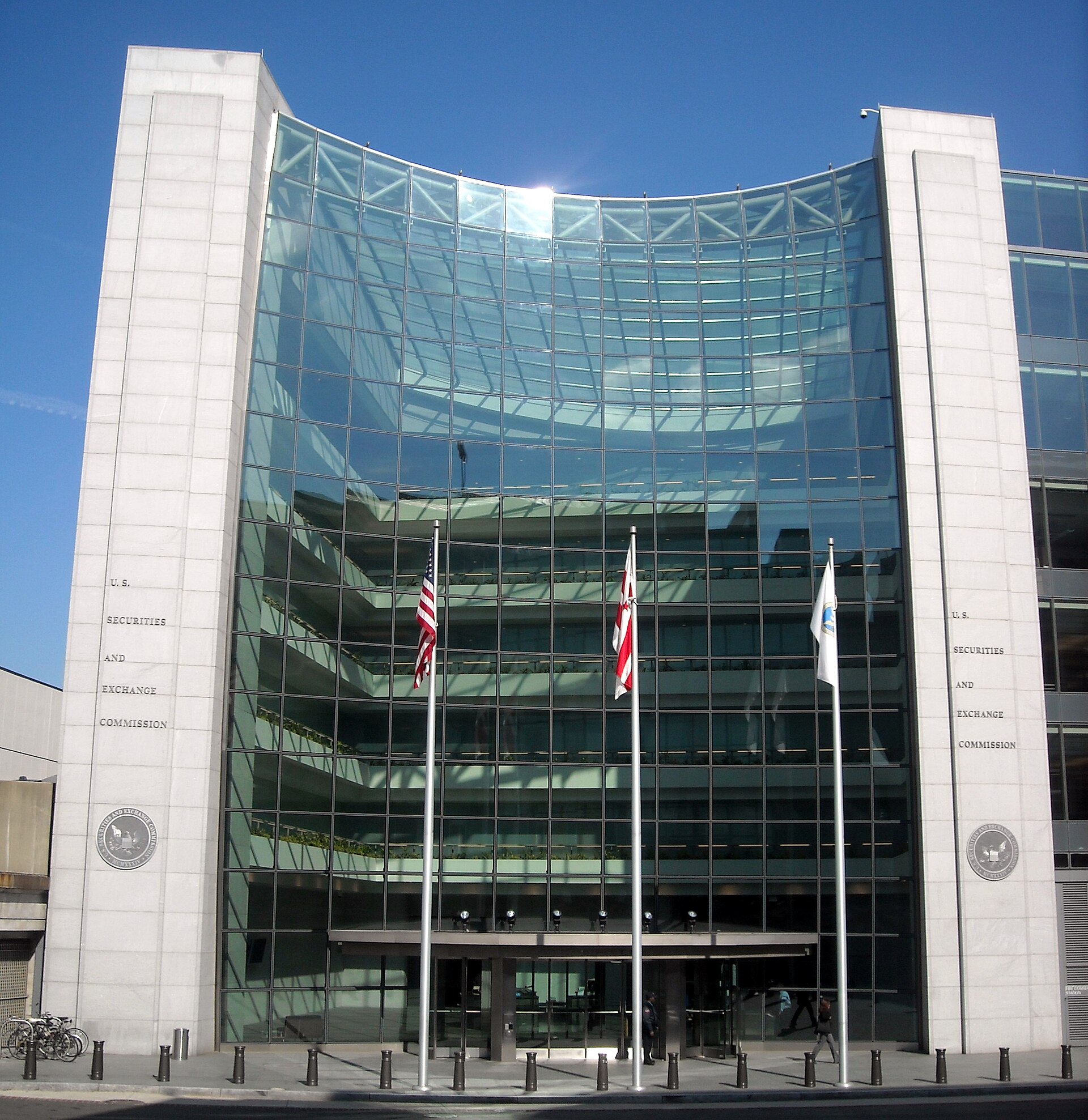
Featured image: U.S. Securities and Exchange Commission headquarters, 100 F Street NE, Washington, D.C. Photo by AgnosticPreachersKid via Wikimedia Commons, CC BY-SA 3.0.
