

The most consequential policy research released this week shares a common thread: institutions stress-testing systems designed for an economy that no longer exists. RAND modeled what happens to federal revenue if artificial intelligence displaces human labor at scale. The Council on Foreign Relations pressed its case that America’s munitions stockpiles cannot be rebuilt on current procurement timelines. Brookings quantified how stablecoins could reshape the Treasury market. Closer to home, AEI tallied where roughly $700 billion in pandemic unemployment dollars actually went, and the Economic Policy Institute updated its long-running measure of what teachers give up to stay in the classroom.
As always, this roundup draws from institutions across the political spectrum. We note each organization’s orientation and funding sources, summarize findings as the authors present them, and link directly to the original documents so readers can judge the work for themselves.
RAND: If AI Replaces Labor, What Happens to the Federal Tax Base?
The week’s most striking piece of fiscal research comes from the RAND Corporation, the nonpartisan research organization that operates federally funded research and development centers and draws much of its revenue from U.S. government contracts. In “Federal Revenue When AI Replaces Labor” (August 25), researchers Carter C. Price and Akshaya Suresh start from a stark accounting fact: in 2024, 84 percent of federal revenue came from individual income and payroll taxes — levies tied directly to human labor income.
The report models scenarios ranging from a transitional case in which highly capable AI displaces 10 percent of the workforce to full displacement. The authors estimate that corporate tax rates would need to roughly double for corporate receipts to reach parity with what labor taxation currently yields, and they warn that cheap, at-cost AI services could trigger deflation that erodes receipts further. “Even if displaced workers seek reemployment and find positions with similar compensation, the fiscal shock would be equivalent to a recession,” they write. The paper recommends planning now: shifting revenue toward corporate and excise taxes, preparing income-support programs, and considering special treatment of windfall AI profits.
CFR: A Two-Year Sprint to Refill the Arsenal
At the Council on Foreign Relations — the nonpartisan membership organization funded by dues, its corporate program, foundations, and an endowment — Michael C. Horowitz distilled the takeaways from CFR’s major new defense-industrial report in an August 24 Expert Take. The underlying report, “Out of Ammo,” argues that the war with Iran severely depleted U.S. air-defense interceptors and precision-guided munitions, and that rebuilding exquisite munitions inventories cannot happen within two years regardless of how much money Congress appropriates.
The authors’ answer is what they call “precise mass”: lower-cost, attritable, increasingly autonomous weapons, sensors, and platforms built on commercial manufacturing lines. Their recommendations read like an oversight checklist — get every appropriated dollar on contract each year, accept portfolio-level procurement risk, legislate multiyear defense budgets, and qualify second-source suppliers for chokepoint components. “Washington needs to immediately put production of precise mass on a wartime footing,” Horowitz writes. “Waiting until conflict begins will be too late.” The framing is explicitly about deterrence: the report describes a roughly two-year window to convince Beijing that an invasion or blockade of Taiwan would fail.
AEI: Where $700 Billion in Pandemic Unemployment Money Went
The American Enterprise Institute — center-right, funded by individual donors, foundations, and corporations, and which by policy accepts no government money — released a report Thursday that belongs on the desk of every program-integrity investigator. In “A Review of the Wide Variation Across States in Federal Pandemic Unemployment Benefit Funding,” Matt Weidinger disaggregates the roughly $700 billion in federal pandemic unemployment spending — $444 billion in supplemental weekly checks (PUC), $132 billion for gig and self-employed workers (PUA), and $85 billion in extended benefits (PEUC).
Measured per member of the labor force, the report finds gaps between the highest- and lowest-funded states ranging from 10-to-1 to 62-to-1 depending on the program; combined funding ran from $8,337 per worker in New York to $567 in South Dakota. Weidinger calculates that states that vote Democratic in presidential elections collected roughly $94 billion more than their share of the labor force would predict. The report also revisits the fraud toll — the Labor Department has acknowledged a 36 percent improper-payment rate for PUA, with official improper-payment estimates of at least $191 billion and private estimates reaching $400 billion. “Too little attention has been paid to the often wildly disproportionate subsidies paid to some states, at significant cost to federal taxpayers,” Weidinger writes, recommending flexible block-grant-style relief in future downturns.
EPI: The Teacher Pay Penalty Eases Slightly, Remains Historically Wide
From the left, the Economic Policy Institute — a progressive research organization whose disclosures indicate labor unions have historically provided about a quarter of its funding — published its annual teacher-compensation study on August 25. Sylvia Allegretto’s analysis finds public school teachers earned 25.2 percent less in weekly wages than comparable college graduates in 2025 — an improvement from 2024’s record 26.9 percent, but more than four times the 6.1 percent penalty measured in 1996.
The state spread is wide: from 10.4 percent in Rhode Island to 40.7 percent in Colorado, the first state reading at or above 40 percent in the history of the series. Teachers’ stronger benefits packages offset part of the gap, leaving a total compensation penalty of 14.5 percent. The data show the penalty falls hardest on men, at 34.5 percent versus 20.0 percent for women — a gap the report attributes to the male-dominated professions against which teaching competes. Inflation-adjusted teacher wages have fallen 6.2 percent over three decades while other college graduates’ wages rose 28.8 percent, a divergence the report links to persistent shortages in the profession.
Brookings: Stablecoins Could Absorb Up to $2.3 Trillion in T-Bills
At Brookings — centrist to center-left, funded by foundations, corporations, and individuals, with some foreign-government contributions disclosed in its annual reports — former Treasury Under Secretary Nellie Liang and Brent Neiman published a Hutchins Center working paper, “Stablecoins after GENIUS” (August 19), examining the fiscal plumbing behind the post-GENIUS Act stablecoin boom. With the market at roughly $270 billion as of June, their scenarios imply first-round net new demand for Treasury bills of $400 billion to $2.3 trillion by 2030.
That demand is not free money, the authors caution: heavier reliance on short-term bills would shorten the average maturity of federal debt, exposing taxpayers to more frequent refinancing and more variable interest costs. The paper recommends keeping the current prohibition on paying interest on stablecoins, at least initially, to avoid disruptive shifts out of bank deposits, and flags a national-security concern — if stablecoins bypass correspondent banking, U.S. sanctions and anti-money-laundering leverage weakens unless issuers and wallet providers are required to block illicit transactions.
Manhattan Institute: Pricing the Interstate Tax Divide
The Manhattan Institute — a conservative, free-market think tank backed by foundations and individual donors — released an interactive analysis by Daniel Di Martino (August 20) modeling combined federal, state, and local income and payroll taxes across all 50 states, D.C., Puerto Rico, and 384 metro areas for tax year 2026. A married New York City couple earning $120,000, the model shows, pays $32,693 in income and payroll taxes and faces a 36.3 percent marginal rate; moving to Nashville would raise their real take-home pay nearly 8 percent even if one spouse gave up a $20,000 job.
The distributional finding cuts against a common assumption: it is not only the wealthy who gain from interstate moves. Di Martino’s calculations show the lowest earners can gain more than 10 percent in price-adjusted after-tax income, and a single $60,000 worker relocating from Los Angeles to Orlando nets $7,475 a year — roughly an 18 percent raise. “Not only the rich, but also low- and middle-income Americans, have a lot to gain from moving across state lines,” he writes.
Urban Institute: A Fix for VA Refinances That Strip Veterans’ Equity
The Urban Institute — center-left, with a substantial share of its funding historically coming from federal contracts and grants alongside major foundations — published an August 26 analysis by Edward Golding, Laurie Goodman, and Ted Tozer, three veterans of federal housing finance, arguing that VA streamline refinances are quietly costing both veterans and FHA borrowers. VA loans prepay at a 13.2 percent rate versus 8.5 percent for FHA — more than 50 percent faster — leading investors in shared Ginnie Mae pools to demand higher rates from everyone, including lower-income FHA borrowers.
Their worked example shows the mechanics: a streamlined refinance that cuts a monthly payment by $92 while raising the loan balance from $289,953 to $300,655, converting home equity into fees. The authors’ proposed fix is blunt — bar any increase in loan amount on streamlined VA refinances, requiring closing costs to be paid in cash or priced into the rate, so that a refinance only happens when it truly benefits the borrower.
Niskanen Center: An Electricity Agenda for the Backlog, Not the Horizon
The Niskanen Center — a center-right reformist shop funded primarily by philanthropic foundations — offered a grid-focused counterpoint to the season’s data-center anxieties. In “More power, faster” (August 20), Kenneth Sercy argues that the quickest path to meeting surging demand is not exotic technology but clearing approval backlogs for mature projects — renewables, storage, and natural gas — which he estimates could add tens of gigawatts per year of new supply through 2030.
The near-term agenda: congressional direction to FERC to accelerate interconnection reform, streamlined federal and state siting reviews, and incentives for reconductoring existing lines to expand grid headroom. Sercy treats load flexibility and data-center colocation as complements to new supply rather than substitutes, and is candid that the big structural options — interregional transmission, clean firm generation — cannot scale before the 2030s. “The fastest way to meet demand is to advance mature projects already in the pipeline,” he writes.
Also on Our Radar
RAND separately published a framework of 262 security controls (August 25) for protecting frontier AI model weights against theft — addressing 31 high-feasibility attack vectors and designed for implementation within six to twelve months. The Cato Institute, the libertarian think tank co-founded by Charles Koch and funded overwhelmingly by private donors, released a 44-country study of occupational licensing (August 19) finding the typical country licenses about a quarter of its workforce and that licensed workers earn 6 to 19 percent more than comparable unlicensed peers. At AEI, Nicholas Eberstadt and Patrick Norrick documented “The Incredible Global Birth Crash” (August 20) — more than 70 percent of humanity now lives in sub-replacement fertility societies. The Center for American Progress, the progressive institute founded by John Podesta, published a case against this fall’s planned seabed-mining lease sales (August 26) near American Samoa and the Mariana Islands, citing a commissioned assessment that commercial viability is unlikely within 15 years. And the Heritage Foundation, the conservative movement’s flagship funded largely by individual donors, took the unusual step of codifying its own worldview in “The Heritage Foundation First Principles” (August 19), a formal statement of the fifteen premises underlying its research.
Why It Matters for Our Beats
Three items this week land squarely on TIJ’s accountability desk. AEI’s pandemic-UI accounting — a documented improper-payment floor of $191 billion — is the backdrop for the state-by-state fraud-recovery records we continue to examine. CFR’s procurement recommendations offer a measurable oversight test: how many appropriated defense dollars actually get on contract each year, a figure we will be watching in upcoming appropriations reporting. And RAND’s revenue modeling gives fiscal committees a framework — and journalists a benchmark — for evaluating whether official budget baselines are pricing in the labor-market disruption that AI developers themselves forecast. Readers should note that all findings summarized above are the claims of the cited authors and institutions; the original reports, linked throughout, contain the methodologies and caveats.
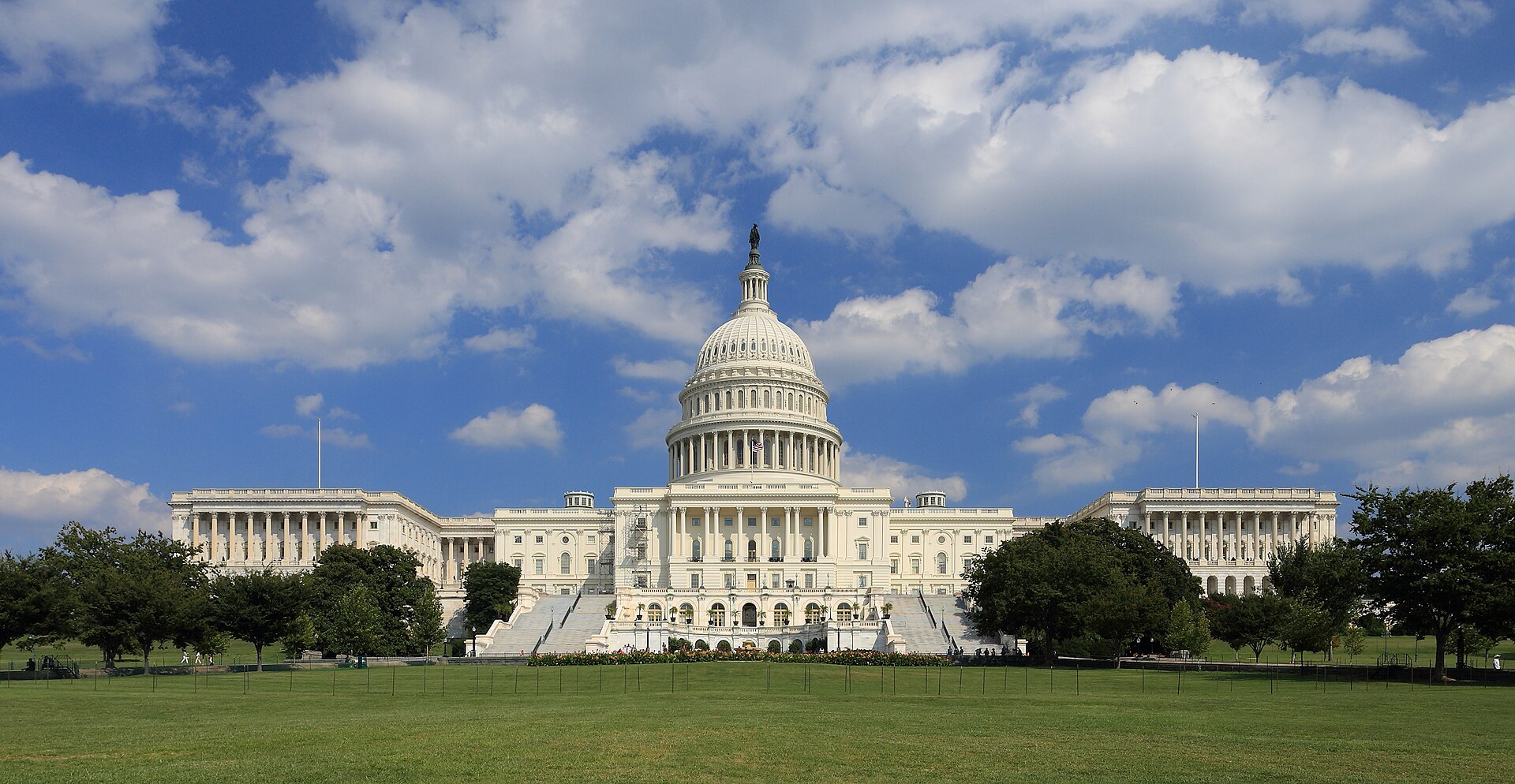
Photo: The U.S. Capitol. Martin Falbisoner via Wikimedia Commons, CC BY-SA 3.0.