

Week in Review is The Investigative Journal’s Saturday analysis column, connecting the accountability reporting we published over the past seven days. Every figure below is drawn from a public record; links to the underlying documents and to our own coverage are provided throughout. This is analysis, not opinion — where a matter is contested or before the courts, we say so.
Read the week’s accountability coverage from a distance and a single tension comes into focus. Federal watchdogs booked some of the largest recovery figures of the year, announced settlements worth more than half a billion dollars, and paid out multimillion-dollar whistleblower awards. And yet the same watchdogs, in their own audits, documented an oversight architecture that is missing deadlines, discarding complaints, and losing track of roughly $186 billion a year. The government’s accountability machine is, by its own accounting, producing bigger numbers and thinner infrastructure at the same time.
That is the throughline of the week: the outputs of oversight and the health of oversight are diverging. Below, we connect the reporting that shows how.
The dollar figures that led the week
The top-line numbers were real and, in places, historic. The Department of Health and Human Services Office of Inspector General — the statutory watchdog for Medicare and Medicaid — told Congress it generated roughly $5.56 billion in expected recoveries and projected savings over the six months from October through March, a return it pegged at $12.70 for every dollar spent, according to its semiannual report to Congress (first reported by The Hill on July 13). The figure was anchored by a handful of large cases, including $674 million in settlements with Kaiser Permanente affiliates and CVS Health’s Aetna over allegedly inflated Medicare Advantage billing.
Environmental enforcement told a similar story of large sums moving through the pipeline. As our EPA Watch documented, three proposed consent decrees entered or remained in public comment this week — a $69 million Clean Water Act settlement over the December 2022 Keystone Pipeline rupture near Washington, Kansas (with a $26.9 million civil penalty), the $450 million Chemours “forever chemicals” agreement, and a $57.6 million Superfund cleanup decree at Columbia Falls, Montana — together representing more than half a billion dollars in penalties and cleanup obligations. Layered on top were whistleblower payouts that themselves signal active enforcement: the SEC posted awards including a single $20 million payment, and the CFTC awarded more than $8 million to five tipsters, per our Oversight Watch.
Taken alone, those numbers describe a vigorous accountability apparatus. The complication is what sits beneath them.
The number beneath the number
Consider the HHS-OIG report more closely, because it contains the week’s paradox in miniature. The same document that reported $5.56 billion in impact also showed the underlying caseload shrinking: combined criminal and civil actions fell to 604 from 833 in the prior period — the lowest in at least two years — while criminal referrals and program exclusions also declined. The office’s own methodology note cautions that its “total monetary impact” measure reflects amounts ordered or agreed to be repaid rather than dollars actually collected. In other words, recovery dollars rose while enforcement volume fell, and the headline figure is a projection, not a bank statement.
Zoom out to the whole government and the leakage is larger still. The Government Accountability Office reported that federal agencies’ estimated improper payments climbed to about $186 billion in fiscal 2025 (GAO-26-108694), an increase of roughly $24 billion over the prior year, with about 82 percent of that total representing overpayments and nearly three-quarters concentrated in five programs, including Medicare, Medicaid and the Earned Income Tax Credit. Set the two figures side by side and the scale problem is stark: the government’s largest health watchdog recovered $5.56 billion over six months, while improper payments across the government ran to $186 billion over the year. The recoveries are real; they are also a fraction of the losses the same auditors document.
Who watches the watchdogs
The week’s most pointed finding turned the accountability lens on the overseers themselves. A GAO review released in June — “Inspectors General Integrity Committee: Strengthened Oversight and Policy Needed to Ensure Consistent Investigations” (GAO-26-107922) — found that the Integrity Committee of the Council of the Inspectors General on Integrity and Efficiency, the panel that investigates alleged wrongdoing by inspectors general themselves, routinely blew past its 150-day statutory deadline. Of the completed investigations GAO examined, none met the deadline; investigation lengths ranged from 427 days to 1,246 days, and the auditors estimated that only 24 percent of cases met all required timeframes. GAO further reported that the committee conducted “improper reviews that could discard complaints” and that some final reports did not reflect the conclusions of the investigating IG office. As our Oversight Watch reported, House Oversight Chairman James Comer and three subcommittee chairmen have since demanded documents from CIGIE, opening a widening inquiry.
The theme — watchdogs flagging weaknesses in the accountability machinery — recurred across beats. The Pentagon’s inspector general found that a $500 million artillery plant had produced zero 155mm parts. Auditors flagged persistent fraud gaps and a lingering technical vulnerability at Login.gov, and the Project On Government Oversight pressed for a still-missing final accounting of the Department of Government Efficiency’s work, per our Watchdog Roundup. One institution appears in nearly all of it: the GAO surfaced in three separate TIJ roundups this week — on the Integrity Committee, on improper payments, and on artificial-intelligence risk — a reminder of how much of the country’s self-auditing capacity runs through a single congressional agency.
The money in motion
If the oversight machinery is straining, the flows it is meant to police are not. Federal lobbying opened 2026 at a record pace: organizations reported spending roughly $1.4 billion in the first quarter, the highest first-quarter total since Congress began requiring quarterly disclosure in 2008, according to an OpenSecrets analysis cited in our Influence Watch. A total of 13,521 organizations reported activity, up about 9 percent year over year; pharmaceuticals and health products led all sectors at roughly $132 million, and lobbying firms collectively took in a record $5.08 billion in 2025.
On the spending side, the competition picture drew scrutiny. Our Spending Watch flagged a $2.2 billion Navy contract to manage construction of up to eight Medium Landing Ships that, by the government’s own notice, drew a single offer — alongside a $370 million engine-overhaul award performed overseas without competition. A one-bid outcome on an award of that magnitude is precisely the competition pattern that oversight offices routinely urge agencies to monitor. And the branch that authorizes much of this spending stalled: the Senate failed to advance its roughly $1.15 trillion FY2027 defense authorization bill on a 50–46 cloture vote, 10 short of the 60 required, as detailed in our Legislative Watch. Read together, the pattern is coherent: money entering the system through influence and leaving it through contracts is running at or near records, even as the appropriations process seizes and the machinery meant to audit the flow shows documented cracks.
An emerging trend: the machines are learning faster than the rules
A quieter thread ran under the week’s numbers — the arrival of artificial intelligence inside accountability-critical systems, ahead of the frameworks to govern it. GAO cautioned that the Department of Veterans Affairs’ plan to deploy AI in its $195 billion disability-compensation program (which paid more than 6.9 million veterans in fiscal 2025) could “increase risk and hinder accountability, in part because even its designers may not fully understand how it works.” Our Investigative Monitor summarized ProPublica’s reporting that the FBI weighed using AI to vet signatures on seized Georgia ballots — a use with obvious accuracy and civil-liberties stakes. And our Think Tank Roundup highlighted a Brookings analysis of AI’s “borrowed expertise” problem. The common denominator: AI is entering benefits adjudication, law enforcement and analysis faster than the oversight tools — GAO’s own AI Accountability Framework among them — are being applied to it.
The data, visualized
Three charts would sharpen the week’s story. The first is a dual-axis line for HHS-OIG over the past several reporting periods: recovery dollars on one axis, the count of criminal and civil actions on the other. The lines cross this period — dollars up, actions down to 604 from 833 — the single clearest picture of the paradox. The second is a simple horizontal bar comparing scale: a $5.56 billion recovery bar dwarfed by a $186 billion improper-payments bar, a visual argument that recovery is a fraction of leakage. The third is a bar chart of the Integrity Committee’s completed investigations against the 150-day statutory line, with bars stretching to 427 and 1,246 days — delay rendered as distance. A fourth, for context, would plot first-quarter federal lobbying totals from 2008 to 2026, with the current $1.4 billion sitting at the peak of the series.
What to watch next week
Several of the week’s threads have near-term tripwires. Majority Leader John Thune preserved his ability to call the defense bill back up through a motion to reconsider, so watch whether the FY2027 NDAA returns to the floor before the recess clock runs out. The Justice Department’s notice of lodging on the Keystone consent decree opened a 30-day comment window (published July 15 at 91 FR 43406), one of several EPA settlement clocks now running. CIGIE’s response to the House Oversight document demand will indicate whether the “who watches the watchdogs” inquiry gains traction or stalls. Obligation data on the $2.2 billion Navy landing-ship award should begin posting to USAspending.gov, allowing independent tracking of a single-bid contract. And the next HHS-OIG reporting period will show whether the two-year decline in enforcement actions is a trend or a trough.
The week’s records do not add up to a scandal so much as a structural signal: an accountability system whose reported results and whose operating capacity are moving in opposite directions. That gap — between what oversight recovers and what oversight can still reliably do — is the story worth following into the fall.
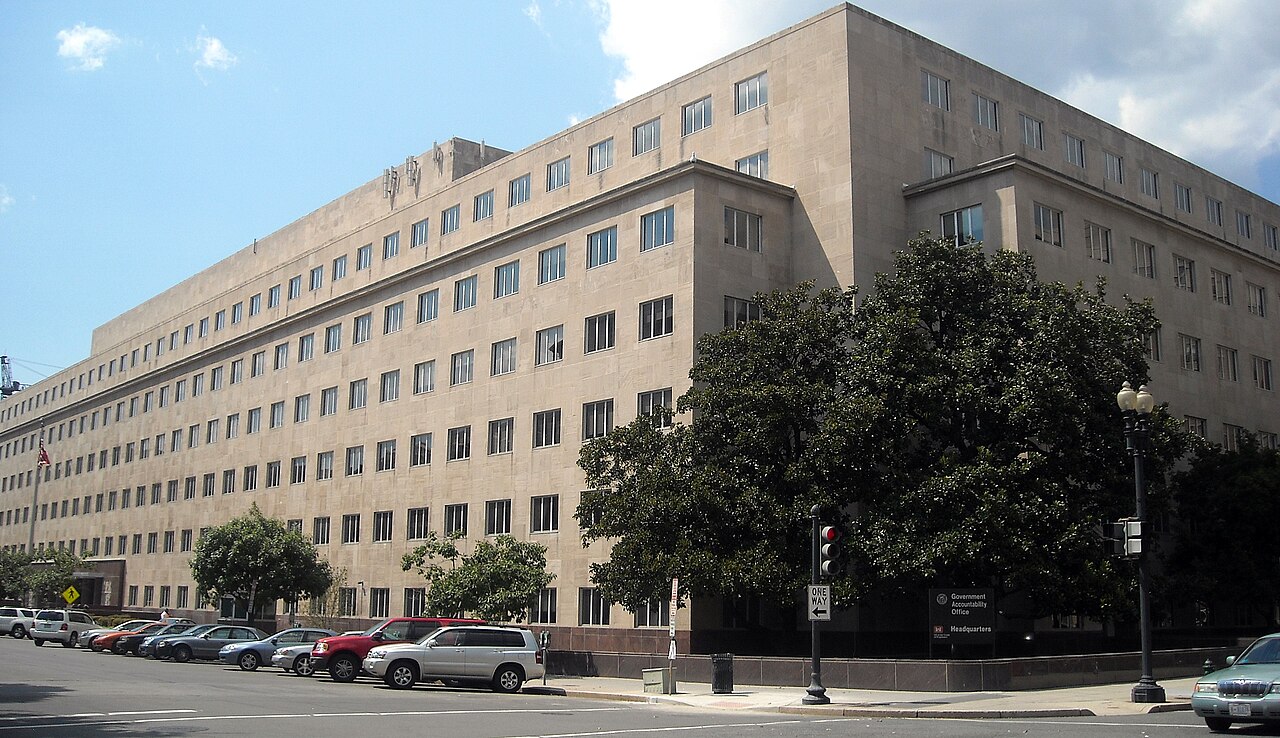
Featured image: The U.S. Government Accountability Office headquarters at 441 G Street NW, Washington, D.C. Photo by APK via Wikimedia Commons, licensed under CC BY-SA 3.0.
