
A quiet end-of-summer week at the Securities and Exchange Commission closed with anything but quiet substance. On August 31, the Commission signed a formal information-sharing pact with the Food and Drug Administration — an agreement with direct consequences for how life-sciences companies handle disclosure. It capped a month in which the agency charged 38 entities over allegedly fabricated adviser filings, brought fraud charges tied to the $1.9 billion collapse of subprime auto lender Tricolor, and advanced new rulemaking. Below, The Investigative Journal reviews the filings and enforcement records that matter most heading into September, with direct links to the underlying documents on SEC EDGAR and SEC.gov.
SEC and FDA Sign Market-Integrity MOU — a New Lens on Biotech Disclosure
The SEC and FDA announced on August 31 that they have entered into a Memorandum of Understanding establishing a framework for cooperation between the two agencies, including information-sharing protocols covering matters relevant to both regulators’ missions. The agreement runs for three years and may be extended by mutual written consent, according to the SEC’s release.
“FDA-related disclosures by public companies have a significant impact on our markets,” SEC Chairman Paul S. Atkins said in the announcement, adding that the FDA is “a valuable partner” in administering and enforcing disclosure requirements under the federal securities laws. Acting FDA Commissioner Kyle Diamantras said streamlined information-sharing “helps protect both the patients who rely on FDA-regulated products and the public trust that drives healthcare innovation.”
The practical significance is hard to overstate for drug and device issuers. Clinical-trial results, approval timelines, and complete response letters are among the most market-moving disclosures in the biotech sector, and the records suggest the agencies now intend to compare notes systematically. Companies whose public statements about FDA interactions diverge from what the FDA itself knows may find that gap easier for SEC enforcement staff to detect.
Corporate Disclosure Watch: SEC Says 38 “Advisers” Faked Their Way Into the Commission’s Own Filing System
On August 27, the SEC charged 38 entities, alleging they made material misrepresentations in Forms ADV filed with the Commission between 2025 and 2026 to pass themselves off as legitimate advisory firms. According to the complaints, filed in the U.S. District Court for the District of Colorado, several defendants connected to the Commission’s filing system from IP addresses tracked to foreign jurisdictions, listed Colorado business addresses where they had no presence, and claimed audits by accounting firms that appear in no federal or state registry.
“When we find bad actors using fraudulent SEC filings to feign legitimacy with retail investors, we will act decisively to disrupt these operations,” said Laura D’Allaird, chief of the Enforcement Division’s Cyber and Emerging Technologies Unit. The complaints allege violations of Sections 204(a) and 207 of the Investment Advisers Act; the SEC seeks injunctions and civil penalties, and the release notes the assistance of the FBI’s Operation Level Up, an initiative aimed at cryptocurrency investment fraud. The Commission says it has removed the 38 entities’ exempt-reporting-adviser filings from its website, and its investor-education office has issued an alert on ERA filing scams.
These are allegations in pending civil actions, not findings. But the case matters beyond its defendants: it is a documented instance of the SEC’s own public database being used as a prop for apparent fraud — a reminder that a filing’s presence on EDGAR or IARD is not a government endorsement.
SEC Enforcement: Former Tricolor Executives Charged Over $1.9 Billion ABS Collapse
The SEC charged Daniel Chu, Jerome Kollar, and Ameryn Seibold — the former CEO, CFO, and senior director of finance of Texas-based Tricolor Holdings, LLC — over an alleged multi-year scheme to double-pledge hundreds of millions of dollars of subprime auto loans across multiple asset-backed securities offerings and lenders. The complaint, filed in the Southern District of New York, alleges Tricolor raised more than $1.9 billion through ABS offerings while representing that collateral loans were free of other liens, and that loan metrics were manipulated to make defaulted loans appear current. More than $945 million in principal remained outstanding at the time of Tricolor’s September 2025 bankruptcy, according to the complaint.
“We allege that these defendants defrauded investors based on bogus collateral and violated the integrity of our private credit markets,” said Enforcement Director David Woodcock. The SEC seeks disgorgement, penalties, and officer-and-director bars against Chu and Kollar; the release notes a parallel criminal case announced by the U.S. Attorney’s Office for the Southern District of New York in December 2025. All charges are allegations pending adjudication. For accountability journalists, the filing is a roadmap to a larger question: how underwriters and rating processes failed to detect collateral pledged twice.
8-K Watch: Live Ventures Reports Dismissal From SEC Enforcement Action; CEO Settles for $175,000
Las Vegas-based Live Ventures Incorporated (Nasdaq: LIVE) disclosed in an 8-K filed August 27 that the U.S. District Court for the District of Nevada granted an order dismissing all claims against the company in the SEC’s long-running enforcement action, SEC v. Live Ventures Incorporated, et al. (Case No. 2:21-cv-01433). As part of the overall resolution, CEO Jon Isaac agreed to a consent judgment that includes a $175,000 civil penalty. The filing states that Mr. Isaac admits no wrongdoing and denies the SEC’s allegations; further detail appears in the Commission’s Litigation Release No. 26613.
The disclosure closes a case that dates to 2021. Consent judgments without admissions are a standard resolution mechanism, and the records show only what the court entered — a dismissal as to the company and a negotiated penalty as to its chief executive. The company’s own press release, filed as Exhibit 99.1 to the 8-K, frames the outcome; readers can weigh that framing against the litigation release.
Proxy Season Preview: Medtronic’s DEF 14A Sets October 15 Annual Meeting
Medical-device maker Medtronic plc filed its definitive proxy statement ahead of an annual shareholder meeting set for Thursday, October 15, 2026. The filing includes the customary non-binding say-on-pay advisory vote on named-executive-officer compensation, which the board recommends approving, and discloses that the board held five regular and two special meetings in fiscal 2026. Chairman and CEO Geoff Martha is the board’s only non-independent director, per the filing, and chairs its Growth and Operations Committees.
Proxy statements remain the single best public window into executive pay, board attendance, and shareholder-proposal fights, and early filers like Medtronic set the tone for the fall meeting season. TIJ will track how large-cap say-on-pay votes fare this cycle.
13-F Corner: Berkshire’s Second-Quarter Report Shows a Turn Back to Buying
Institutional holdings reports filed August 14 for the quarter ended June 30 continue to reverberate. Berkshire Hathaway’s Form 13F-HR — the second filed with Greg Abel as CEO — showed the conglomerate turning net buyer of equities, with CNBC reporting roughly $17 billion added to its Alphabet stake, lifting that position to about 106 million shares and making Alphabet Berkshire’s third-largest holding behind Apple and American Express. Independent trackers estimate the reported equity portfolio at roughly $299 billion, with trims in Bank of America, DaVita, Kroger, Ally Financial, and Capital One.
As always, 13-F data shows positions as of quarter-end only, excludes shorts and most non-U.S. holdings, and arrives 45 days stale — useful for direction, not for timing.
Foreign Private Issuer File: Webull’s 6-K and Its Candid Risk Language
Webull Corporation, the St. Petersburg, Florida-based online brokerage, furnished a Form 6-K covering its results for the quarter ended June 30, 2026. Beyond the earnings exhibits, the filing’s forward-looking-statements section is notable for its specificity: it cites the risk of “further actions taken by various government bodies in the United States that have made the Company the subject of inquiries and investigations relating to concerns about our connections to China,” alongside reliance on payment for order flow, exposure to prediction-market and crypto regulation, and a share-repurchase program of up to $100 million. Risk-factor language is drafted by counsel to be protective, but filings indicate where a company itself sees exposure — and Webull’s list is unusually direct.
Rulemaking Note: EU Debt Obligations Proposed for Rule 3a12-8 List
On August 28, the Commission proposed amendments to Exchange Act Rule 3a12-8 that would add debt obligations of the European Union itself — not merely those of member states already listed — to the roster of “exempted securities” for futures trading purposes, placing EU debt futures under exclusive CFTC jurisdiction. Chairman Atkins called the proposal “harmonization in practice.” The proposing release is open for comment for 60 days after Federal Register publication.
What Warrants a Deeper Look
Three threads from this digest merit sustained TIJ attention. First, the fake-adviser sweep: the SEC’s complaints describe 38 entities with near-identical ownership data and fabricated auditors, several traced to overseas IP addresses — but the filings do not identify who ultimately ran them. Establishing common control, and whether the same network filed under other names that remain live on regulatory databases, is an open investigative question. Second, the Tricolor complaint’s account of double-pledged collateral raises unanswered questions about the diligence performed by the underwriters and warehouse lenders on $1.9 billion in offerings — parties the complaint describes as deceived, whose own processes nonetheless deserve scrutiny. Third, the SEC-FDA MOU arrives one month after the Commission stood up a Financial Reporting and Accounting Unit in the Enforcement Division; together, the records suggest a rebuilt disclosure-enforcement apparatus aimed squarely at the life-sciences and accounting-fraud space. Issuers with pending FDA matters should expect their disclosure files to be read by two agencies at once.
Methodology and right of reply: This digest is drawn entirely from public records — SEC EDGAR filings, SEC press releases, and litigation releases linked above, supplemented by cited press reporting on 13-F data. Allegations in SEC complaints are just that — allegations — until adjudicated. TIJ did not seek pre-publication comment for this records-based digest; any company or individual named may submit a response to The Investigative Journal, and we will publish substantive replies. Corrections: editor@tij.news.
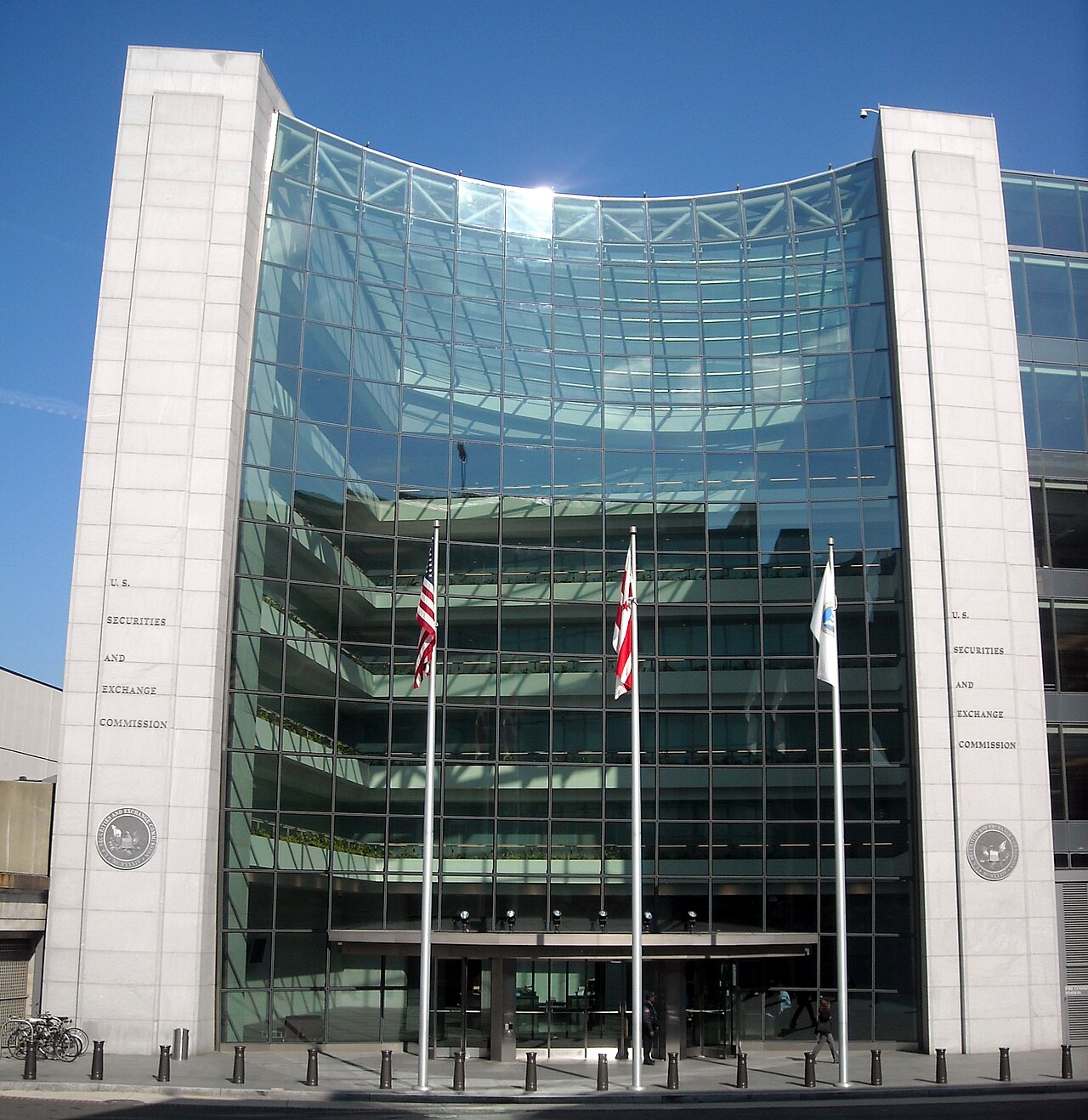
Photo: SEC headquarters, 100 F Street NE, Washington, D.C. Credit: AgnosticPreachersKid via Wikimedia Commons, CC BY-SA 3.0.
