

The Investigative Journal’s Morning Wire is a daily digest of overnight developments across government, the courts, and international affairs. All items below are drawn from public records, official statements, and wire reporting; links point to primary or original sources.
WASHINGTON, Sept. 3 — The White House closed out Wednesday touting what it calls the largest oil agreement in history, a deal it says hands U.S. interests majority control of more than 65 billion barrels of Venezuelan reserves. Overnight developments also include a landmark antitrust ruling sparing Google a breakup, a fresh judicial block on the administration’s birthright citizenship order, and continuing U.S. strikes on Revolutionary Guard targets in Iran. Here is what moved while you slept.
Government
White House announces “biggest oil deal in world history” with Venezuelan operator
In a release published late Wednesday evening, the White House announced that the United States has secured “majority control of more than 65 billion barrels of proven oil reserves in Venezuela,” through an agreement with a private operator the administration describes as a “new private Venezuelan oil champion.” According to the release, the deal was signed by Secretary of State Marco Rubio and Secretary of War Pete Hegseth and gives the U.S. government “powerful governance rights, economic ownership, and guaranteed low-cost off-take.” An accompanying fact sheet released Aug. 31 frames the agreement as part of a three-phase plan for Venezuela of stabilization, reconstruction, and democratic transition.
Independent reporting fills in the structure. According to CNBC, Venezuelan interim authorities granted North American Blue Energy Partners (NABEP) 100-year concessions covering 17 oil fields; trade publication World Oil reports the fields hold roughly 65 billion barrels of proven reserves, many previously operated by Chinese and Russian firms. Reuters reporting carried by Investing.com indicates Venezuela’s assembly has backed the arrangement. The White House says the deal was struck with a private company rather than the interim government, and that “at-cost oil” should begin flowing to market by the end of the year.
Not all reaction has been unqualified. U.S. officials defending the agreement acknowledged questions about its long-term structure, according to the Washington Times, and Reuters-cited industry advisers have asked whether rival producers can compete on equal terms against an operator backed by a U.S. government stake and guaranteed purchasing rights. Those questions will follow the deal as implementation details emerge.
Stopgap funding measure clears Congress ahead of Sept. 30 deadline
The threat of an Oct. 1 government shutdown has receded. The House on Tuesday passed a continuing resolution extending current funding levels through Dec. 11 by a vote of 370-48, sending the measure to the president’s desk, according to Government Executive. The Senate had approved the stopgap earlier this summer on a 90-6 vote, per The Hill, and House Appropriations Chairman Hal Rogers’ office confirmed the extension has now cleared both chambers.
Separately, the White House announced Wednesday that H.R. 6500 had been signed into law; the brief statement did not elaborate on the bill’s contents. With a full-year appropriations package still unfinished — none of the 12 annual spending bills has been enacted — the practical effect of the stopgap is to move the funding cliff past the November midterms and into mid-December, where a lame-duck Congress will take it up.
G20 innovation ministerial ends with consensus statement
The White House also announced Wednesday that the G20 Innovation Ministerial concluded with a consensus statement — a modest but notable diplomatic outcome given how frequently G20 ministerials in recent cycles have ended without agreed language. The administration did not immediately release the statement’s full text.
Courts
Judge spares Google an ad-tech breakup, orders conduct changes
U.S. District Judge Leonie Brinkema of the Eastern District of Virginia ruled Wednesday that Google will not be forced to divest its advertising technology business, rejecting the Justice Department’s bid to make the company sell its AdX exchange, according to CNBC. The decision comes despite Brinkema’s earlier finding that Google unlawfully monopolized ad-tech markets. Per Courthouse News, the judge instead ordered behavioral remedies — changes to how Google runs the business — reasoning during the remedies phase that a divestiture could harm small publishers and invite years of appeals.
The mechanics matter for what comes next: AdExchanger reports the parties have 30 days to file a jointly proposed final judgment, and the memorandum opinion remains under seal for 14 days. Industry group CCIA, which counts Google as a member, welcomed the ruling. The Justice Department had not announced whether it will appeal as of publication; the case remains pending until a final judgment is entered.
Federal judge blocks administration’s latest birthright citizenship order
U.S. District Judge Deborah Boardman on Wednesday blocked the president’s August executive order limiting birthright citizenship, writing in a 35-page ruling that the order “is almost certainly unconstitutional,” according to CNN. NBC News reports the decision is the latest in a line of rulings against successive versions of the policy, which seeks to narrow which children born on U.S. soil receive citizenship.
The ruling is a preliminary block, not a final merits decision, and the administration is expected to appeal, as it has in prior rounds of this litigation. The dispute — which turns on the Fourteenth Amendment’s citizenship clause — remains a strong candidate for eventual Supreme Court review.
Justice Department charges 11 in alleged marriage-fraud operation
The Justice Department has charged 11 people in connection with an alleged multimillion-dollar marriage fraud scheme, according to The Hill. Filings indicate the operation allegedly arranged sham marriages to secure immigration benefits. The charges are allegations; all defendants are presumed innocent unless and until convicted, and the case is pending.
International
U.S. strikes on IRGC targets continue as Iran claims retaliation
U.S. Central Command said its forces completed strikes on Islamic Revolutionary Guard Corps targets inside Iran, hitting air defense sites, radar, maritime assets, mine-laying capabilities, and communications sites. The command said the strikes respond to attempted IRGC attacks on commercial shipping in the Strait of Hormuz and on American service members. CNN reports Iran retaliated with claimed strikes on U.S. assets in Bahrain, Jordan, Kuwait, and Iraq — claims of American casualties that U.S. officials denied. The Critical Threats Project tracks the exchange as part of a widening Hormuz crisis now in its ninth day of strikes.
Two threads deserve caution. First, Iranian state media outlets have claimed a U.S. strike hit a wedding party and killed civilians; CENTCOM denies the report, and the claim remains unverified by independent observers, per the roundup in Just Security. Second, the campaign has expanded to Iranian government tankers: The War Zone reports two Iranian tankers were struck under what officials describe as a policy of responding in kind to Iranian attacks on commercial shipping. Energy markets and Gulf shipping insurers will be watching today’s developments closely.
Russia hits Kyiv and Odesa; new power outages reported
Russian drone attacks on Kyiv on Wednesday injured nine people, including two doctors, and damaged five residential buildings, a kindergarten, and a university building across three districts, according to Ukrinform. Overnight, a missile and drone barrage on Odesa damaged a 24-story apartment block and injured eight people, including a child, per Meduza.
The strikes are part of a sustained wave: reporting indicates attacks on the capital have now continued for roughly a week, and strikes on energy infrastructure in the Odesa region left large numbers of consumers without power, according to Asharq Al-Awsat’s English service, citing grid operator Ukrenergo. With autumn approaching, the targeting of Ukraine’s grid ahead of heating season is a pattern familiar from prior years of the war.
Nepal seeks climate compensation from U.S., China, and India after deadly floods
Nepal has launched a diplomatic campaign seeking compensation from the United States, China, and India — the world’s largest greenhouse gas emitters — for catastrophic flash flooding that reports indicate has killed more than 1,000 people across three districts, according to Bloomberg. Nepal’s foreign minister has framed the request as “not charity but moral liability,” per ThePrint, arguing major emitters bear responsibility for climate-linked disasters in vulnerable states.
Reconstruction needs are estimated at $4-5 billion — nearly a tenth of Nepal’s economy, according to reporting from The Business Standard. The demand tests an unsettled question in international climate diplomacy: whether “loss and damage” claims can be pressed bilaterally against specific emitters rather than through multilateral funds. Washington has not publicly responded to the compensation request as of this writing.
Worth Watching
Economic data this morning. A heavy calendar: the ADP private employment report lands at 8:15 a.m. ET, followed at 8:30 by weekly initial jobless claims (forecast near 205,000), July trade data, and August personal income and spending, per the September economic calendar. The main event remains Friday’s August jobs report from the Bureau of Labor Statistics — the last before the Fed’s mid-September meeting.
Google remedies fallout. Watch for the Justice Department’s signal on appeal, and mark two dates from Wednesday’s ruling: the sealed memorandum opinion becomes public in roughly two weeks, and the parties’ jointly proposed final judgment is due within 30 days.
Venezuela deal scrutiny. Expect congressional reaction to the NABEP agreement’s structure — the 100-year concessions and U.S. government stake in particular — and watch for filings or disclosures identifying the company’s ownership. The White House says at-cost oil begins flowing by year-end; that timeline is now on the record and checkable.
Strait of Hormuz. CENTCOM’s tempo of announced strikes has been near-daily; today’s question is whether Iranian retaliation expands beyond claimed strikes on U.S. regional assets, and how tanker traffic and insurance rates respond.
The funding runway. With the stopgap done, appropriators return to the 12 unfinished full-year bills against a Dec. 11 deadline — and a midterm campaign season in between.
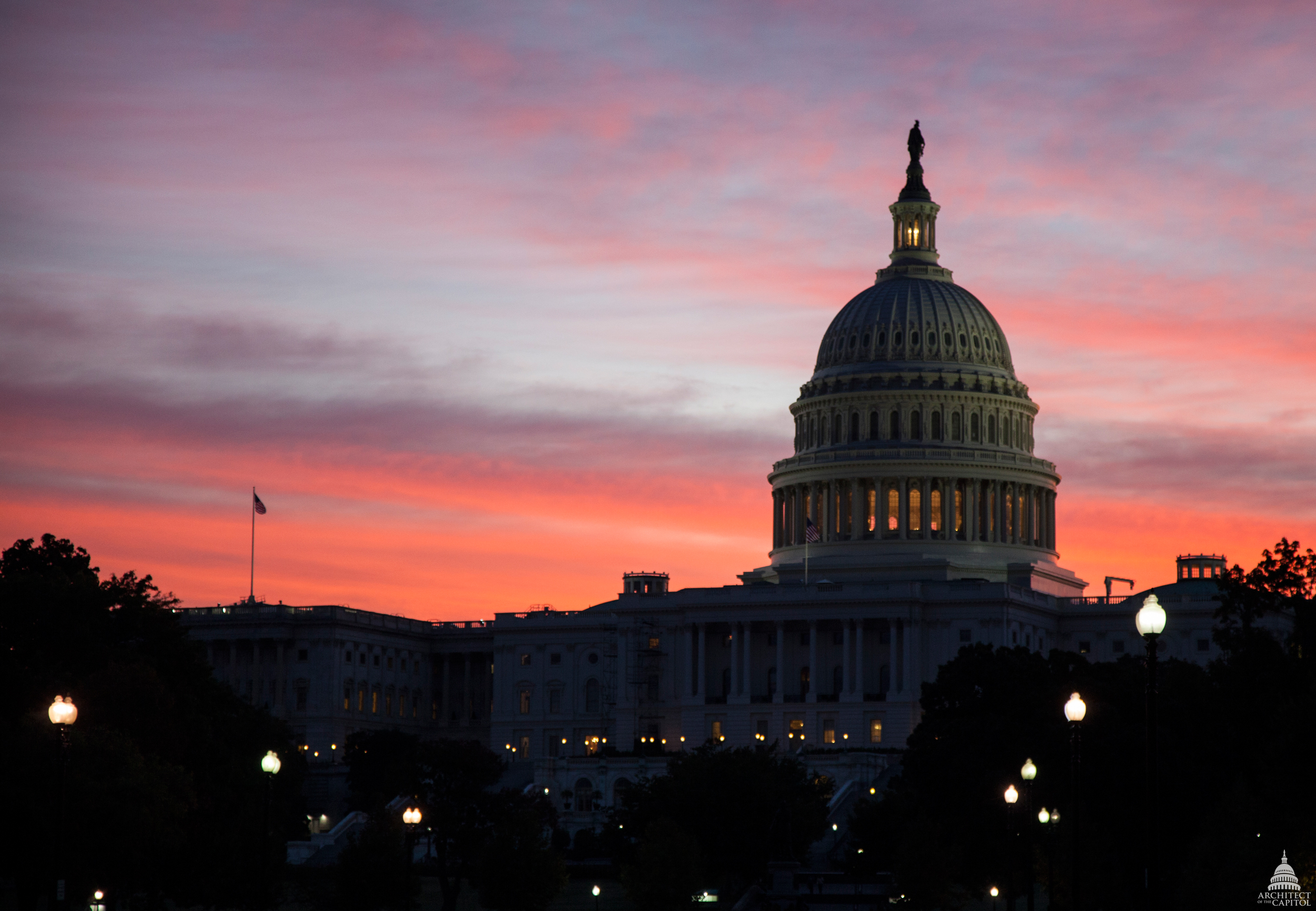
Featured image: “The Capitol at Dawn,” Architect of the Capitol via Wikimedia Commons (public domain). The Investigative Journal compiled this briefing from official statements, court records, and wire reporting; all claims are attributed to linked sources. Entities named in pending cases are presumed innocent unless proven otherwise, and are invited to respond via our contact page.