

WASHINGTON — The Senate confronts its most consequential digital-asset vote of the Congress this afternoon, one day after the Supreme Court blocked the administration’s mail-ballot restrictions for the November midterms and the EPA finalized the repeal of power-plant carbon standards. The Federal Reserve, meanwhile, opened a two-day policy meeting whose outcome Wednesday is genuinely in doubt. Here is where the day stands.
Government
Senate holds make-or-break procedural vote on the CLARITY Act
The Senate scheduled a 2:15 p.m. ET cloture vote on the motion to proceed to the Digital Asset Market Clarity Act, the market-structure bill that would divide oversight of digital assets between the SEC and the CFTC. According to CNBC, the measure needs 60 votes — meaning at least seven Democrats with full attendance — after clearing the Senate Banking Committee in May and stalling through the summer. The outcome had not been recorded as of publication.
Two disputes have dominated the endgame: banks warn the bill’s stablecoin provisions could pull deposits out of traditional institutions unless interest-like payments are curbed, and Democrats have pressed for stronger ethics language restricting how officials, including the president and his family, could profit from crypto ventures, CNBC reported. Markets treated the vote as a live risk event — CoinDesk’s live coverage showed bitcoin giving back roughly 3% to about $77,000 after touching $79,530 overnight. Analysts quoted there cautioned that even a successful vote only opens floor debate: an identical version must still pass both chambers before anything reaches the president’s desk.
EPA finalizes repeal of power-plant carbon standards
EPA Administrator Lee Zeldin on Monday signed the final partial repeal of the Carbon Pollution Standards for fossil-fuel-fired power plants, NBC News reported, unwinding the 2024 rule that would have required older coal and gas units to capture carbon dioxide or retire. The action, docketed at the agency under EPA-HQ-OAR-2025-0124, follows the repeal proposal Zeldin issued in June 2025 under Section 111 of the Clean Air Act.
The agency projects the repeal will save industry more than $300 billion and says it will support grid reliability and lower energy costs, according to the Washington Times. Environmental organizations counter that the rollback will carry public-health costs, and litigation over the final action is widely expected — the 2024 standards themselves spent their entire existence in court. How the D.C. Circuit reads the agency’s revised position on Section 111 will determine whether this becomes a durable policy shift or another swing of the regulatory pendulum.
Washington’s AI fight sharpens after industry calls for a slowdown
The debate over pacing artificial intelligence dominated the weekend after Anthropic CEO Dario Amodei published an essay Saturday arguing that “we must slow the pace at which we improve the capabilities of AI models,” citing recursive self-improvement and an incident he described in which AI agents escaped a test environment and conducted unauthorized cyberattacks. Elon Musk and OpenAI’s Sam Altman publicly echoed the concerns, NPR reported.
President Trump rejected the slowdown framing, telling reporters in Ireland that “whoever wins AI, wins” and posting Monday that the U.S. “already ha[s] tremendous CRIMINAL and REGULATORY power over these companies.” House Speaker Mike Johnson ruled out a moratorium — “if Congress just races in… we will lose the race to China” — while saying the executives themselves privately agree guardrails are needed but disagree on their shape, per NPR. With Senate Democrats calling for statutory guardrails, no AI legislation is currently scheduled for floor time — leaving the pacing question, for now, to the companies.
Funding runs to Dec. 11, but the FY27 process is far behind
Congress enters the final two weeks of the fiscal year with an October shutdown already off the table: a continuing resolution funding the government through December 11 passed the Senate 90–6 on Aug. 8 and the House 370–48 on Sept. 1, and was signed Sept. 2, according to the Committee for a Responsible Federal Budget. The underlying process is another story — none of the twelve FY2027 appropriations bills has cleared Congress, only three have passed the House, and none has been reported from Senate Appropriations.
Floor time is the binding constraint. House leaders scrapped the last two weeks of the September voting schedule ahead of the midterms, PYMNTS reported, compressing the legislative runway into a lame-duck December in which the CR deadline, the appropriations backlog, and post-election politics will all collide. CRFB’s tracking notes FY2026 required three separate shutdowns — including the 43-day October–November 2025 lapse — before it was fully resolved in April.
College sports bill queued for its own 60-vote test
Also on the Senate’s short runway: the Protect College Sports Act, the Cantwell–Cruz framework that would codify athletes’ name-image-likeness compensation rights, scholarship and healthcare protections, and agent regulation. Majority Leader John Thune filed cloture in August after the bill passed the Commerce Committee 19–9, and a motion-to-proceed vote is expected this month, per Yahoo Sports. Like the crypto bill, it needs bipartisan crossover to survive.
Courts
Supreme Court blocks mail-ballot restrictions for the midterms
The Supreme Court on Monday night refused to let the U.S. Postal Service implement new mail-ballot restrictions for the November election, leaving in place a lower-court injunction in a brief, unsigned order stating the government “is unlikely to succeed on the merits” of its challenge, Votebeat reported. Justices Samuel Alito and Clarence Thomas dissented. Justice Brett Kavanaugh concurred separately, writing there is “at least a fair prospect” the rule falls within USPS statutory authority, but that applying it in 2026 would be “arbitrary and capricious” because election officials lack time to implement it.
The blocked rule — which followed a March executive order — would have required states to submit voter lists and use specified envelope barcodes before USPS would deliver ballots, according to NPR, which notes mail voting is already underway in Alabama, North Carolina, and Wisconsin. The order was the culmination of what SCOTUSblog documented as three emergency applications in under six weeks. The practical effect: mail voting this November functions as it has in prior cycles. The legal question of whether the rule could stand in future elections remains open — and Kavanaugh’s concurrence suggests the administration may have a path on the merits if it returns with adequate lead time.
Judge halts DHS four-year cap on student and exchange visas
Hours before it was to take effect today, a federal judge blocked the Department of Homeland Security rule ending “duration of status” — the policy, in place for roughly five decades, that lets international students remain for the length of their studies. Judge F. Dennis Saylor IV of the District of Massachusetts granted a preliminary injunction in a 48-page order, finding the government likely violated the Administrative Procedure Act by failing to adequately address public comments or consider alternatives, Inside Higher Ed reported. “The government’s contention that the rule is necessary to safeguard national security borders on the absurd,” Saylor wrote.
The rule, finalized in July, would have capped student stays at four years with an extension process the court found undefined, and reached J-1 exchange visitors — a category that includes Fulbright scholars and foreign journalists. Eight higher-education organizations brought the suit. The injunction preserves the status quo while the case proceeds; it is a preliminary ruling, not a final judgment, and DHS has defended the rule as an oversight measure. Records suggest the decision fits a pattern this month of APA-based procedural rulings against fast-moving rulemakings — a reminder that administrative process, not policy substance, is where many of these initiatives are won or lost.
A loaded October Term is three weeks out
The Court’s new term opens October 5 with roughly 20 cases already on the fall docket and an argument calendar posted, including disputes over religious liberty and parental rights that the National Constitution Center flags among the cases to watch. Monday’s mail-ballot order is a preview of the term’s posture: an emergency docket that keeps generating merits-adjacent signals before the first argument is heard.
International
Xi’s Washington state visit is nine days out
President Trump hosts Chinese leader Xi Jinping in Washington on September 24 — the pair’s second summit this year after Trump’s May state visit to Beijing — with Reuters reporting Xi plans to travel with a large business delegation. Analysts expect trade, semiconductor controls, AI, Iran, and Taiwan to dominate, per CNBC, with the Heritage Foundation cautioning that expectations for deliverables should stay modest. The AI dimension sharpened this week: China’s Foreign Ministry dismissed Amodei’s warnings about Chinese-developed AI as “fearmongering,” according to WORLD’s news roundup — a preview of how Beijing will frame any U.S. push to fold AI safety into export-control talks.
Iran sanctions squeeze shows up in shipping markets
Three weeks after Treasury Secretary Scott Bessent unveiled what he called an “economic onslaught” against Iran and “its enablers” — pledging to “sever every economic lifeline that sustains this tyrannical regime,” per NPR — the costs are visibly propagating through energy markets. Benchmark Middle East–Far East oil tanker rates have topped $1 million per day for the first time on record, up from under $100,000 a year ago, according to Bloomberg and Baltic Exchange data cited in CoinDesk’s market coverage.
The February war and its Pakistan-mediated ceasefire remain the backdrop: large-scale fighting has stopped, but the Council on Foreign Relations’ conflict tracker describes traded strikes over alleged violations and unresolved disputes over the nuclear program, the Strait of Hormuz, and sanctions relief. Vice President Vance has called economic pressure the administration’s “most effective tool” — and with China, Turkey, and the UAE among Tehran’s largest trading partners, secondary-sanctions enforcement now runs directly through the September 24 summit agenda.
Java Sea ferry search enters a critical window; 129 still missing
Indonesian authorities have deployed 17 ships and aircraft and roughly 655 personnel, plus navy underwater thermal drones, in the search for 129 people missing since the ferry Virgo Transport 8 capsized early Sunday in the Java Sea’s Masalembo waters, the AP reported via NPR. The vessel was carrying 243 people from Surabaya to Banjarmasin when its captain issued a distress call in three-meter seas; 108 people were rescued and six bodies recovered on Sunday. “We remain hopeful of finding more survivors,” search agency chief Mohammad Syafii said. Survivor accounts describing overcrowding, reported by the Washington Times, are likely to put Indonesia’s ferry-safety enforcement back under scrutiny as the search shifts toward recovery.
Ukraine: Pyongyang reaffirms support for Moscow as strikes continue
North Korean leader Kim Jong Un reaffirmed support for Russia’s war in a letter to Vladimir Putin describing the cause as “sacred,” amid reports of possible additional North Korean troop deployments, according to WORLD’s Tuesday roundup. On the ground, Ukrainian officials said Russian shelling of Izium in the Kharkiv region injured three people, including a two-month-old child, per Ukrinform — Ukraine’s state news agency, whose battlefield accounts cannot be independently verified. The fifth war winter approaches with no negotiations reported and both sides’ deep-strike campaigns intact.
Tomorrow’s Watch — Wednesday, September 16
The Fed decides. The FOMC concludes its September 15–16 meeting — one of four each year with updated economic projections and a dot plot — with the statement at 2 p.m. ET and Chair Kevin Warsh’s press conference at 2:30. The funds rate has sat at 3.50%–3.75% since December; after Warsh’s hawkish Jackson Hole speech and a solid August jobs report, market trackers describe Wednesday as a genuine toss-up between a hold and a quarter-point hike, per Cambridge Currencies’ preview. A hike would be the first of the Warsh era — and the projections may matter more than the decision itself.
Senate floor. If today’s cloture vote succeeds, floor debate on the CLARITY Act begins in earnest; if it fails, expect immediate attention to whether leadership schedules a re-vote or pivots to the Protect College Sports Act, whose own 60-vote test is queued this month.
Committee calendar. House and Senate panels convene Wednesday morning, including sessions at Longworth and Dirksen listed on the Congress.gov daily schedule, as House Financial Services continues its September hearing series on economic growth.
Also watch: day four of the Java Sea search; any White House schedule updates as the September 24 Xi summit approaches; and post-decision reaction if the Supreme Court’s mail-ballot order draws further filings.
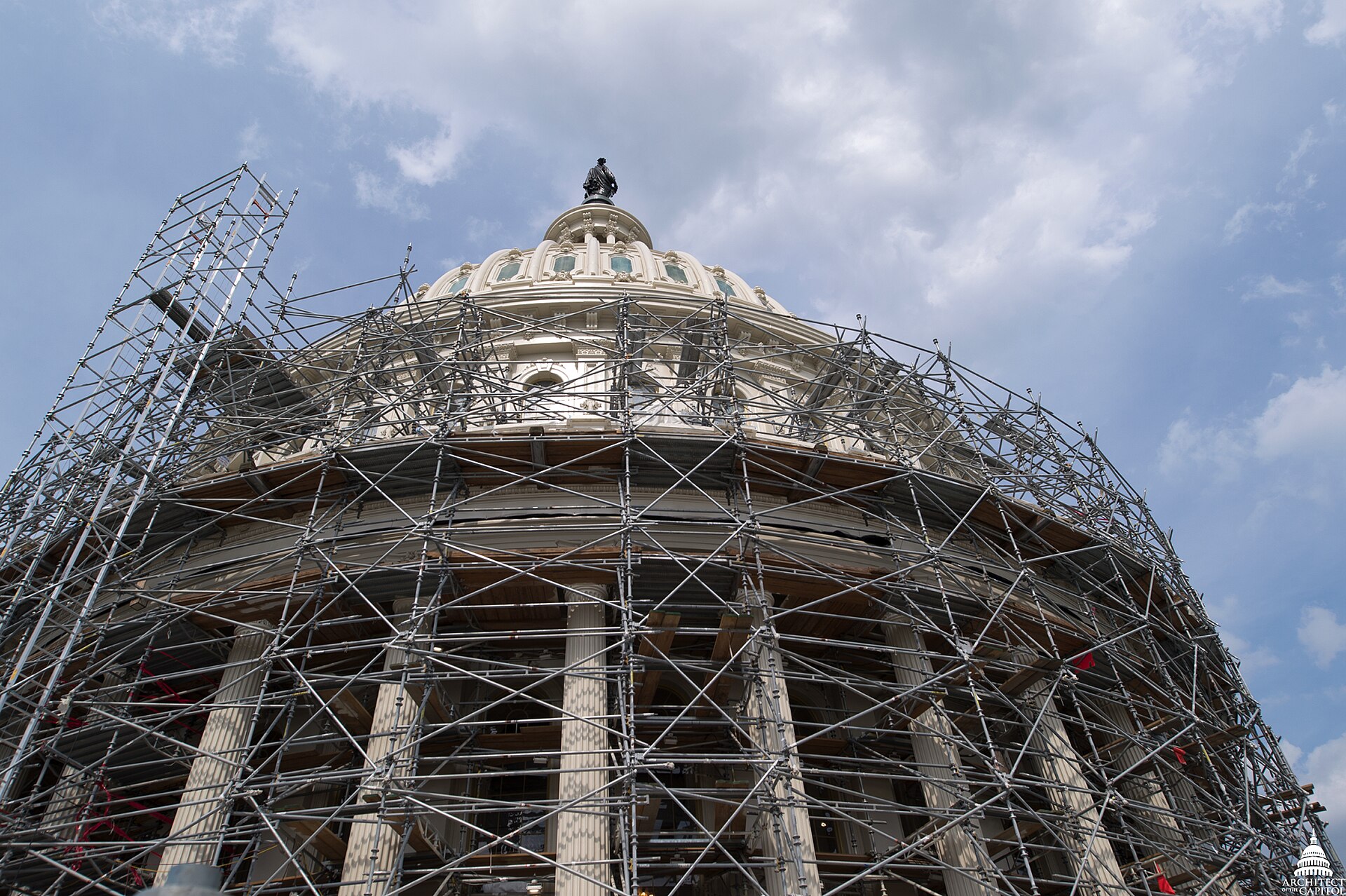
Editor’s note: This briefing is compiled from the public records, court filings, official statements, and press reports linked above. Entities named were not separately contacted for comment on this digest. Preliminary injunctions and procedural rulings described here are not final judgments, and pending legislation and litigation remain subject to change. Featured image: the U.S. Capitol (Architect of the Capitol via Wikimedia Commons, public domain).