

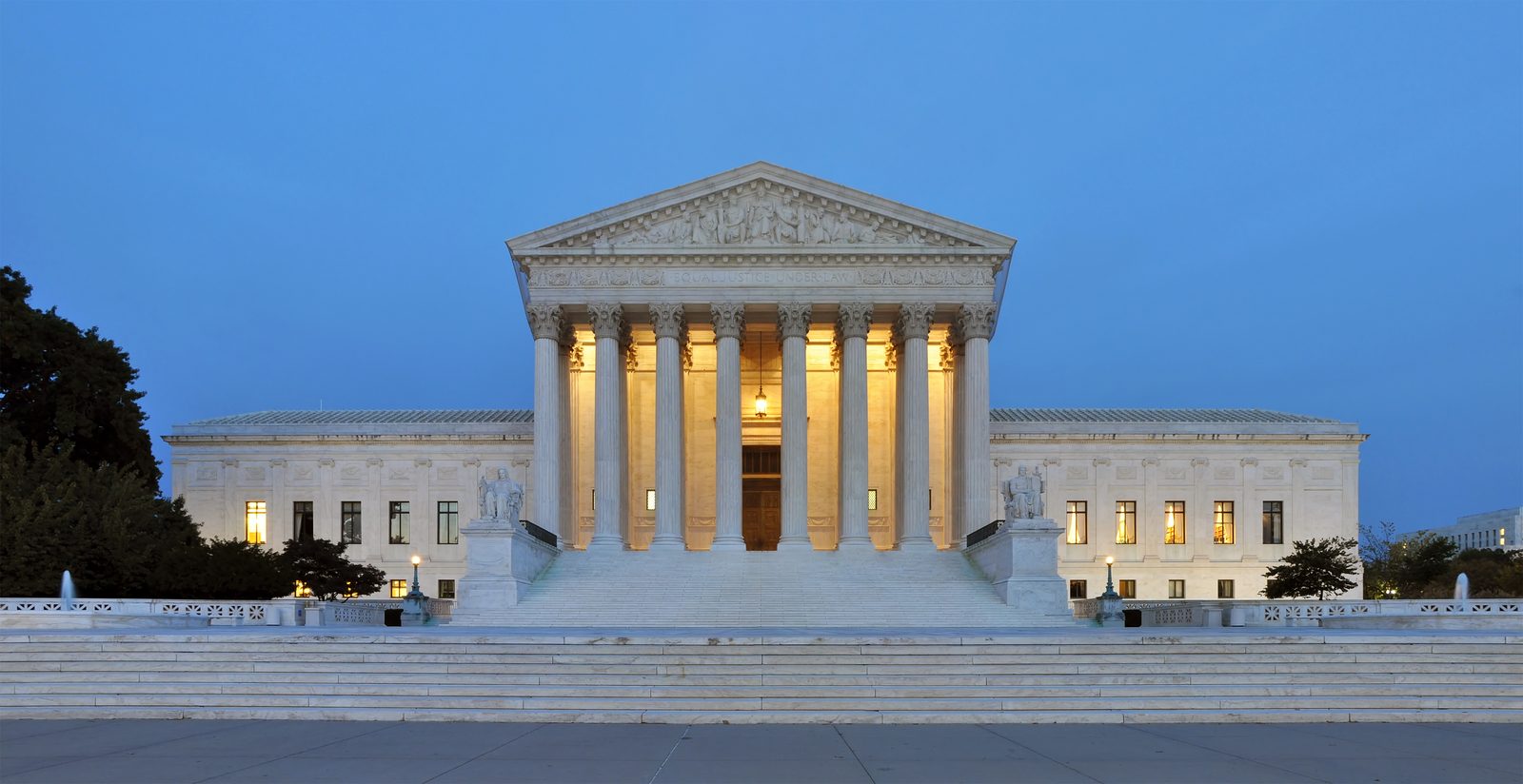
Court Watch is The Investigative Journal’s weekly digest of notable rulings, orders, and filings across the American judiciary. This installment covers the week of June 22–28, 2026, as the Supreme Court entered the final stretch of its term. The justices issued a cluster of consequential opinions — including a pair of immigration rulings that sharply curtailed judicial review, a Second Amendment decision striking a Hawaii carry restriction, and a preemption ruling shielding the maker of Roundup. Lower courts, meanwhile, acted on election administration and online-speech laws, and a major gig-economy settlement advanced. The Court’s next scheduled opinion day is Monday, June 29.
Supreme Court
Two immigration rulings narrow the courts’ role. On June 25, the Court handed the Trump administration two procedural victories in immigration cases, both decided 6-3 with opinions by Justice Samuel Alito. In Mullin v. Doe (No. 25-1083), the majority held that the statute governing Temporary Protected Status generally bars federal courts from reviewing the Homeland Security secretary’s determination to end a country’s designation. The decision paused lower-court orders out of Washington, D.C., and New York that had blocked the termination of TPS for Haiti and Syria. According to SCOTUSblog’s analysis, the ruling immediately affects roughly 350,000 Haitian and 6,000 Syrian beneficiaries, with potential repercussions for nationals of additional designated countries.
In the companion case, Mullin v. Al Otro Lado (No. 25-5), the Court held that noncitizens who present themselves at ports of entry on the Mexican side of the border have not “arrived in the United States” for purposes of the asylum statute, and therefore may be turned away. Writing for the majority, Alito reasoned that “an alien ‘arrives in the United States’ only when he crosses the border,” according to the opinion as reported by NPR. CNN Supreme Court analyst Steve Vladeck characterized the two decisions as wins secured “not by upholding the government’s substantive policies, but by dramatically limiting the ability of courts to review those policies,” per CNN’s coverage. The dissenting justices warned that the rulings leave affected migrants with little recourse; the majority countered that Congress assigned these determinations to the executive branch.
Hawaii’s ‘private property’ carry rule struck down. Also on June 25, in Wolford v. Lopez (No. 24-1046), the Court ruled 6-3 that Hawaii could not make it a crime to carry a firearm onto private property open to the public — such as a store or restaurant — absent the owner’s express consent. In his opinion for the Court, Alito wrote that the law “hobbles what the Second Amendment protects: the right of Americans to carry arms for self-defense as they go about their daily lives,” according to SCOTUSblog. Justice Ketanji Brown Jackson dissented, arguing the rule “fairly applies a first principle of property law — the right to exclude,” and Justice Elena Kagan filed a separate dissent invoking founding-era analogues.
The decision reaches beyond Hawaii. As CBS News reported, four other states — California, Maryland, New York, and New Jersey — maintain similar “default-no-carry” rules for private property open to the public, and those laws are now exposed to challenge. The Court’s opinion preserves the ability of individual property owners to bar firearms on their premises, including by posting signage; what it forecloses is a statewide presumption against carry that shifts the default the other way.
Roundup maker shielded on preemption grounds. In Monsanto Co. v. Durnell (No. 24-1068), the Court held 7-2 that the Federal Insecticide, Fungicide, and Rodenticide Act expressly preempts state-law failure-to-warn claims that would require pesticide labels to carry cancer warnings beyond what the EPA has approved. Justice Brett Kavanaugh wrote for the majority, and the ruling reversed a $1.25 million Missouri verdict, according to SCOTUSblog and NPR. Justice Jackson dissented, joined by Justice Neil Gorsuch.
The decision carries significant implications for the long-running glyphosate litigation, in which Bayer’s Monsanto unit has faced thousands of claims alleging that Roundup caused cancer. By holding that EPA-approved labeling preempts contrary state warning requirements, the ruling narrows a central theory plaintiffs have used to pursue damages. Legal observers cautioned that the holding is confined to failure-to-warn claims keyed to labeling and does not, on its face, resolve every category of claim in the broader docket.
The Alien Tort Statute door closes further. Two days earlier, on June 23, the Court decided Cisco Systems, Inc. v. Doe I (No. 24-856), holding 6-3 that the Alien Tort Statute does not authorize federal courts to recognize new causes of action and that neither the ATS nor the Torture Victim Protection Act imposes liability for aiding and abetting. Justice Amy Coney Barrett wrote for the majority. The plaintiffs, who identified as practitioners of a faith persecuted in China, had alleged that Cisco built surveillance technology enabling that persecution, according to SCOTUSblog’s case file.
Barrett wrote that the Court “decline[d] to distort the statutory text or the Constitution’s allocation of powers to enlist U.S. courts” in providing redress for atrocities abroad, while acknowledging such cases “frequently involve heinous and inhumane acts.” Justice Sonia Sotomayor, in dissent, wrote that the decision was “yet another notch in its belt, unabashedly remaking the law in its preferred image.” Analysts at Just Security described the ruling as effectively foreclosing human-rights suits under the centuries-old statute — a characterization the majority did not frame in those terms.
RLUIPA damages limited. Also on June 23, in Landor v. Louisiana Department of Corrections and Public Safety (No. 23-1197), the Court held that the Religious Land Use and Institutionalized Persons Act does not authorize money-damages claims against state officials sued in their individual capacities, absent their voluntary and knowing consent. The case arose from allegations that a Rastafarian inmate, Damon Landor, had his head forcibly shaved despite presenting documentation of his religious practice, according to SCOTUSblog. Justice Gorsuch wrote for the Court, reasoning that because RLUIPA’s prison provisions rest on Congress’s Spending Clause authority, additional sanctions require clear notice and consent; Justice Jackson dissented. The same five-opinion sitting also produced rulings in Exxon Mobil Corp. v. Corporación Cimex, Pung v. Isabella County, Michigan, and Blanche v. Lau, summarized in SCOTUSblog’s roundup.
Federal Appeals Courts
Federal Circuit lets the 10% global tariff stand — for now. On June 25, the U.S. Court of Appeals for the Federal Circuit declined to disturb President Trump’s across-the-board 10% import tariff while litigation continues, finding that the government “has made a sufficient showing that it is likely to succeed on the merits,” according to The Hill. The unsigned order allows the levy to remain in effect after the U.S. Court of International Trade had earlier found it unlawful as applied to the challengers.
The dispute is the second act in a closely watched separation-of-powers fight over trade authority. Earlier this year, on February 20, the Supreme Court ruled in Learning Resources, Inc. v. Trump that the International Emergency Economic Powers Act does not authorize the president to impose tariffs. The administration subsequently grounded the 10% duty in different statutory authority, prompting the renewed challenge from a coalition of states and small businesses. The Federal Circuit’s order is provisional; a merits decision is expected later in the litigation, and further Supreme Court review is possible.
District Courts
Permanent injunction against parts of the 2025 elections executive order. On June 24, U.S. District Judge Denise Casper in Boston entered a permanent injunction barring enforcement of several provisions of the administration’s 2025 executive order on election administration, converting a preliminary injunction she issued roughly a year earlier into a lasting one. According to Democracy Docket and PBS News, the order blocked a documentary proof-of-citizenship requirement on the federal voter-registration form, restrictions affecting military and overseas voters, and an effort to pressure states into rejecting ballots that are postmarked by Election Day but arrive afterward.
The ruling is one of several where district courts have continued to test the boundaries of executive authority following the Supreme Court’s 2025 decision curbing nationwide injunctions. Filings indicate the government is expected to appeal. As with all matters discussed here that remain in active litigation, the ruling reflects a trial court’s judgment that may be revisited on appeal.
Nebraska online age-verification law partially blocked. Separately, Senior U.S. District Judge John Gerrard partially enjoined a Nebraska statute requiring age verification for social-media access, finding that several components likely violate the First Amendment and barring them from taking effect in July, according to Nebraska Public Media. The decision adds to a growing body of conflicting lower-court rulings on state efforts to regulate minors’ access to online platforms — an issue many observers expect to reach the Supreme Court.
State Courts and State-Law Impact
State high courts produced no single decision this week on the scale of the federal slate, but several of the week’s federal rulings will reverberate through state law. Wolford v. Lopez directly destabilizes carry statutes in California, Maryland, New York, and New Jersey; the TPS and asylum rulings shift consequences onto states with large affected immigrant populations; and Monsanto v. Durnell forecloses a category of state tort recovery nationwide. Court Watch will track notable state supreme court opinions as they are posted to official reporters in the coming weeks.
Class Actions
Grubhub’s $24.75 million driver-classification settlement. In the gig-economy arena, Grubhub agreed to pay $24.75 million to resolve allegations that it misclassified California delivery workers as independent contractors rather than employees, according to Top Class Actions. Court records indicate the settlement covers drivers who completed at least one delivery in California between December 2014 and March 2026. The agreement is the latest data point in a years-long contest over worker classification on app-based platforms — a question that continues to generate litigation and legislation in parallel. The settlement resolves allegations without an admission of liability and remains subject to the ordinary process of court approval.
Cases to Watch in the Coming Week
With the term winding down and the next opinion day set for June 29, several blockbuster cases remain undecided. According to NPR and SCOTUSblog, the outstanding docket includes the administration’s bid to end birthright citizenship (Trump v. Barbara); a challenge to the president’s effort to remove Federal Reserve Governor Lisa Cook; two cases on state laws barring transgender athletes from girls’ and women’s sports (Little v. Hecox and West Virginia v. B.P.J.); a dispute over mail-in ballot deadlines; and a campaign-finance case on coordinated party expenditures. Any of these could land in the final sittings of June or early July, per U.S. News.
Looking past the recess, the Court has already begun stocking its 2026–27 docket. Among the grants, the justices agreed to hear a case on whether individuals may sue federal officials for constitutional violations absent a statute expressly authorizing such claims — a question with implications for accountability across the executive branch. Court Watch will return next Monday with the term’s closing decisions and the first full read on what the justices left for the fall.
Editor’s note: This digest summarizes public court records and reputable reporting. Matters described as pending have not reached final judgment; allegations in active cases are not findings of liability. Links point to primary opinions and docket materials where available. Corrections may be directed to the editor.