

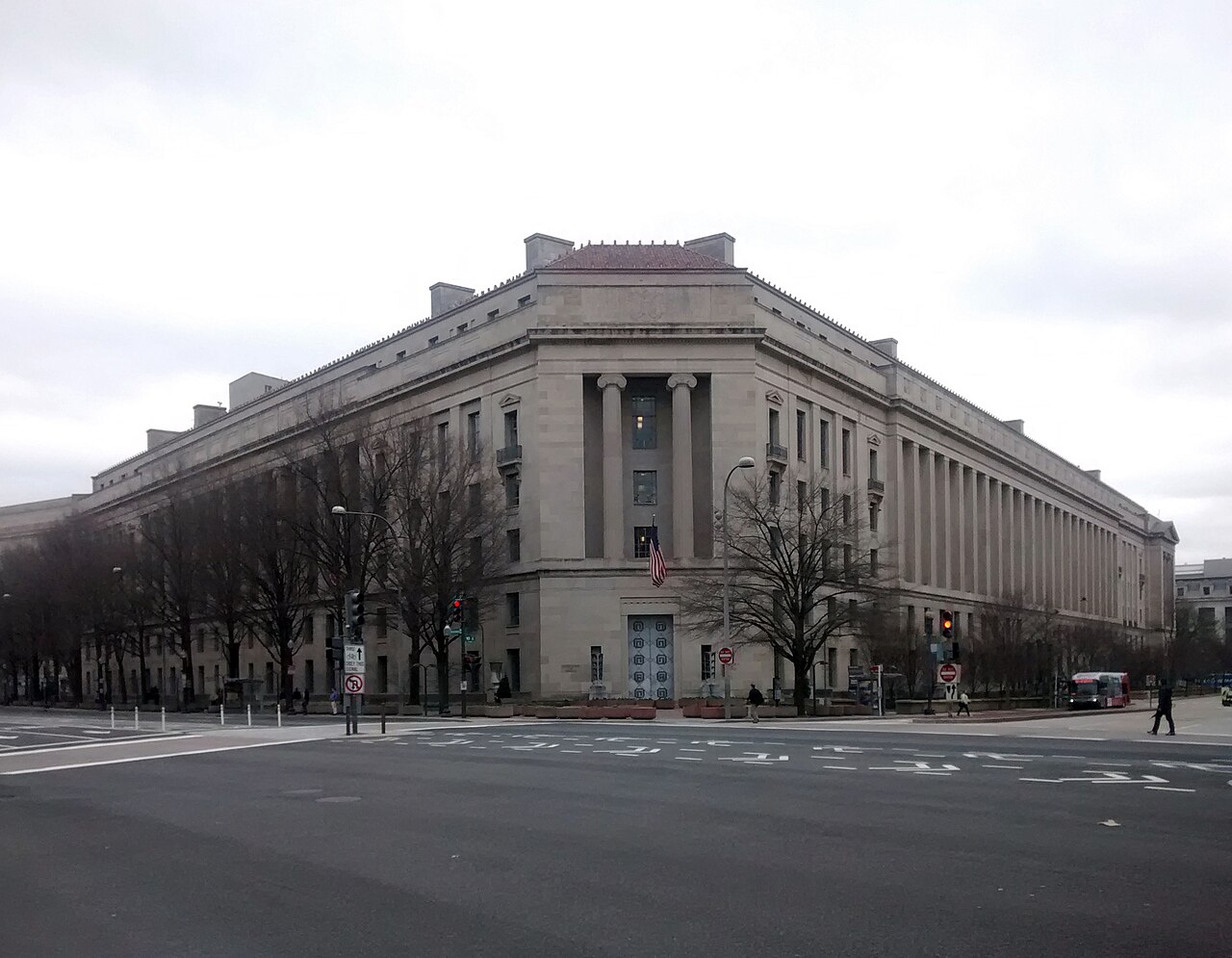
The Justice Department closed the week of June 15 with a dense slate of enforcement activity spanning national-security prosecutions, multimillion-dollar health care fraud settlements, and a first-of-its-kind corporate declination in an export-control case. Several actions ran through the department’s new National Fraud Enforcement Division, created April 7, 2026, and the administration’s Task Force to Eliminate Fraud. This edition of DOJ Watch summarizes seven notable actions drawn entirely from public filings and department press releases, and flags several matters that warrant closer scrutiny. All charges described as pending are allegations; defendants are presumed innocent unless and until proven guilty.
San Diego man charged in alleged $600,000 Hamas financing scheme
On June 17, federal prosecutors in the Southern District of New York unsealed a five-count complaint charging Reda Mazen Rida Sabassi, 38, of San Diego, with conspiring to provide material support to Hamas, sanctions evasion, wire fraud, money laundering, and making false statements. According to the department, Sabassi was arrested in San Diego on June 16 and presented before a federal magistrate judge.
Court filings allege that Sabassi used social media, crowdfunding websites, and a putative charity, Ikram — The Arab Charity Foundation Inc., to solicit donations he claimed would fund humanitarian aid in Gaza. Prosecutors allege that between roughly December 2023 and February 2024 he raised about $600,000, sent approximately $116,000 to a Hamas member, and attempted to convert about $382,000 into cryptocurrency to route to Hamas through a fundraising network known as Gaza Now — an entity the Treasury Department’s Office of Foreign Assets Control designated as a Specially Designated Global Terrorist in March 2024. The complaint contains allegations only.
The case, handled by the National Security Division and the FBI’s Joint Terrorism Task Forces, reflects a continued federal emphasis on terror-financing networks that operate through ostensibly charitable fundraising in the wake of the October 7, 2023 attacks. Each of the four most serious counts carries a statutory maximum of 20 years in prison; statutory maximums are set by Congress and any sentence would be determined by a judge.
Justice Department declines to prosecute Bosch in first NSD corporate declination
In a notable policy first, the National Security Division on June 17 announced it had declined to prosecute Robert Bosch GmbH over an alleged scheme to ship foreign-produced sensor products and software to a company on the U.S. Entity List. The department said it is the first time NSD has granted a declination under the department-wide Corporate Enforcement and Voluntary Self-Disclosure Policy.
According to the department, between September 2020 and September 2024, two Bosch subsidiaries — Bosch Sensortec and ETAS — exported more than $70 million in micro-electro-mechanical-systems sensor products and software to Huawei and affiliates on the Commerce Department’s Entity List without required licenses, in violation of the Export Administration Regulations’ Foreign Direct Product Rule. DOJ said Bosch voluntarily self-disclosed the conduct, cooperated, and remediated, and agreed to disgorge $11,430,098 in profits. A parallel civil action by Commerce’s Bureau of Industry and Security carried a $36,184,680 penalty, against which part of the disgorgement is credited.
The declination shows how DOJ is operationalizing its voluntary-self-disclosure incentives in the national-security context, rewarding companies that promptly report export-control violations and remediate. For corporate compliance officers, the resolution is a concrete data point on both the benefits and the boundaries of self-reporting under the current policy.
Arkansas pathology lab and owners to pay $30 million over kickback allegations
Advanced Pathology Solutions (APS) of North Little Rock, its management organization, and three current and former owners — Kevin Hannah, Donell Burkett, and Daniel Hunter Pledger — agreed to pay a total of $30 million to resolve False Claims Act allegations that they furnished unlawful kickbacks and billed federal health programs for medically unnecessary pathology testing.
The government’s April 8 complaint alleged a “lean lab” model in which APS set up and managed limited-purpose labs inside gastroenterology practices nationwide and, in exchange for various benefits, induced those practices to refer testing exclusively to APS. The complaint further alleged that APS directed personnel to automatically order certain “special stains” before a pathologist determined whether the testing was necessary. The settlement also resolves allegations of volume-based commission payments to a marketer for nerve-fiber-density testing. The claims are allegations only, and there has been no determination of liability; APS entered a five-year Corporate Integrity Agreement with HHS-OIG.
The matter arose from three whistleblower, or qui tam, lawsuits and follows a $4.75 million settlement earlier this year with a former APS client, Atlanta Gastroenterology Associates. The structure of the “lean lab” arrangement, and how widely it was replicated across gastroenterology practices, is a thread worth tracing in future reporting.
Louisiana nurse practitioner sentenced to 87 months in $12 million Medicare scheme
Scharmaine Lawson Baker, 59, was sentenced June 17 to 87 months in prison and ordered to pay $1,508,868.25 in restitution after a July 2025 jury convicted her on six counts of health care fraud. Prosecutors said she caused more than $12.1 million in false claims to Medicare for medically unnecessary cancer genetic tests.
According to court documents and trial evidence, Lawson Baker — who had authored books on medical necessity and the patient-provider relationship — signed hundreds of test orders after brief phone calls, often lasting less than 30 seconds, without examining patients, in exchange for kickbacks from a telehealth company. Trial evidence showed she ordered ovarian and cervical cancer tests for male patients and never reviewed the results. These are findings from a completed jury trial, not pending allegations.
The sentencing falls under DOJ’s Health Care Fraud Strike Force program, which the department says has charged more than 6,200 defendants tied to over $45 billion in billings to public and private payers since 2007. Telehealth-linked genetic-testing schemes remain a recurring enforcement vector.
Alabama defense contractor settles cybersecurity False Claims Act case
Defense contractor LOGZONE Inc. of Huntsville, Alabama, agreed to pay $507,144 to resolve allegations under the False Claims Act that it knowingly failed to comply with cybersecurity requirements on two contracts with the Department of the Navy. The claims are allegations only, and there has been no determination of liability.
The settlement resolves allegations that, from May 2021 to March 2025, LOGZONE failed to implement certain controls in NIST Special Publication 800-171 that, if absent, could enable exfiltration of sensitive defense information. A Defense Contract Management Agency assessment scored the company’s implementation at -170, near the bottom of a range running from -203 to 110, according to the department.
The action reflects DOJ’s continued use of the False Claims Act to enforce contractor cybersecurity obligations across the defense industrial base. Even comparatively modest settlements signal that the department views cyber-compliance representations in federal contracts as material and enforceable.
Fifteen charged in $1.4 million Massachusetts benefit-fraud sweep
On June 18, the department announced charges against 15 individuals — described by officials as 11 people unlawfully present in the United States and four U.S. citizens — in connection with more than $1.4 million in alleged SNAP, MassHealth, disability, and unemployment benefit fraud. The charges are allegations, and defendants are presumed innocent.
The charges include aggravated identity theft, passport fraud, theft of government funds, and false statements; alleged individual loss amounts range from several thousand dollars to $546,463, according to the charging documents. U.S. Attorney Leah B. Foley said her office, through a newly created Benefit & Voter Fraud Team, would announce benefit-fraud charges “on a rolling basis.” The department framed the arrests as part of a broader surge operation in Massachusetts.
The sweep reflects intensified federal benefit-program enforcement, and the department’s stated intention to bring additional cases. As with all pending charges, the government must still prove its allegations beyond a reasonable doubt.
Twenty-six charged in Rhode Island racketeering indictment
Federal prosecutors in Rhode Island announced on June 18 that 26 individuals were charged in connection with an indictment alleging that Providence-area street gangs operated as a criminal enterprise since at least 2013. The indictment charges 23 defendants with racketeering conspiracy and three additional defendants with related offenses. The charges are allegations, and all defendants are presumed innocent.
According to court documents, the indictment alleges violence — including murder, attempted murder, and robbery — alongside narcotics trafficking in fentanyl, cocaine, and other drugs, firearms offenses, and fraud schemes involving unemployment insurance, COVID-19 relief programs, and tax filings. The case was investigated by the ATF, the Providence Police Department, the Labor Department’s Office of Inspector General, IRS Criminal Investigation, and Homeland Security Investigations.
The indictment’s blend of alleged street-gang violence with pandemic-era benefit fraud underscores a pattern federal prosecutors have flagged repeatedly: relief-program fraud became a revenue stream for organized criminal groups, and those proceeds are now surfacing in racketeering cases.
Cases TIJ is watching
Three matters from the same window merit deeper investigation. First, on June 16 the department filed a civil suit in the Eastern District of New York targeting alleged Medicaid fraud connected to New York’s roughly $10 billion home-care program — a systemic action whose scope and remedies are worth tracking. Second, prosecutors on June 12 announced the arrests of seven men across three states tied to fraudulent COVID-19 relief loan applications, a reminder that pandemic-relief prosecutions continue five years on. Third, the “lean lab” referral structure at the center of the $30 million Arkansas pathology settlement raises a broader question about how many gastroenterology practices nationwide adopted similar arrangements.
Methodology and sourcing: Every factual claim in this digest is drawn from public Department of Justice press releases and court filings linked above. Pending charges are allegations only; defendants are presumed innocent. The Investigative Journal extends the standard right of reply to named individuals and entities and will update this report with any responses received. Featured image: the Robert F. Kennedy Department of Justice Building, Washington, D.C. (Photo: Gunnar Klack / Wikimedia Commons, CC BY-SA 4.0).