

By Eduardo Bacci | The Investigative Journal
Congress is out of town. Both chambers are holding only brief pro forma sessions until after the November 3 elections, and the House Republican Cloakroom’s schedule shows no legislative business this week. The Senate’s floor schedule shows the same, with a return set for Monday, November 9. That makes this a useful moment to take stock: a stopgap funding law with a December 11 expiration, an unfinished farm bill, a Senate permitting vehicle queued for the first day back, and a fresh batch of Congressional Budget Office (CBO) cost estimates on bills already moving through committees. Status labels below reflect the public records cited; readers should confirm current status on Congress.gov.
1. Continuing Resolution Funds Government Through December 11 (H.R. 6500)
Status: Enacted. According to Fox News reporting, President Trump signed H.R. 6500 in early September, funding federal agencies at fiscal 2027 levels through December 11, 2026. The measure also extended authorities for programs including surface transportation and veterans programs, delayed a congressionally approved hemp product ban by 30 days, and included a provision limiting administration control over federal grants. The bill text and actions are tracked on Congress.gov.
The significance is the calendar. A NEFI weekly summary states that none of the 12 fiscal 2027 appropriations bills has been completed. House Appropriations Chairman Tom Cole (R-OK) has said that a little over a month is not enough time to write a full-year budget, and has warned of a possible year-long continuing resolution or another shutdown, according to the same Fox News report. Lawmakers will return for a lame-duck session with roughly five weeks to act.
2. Rescission Dispute Complicates the Lame-Duck Funding Talks
Status: Administration request pending; no floor action. NEFI’s summary reports that on September 25 the White House sent Congress $810 million in pocket rescission requests. Senate Appropriations Chair Susan Collins (R-ME) called the move “a usurpation of Congress’s appropriations powers,” per that summary. The Senate Appropriations Committee’s website carries the committee’s bill and hearing information.
Pocket rescissions, which are requests sent near the end of a fiscal year so the funds lapse before Congress can act, have long been a point of friction between the branches over the Impoundment Control Act. A public disagreement between the administration and the Republican chair of the Senate’s spending panel is notable because Senate appropriators will need bipartisan support to move any final package. The dispute may complicate November talks, as NEFI’s report notes; how much remains an open question until negotiators reconvene.
3. Farm Bill: Extension Lapsed, Senate Committee Advanced Its Text
Status: Reported by Senate Agriculture Committee; awaiting floor. NEFI reports that the farm bill extension expired September 30. The Senate Agriculture Committee advanced its bill on September 16 after an earlier failed vote, per the same summary. Committee materials are posted at the Senate Agriculture Committee site. The measure needs 60 votes on the Senate floor, and a dispute over cost-sharing in the Supplemental Nutrition Assistance Program (SNAP) remains unresolved, according to NEFI.
Year-round E15 fuel blending and small refinery exemption reform are expected to wait for the lame duck, the same source says. Farm bills are among the few bipartisan vehicles that carry commodity policy, nutrition spending and conservation programs together, and the SNAP cost-share question puts the largest line item squarely in play. With a lapsed extension, programs may default to permanent-law baselines, though readers should consult USDA guidance for specifics.
4. Senate Permitting Reform: Vehicle Set for November 9
Status: House-passed framework; Senate motion to proceed pending. The Senate’s Daily Press page says the chamber will resume consideration of the motion to proceed to H.R. 2347 on November 9, describing it as the legislative vehicle for a permitting reform bill, with a cloture vote on the motion expected around 5:30 p.m. that day. The vehicle’s text is listed on Congress.gov.
Coverage from law-firm and trade outlets, such as Brownstein Hyatt Farber Schreck, has described a bipartisan House-passed permitting package facing obstacles in the Senate. Reform efforts target federal approval timelines for energy and infrastructure projects, including pipelines, transmission lines and highways. A cloture vote requires 60 votes, so the November 9 tally will be an early read on whether any bipartisan deal holds.
5. CBO Estimates: Budget Process Bills Carry No Direct Cost
Status: Ordered reported by House Budget Committee on September 16. CBO’s estimate for H.R. 6470, the Increasing Baseline Updates Act, published October 20, finds the bill would require CBO, where practicable, to issue at least two updates each year to its budget and economic forecast, and would require the administration to provide technical budget data by February 1. CBO estimates zero effect on direct spending, revenues and the deficit over 2027-2036, with spending subject to appropriation under $500,000 in 2027 and over 2027-2031.
A companion estimate for H.R. 4464, the Preventive Health Savings Act, also published October 20, finds that the bill would direct CBO to estimate the budgetary effects of preventive health legislation over a 30-year period under certain conditions. Those long-term estimates could not be used for budget enforcement, CBO says, and the bill has no estimated direct budgetary effect. Committee information is on the House Budget Committee site. They matter less for dollars than for method: they would change what information lawmakers see when weighing legislation.
6. Critical Minerals Reporting Bill (S. 789) and Energy Measures
Status: Ordered reported by Senate Energy and Natural Resources on June 10. CBO’s October 19 estimate for S. 789 says the bill would require the Interior Department, working with the Energy Department and other agencies, to report to Congress within a year of enactment on global critical mineral and rare earth resources, including those controlled by foreign entities of concern, the United States and its allies. CBO estimates no direct spending or revenue effect and implementation costs under $500,000 over 2027-2031, subject to appropriations. Bill history is on Congress.gov.
The same committee’s FLOWS Act (S. 3518), also scored October 19, would change Federal Energy Regulatory Commission licensing for nonfederal hydropower, letting licensees perform minor alterations and routine upkeep without FERC approval and revising procedures for micro hydrokinetic projects. CBO estimates no net budgetary effect, since FERC recovers costs through fees. CBO’s figures suggest both bills are low-cost; no floor schedule has been announced.
7. Locomotive Emissions Preemption (H.R. 3194) and Broadband Strategy (H.R. 2805)
Status: Ordered reported by House Energy and Commerce (September 2 and September 16, respectively). CBO’s estimate for the LOCOMOTIVES Act says the bill would amend the Clean Air Act to bar EPA from waiving preemption so states could enforce emissions standards for existing locomotives. California is the only state that qualifies for such waivers, and CBO notes it withdrew its pending request for existing locomotives in January 2025. CBO finds no federal budgetary effect and a state-and-local mandate cost below the Unfunded Mandates Reform Act threshold.
The PLAN for Broadband Act (H.R. 2805) would require the National Telecommunications and Information Administration to develop a strategy and implementation plan across 14 agencies. CBO estimates about $5 million in discretionary costs over 2027-2031 and no direct spending effect. Details are on Congress.gov.
8. Great Lakes Regional Partnership (S. 4573) and Jones Act Waiver Clock
Status: S. 4573 ordered reported by Senate Commerce on September 16. CBO’s estimate says the bill would designate the Great Lakes Commission as a regional ocean partnership, with no budgetary effect; current law authorizes $11 million for 2027 in NOAA grants to the four recognized partnerships, and the bill does not change that authorization.
Separately, NEFI reports that a Jones Act waiver allowing foreign-flagged vessels to move fuel between U.S. ports expires November 15, and that the group has asked the White House to extend it through year-end. That is an executive-branch action rather than legislation, but it falls inside the same lame-duck window.
Legislation Relevant to TIJ Beats
For readers following supply-chain security and foreign influence, S. 789’s focus on resources controlled by “foreign entities of concern” is the most relevant item this week. The report it requires would give Congress a baseline for critical mineral dependence. On infrastructure and government accountability, the stalled FY2027 appropriations process, the rescission dispute and CBO’s budget-process bills (H.R. 6470 and H.R. 4464) bear on how transparently Congress tracks federal spending. The broadband strategy bill touches telecommunications oversight. TIJ will continue to monitor each and report developments when Congress returns on November 9.
Editorial Notes
Bill statuses reflect committee actions cited in CBO estimates and the sources linked above; none of the measures discussed here has been described as signed into law other than H.R. 6500. Statements attributed to officials come from the cited reports and have not been independently confirmed by TIJ. Congressional offices and the administration are invited to submit responses or corrections to the newsroom, and TIJ will update this report accordingly.
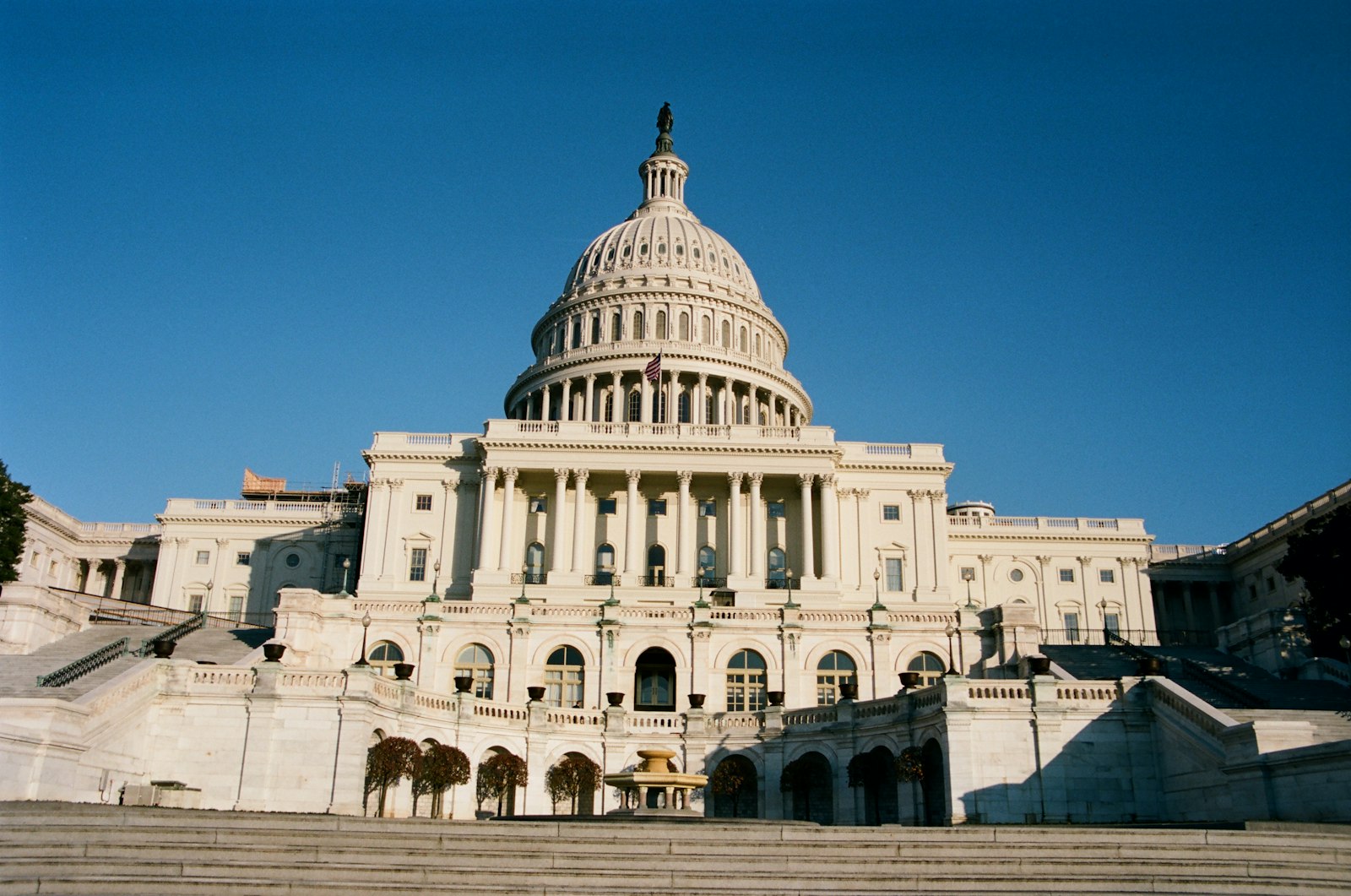
Sources: Congress.gov; CBO cost estimates; U.S. Senate Daily Press; House Republican Cloakroom; NEFI, This Week in Congress; Fox News. Featured image: U.S. Capitol, photo by Chad Stembridge via Unsplash.