

The U.S. Securities and Exchange Commission entered the second week of July with a structural signal about where its enforcement priorities are heading: on July 7, the agency announced a new Retail Fraud Working Group housed in the Division of Enforcement. The move landed alongside a run of freshly docketed litigation releases targeting microcap manipulators and unregistered brokers, and against a backdrop of notable boardroom exits disclosed by two large public companies. Taken together, this week’s filings offer a data-driven look at an SEC that, under Chairman Paul S. Atkins, says it is recentering its docket on fraud and individual accountability.
This edition of SEC Watch reviews the most consequential filings and releases posted to SEC EDGAR and the Commission’s newsroom over the past several days, with direct links to the underlying public records. As always, allegations described in complaints are unproven; settlements and consent judgments are entered without any admission of wrongdoing unless otherwise stated.
SEC Enforcement
A new Retail Fraud Working Group signals proactive case generation
The Retail Fraud Working Group announced July 7 is designed, in the Commission’s words, to “identify and combat fraud targeting everyday investors,” including offering frauds, pump-and-dump schemes, market manipulation, and breaches of duty by investment advisers and broker-dealers. According to the release, the group will focus on proactive case generation, coordination with domestic and foreign regulators, and investor-education outreach through the SEC’s Office of Investor Education and Assistance.
The unit will be led by Kate Zoladz, Deputy Director, West, and Kim Frederick, Assistant Director in the Asset Management Unit, and reports up through Enforcement Director David Woodcock. Chairman Atkins framed the initiative as “a return to the core values and principles of the enforcement program.” The announcement is consistent with the SEC’s fiscal-year 2025 enforcement results, published in April, which reported 456 enforcement actions and a record 53,753 tips, complaints, and referrals, while emphasizing a shift away from what the current Commission characterized as volume-driven cases and toward fraud that produces direct investor harm.
SEC charges alleged $3.36 billion “phantom investment” scheme involving Napster’s predecessor
In one of the more striking complaints filed recently, the SEC on June 11 charged North Carolina resident Charles J. Cole and Utah attorney Torben M. Welch, along with three Cole-controlled entities, in connection with an alleged fraudulent stock scheme that netted 239 million shares of Infinite Reality, Inc.—the company now known as Napster Corp. According to the SEC’s complaint, filed in the Southern District of New York, Cole falsely promised to invest $3.36 billion in Infinite Reality and, with Welch’s assistance, told the company that Cole or his entity Avranoc controlled at least $55 billion in assets.
The complaint alleges that, based on those representations, Infinite Reality issued more than 239 million shares in late 2024 and early 2025 despite never receiving any funds from Cole. The SEC further alleges that Cole then pledged nearly 45 million of those shares to secure a $1 million loan from a third-party lender, and that Welch provided forged documents purporting to verify Cole’s assets. The U.S. Attorney’s Office for the Southern District of New York announced parallel criminal charges against Cole, and the SEC’s investigation, handled out of the Boston Regional Office, remains ongoing. The charges are allegations that have not been proven in court.
Microcap defendant settles in long-running fraud case
On July 10, the Commission issued a litigation release disclosing that defendant Steve M. Bajic, a citizen of Canada and Croatia, agreed to settle charges tied to a microcap fraud scheme the SEC first filed against 15 defendants in January 2020. According to the Commission’s complaint, Bajic worked with Rajesh Taneja to help undisclosed public-company insiders secretly sell large quantities of microcap stock through a network of foreign companies used to conceal control persons’ ownership.
Bajic consented to a final judgment enjoining him from violating registration and antifraud provisions of the federal securities laws, imposing a penny stock bar, and ordering $837,734 in disgorgement—an amount the filing states will be deemed satisfied by a forfeiture judgment in a parallel criminal case in the District of Massachusetts. The settlement, which Bajic entered without admitting the allegations, reflects the SEC’s stated emphasis on coordinating civil and criminal remedies while continuing to pursue the individuals who facilitate market manipulation.
Las Vegas “financial education” firm resolves unregistered-broker claims
The retail-protection theme continued in a final consent judgment disclosed July 6 against Las Vegas-based Quest Education L.L.C., its principal Daniel Blue, and former employees David Christopher White and Keitoh Jordan Spears. The SEC’s complaint alleged that Quest marketed itself as an investor-education company helping customers set up self-directed retirement accounts, while its largest revenue driver was commission payments for steering those customers into unregistered securities offerings.
According to the complaint, between October 2019 and April 2023 Quest solicited customers into offerings from at least eight issuers and collected roughly $2.5 million in commissions, with White and Spears each receiving more than $200,000—none of them registered as brokers. Without admitting the allegations, the defendants consented to permanent injunctions under Section 5 of the Securities Act and Section 15(a)(1) of the Exchange Act, and Blue and Spears each agreed to pay an $11,823 civil penalty. The case underscores continued SEC attention to the intersection of self-directed IRAs and unregistered private offerings—an area where retail retirement savings are frequently at risk.
Corporate Disclosure Watch
Fiserv discloses president’s departure “for good reason”
Payments and financial-technology giant Fiserv, Inc. (Nasdaq: FISV) disclosed a notable executive change in a Form 8-K filed July 7. Under Item 5.02, the company reported that President Dhivya Suryadevara resigned “for ‘good reason'” under her August 2025 offer letter and the company’s Executive Severance and Change of Control Policy, effective July 7, 2026. The filing states she will remain a non-executive officer employee through July 31 to enable an orderly transition.
The invocation of a “good reason” clause—language typically tied to a material change in an executive’s role, responsibilities, or reporting line—is a detail worth noting, because it can trigger severance and change-of-control benefits described in the company’s April 2, 2026 proxy statement. In a same-day Regulation FD disclosure, Fiserv named Andrew Gelb, EVP and COO of Financial Solutions, and Srini Krish, Head of Technology and Operations for Financial Solutions, as interim leaders of that business. For a company of Fiserv’s scale in the U.S. payments infrastructure, the departure of a president via a contractual “good reason” exit is the kind of disclosure that warrants attention to subsequent filings.
Copart’s founder returns to the CEO seat as Liaw exits the board
Vehicle-remarketing company Copart, Inc. (Nasdaq: CPRT) disclosed a leadership transition in a Form 8-K reporting a June 29 announcement. The board appointed Executive Chairman A. Jayson “Jay” Adair as chief executive officer effective July 31, 2026, with Jeffrey Liaw stepping down as CEO and resigning from the board the same day. The filing states that Liaw’s decision “was not the result of any disagreement with the Company regarding its financial reporting, policies or practices,” and discloses that Adair is the son-in-law of Copart Chairman Willis J. Johnson.
The 8-K details a Transition and Separation Agreement dated June 25 under which Liaw becomes a senior advisor through July 31, 2027 and is entitled to a $450,000 lump sum, a further $200,000 during the transition period, accelerated and modified equity terms, his fiscal 2026 bonus, and limited private-aircraft usage, subject to non-compete, non-solicitation, and non-disparagement obligations. Market coverage indicated Copart shares declined following the announcement, per reporting on the transition. A founder-aligned executive returning to the top job while the incumbent departs the board is a governance development shareholders will be watching.
Filings that may warrant deeper TIJ investigation
Several recent records merit continued monitoring. The Fiserv “good reason” resignation raises the question of what underlying change prompted the departure; future proxy disclosures and the company’s next quarterly report may add context. In two marquee matters, the Commission has filed proposed consent judgments that still require court approval: the SEC’s action against Elon Musk over the allegedly late beneficial-ownership report tied to his 2022 accumulation of Twitter stock, in which a Musk revocable trust agreed to a $1.5 million penalty that would resolve the case, and the consent judgments against Gautam and Sagar Adani, carrying proposed penalties of $6 million and $12 million respectively over disclosure claims connected to a 2021 Adani Green Energy bond offering. Both remain subject to judicial sign-off, and the docket entries are worth tracking.
Finally, calendar mechanics will soon add to the disclosure flow: institutional investment managers must file Form 13-F for the quarter ended June 30 within 45 days—by mid-August—offering the next window into how large holders repositioned during the second quarter. TIJ will continue to track the SEC’s enforcement docket and material corporate disclosures as they post to EDGAR.
Sources: U.S. Securities and Exchange Commission newsroom and EDGAR filings, including Press Release 2026-63; Press Release 2026-34; Litigation Releases 26563, 26583, 26580, 26548, and 26554; and Forms 8-K filed by Fiserv, Inc. and Copart, Inc.
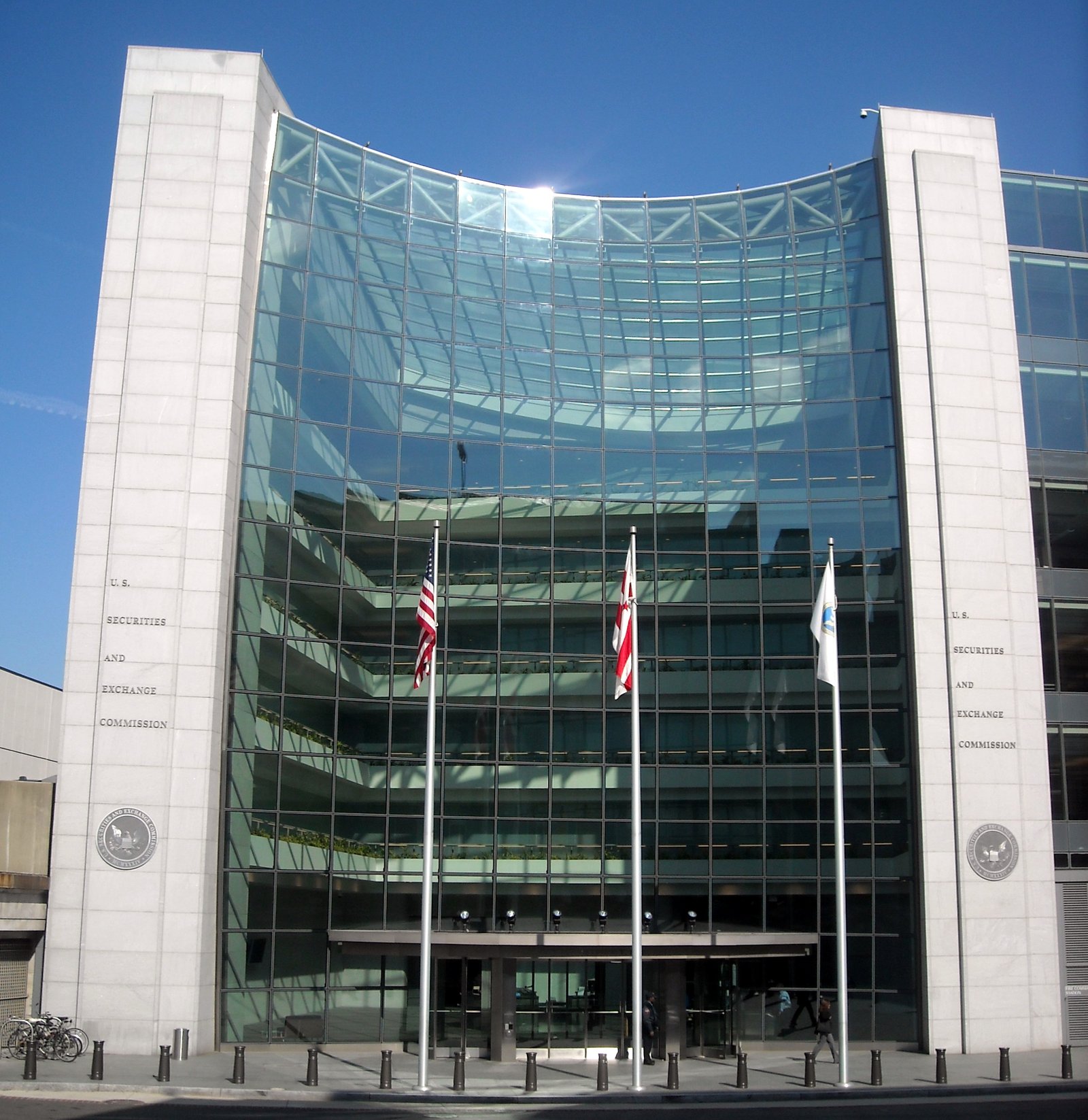
Featured image: The U.S. Securities and Exchange Commission headquarters, Washington, D.C. Photo by AgnosticPreachersKid, CC BY-SA 3.0, via Wikimedia Commons.