

The Investigative Journal’s monthly review of federal lobbying disclosures, revolving-door hires and foreign-influence filings. All figures are drawn from public records filed under the Lobbying Disclosure Act (LDA) and the Foreign Agents Registration Act (FARA), and from open-data trackers maintained by OpenSecrets.
Federal lobbying opened 2026 at a record pace. According to an OpenSecrets analysis of first-quarter LDA filings, organizations reported spending roughly $1.4 billion to influence the federal government between January and March — the highest first-quarter total since Congress began requiring quarterly disclosure in 2008. A total of 13,521 organizations reported lobbying activity in the quarter, collectively increasing outlays by about $115 million, or roughly 9 percent, over the same period in 2025.
The data show an influence economy expanding across nearly every major sector, led by health care, business trade associations, technology and finance. The transportation sector, which includes the automotive industry, spent about 14 percent more than a year earlier, filings indicate, while the finance, insurance and real-estate sector rose about 10 percent — with the real-estate industry alone up 17 percent. Taken together, the first-quarter numbers extend a multi-year, bipartisan trend: as Washington’s policy stakes have grown — on tariffs, taxes, artificial intelligence and defense — so has the money spent trying to shape outcomes.
Who spent the most
Among individual clients, the U.S. Chamber of Commerce again topped the list, reporting about $20.2 million in first-quarter lobbying, according to OpenSecrets tabulations. The National Association of Realtors reported roughly $15.5 million, a 38 percent increase over the first quarter of 2025. By industry, pharmaceuticals and health products led all sectors with about $132 million in reported first-quarter spending, consistent with the industry’s long-standing position atop the LDA rankings.
On the supply side of the influence market — the firms paid to lobby — the concentration of revenue near the current administration is striking. OpenSecrets reported that lobbying firms collectively took in a record $5.08 billion in 2025, up about 11 percent from 2024 after adjusting for inflation — the largest single-year jump since quarterly reporting began. Leading that surge was Ballard Partners, the firm founded in 2017 by Brian Ballard, who chaired Trump Victory in 2016 and 2017. Ballard reported a record $88.1 million in 2025, dethroning Brownstein Hyatt Farber Schreck, which had ranked first for the prior four years.
That momentum carried into 2026. Ballard Partners became the first lobbying firm to clear $30 million in a single quarter, filings show, outpacing every rival on K Street. By comparison, BGR Group reported about $20.8 million and Brownstein Hyatt Farber Schreck about $20.3 million — the only other firms to surpass $20 million in the quarter. Readers can review the firm’s disclosures directly on its OpenSecrets lobbying profile.
The revolving door keeps turning
Lobbying and the movement of personnel between government and the influence industry are legal, disclosed and long-standing features of Washington under both parties. What the public records document is the scale and proximity of the current cycle. Ballard’s rise is inseparable from its alumni network: former Ballard lobbyists now hold senior administration posts, including White House Chief of Staff Susie Wiles and Attorney General Pam Bondi, per OpenSecrets’ reporting on the firm.
The traffic runs both directions. The Campaign Legal Center, a nonpartisan watchdog, has identified at least 47 former lobbyists nominated for or serving as senior political appointees as of early April 2026. OpenSecrets’ Revolving Door database, meanwhile, records a relatively high number of departures to K Street in the administration’s first year. Reporting by Bloomberg Government notes that strategists with recent administration experience can command compensation ranging from the high six figures to more than $1 million, as clients seek proximity to decision-makers.
Transparency advocates have flagged enforcement gaps. Watchdogs point to the persistence of so-called shadow lobbying — activity that resembles lobbying but is labeled “strategic consulting” to stay below LDA registration thresholds. In February, Sen. Elizabeth Warren (D-Mass.) and colleagues wrote to 16 inspectors general raising questions about former lobbyists serving in the administration. The letter reflects an allegation and a request for review, not a finding of wrongdoing; affected officials and firms are entitled to respond, and TIJ notes that registration and recusal questions remain unresolved.
The AI-fication of K Street
No trend has reshaped the influence industry faster than artificial intelligence. OpenSecrets’ February analysis found that in 2025 lobbyists reported representing 774 organizations on AI issues and filed more than 3,500 reports mentioning the topic — increases of 423 percent and 505 percent, respectively, since 2020. More than one in four registered federal lobbyists — about 3,570 people, or 26 percent — reported working on AI last year.
The spending follows. Eleven large technology companies spent more than $105 million on federal lobbying in 2025, and the pace accelerated into 2026. Citing a tally by the advocacy group Issue One, Fortune reported that a group of top tech firms spent roughly $20 million in the first quarter — about $226,000 a day. Meta led with about $7.1 million, followed by Amazon ($4.4 million) and Google ($2.9 million). Axios reported that both Anthropic (about $1.6 million) and OpenAI (about $1 million) posted their biggest-ever lobbying quarters. Across six leading AI and tech companies, filings show 307 lobbyists retained in the first quarter alone, with Alphabet and Meta each fielding more than 80.
The money now extends well beyond registered lobbying into elections. Super PACs funded by the cryptocurrency and AI industries have amassed more than $321 million in the 2026 cycle, according to The Nation — a figure TIJ attributes to that outlet’s reporting and flags for independent confirmation. Among the vehicles is “Leading the Future,” reported to hold a war chest exceeding $125 million, with backing that includes OpenAI president Greg Brockman.
Legislation drawing the heaviest fire
Three legislative battles are concentrating lobbying muscle in 2026. On digital assets, the industry’s flagship market-structure bill — the CLARITY Act — would place most digital tokens under the lighter-touch Commodity Futures Trading Commission rather than the Securities and Exchange Commission; the banking industry is separately lobbying to restrict interest-like rewards on payment stablecoins. On AI, firms including OpenAI and Meta are pressing for federal preemption of state regulation, while consumer, civil-rights and child-safety coalitions push guardrail measures. And in defense, both legacy contractors and AI-native startups are targeting the National Defense Authorization Act and appropriations bills. OpenSecrets noted, for example, that autonomy developer Applied Intuition increased reported lobbying from about $550,000 in 2024 to roughly $910,000 in 2025 as it pushed autonomous-systems programs for the Navy and Air Force.
Foreign influence: FARA filings climb
Foreign-agent activity is rising alongside domestic lobbying. Ballard Partners’ foreign practice has expanded rapidly: the firm has registered under FARA to represent clients including the Democratic Republic of Congo, Japan and Saudi Arabia, with several engagements reported in the $1 million-to-$2 million range. Filings reviewed in reporting on the firm describe a roughly $1 million-a-year contract, for up to five years, to represent Uzbekistan’s national oil and gas company, and a March 31 agreement carrying a $60,000 monthly fee — about $720,000 annually — for communications work tied to the Saudi Arabian embassy. Primary registration documents are searchable in the Justice Department’s FARA eFile system and via OpenSecrets’ Foreign Lobby Watch.
Analysts tracking the field report a rise in higher-risk foreign clients. A July policy brief from the Anti-Corruption Data Collective counted a record number of “high-risk” individual registrants during the administration’s first year, with several new such clients already registered in the first five months of 2026. In response, the Senate has advanced two measures — the Disclosing Foreign Influence in Lobbying Act (S. 856 / H.R. 1883) and the Lobbying Disclosure Improvement Act (S. 865 / H.R. 1887) — aimed at tightening foreign-agent disclosure. Their status and text can be tracked at Congress.gov.
Think tanks: the disclosure blind spot
Influence money also flows through the idea-generating institutions that shape policy debates. The Think Tank Funding Tracker, maintained by the Quincy Institute, estimates that leading U.S. foreign-policy think tanks received more than $25 million from foreign governments and about $7 million from Pentagon contractors in 2024 — figures the project calls conservative, because roughly 40 percent of the institutions it reviews disclose no donors at all. Among disclosed foreign-government donors, the tracker lists Canada ($4.4 million), the United Arab Emirates ($3.1 million), Japan ($3.1 million) and the United Kingdom ($2.8 million) near the top. A pending bill, the Think Tank and Nonprofit Foreign Influence Disclosure Act (H.R. 3966), would require broader reporting of such funding.
Networks worth watching
Several influence networks emerge from this quarter’s filings as candidates for deeper TIJ investigation. First, the Ballard nexus — the overlap between a record-setting firm, its foreign-government clients and its alumni in senior government roles — sits at the intersection of the LDA and FARA disclosure systems and warrants line-by-line cross-referencing. Second, the AI-defense corridor, where autonomy startups and legacy primes are converging on the same appropriations lines while affiliated super PACs spend in the same districts, deserves scrutiny of who is funding whom. Third, the stablecoin and market-structure fight pits crypto and banking lobbies against each other with hundreds of millions in election spending in the background. And fourth, the think-tank disclosure gap — where two-fifths of leading institutions reveal no donors — remains the least transparent corner of the influence economy.
TIJ will continue mapping these networks against the primary record. Every claim above is anchored to a public filing or a named tracker; where reporting rests on a single outlet, we have said so and flagged it for confirmation. Individuals and firms named in disclosures are engaged in lawful, reported activity unless a court or regulator finds otherwise, and all retain a right of reply, which this publication will honor.
Sources and primary records: OpenSecrets — Q1 2026 lobbying record; OpenSecrets — $5 billion in 2025; OpenSecrets — AI-fication of K Street; OpenSecrets — Top Spenders; OpenSecrets — Revolving Door; OpenSecrets — Foreign Lobby Watch; DOJ FARA eFile; Fortune — Big Tech Q1 lobbying; Axios — Anthropic vs. OpenAI; Bloomberg Government — revolving door; Campaign Legal Center; Quincy Institute Think Tank Funding Tracker; H.R. 3966 text.
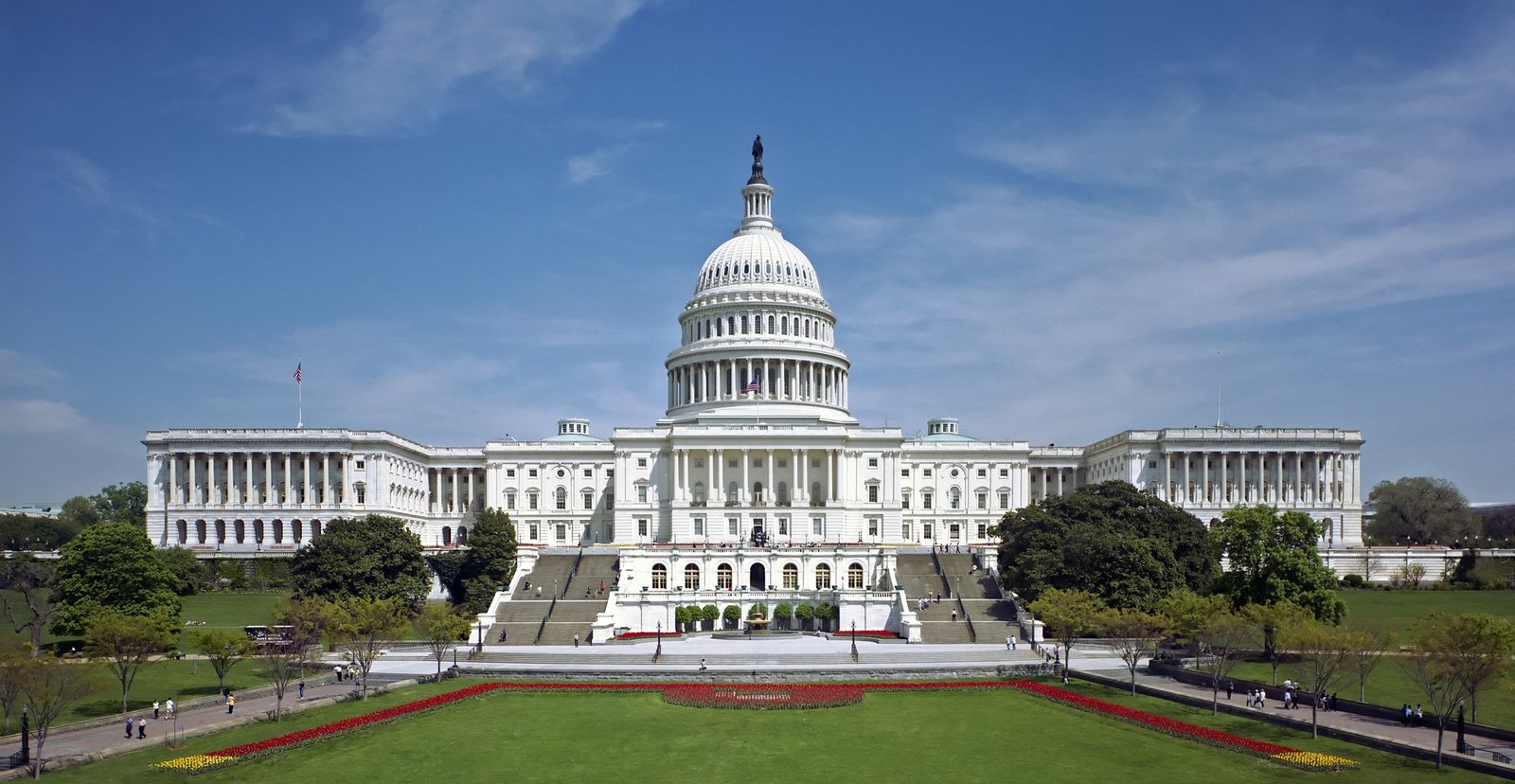
Featured image: U.S. Capitol, west front (Architect of the Capitol, public domain).