

WASHINGTON — The workweek opens with the administration’s two most consequential foreign-policy tracks under strain: Israeli Prime Minister Benjamin Netanyahu on Sunday rejected the U.S.-backed 15-point framework for Gaza, and talks to reopen the Strait of Hormuz remain unresolved after a week in which officials repeatedly signaled a deal was near. At home, the Pentagon is pressing defense manufacturers to accelerate production as munitions stockpiles run low, and a set of late-week court rulings curbed executive-branch positions on federal labor contracts, firearms registration, and offshore wind. Here is what moved overnight and over the weekend — and what to watch today.
Government
Pentagon asks industry to ramp up as munitions stocks run low. The Defense Department has sent a memo asking U.S. defense manufacturers to accelerate production as stockpiles are drawn down by the conflict with Iran, according to CNN reporting Sunday. The request follows earlier reporting, cited in Just Security’s roundup of Reuters sourcing, that the United States has expended “virtually all” of its global stockpile of highly accurate long-range missiles during the war — a level that some officials worry could constrain deterrence elsewhere.
The White House has pushed back on the stockpile characterization. In a statement issued in response to the Reuters reporting, President Trump said the United States has “far more munitions than anyone in the world” and “far more than we need.” Sources cited by CNN said the drawdown has nonetheless been a point of frustration inside the administration as it seeks to maintain leverage over Tehran.
Trump says U.S. is “only semi-negotiating” with Iran. The president told Axios in a Sunday phone interview that Washington is “low-keying” its talks with Tehran and emphasized economic pressure instead: “We are only semi-negotiating with them. We are just watching Iran with its huge inflation and the fact they have no money.” The comments came the same day Iran denied that any direct talks with the United States are under way on reopening the Strait of Hormuz, according to CNBC. Earlier in the week, Axios reported that negotiators had circulated draft language and that Washington had aimed to announce an interim deal by mid-week — a target that came and went without an agreement.
White House details mining push topping $2 billion. Following Friday’s roundtable with mining executives held at the State Department, the White House released a fact sheet outlining new deals and investments intended to rebuild domestic mineral supply chains, including reported commitments of $1.4 billion involving Sila Nanotechnologies, $400 million for Sunrise Energy Metals, $150 million for Niron Magnetics, and $85 million for Standard Bauxite, alongside a $180 million mining-workforce initiative. CNBC reported the administration’s defense-linked minerals commitments total roughly $3 billion, part of an effort officials describe as reducing reliance on foreign-controlled processing.
Immigration orders signed Thursday continue to draw scrutiny. Rounding out the week’s executive actions, the president signed two orders on citizenship — “Ending Birth Tourism,” which directs the State and Homeland Security departments to deny or revoke visas for suspected birth tourism, and a companion order addressing citizenship for children of foreign-government employees. NPR notes the orders follow the Supreme Court’s June decision striking down the administration’s earlier birthright-citizenship order; legal challenges to the new orders are widely expected but had not been docketed as of this writing.
Courts
Judge blocks VA’s third attempt to end its union contract. U.S. District Judge Melissa DuBose on Friday granted a motion enforcing her preliminary injunction preserving collective bargaining at the Veterans Affairs Department, Government Executive reports, describing the department’s latest effort to terminate its agreement with the American Federation of Government Employees — timed to the contract’s Aug. 8 expiration date — as “in direct contravention” of her prior orders. A federal appeals court upheld most provisions of the underlying injunction in May.
The VA, for its part, argued the union failed to begin negotiations within a 30-day window, an assertion the judge found “not well-taken” based on the parties’ correspondence. The filings indicate the dispute traces to the March 2025 executive order limiting collective bargaining at national-security-designated agencies, and further contempt proceedings remain possible if the department proceeds.
Federal judge voids NFA registration rules in West Virginia case. A federal judge has ruled that the National Firearms Act’s registration requirements for short-barreled rifles, short-barreled shotguns, and suppressors are no longer valid, according to an announcement from West Virginia Attorney General JB McCuskey. The court agreed with the state’s argument that once Congress eliminated the underlying transfer taxes in last year’s reconciliation law, the registration regime — fingerprinting, photographs, and ATF approval — lost its constitutional footing as a tax-collection measure. The Justice Department has not yet said whether it will appeal, and the ruling’s immediate scope remains a matter for the parties and the court.
Pentagon ordered to resume wind-project reviews. A federal judge has ordered the Defense Department to lift its freeze on wind-power project reviews and to report progress to the court every 30 days, per reporting first published by The New York Times. The order is a setback for the administration’s pause on offshore wind permitting; compliance reports will offer an early measure of how quickly stalled projects move.
International
Netanyahu rejects U.S.-backed Gaza framework. Prime Minister Netanyahu said Sunday that “Israel rejects the 15-point document” negotiated under the administration’s “Board of Peace,” insisting there will be no Israeli withdrawal from Gaza until Hamas fully disarms — “genuine disarmament, not fictitious disarmament,” CBS News reports. President Trump had described the framework as a “historic agreement for the complete disarmament of Hamas.” The plan reportedly envisions disarmament and withdrawal proceeding in phases, while Netanyahu’s position makes disarmament a precondition; Hamas, per NPR, insists Israel halt operations before it implements any arms provisions. The rejection lands as Netanyahu campaigns ahead of Israel’s Oct. 27 election, balancing coalition pressure against Washington’s push to close out the conflict.
Houthis strike Saudi Aramco’s Jazan refinery. Yemen’s Houthis said they carried out a drone attack Sunday on the 400,000-barrel-per-day Jazan refinery in southwestern Saudi Arabia, NBC News reports. The Saudi energy ministry said a fire broke out and was extinguished with no injuries reported. Houthi military spokesman Yahya Saree characterized the strike as retaliation for alleged Saudi drone incursions over Yemeni provinces; UPI reports the group also claimed an attack on the Yemeni Red Sea port of Mokha.
Riyadh’s new security architecture takes shape. The refinery strike came two days after Saudi Arabia, Turkey, and Pakistan signed the “Mecca Joint Deterrence Agreement,” a mutual-defense pact under which an attack on one member is to be treated as an attack on all, Foreign Policy reports. Analysts at the Atlantic Council read the pact — concluded after nearly a year of negotiation — as a hedge against regional spillover from the Iran war and as a signal of diminished confidence in the U.S. security umbrella among Gulf partners.
Russia and Ukraine trade weekend strikes. Overnight exchanges into Sunday killed at least seven people and injured many more, according to Associated Press reporting. Ukraine’s air force said it downed 174 Shahed-type drones in the Saturday-night barrage, while strikes hit an electrical substation in Odesa and a road bridge near the Danube ports, per the Kyiv Independent, which reported at least 13 killed and roughly 90 injured across Ukraine over the preceding day. Russian regional authorities said Ukrainian drone attacks killed five people in Belgorod. The exchanges follow the European Commission’s announcement last week that it will channel €1.4 billion in proceeds from immobilized Russian central-bank assets to Ukraine.
Iran shakes up its top security body. Iran’s supreme leader named Mohsen Rezaee — the former Islamic Revolutionary Guard Corps commander — as secretary of the Supreme National Security Council and his personal representative to the body, replacing Mohammad Baqir Zolghadr, according to wire reporting. Iran International had reported days earlier that a change atop the council was in the works. The reshuffle is the most significant change to Tehran’s security leadership since the war began, and analysts will parse whether it signals a harder or more pragmatic line in the Hormuz talks.
Worth Watching
Hormuz endgame. After last week’s missed target for an interim announcement, watch for renewed shuttle diplomacy through Oman and Qatar and any White House readout on reopening the strait. Oil markets opened the week weighing the prospects, and any confirmed deal — or confirmed breakdown — moves prices and the broader U.S.-Iran trajectory.
July inflation data Wednesday. The Bureau of Labor Statistics releases the July Consumer Price Index Wednesday at 8:30 a.m. ET — the week’s biggest economic data point, watched closely for tariff pass-through into goods prices ahead of the administration’s newly announced polysilicon tariffs taking effect.
A quiet Capitol. Congress remains in its long summer recess: the House returns for a one-week session beginning Aug. 31, and the Senate is not due back until Sept. 14, per Federal News Network — leaving executive actions and the courts as the week’s principal arenas.
Compliance checkpoints. Watch whether the VA moves again on the AFGE contract after Friday’s order, and for the Pentagon’s first 30-day wind-review progress report. Both will test how agencies respond to adverse rulings during the recess.
The president’s week. The president returned to the White House from Bedminster on Sunday evening, per the public schedule; today’s schedule posts at midnight and will indicate whether Iran, Gaza, or the economy tops the docket.
The Morning Wire is compiled from wire services, court records, and official government releases. All claims are attributed to the linked sources; developing stories may be updated as records become available.
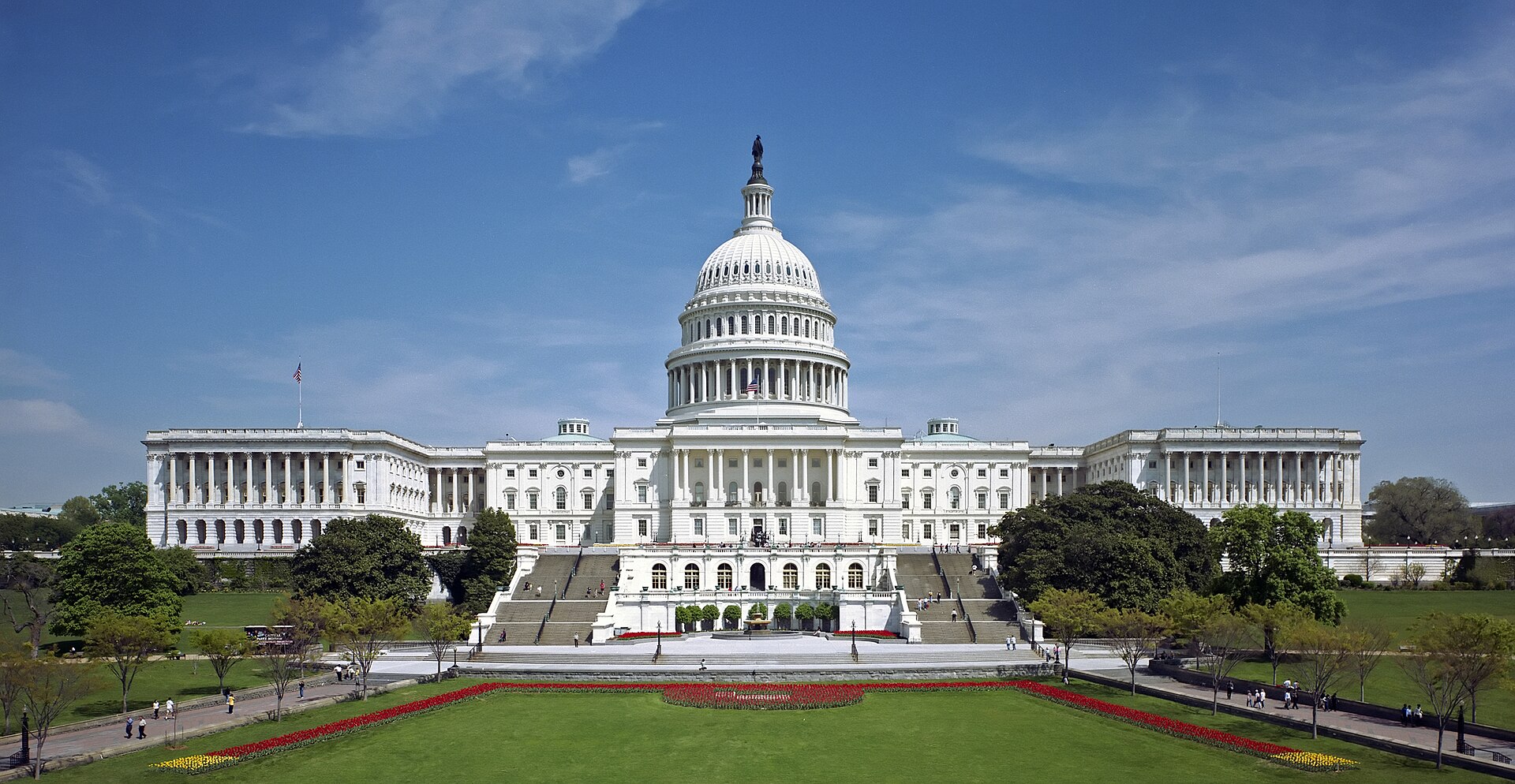
Featured image: U.S. Capitol, west front. Public domain, via Wikimedia Commons.