

WASHINGTON — The afternoon picture on this Tuesday, August 25, is dominated by a sharpening collision between the federal courts and the administration over mail-voting rules, a widening economic campaign against Iran, and a U.S.–Canada trade rupture that hardened into force over the weekend. Abroad, Congo’s Ebola outbreak has become the deadliest in that country’s history, and Ukraine marked its Independence Day under drone fire. Here is where the day’s major threads stand, with links to primary records throughout.
Government
Treasury widens Iran squeeze under “Operation Economic Outcast”
Treasury Secretary Scott Bessent on Monday announced an expansion of secondary sanctions targeting businesses that maintain relationships with Iran, extending the campaign into digital assets, technology, gold, aviation and shipping. The department designated nearly 60 entities, individuals and vessels tied to what officials describe as illicit procurement of nuclear and missile technology, cyber operations and oil smuggling, a package Bessent has dubbed “Operation Economic Outcast.”
The Office of Foreign Assets Control’s August 24 recent-actions notice records the new Iran-related designations and general-license updates, and includes an alert on sanctions risks associated with Iranian demands for Strait of Hormuz passage. Bessent said the public should expect a major announcement targeting an unspecified financial institution by the end of this week; asked about Chinese banks, he described a preference for “quiet diplomacy” while adding that “no one is above the reach of US sanctions,” according to NBC News.
The economic track is unfolding amid what officials and analysts describe as a “no war, no deal” limbo following this year’s hostilities. Defense Secretary Pete Hegseth signaled Monday that Washington expects the pressure to push Tehran back to the negotiating table and has not ruled out further military action, according to press reports.
U.S.–Canada rupture hardens: 50 percent tariffs in effect, retaliation set for September 8
Tariffs of 50 percent on roughly $20 billion of Canadian goods are now in effect after negotiations collapsed Friday night. Prime Minister Mark Carney, explaining Ottawa’s walkout, said the American side “asked too much, and they offered too little,” per CNN, and announced Canada will match the measures “dollar for dollar” beginning September 8 — with counter-tariffs on steel, dairy, appliances, agricultural equipment, pulp, paper and electronics, according to Global News.
The war of words escalated Monday. President Trump pledged to raise tariffs on cars, steel and other goods to 50 percent in January, and Ontario Premier Doug Ford responded in unusually blunt terms, telling reporters the president could “kiss my ass” and calling him a “bully” and a “dictator,” per Forbes. The exchange leaves the continent’s largest trading relationship facing a two-week runway to a second round of escalation, with no talks currently scheduled, records and statements from both governments indicate.
Guard deployment in the capital passes the one-year mark
The National Guard presence in Washington, D.C., has now been in place for over a year, with more than 4,600 troops having patrolled the District since the deployment began on August 11, 2025, according to NPR. The White House recently extended the mission through the end of 2029, and reporting citing a Defense Department estimate puts cumulative costs at roughly $1.4 billion through that horizon, at approximately $3 million per day, The Week reports.
The anniversary drew demonstrations near the White House earlier this month, per WTOP, and data cited in press accounts indicate violent crime in the District had fallen to multi-decade lows before the mobilization and is up about 3 percent year-over-year since. The deployment is described in press accounts as the largest and longest domestic military deployment in recent American history; its next-phase funding and rules of engagement remain items to watch as Congress returns.
Sanctions housekeeping: Syria delisting implemented alongside Iran actions
Largely overshadowed by the Iran package, OFAC’s same August 24 notice records the removal of Syria’s designation as a State Sponsor of Terrorism from associated sanctions lists, along with updates to Iran-related general licenses — including a new license authorizing certain activities involving a French refining firm and a wind-down authorization for previously permitted Iranian transactions. The administrative entries formalize a significant realignment of the U.S. sanctions architecture in the region; the filings themselves are the primary record here, and downstream compliance guidance is expected to follow.
Courts
Supreme Court lifts one of two blocks on the mail-voting order
The Supreme Court on Monday granted the administration’s request to stay an injunction that had blocked key parts of the president’s election executive order, handing the White House an interim win ahead of the midterms, NPR reports. The Court divided 6–3, lifting a June injunction won by California and 22 other states, according to NBC News. At issue are provisions directing a federal list of eligible voters and instructing the Postal Service on which ballots it may deliver.
The majority’s rationale was procedural: the lower court acted before the dispute was ripe, because DHS and USPS had not yet issued final implementing regulations, per CBS News. In a statement accompanying the order — posted by the Campaign Legal Center — Justice Sonia Sotomayor, joined by Justice Elena Kagan, wrote that the decision “does not address whether the President’s attempts to interfere with States’ administration of the November 2026 elections are lawful.”
Critically, the ruling does not clear the order’s path: a separate nationwide injunction issued August 11 by U.S. District Judge Indira Talwani in Boston still bars the Postal Service from carrying out the directives, Votebeat notes.
Boston judge sets 8 a.m. deadline over USPS rule filed “after the courts closed”
That second injunction is now the center of its own fast-moving fight. Court filings indicate the Postal Service transmitted a final mail-ballot rule to the Office of the Federal Register on Friday night — listing an effective date of August 21 and a formal publication date of August 26 — while Judge Talwani’s order blocking implementation remained in force, according to Law&Crime. Plaintiffs, led by League of Women Voters chapters, filed an emergency motion arguing the administration “flouted” the court’s order.
In a Sunday order, Talwani wrote that the government had created the emergency itself by posting the rule after courts closed for the weekend, and she directed the administration to respond by 8 a.m. Eastern this morning — earlier than the deadline plaintiffs had requested. The Justice Department has said the rule will make clear that USPS “will not take any action to implement” it for any election held on or before November 3, 2026, unless the government first obtains relief from both outstanding court orders, filings indicate. The docket’s next entries, expected today, will show whether that assurance satisfies the court; no findings of contempt or violation have been made at this stage.
White House ballroom construction may continue, for now
Rounding out a consequential stretch at the high court: the justices on Friday temporarily allowed construction of the White House ballroom to continue while litigation proceeds, CNN reports. The interim order preserves the project’s schedule without resolving the underlying legal challenge, which remains pending.
International
Congo’s Ebola outbreak becomes the deadliest in the country’s history
The World Health Organization’s latest Disease Outbreak News bulletin reports 5,514 confirmed cases and 2,642 deaths in the Democratic Republic of the Congo’s Ebola Bundibugyo outbreak, with data through August 23. The toll surpasses the 2,299 deaths of the 2018–2020 epidemic, making this the deadliest outbreak in the country’s history, according to UN News, and press summaries of the latest weekly data describe more than 300 deaths in a single week.
Ituri province remains the epicenter, with 4,607 cases and 2,065 deaths reported across 28 of 36 health zones, and 808 patients currently hospitalized in isolation, per WHO situation reporting. NPR reports the outbreak is the fastest-growing on record and is outpacing response efforts, raising the stakes for international financing and vaccine logistics decisions in the days ahead.
Ukraine marks Independence Day under fire as Europe adds $7 billion
Ukraine marked its Independence Day on Monday under attack, with Russian forces launching 72 drones and a missile against the country overnight, according to Ukrainska Pravda; at least one person was killed and 16 wounded, wire reports indicate. The European Union used the date to green-light $7 billion in defense loans, with Commission President Ursula von der Leyen saying Europe’s support is “unfaltering and concrete,” per ABC News.
British Prime Minister Andy Burnham was among the leaders in Kyiv, and London announced it would grant Ukraine access to classified technology to begin domestic production of European SCALP long-range cruise missiles — a step the Kremlin said would “add fuel to the fire” of worsening relations, the same reporting indicates. Kyiv also announced the return of 10 servicemen previously listed as missing in action as part of a prisoner exchange.
Black Sea shipping risk lingers after Novorossiysk strikes
Manila confirmed that 39 Filipino seafarers aboard two vessels near the Russian port of Novorossiysk are safe following reported drone attacks in the area, per Philippine wire reporting. The scare underscores lingering commercial exposure after Ukraine’s August 12 strike on the port, in which commercial satellite imagery confirmed damage to at least four Russian warships, including two Admiral Grigorovich-class frigates, according to Naval News.
That earlier attack also forced two major grain terminals to halt work, and with Russia the world’s largest wheat exporter, elevated Black Sea shipping risk continues to add pressure to global grain markets, CNBC reports. Insurers, charterers and commodity desks will be watching whether this week’s reported incidents mark a renewed Ukrainian campaign against Russian export infrastructure.
Tomorrow’s Watch — Wednesday, August 26
Federal Register publication. The Postal Service’s contested mail-ballot rule is slated for formal publication on August 26, per court filings — a step that will land squarely in the middle of Judge Talwani’s docket and could trigger further emergency motions.
Nvidia earnings. The AI bellwether reports second-quarter results after the close. Management guided to roughly $91 billion in revenue, plus or minus 2 percent, and the Street consensus sits at $92.07 billion with adjusted EPS of $2.09, up from $1.05 a year ago, according to analyst previews. China data-center exposure remains the key variable to watch.
Treasury follow-through. Bessent said a major sanctions action against an unspecified financial institution should be expected “by the end of this week” — Wednesday begins the window in earnest.
Jackson Hole eve. The Kansas City Fed’s Jackson Hole Economic Policy Symposium opens Thursday, August 27, under the theme “Financial Innovation: Implications for Payments and Policy,” with Chair Kevin Warsh delivering his first keynote in the role Friday morning. Expect positioning and previews to dominate market commentary tomorrow.
Canada clock. Ottawa’s September 8 retaliation date is now under two weeks out; watch for signals from either capital on whether talks resume.
Right of reply: individuals, agencies and entities referenced above are characterized solely through public filings, official statements and on-record remarks linked inline. Responses or corrections received after publication will be reflected in subsequent briefings.
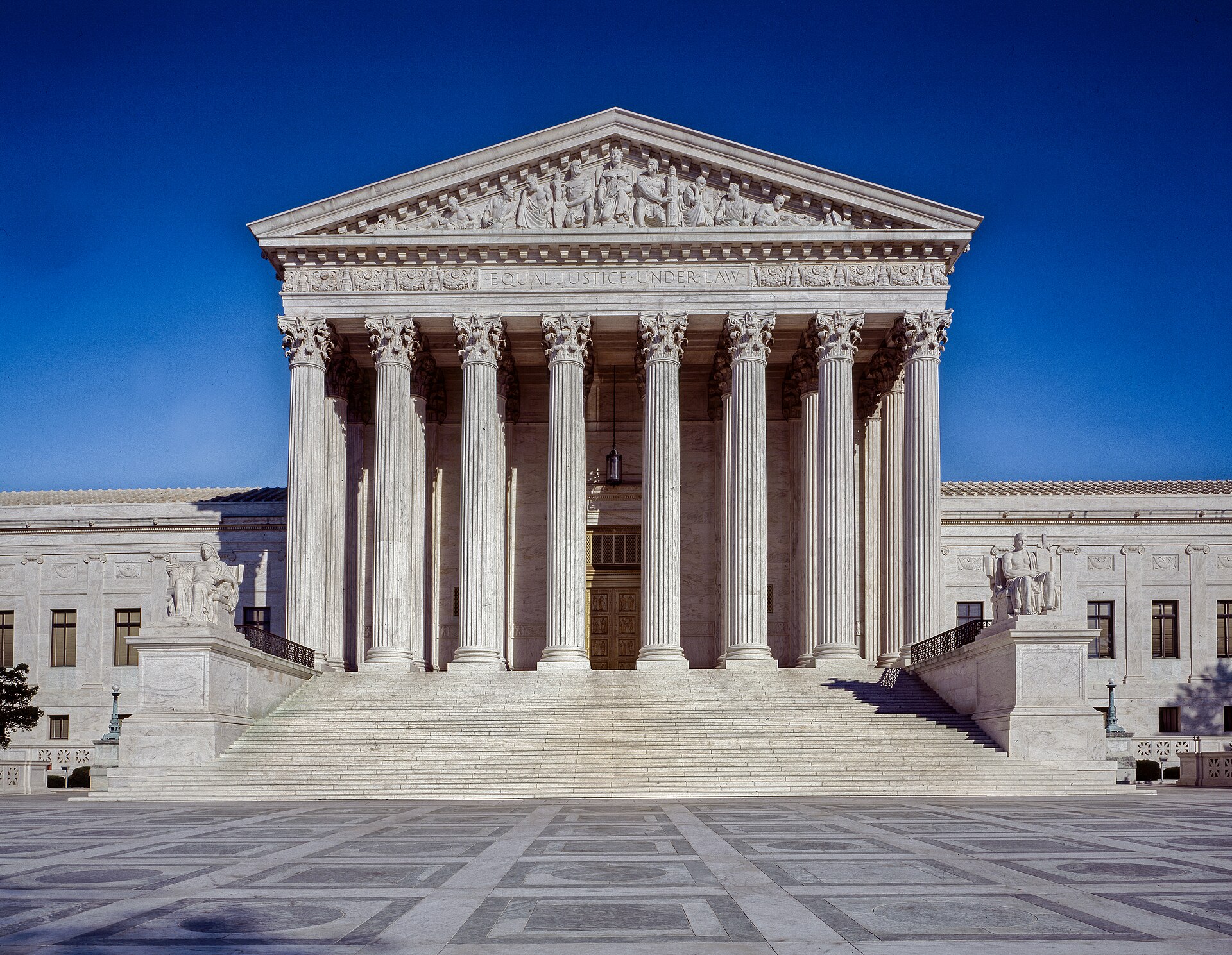
Featured image: U.S. Supreme Court Building, Washington, D.C. Photo by Carol M. Highsmith via Wikimedia Commons / Library of Congress (public domain).