

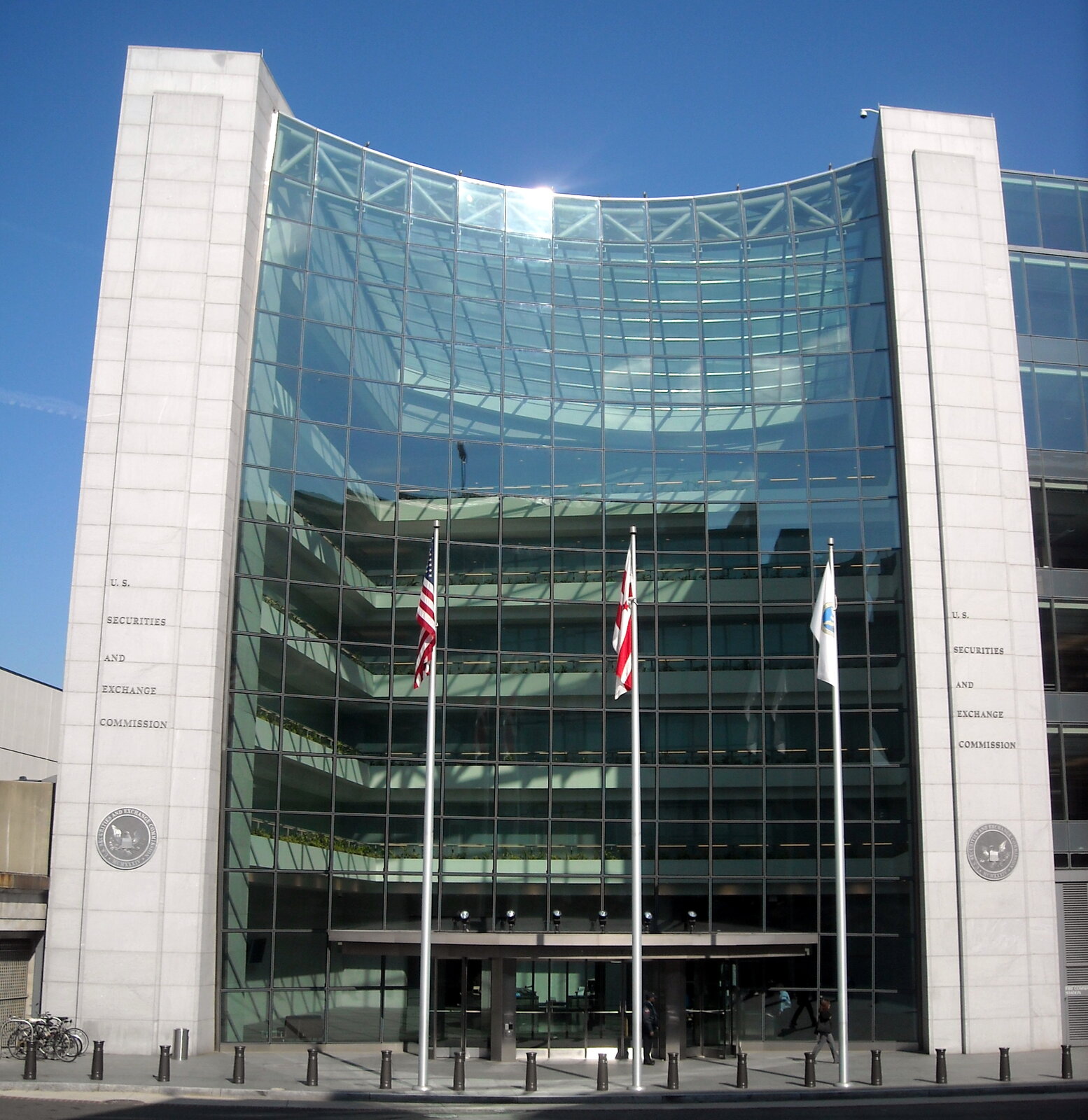
The Investigative Journal’s daily review of notable filings and actions on the U.S. Securities and Exchange Commission’s EDGAR system and enforcement dockets. All figures below are drawn from public records; links to source documents are provided throughout.
The week closing June 20, 2026 was defined less by the routine flow of annual and quarterly reports — mid-June sits in a quiet stretch between proxy season and second-quarter earnings — than by a cluster of abrupt executive departures, a consequential market-structure rulemaking, and a steady drumbeat of insider-trading settlements out of the SEC’s Division of Enforcement. The single most consequential corporate disclosure was Fiserv, Inc.’s sudden chief executive change, filed days after Chairman Paul Atkins moved to unwind one of the foundational rules of modern U.S. equity markets. Below, TIJ reviews the filings that warrant attention.
Fiserv discloses abrupt CEO resignation — and an unusually rich retention sweetener
Payments and financial-technology giant Fiserv, Inc. (Nasdaq: FISV) disclosed in a Form 8-K that Michael P. Lyons resigned as chief executive officer and as a director on June 12, 2026, effective immediately. The filing states that Lyons’s departure “was not the result of any disagreement with the Company on any matter relating to the Company’s operations, policies or practices,” and that he would receive “only his accrued but unpaid base salary,” with no severance, accelerated equity vesting, or benefits continuation. For a chief executive who, according to the filing, had only signed his offer letter in January 2025, the abrupt, no-severance exit is notable. Several news outlets reported that Lyons is departing to become chief executive of Truist Financial Corporation; that destination is not stated in the SEC filing itself and is attributed here to press reports.
The board appointed Takis Georgakopoulos, 56, as chief executive and director effective June 14, 2026. Records show Georgakopoulos joined Fiserv in September 2024 and most recently served as Co-President, Head of Merchant and Technology, after a stint as chief operating officer; he previously spent 2007 to 2024 at JPMorgan Chase, latterly as Global Head of Payments for the corporate and investment bank. His offer letter provides a base salary of $1.3 million, a target annual cash incentive of 200% of salary, an annual equity opportunity of $18.6 million, and a one-time $6 million promotion equity grant split between performance and restricted stock units. The filing also disclosed that Dhivya Suryadevara’s title was updated to President.
One detail in the filing merits closer scrutiny than the headline succession. To keep chief financial officer Paul M. Todd in place, the company agreed to grant him $5 million in restricted stock units in exchange for his acknowledgement that he would not exercise a “Good Reason” resignation right that, under his October 2025 offer letter, was triggered by Lyons’s departure within 12 months of Todd’s start date. In plain terms, the filing indicates Fiserv paid a seven-figure retention premium to forestall a second C-suite departure cascading from the first. The 8-K, signed by Todd as CFO, attaches the press release as Exhibit 99.1 and the two offer/letter agreements as Exhibits 10.1 and 10.2.
SEC proposes scrapping Regulation NMS Rules 611 and 610(e)
In a move with far broader market implications than any single company filing, the Commission on June 11, 2026 proposed rescinding Rules 611 and 610(e) of Regulation NMS. Rule 611 — the “Order Protection Rule,” or trade-through rule — has for roughly two decades required trading centers to route orders to the venue displaying the best price, while Rule 610(e) restricts locking and crossing quotations. The proposal would also strike related defined terms in Rule 600 and make conforming changes.
“After two decades of Rule 611, it is high time that the Commission review its unintended consequences that have hindered — rather than enhanced — the long-term growth of our markets,” SEC Chairman Paul S. Atkins said in the announcement, framing the proposal as an effort to “simplify market structure and reduce costs for market participants while allowing competition, innovation, and other market forces to shape” the markets’ evolution. The Commission has published a fact sheet and opened a 60-day public comment period following publication in the Federal Register. The proposal is at an early stage; market participants on both sides of the long-running debate over the trade-through rule will have an opportunity to weigh in before any final action, and exchanges, wholesalers, and institutional investors are expected to respond in force.
Executive turnover spreads beyond Fiserv
Fiserv was not the only issuer reporting leadership upheaval. Beverage maker Zevia PBC (NYSE: ZVIA) disclosed that Amy E. Taylor resigned as president and chief executive, effective June 15, 2026, with director Alexandre I. Ruberti named to succeed her, according to the company’s Form 8-K. Separately, blank-check company M3-Brigade Acquisition V Corp. reported in an 8-K that its chief executive, chief financial officer, and chief operating officer all resigned effective June 18, 2026 — a near-simultaneous departure of an entire C-suite that, for a special-purpose acquisition company, often signals a strategic reset or a stalled deal search.
Taken together, the filings underscore a theme worth tracking: clusters of senior-officer departures, particularly where they arrive without severance or alongside retention payments to remaining executives, can be an early indicator of strategic or governance stress that later surfaces in operating results. TIJ will monitor whether these transitions are followed by restated guidance or further Item 5.02 disclosures.
Enforcement: SEC charges Chicago adviser in alleged $4 million Ponzi-style fraud
On the enforcement side, the Commission’s most substantial new fraud action of the week targeted a Chicago investment adviser. According to Litigation Release No. 26562, dated June 8, 2026, the SEC on June 5 charged John Sterling Myers and his firms Sterling Capital, LLC and Sterling Capital Management, LLC in the U.S. District Court for the Northern District of Illinois, alleging a multi-year fraud against investors in a pooled fund.
The SEC’s complaint alleges that from January 2022 through at least July 2025, Myers raised roughly $4 million from approximately 28 investors in what he marketed as a “premier” and “exclusive investment pool,” then “perpetually drained the pool through unsuccessful trading and personal spending,” leaving more than $3.6 million of investor money gone. The agency alleges Myers sent investors fabricated quarterly statements depicting gains that beat the S&P 500, concealed losses by failing to issue required tax forms, and misappropriated at least $1.8 million for personal use. The complaint charges violations of the antifraud provisions of the Securities Act, the Securities Exchange Act, and the Investment Advisers Act, and seeks injunctive relief, disgorgement with prejudgment interest, and civil penalties. The allegations have not been proven in court; the complaint is publicly available, and the defendants are entitled to respond in the litigation.
Two insider-trading settlements, both tied to biotech information
The SEC also resolved two insider-trading matters, both notably involving confidential information about biotechnology companies. In Litigation Release No. 26567 (June 15, 2026), the agency announced a settled action against Rakesh Ahuja, a former employee of an investment advisory firm, who allegedly traded ahead of corporate announcements using confidential clinical-trial data he obtained through his firm’s due diligence — routing trades through a close relative’s brokerage account across three companies on four occasions for roughly $65,000 in profits. Without admitting the allegations, Ahuja consented to a permanent antifraud injunction, a two-year associational bar, and payments of $65,404.25 in disgorgement, $12,289.01 in prejudgment interest, and a $65,404.25 civil penalty. The matter was handled by the Division of Enforcement’s Market Abuse Unit.
In a parallel resolution, Litigation Release No. 26568 (June 16, 2026) reported that Texas resident Bruce Cameron Conway agreed to settle charges that, in July 2020, he traded on material nonpublic information about a private biotech firm’s planned merger with Cancer Genetics. Filings indicate Conway bought Cancer Genetics shares across fifteen accounts belonging to himself, family members, and family trusts; the stock rose 215% when the merger was announced on August 24, 2020, at which point he began selling. Without admitting the allegations, Conway consented to a final judgment — subject to court approval — providing for a permanent injunction and payments of $60,201.95 in disgorgement, $19,461.39 in prejudgment interest, and a $160,936.22 civil penalty. The two cases reinforce that the SEC’s market-abuse staff continues to prioritize misuse of confidential drug-development information, a recurring vulnerability in the biopharma sector.
A delinquent-filer registration revoked
Rounding out the week’s actions, the Commission issued an administrative order (Exchange Act Release No. 105724, June 17, 2026) revoking the registration of Tenaya Group, Inc. (CIK 1739208), a Nevada corporation based in Los Angeles. The order, entered by consent and effective June 18, 2026, finds that Tenaya failed to comply with periodic-reporting requirements, having filed no periodic reports since a Form 10-Q for the quarter ended June 30, 2023. Section 12(j) revocations of this kind are routine housekeeping, but they are also a useful map of which once-registered shells and dormant issuers have gone dark — a category that warrants attention given its frequent association with later micro-cap manipulation schemes.
Filings that may warrant deeper TIJ investigation
Several threads from this week deserve continued reporting. First, the Fiserv transition raises governance questions worth pursuing: the combination of a no-severance CEO exit, a $5 million retention award to the CFO triggered by that exit, and a $6 million promotion grant to the incoming chief executive is a lot of compensation activity to compress into a 72-hour window, and proxy-disclosure follow-through will be telling. Second, the Regulation NMS rescission proposal is among the most significant equity-market-structure shifts in two decades; TIJ will track the comment file and the positions taken by exchanges, retail brokers, and institutional investors. Third, the back-to-back biotech insider-trading settlements point to a sector-specific enforcement focus that may yield further actions. Finally, dormant and delinquent issuers such as Tenaya Group, and continued activist accumulation reflected in recent Schedule 13D/A filings (including an amended 13D on file for EchoStar Corp.), are worth monitoring for the corporate-control and micro-cap stories they can foreshadow.
Sourcing note: Every factual claim above is drawn from the linked SEC EDGAR filings, SEC litigation and administrative releases, and the Commission’s newsroom. Allegations in pending matters are described as allegations and have not been proven; settling parties resolved claims without admitting the SEC’s findings. The Investigative Journal welcomes responses from any party named in a public record discussed here.