

WASHINGTON — Saturday, September 5, 2026. The clearest way to understand this week in Washington is to ask who set the deadlines.
It was not Congress. The legislature’s principal product this week was time: the House passed, and the president signed, a clean continuing resolution — H.R. 6500 — that moves the government-funding deadline to December 11, and House leaders then canceled two of the chamber’s remaining September work weeks, leaving September 17 as the last scheduled voting day before the November 3 midterms, as TIJ’s Capitol Watch and Morning Wire reported. The deadlines that actually bound anyone were set elsewhere: a Boston judge’s restraining order that expires September 14, a Supreme Court directive that challengers respond by 10 a.m. on September 8, North Carolina’s September 4 ballot-mailing date, a 60-day public-comment window on a $250 million antitrust settlement, and an October 5 appellate deadline the Justice Department has not publicly committed to meeting.
Reviewing the seven days of coverage across TIJ’s beats — the wires, the enforcement digests, the regulatory and watchdog roundups — one pattern recurs in file after file: the binding constraints on public and private power this week were procedural clocks administered by courts, comment dockets, and auditors. What follows connects those files, with every analytical point tied to the underlying records.
The midterm rulebook, written one interim order at a time
Start with the mail-ballot fight, which TIJ has tracked through three distinct phases in a single week. On August 27, U.S. District Judge Indira Talwani in Boston issued a 14-day temporary restraining order against portions of the new U.S. Postal Service rule governing mail ballots — the second block on the underlying policy, as the August 29 Afternoon Wire reported. On Thursday, September 3, Solicitor General D. John Sauer filed an emergency application asking the justices to lift that order, writing that “once those ballot envelopes enter the mailstream, there is no retrieving them” — a reference to North Carolina’s September 4 mailing date, with Alabama to follow September 9, per SCOTUSblog and TIJ’s September 4 Afternoon Wire. The challengers — filings indicate 23 states led by California, plus the District of Columbia — are due to respond by Tuesday morning, and Judge Talwani’s order lapses on its own terms September 14. It is the administration’s second trip to the Court on mail voting in six weeks; the first, in late August, ended with the justices allowing implementation to begin on the ground that the states’ challenge was premature.
The same architecture appeared in three other matters TIJ covered this week. In Maryland, U.S. District Judge Deborah Boardman preliminarily blocked the president’s August 6 executive order narrowing birthright citizenship, writing that it is “almost certainly unconstitutional” in light of the Supreme Court’s June decision striking the first such order. In Missouri, the state supreme court ruled that a referendum petition against the legislature’s redrawn congressional map “was legal, sufficient, and timely,” meaning the 2020-census map governs November’s election unless the U.S. Supreme Court intervenes — and Attorney General Catherine Hanaway said she would seek exactly that, per the Morning Wire. And at the White House itself, above-ground work on the new State Ballroom proceeded under an August 31 emergency stay granted 5–4 — over a dissent by Chief Justice John Roberts calling the project “likely unlawful” — while the merits, including an appeals-court holding that congressional sign-off is required, remain unresolved.
The analytical point is not who is winning. It is that in each case the operative rule — what ballots go out, which map elects a delegation, whether concrete gets poured — is being fixed by interim rulings that expressly decline to resolve the law. The late-August mail-ballot order turned on standing; the ballroom stay turned on standing; the Missouri ruling turned on referendum procedure; Judge Boardman’s injunction is by its terms preliminary. Records across the week’s coverage suggest a governing style in which the emergency posture, not the merits determination, decides what the country actually experiences between now and November.
The paper trail beneath the litigation
While the mail-ballot rule was moving up the appellate ladder, the documentary record beneath it thickened. ProPublica reported September 2 — and TIJ’s Watchdog Roundup summarized — that senior Postal Service officials raised internal concerns that the rules could delay or block ballots from eligible voters before the rules advanced. A whistleblower disclosure filed with Senator Richard Blumenthal on August 31 asserts that a directive to reject an entire bulk mailing if a single ballot fails barcode verification moved forward against internal recommendations; ProPublica reported USPS staff told election officials that one bad barcode in a Maricopa County mailing of more than two million ballots could delay the whole batch. Both the agency and the White House contest that framing: USPS’s court filings state the rule “need not and should not prevent a single voter from voting by mail,” and a White House spokesperson said the barcode software is routine and the administration is “working to ensure safe, transparent, and honest elections.” The dispute is now precisely framed for the courts: the whistleblower’s technical claim and the government’s operational assurance cannot both describe the same system, and the litigation record will eventually show which the agency built.
Congress’s chief export this week: time
The stopgap itself deserves scrutiny beyond the sigh of relief. The House vote was 370–48, and the House Appropriations Committee described the measure as a clean extension of fiscal 2026 levels. But according to the Committee for a Responsible Federal Budget’s tracker, none of the twelve full-year appropriations bills has been enacted. The Senate does not resume full business until September 14; the House stops voting September 17. That leaves a handful of overlapping session days before the election — and a December 11 lame-duck cliff onto which Congress has now stacked the full appropriations slate, a stalled defense-authorization bill, and, as TIJ’s Legislative Watch noted, a Congressional Budget Office reassessment of tariff revenue on the order of $0.9 trillion whose fiscal implications lawmakers have yet to absorb. Budget analysts have documented this pattern for decades — Congress has not completed all twelve bills on schedule since the 1990s — but the compression this year is unusually explicit: the calendar was not overtaken by events; it was cleared by choice.
Where the public still has the floor: comment windows
A quieter version of the same clock-driven accountability ran through the week’s enforcement files. The Justice Department’s Tunney Act notice in United States v. KKR & Co. opened a 60-day public-comment period on a proposed $250 million civil penalty over what the government’s complaint alleges were at least sixteen incomplete Hart-Scott-Rodino premerger filings — allegations KKR moved to dismiss, a motion the court has not decided, as TIJ’s Regulatory Roundup detailed. The settlement takes effect only if the court finds it in the public interest. The same structure — remedy proposed, public invited, court or agency to decide — appeared in TIJ’s EPA Watch (Domtar’s $1.5 million Clean Air Act consent decree awaiting court entry, and an unusual $20,000 ability-to-pay Superfund settlement open for comment in Oklahoma) and in the Department of Homeland Security’s proposed $103,265 H-1B fee, whose comment window closes September 24. Records suggest a common thread: in a week when final judgments were scarce everywhere, the comment docket was the one venue where the public’s participation was still formally scheduled.
The auditors put a price on waiting
If the week had a unifying number, it came from the Government Accountability Office. In GAO-26-109256, auditors found the Navy lost more than 15,000 operational days over the past decade — at an estimated $3.4 billion — sustaining attack submarines that “provided no operational capability,” and projected that without mitigation, fifteen more boats will accumulate over $3.1 billion in further idle costs through 2030. GAO records that the Navy concurred verbally but filed no written comments, leaving no documented implementation commitment, as TIJ’s Watchdog Roundup reported. The same roundup carried the Education Department inspector general’s finding that the office responsible for closing external audits was “effectively eliminated” in early 2025 and that no external OIG audits have been closed since January 2025, and POGO’s data showing ICE detention-facility violations fell nearly 70 percent while “Superior” ratings hit records — under a ratings rubric that is not public. Three different institutions, one measurable phenomenon: when the process that closes the loop is deferred or opaque, the cost does not disappear; it accrues. The submarine report prices deferral in dollars; the OIG report prices it in unclosed audits; the ICE data raise the question of whether the loop is being closed on paper without being closed in fact.
Three charts worth drawing
The week’s records lend themselves to visualization, and readers tracking these stories may find three frames useful. First, a litigation-versus-logistics timeline: the mail-ballot rule’s court milestones (August 27 TRO, September 3 application, September 8 response deadline, September 14 order expiry) plotted against state ballot-mailing dates beginning September 4 — the chart would show the legal calendar and the election calendar converging to within days of each other. Second, a session-day calendar: House and Senate voting days between now and December 11 shaded against the pending workload (twelve appropriations bills, the defense authorization), which would make the lame-duck compression visible at a glance. Third, a deferral curve: GAO’s idle-submarine days by fiscal year 2016–2025, extended by its 2026–2030 projection, showing a cost trend that oversight has documented but not yet bent.
The longer arc
None of these mechanisms is new. The Tunney Act dates to 1974, when Congress moved antitrust settlements into public view after controversy over negotiated decrees; the National Firearms Act framework now enjoined in one Texas district dates to 1934, as TIJ’s September 4 Afternoon Wire noted; and legal scholars have tracked the Supreme Court’s growing reliance on emergency applications for the better part of a decade. What the week’s records suggest is not novelty but velocity: the emergency docket is now processing election administration in real time against ballot-printing schedules, and the ordinary venues — floor votes, final judgments, closed audits — are the ones running slow. That observation is not a criticism of any single actor; it is what the filings, dockets, and calendars collectively show.
What to watch in the coming week
Four dates carry most of the load. Tuesday, September 8, 10 a.m.: the states’ response is due in the Postal Service case, with a ruling possible any time after — and effectively required before the TRO expires September 14, the same day the Senate returns. Missouri’s promised emergency application on its congressional map could reach the justices’ docket any day, with ballot-finalization deadlines close behind. September 17 is the House’s last scheduled voting day before the election. And in the background, the Federal Reserve meets this month with the August employment data — a soft summer of revisions behind it, per the Bureau of Labor Statistics release — as the last major reading in hand. TIJ will track each through the primary records.
Methodology and right of reply: This analysis synthesizes The Investigative Journal’s reporting published August 29 – September 4, 2026, linked above, together with the primary records those reports cite — court filings, Federal Register notices, agency reports, and official releases. Claims arising in pending litigation, including the KKR, Postal Service, birthright citizenship, and ballroom matters, are allegations or interim rulings, not final findings, and are identified as such. Comment and right-of-reply status for parties named in the underlying coverage is noted in each linked digest; any party referenced here may respond via the contact page and responses will be noted in updates.
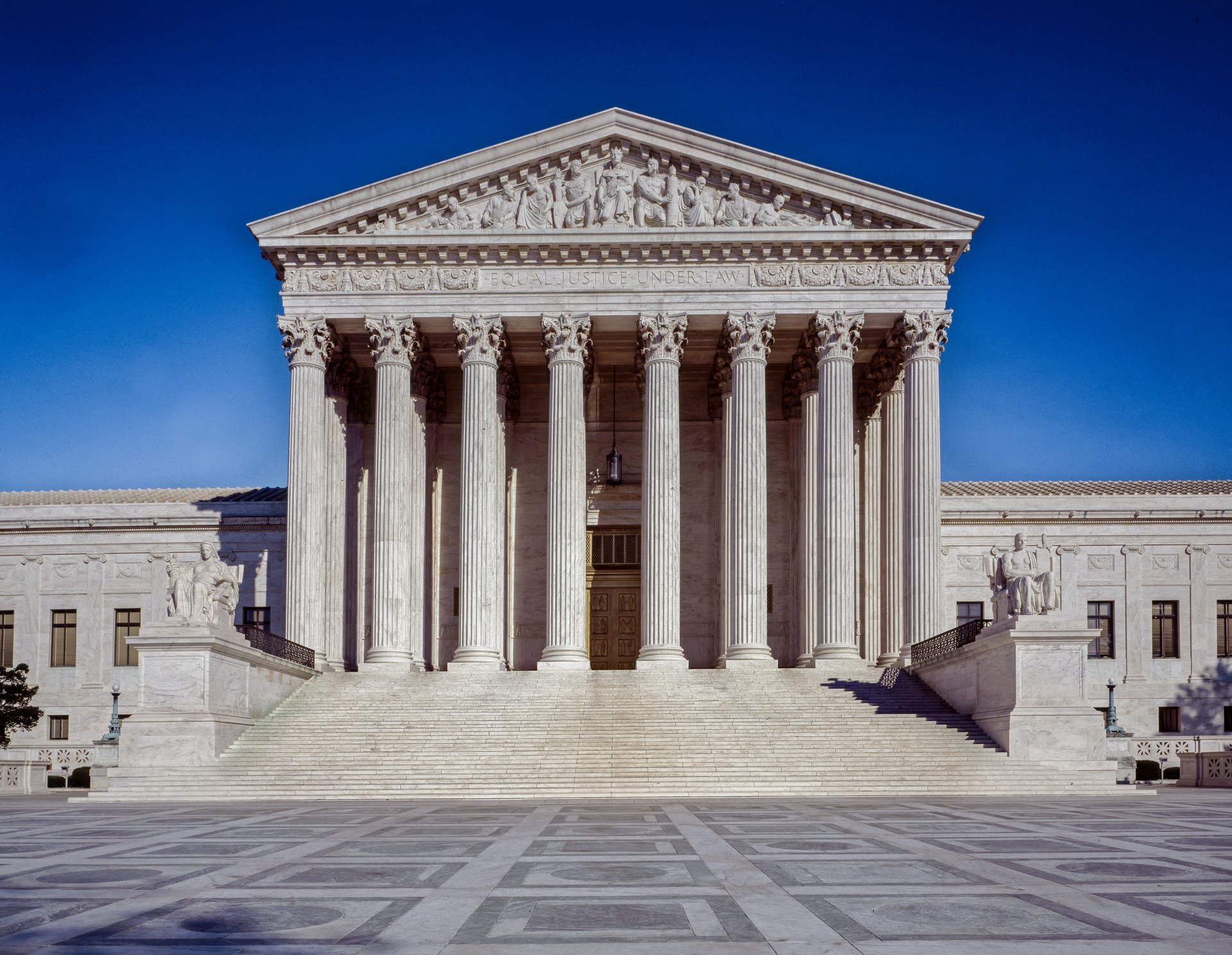
Featured image: the United States Supreme Court building, Washington, D.C. Photograph by Carol M. Highsmith, Library of Congress; no known copyright restrictions (public domain), via Wikimedia Commons.
